 Money Facts To Know
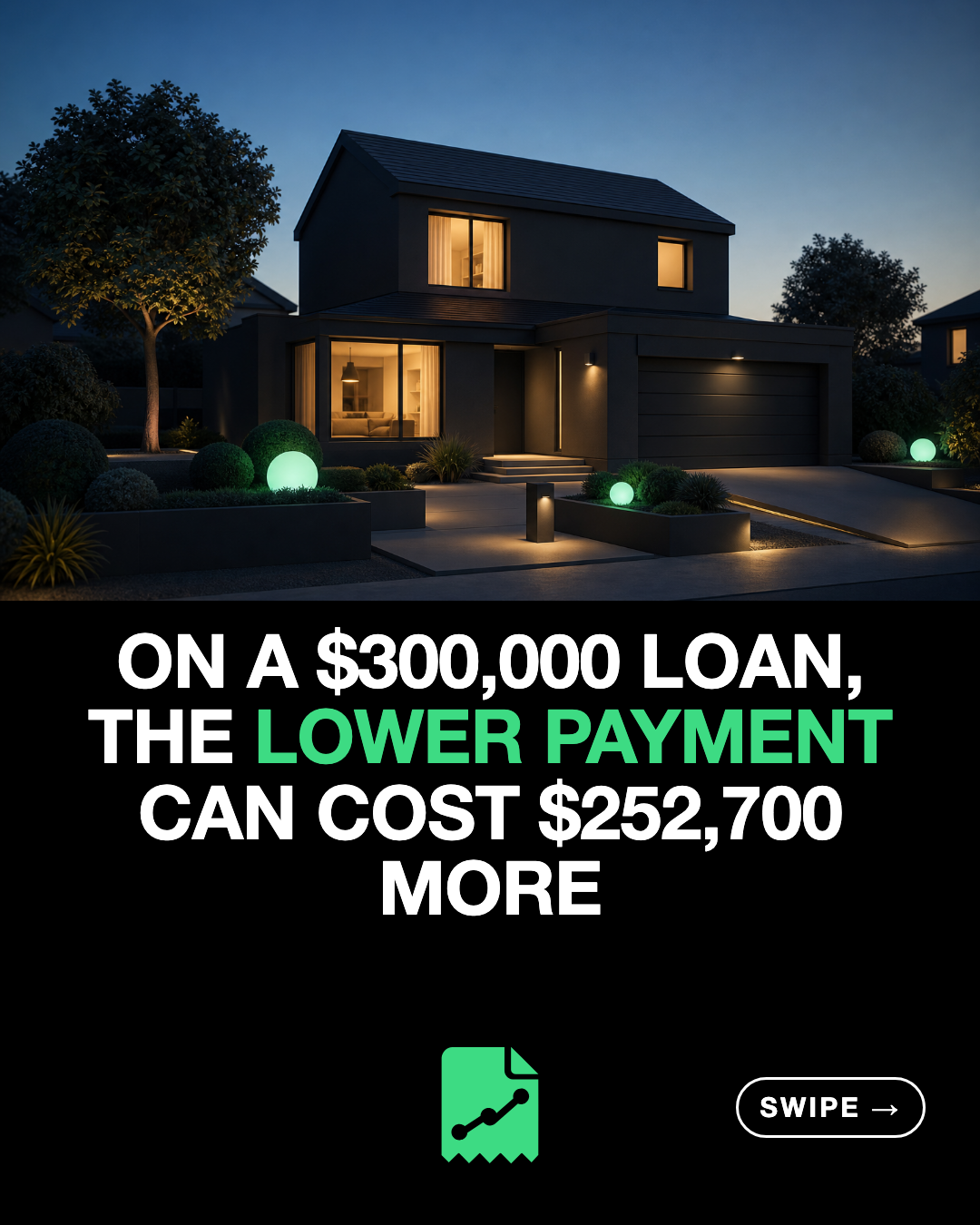
On a $300,000 loan, the lower payment can cost $252,700 more
Shoppers compare the wrong number
It's easy to compare loans by the monthly payment alone. A longer term almost always looks cheaper each month, even when it costs far more overall.
Source: CFPB
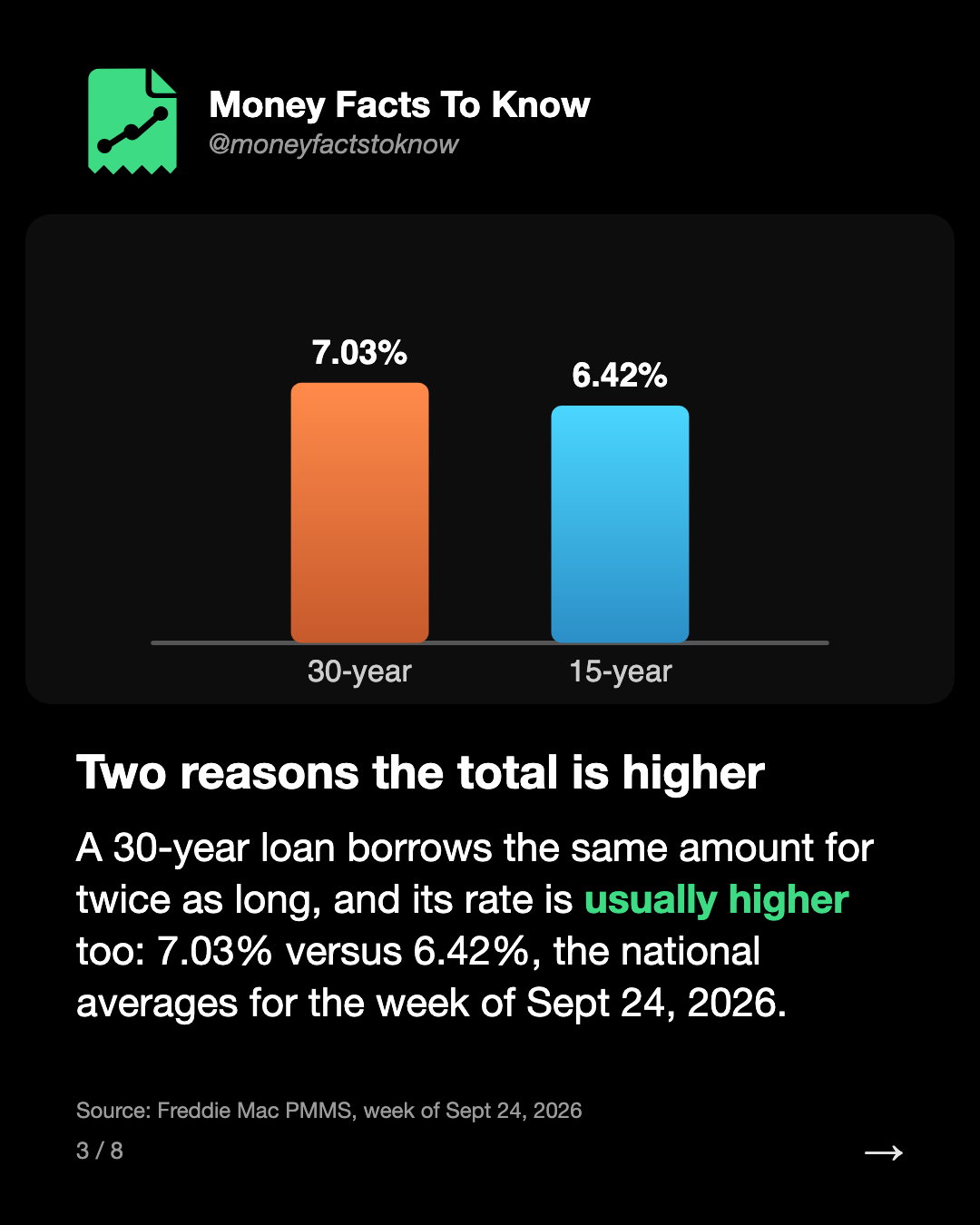
Two reasons the total is higher
A 30-year loan borrows the same amount for twice as long, and its rate is usually higher too: 7.03% versus 6.42%, the national averages for the week of Sept 24, 2026.
Source: Freddie Mac PMMS, week of Sept 24, 2026
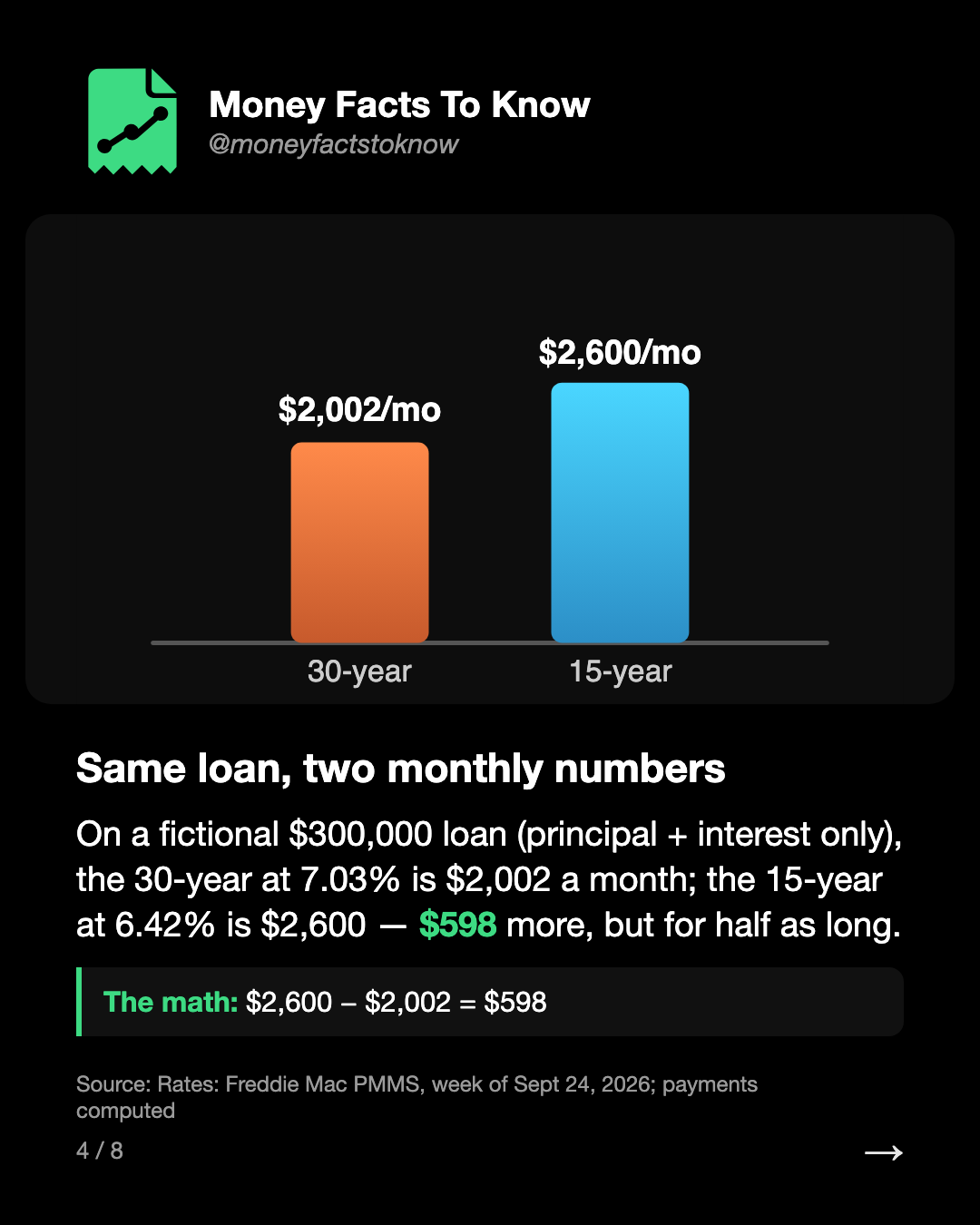
Same loan, two monthly numbers
On a fictional $300,000 loan (principal + interest only), the 30-year at 7.03% is $2,002 a month; the 15-year at 6.42% is $2,600 — $598 more, but for half as long.
The math: $2,600 − $2,002 = $598
Source: Rates: Freddie Mac PMMS, week of Sept 24, 2026; payments computed
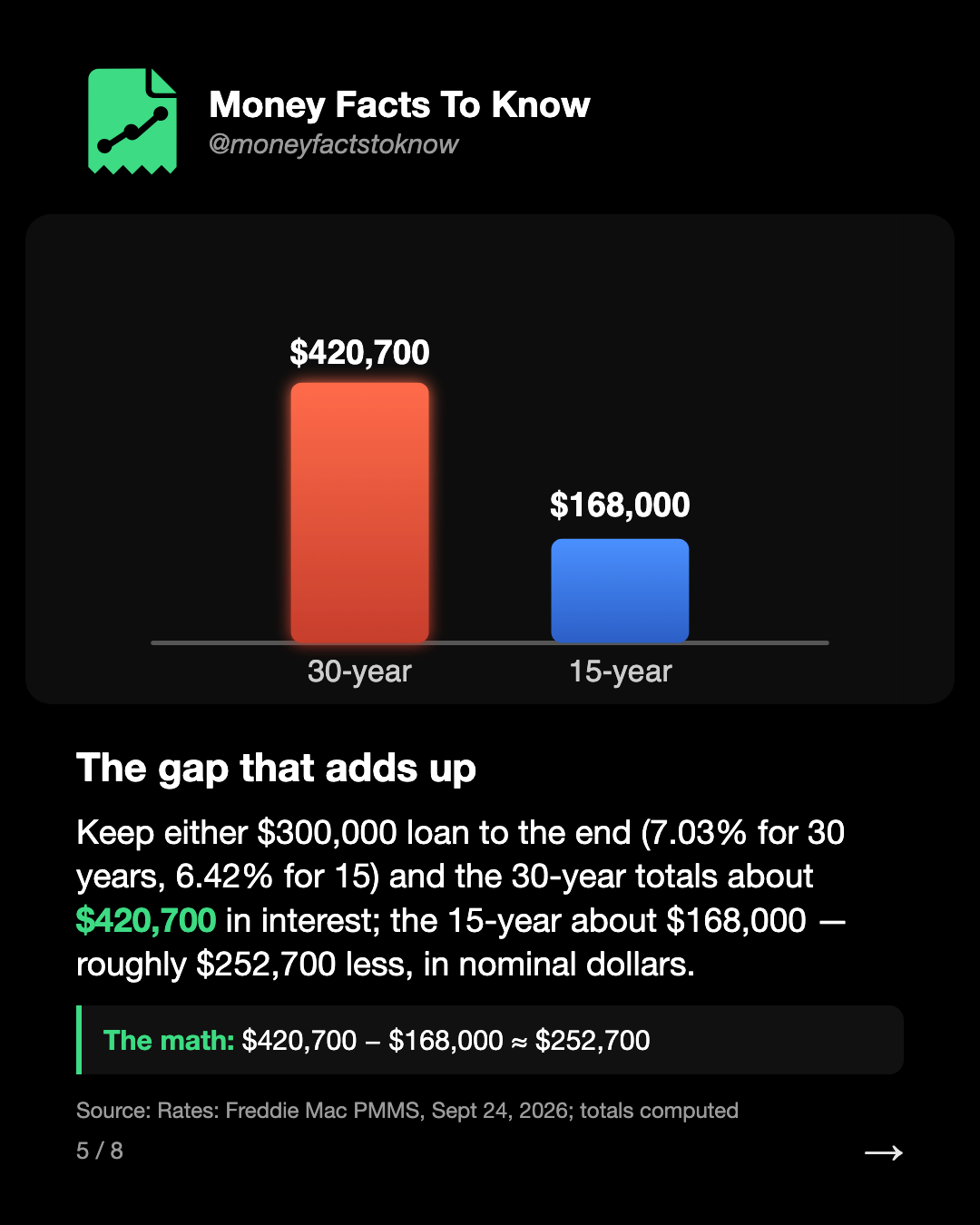
The gap that adds up
Keep either $300,000 loan to the end (7.03% for 30 years, 6.42% for 15) and the 30-year totals about $420,700 in interest; the 15-year about $168,000 — roughly $252,700 less, in nominal dollars.
The math: $420,700 − $168,000 ≈ $252,700
Source: Rates: Freddie Mac PMMS, Sept 24, 2026; totals computed
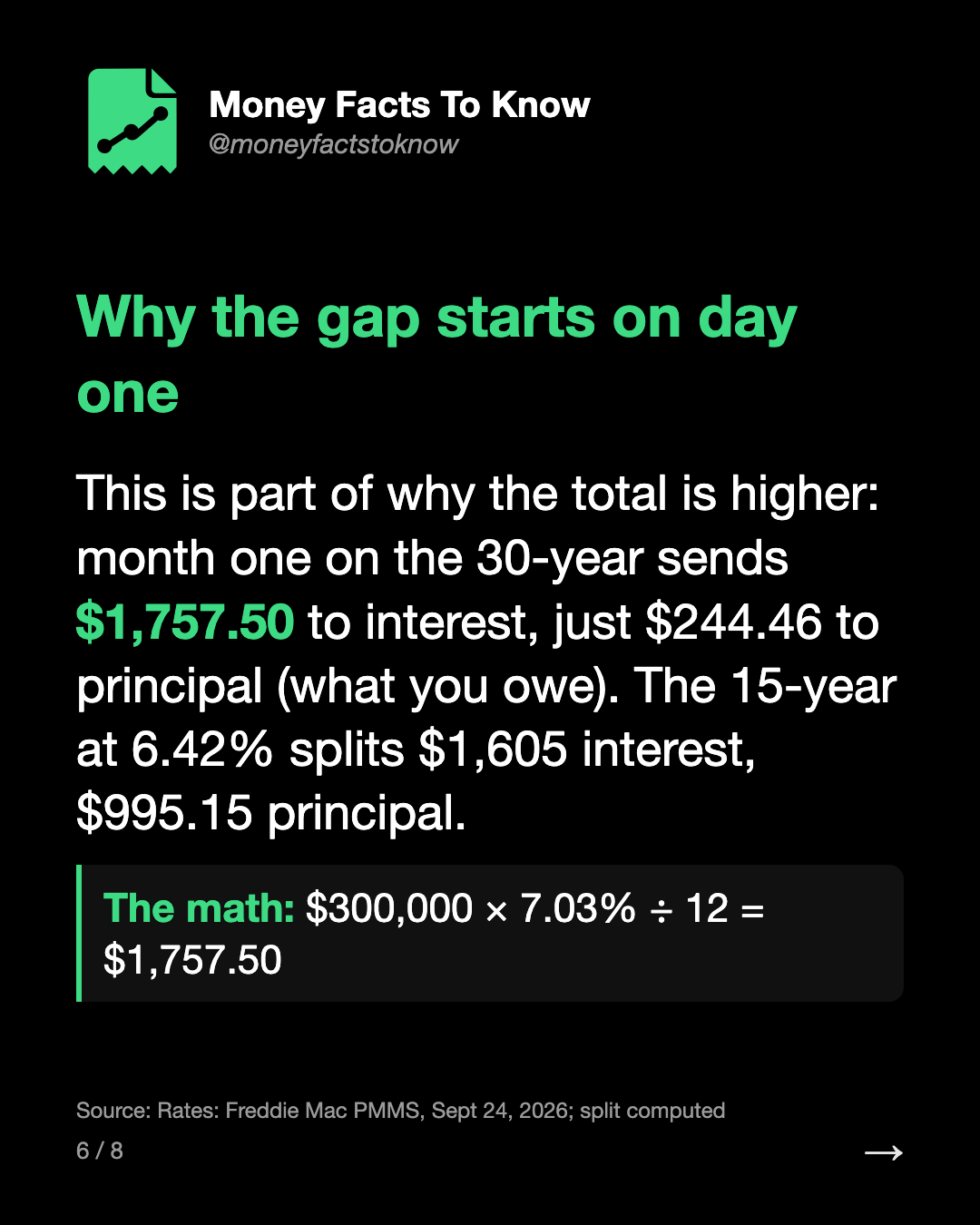
Why the gap starts on day one
This is part of why the total is higher: month one on the 30-year sends $1,757.50 to interest, just $244.46 to principal (what you owe). The 15-year at 6.42% splits $1,605 interest, $995.15 principal.
The math: $300,000 × 7.03% ÷ 12 = $1,757.50
Source: Rates: Freddie Mac PMMS, Sept 24, 2026; split computed
What the example leaves out
This assumes the full term, no refinancing, and leaves out property taxes, insurance and any interest deduction. Totals are nominal dollars: no inflation adjustment, no credit for what $598 a month could earn.
Source: CFPB
Sources and assumptions
- Freddie Mac Primary Mortgage Market Survey (PMMS): U.S. weekly averages as of 09/24/2026: 30-year fixed 7.03%, 15-year fixed 6.42% (checked 2026-09-29)
- CFPB, Understand the different kinds of loans available: 15-year loans have higher monthly payments, typically lower rates and a lower total cost. 30-year loans have lower monthly payments and a higher total cost. The shorter-term rate is usually lower, by as much as a full percentage point. (checked 2026-09-29)
- CFPB, How do I compare auto loan offers?: Supporting context only: lowering the monthly payment with a longer loan means paying more interest over the life of the loan (general principle, auto-loan page) (checked 2026-09-29)
Assumptions:
- Fictional borrower, $300,000 loan amount (not the home price)
- Fixed rates equal to the Freddie Mac PMMS averages for the week of 09/24/2026: 7.03% for 30 years, 6.42% for 15 years. Actual quotes vary with credit score, down payment, points and lender.
- The payment is principal and interest only. Property tax, homeowners insurance, PMI, HOA dues, points and closing costs are excluded.
- The borrower keeps the loan the full term with no extra payments, refinancing or sale
- Standard fixed-rate amortization with monthly compounding: payment = P·r / (1 − (1+r)^−n), with r = APR/12
- Dollar amounts are nominal and not adjusted for inflation or for what the $598 monthly difference could earn elsewhere
The short version
- A lower payment isn't a lower cost
- Same $300,000 loan, $252,700 more interest
- Shorter terms usually have lower rates too
- Check total interest, not just the payment