 Money Facts To Know
Two "0%" offers. One can charge interest back to day one.
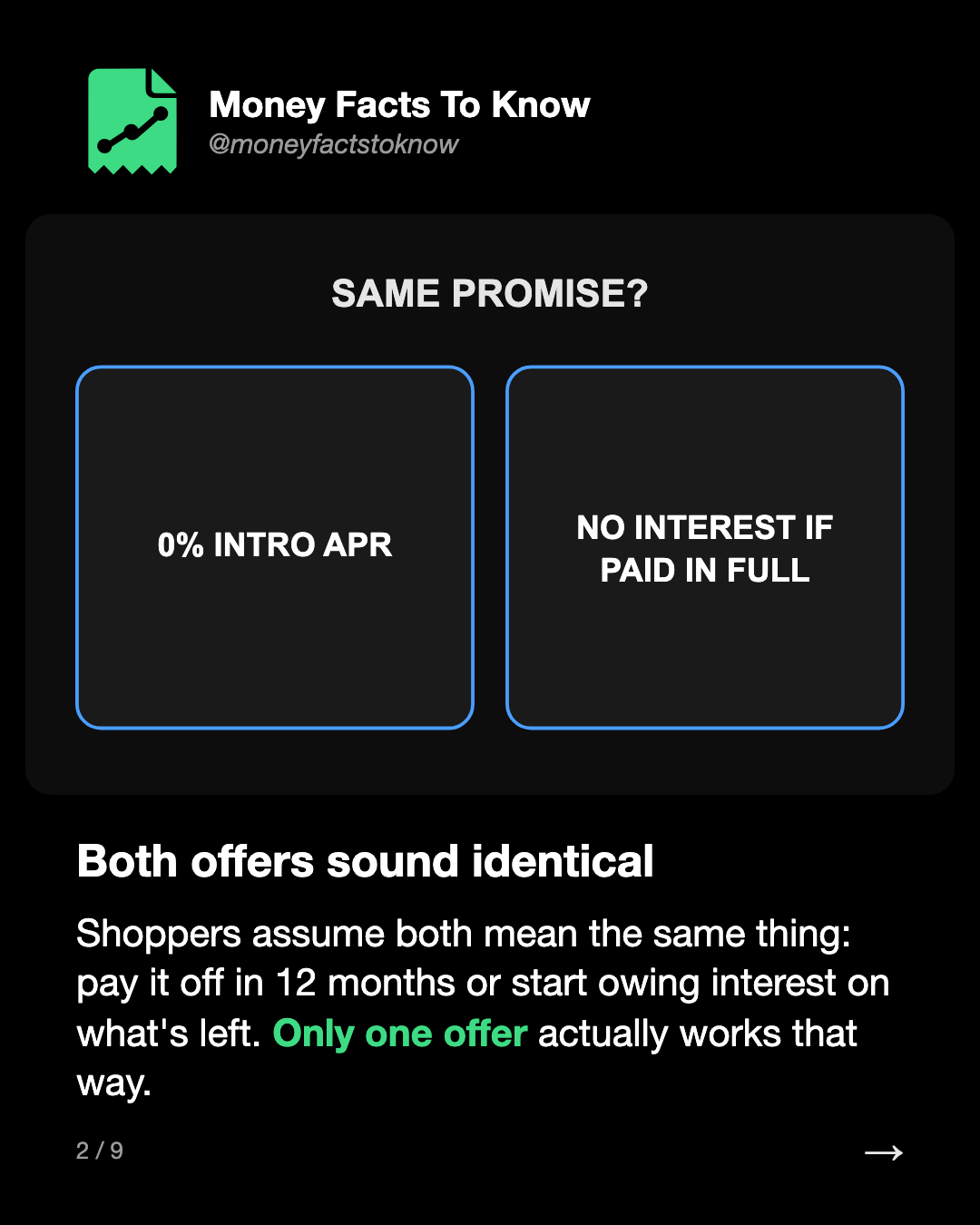
Both offers sound identical
Shoppers assume both mean the same thing: pay it off in 12 months or start owing interest on what's left. Only one offer actually works that way.
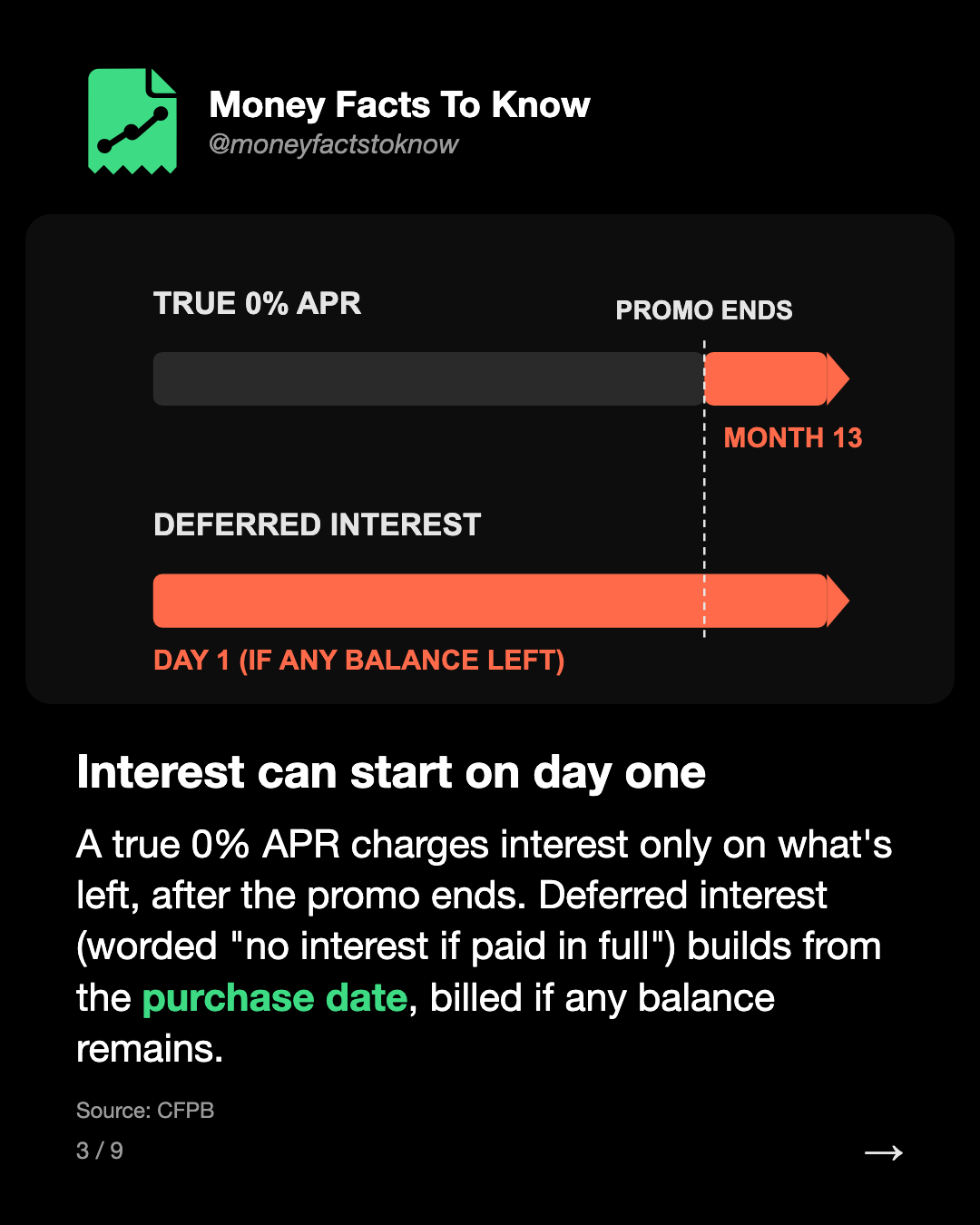
Interest can start on day one
A true 0% APR charges interest only on what's left, after the promo ends. Deferred interest (worded "no interest if paid in full") builds from the purchase date, billed if any balance remains.
Source: CFPB
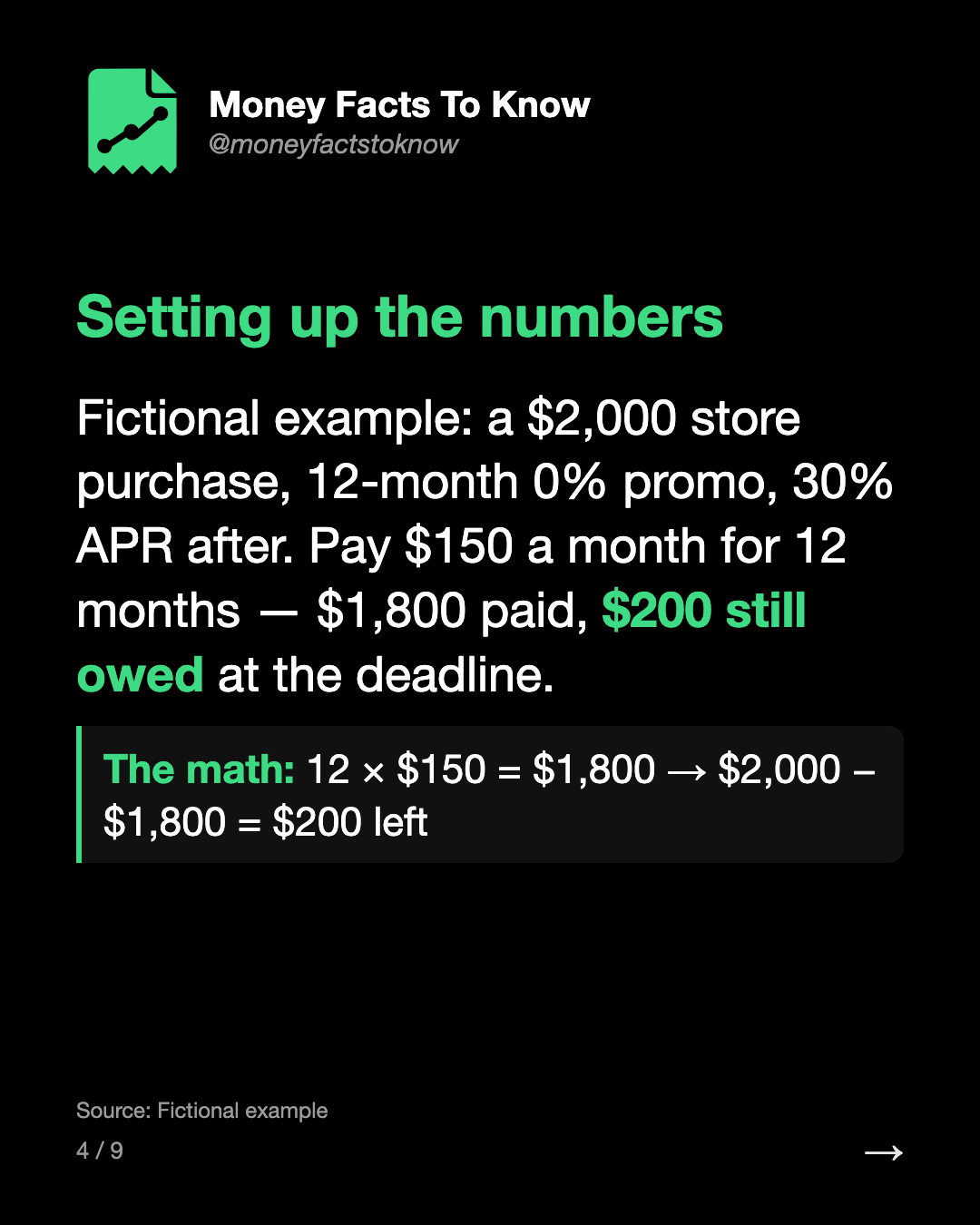
Setting up the numbers
Fictional example: a $2,000 store purchase, 12-month 0% promo, 30% APR after. Pay $150 a month for 12 months — $1,800 paid, $200 still owed at the deadline.
The math: 12 × $150 = $1,800 → $2,000 − $1,800 = $200 left
Source: Fictional example
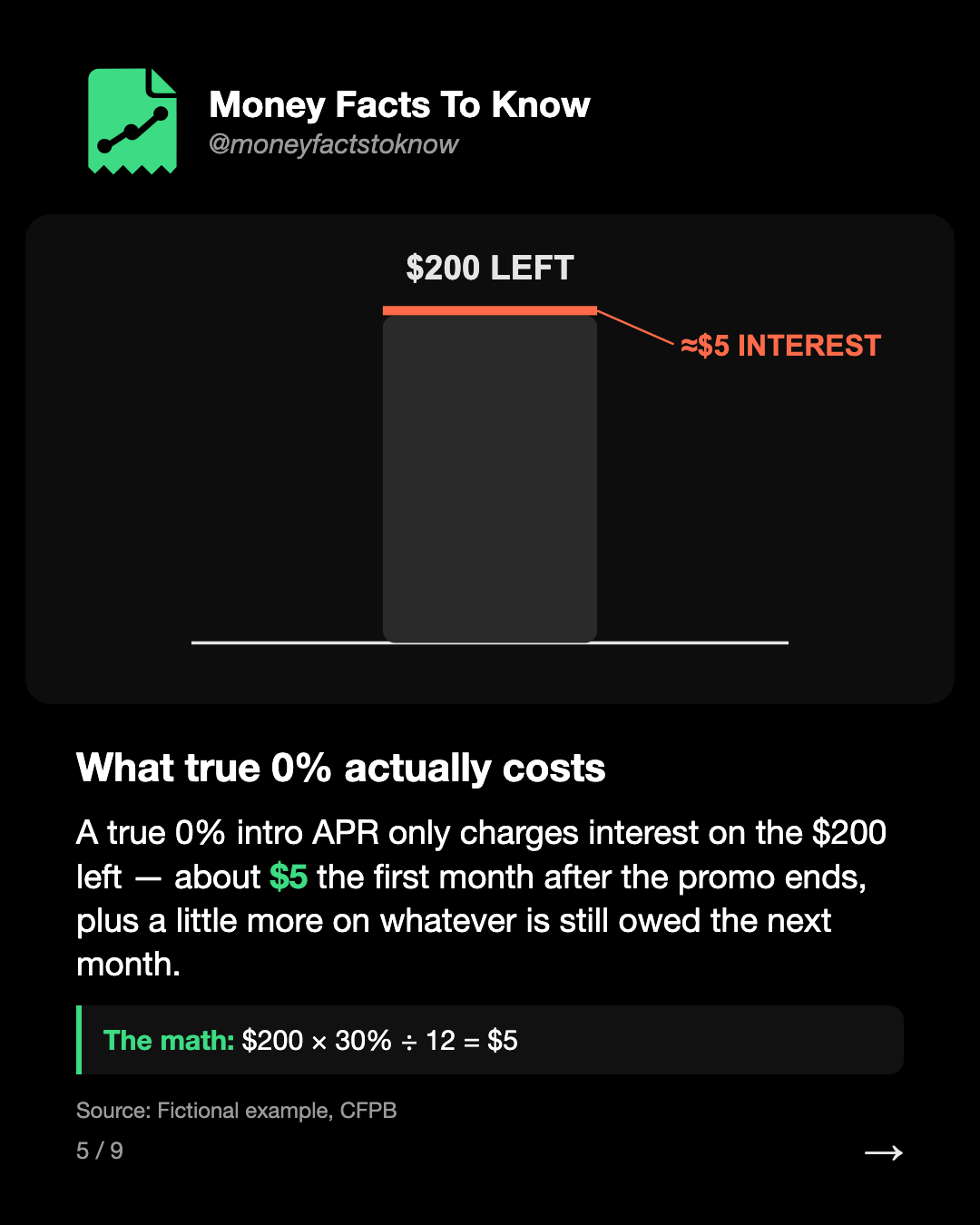
What true 0% actually costs
A true 0% intro APR only charges interest on the $200 left — about $5 the first month after the promo ends, plus a little more on whatever is still owed the next month.
The math: $200 × 30% ÷ 12 = $5
Source: Fictional example, CFPB
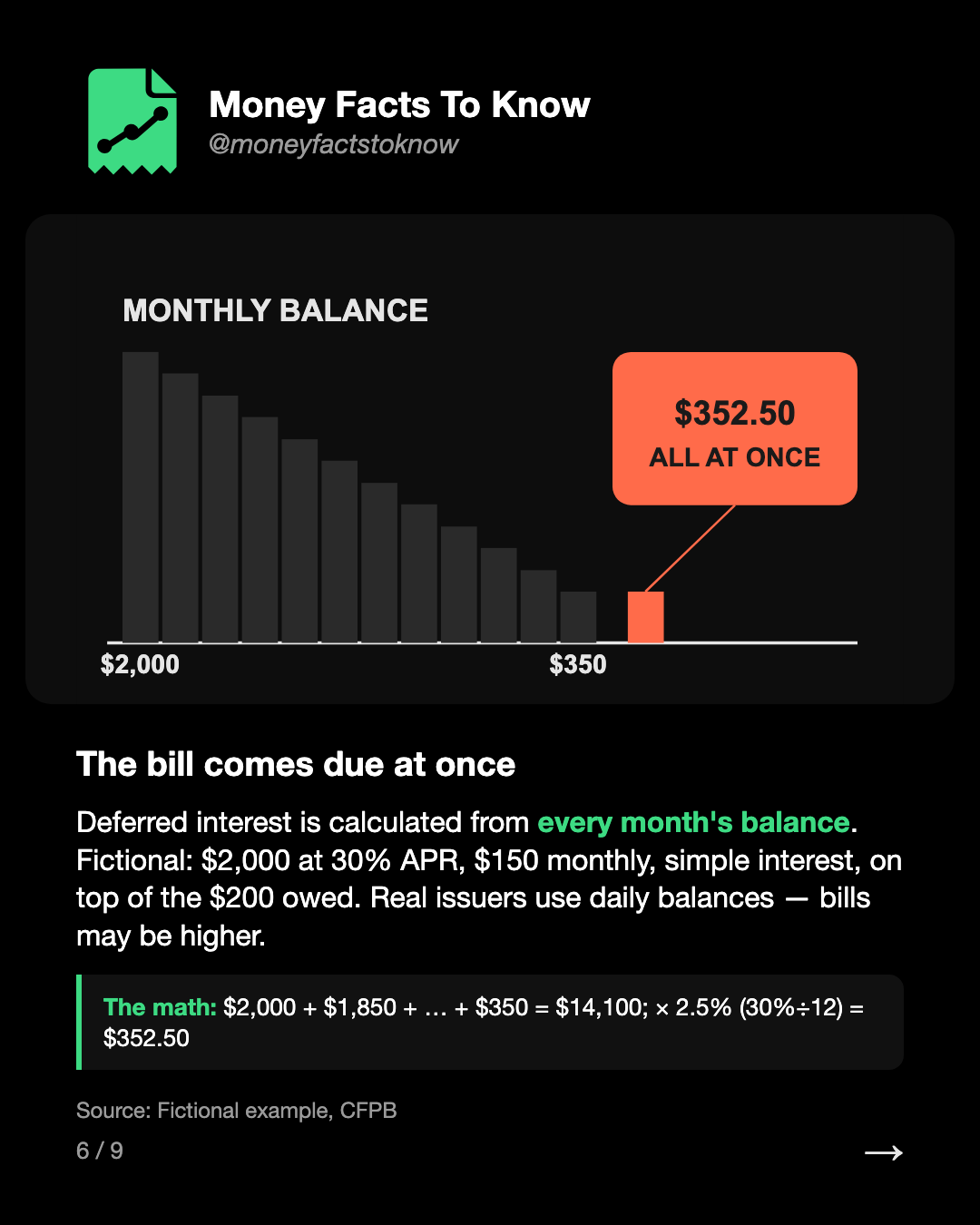
The bill comes due at once
Deferred interest is calculated from every month's balance. Fictional: $2,000 at 30% APR, $150 monthly, simple interest, on top of the $200 owed. Real issuers use daily balances — bills may be higher.
The math: $2,000 + $1,850 + … + $350 = $14,100; × 2.5% (30%÷12) = $352.50
Source: Fictional example, CFPB
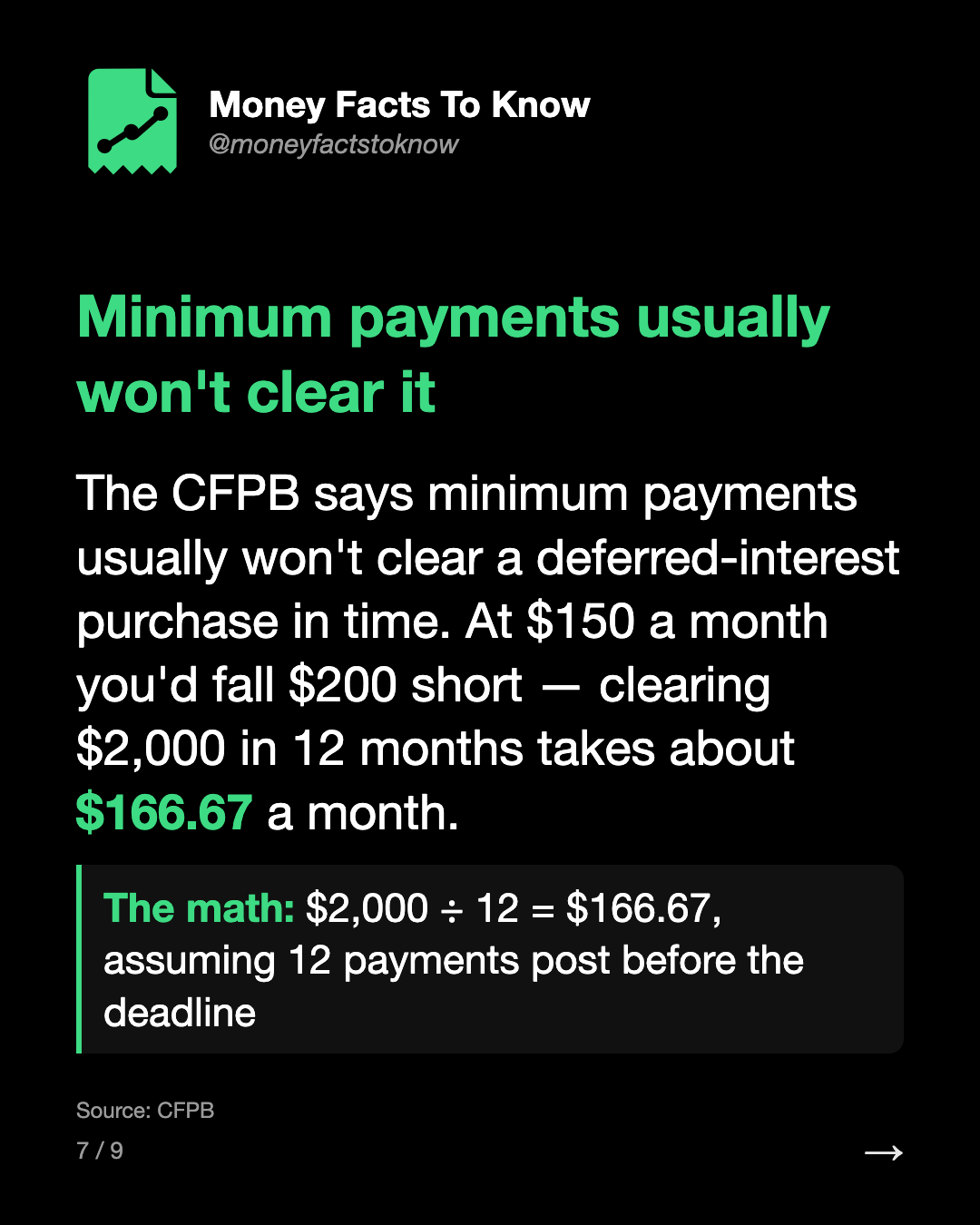
Minimum payments usually won't clear it
The CFPB says minimum payments usually won't clear a deferred-interest purchase in time. At $150 a month you'd fall $200 short — clearing $2,000 in 12 months takes about $166.67 a month.
The math: $2,000 ÷ 12 = $166.67, assuming 12 payments post before the deadline
Source: CFPB
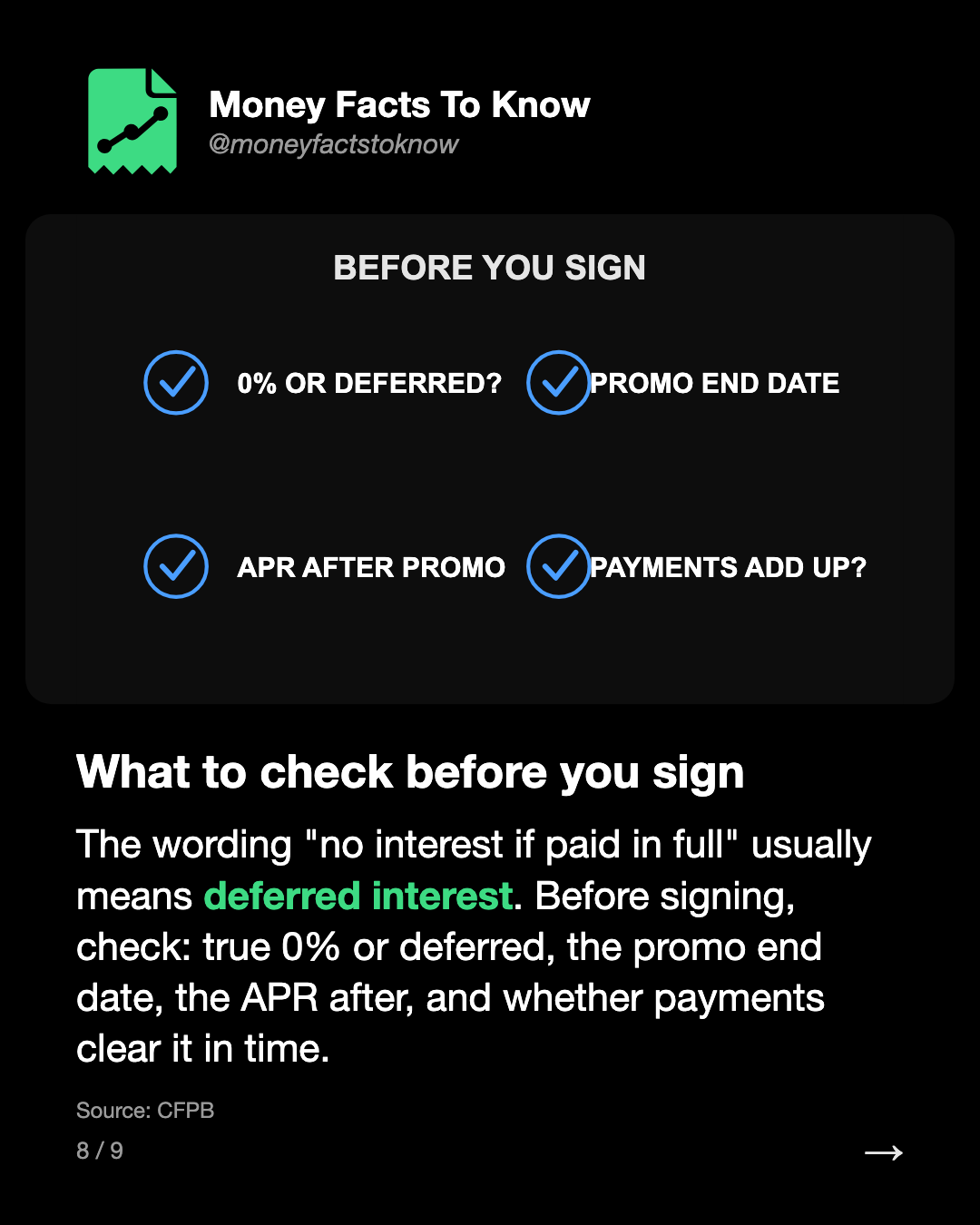
What to check before you sign
The wording "no interest if paid in full" usually means deferred interest. Before signing, check: true 0% or deferred, the promo end date, the APR after, and whether payments clear it in time.
Source: CFPB
Sources and assumptions
- CFPB, Ask CFPB: "I got a credit card promising no interest for a purchase if I pay in full within 12 months. How does this work?": Definition of deferred interest; interest is charged if the balance isn't paid off in time or the account is more than 60 days late on a minimum payment; interest is calculated on the balance owed in each month since the purchase, back to the original charge date; the contrast with a true 0% offer, where interest starts only on the remaining balance from the end of the promo (checked 2026-09-29)
- CFPB blog: How to understand special promotional financing offers on credit cards: Minimum payments usually won't pay off a deferred-interest purchase before the promo ends; figure out the monthly payment needed to clear the promotional balance in time (checked 2026-09-29)
- CFPB newsroom: CFPB Encourages Retail Credit Card Companies to Consider More Transparent Promotions: The CFPB's concern that deferred-interest promotions surprise consumers with high retroactive interest; the CFPB suggests issuers use more transparent 0% promotions instead (checked 2026-09-29)
- CFPB, Issue Spotlight: The High Cost of Retail Credit Cards: Deferred-interest promotions are common on store cards; retroactive interest is computed on daily balances back to the purchase date; retail cards commonly carry APRs above 30% (context for choosing a fictional 30% APR; not shown as a number on the slides) (checked 2026-09-29)
Assumptions:
- The purchase is fictional: $2,000 on a store card with a 12-month promo.
- The APR after the promo is fictional, 30% a year, used as a monthly rate of 2.5% (30% ÷ 12).
- The buyer pays exactly $150 on time every month for 12 months (total $1,800), leaving $200 at the deadline. There are no other purchases or balances on the card and no fees.
- Calculation convention: the example's interest is 2.5% of the balance at the start of each month, with no compounding, and each payment is subtracted after that month's interest is calculated. Real issuers use daily balances and may compound, so actual deferred-interest charges can differ, and can be higher.
- For the true 0% case, interest starts only after the promo ends, on the $200 left: $5 in the first month, and more each month until it's paid off.
- The deferred-interest example assumes the buyer was never more than 60 days late. Being that late can also trigger the retroactive charge before the deadline.
- Direct fetches of consumerfinance.gov returned HTTP 403 from this machine. The CFPB wording was checked against search-indexed extracts of the exact URLs listed, and the finance reviewer should re-open them in a browser.
Know the difference
- Deferred interest builds from day one.
- Pay it all off, or owe the back interest.
- True 0% only charges what's left.
- Check the payoff deadline before you sign.
- This $352.50 example is fictional.