 Money Facts To Know
The free money a '50% up to 6%' match adds on $60k

Two numbers, one formula
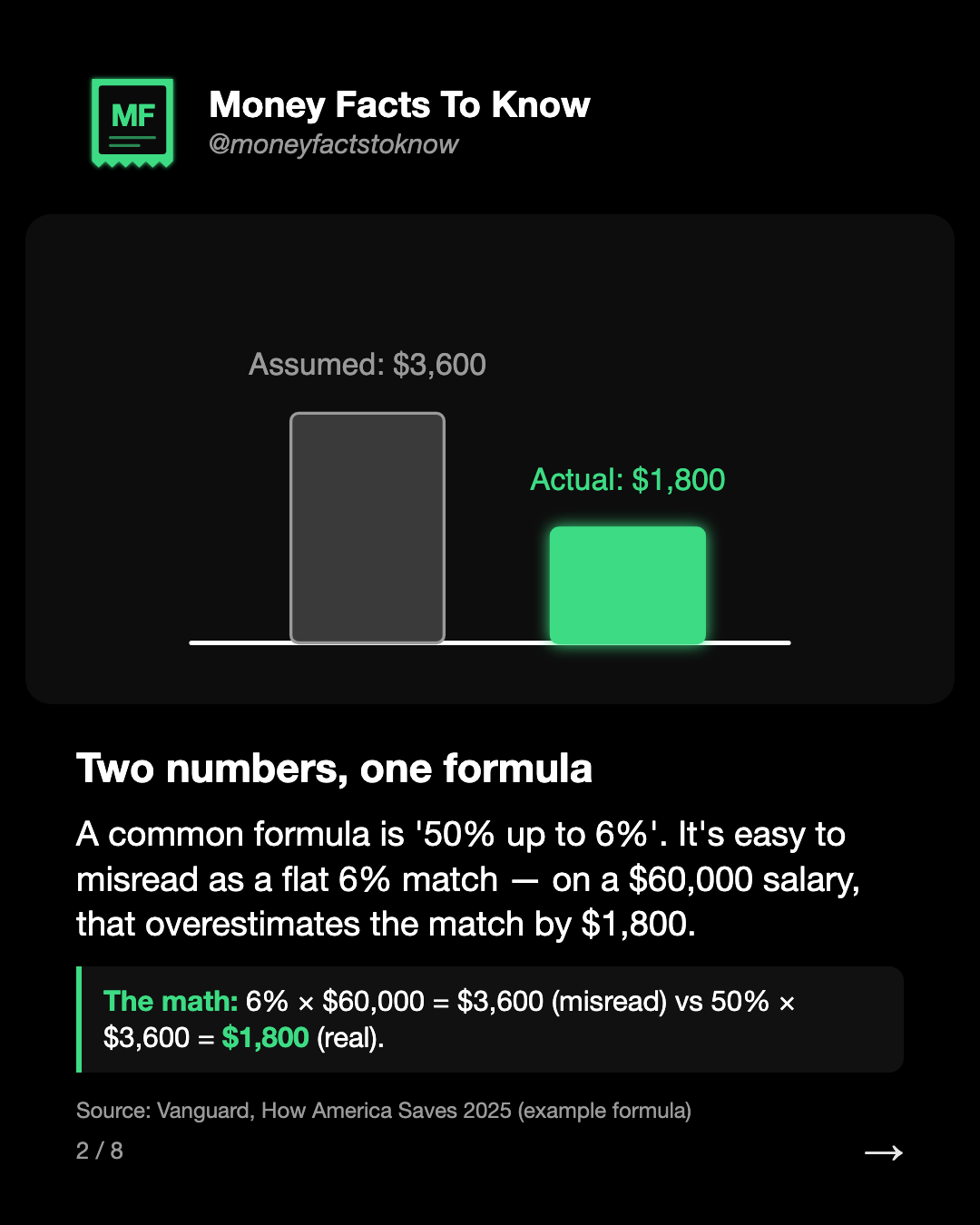
A common formula is '50% up to 6%'. It's easy to misread as a flat 6% match — on a $60,000 salary, that overestimates the match by $1,800.
The math: 6% × $60,000 = $3,600 (misread) vs 50% × $3,600 = $1,800 (real).
Source: Vanguard, How America Saves 2025 (example formula)
The first number: 50%
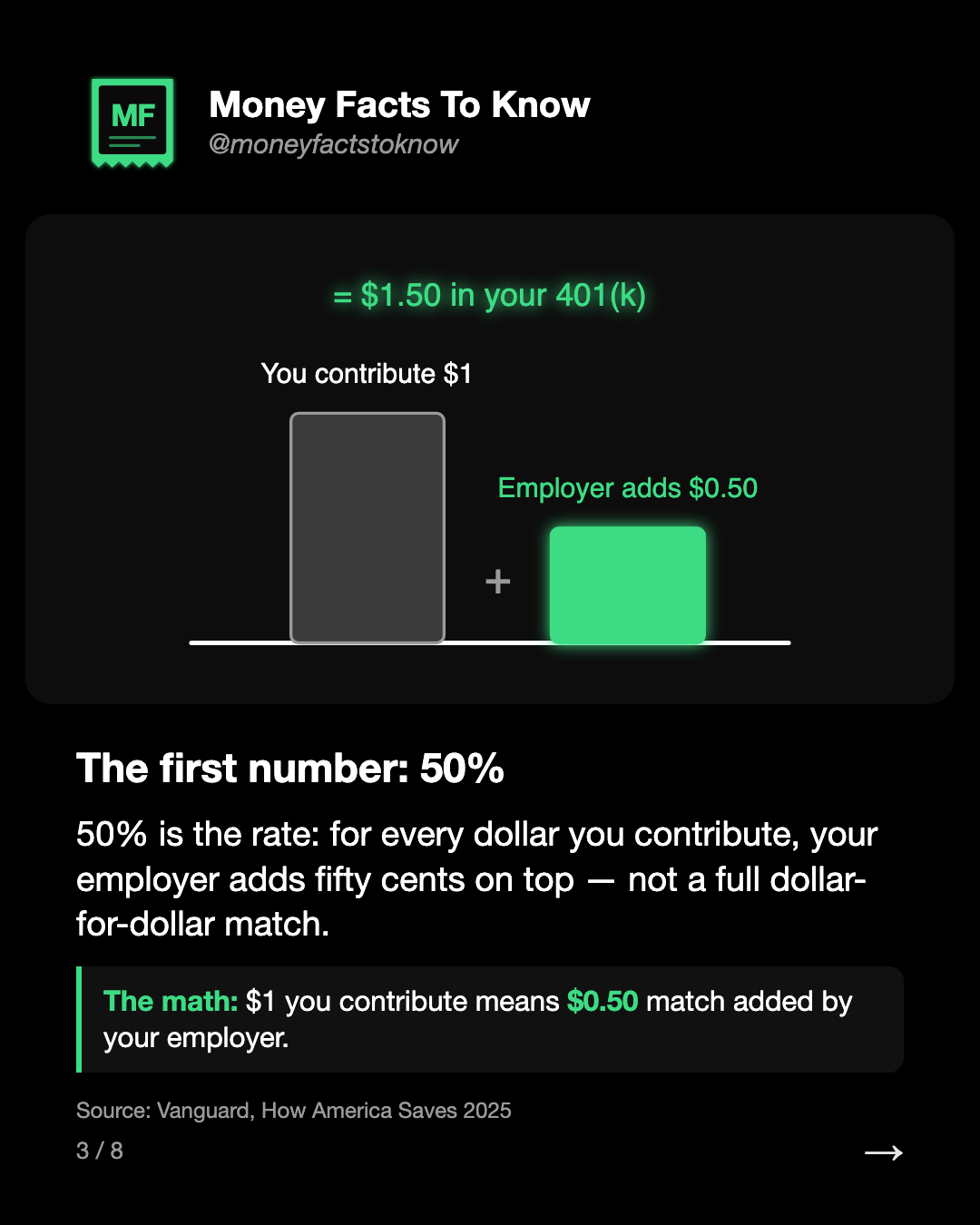
50% is the rate: for every dollar you contribute, your employer adds fifty cents on top — not a full dollar-for-dollar match.
The math: $1 you contribute means $0.50 match added by your employer.
Source: Vanguard, How America Saves 2025
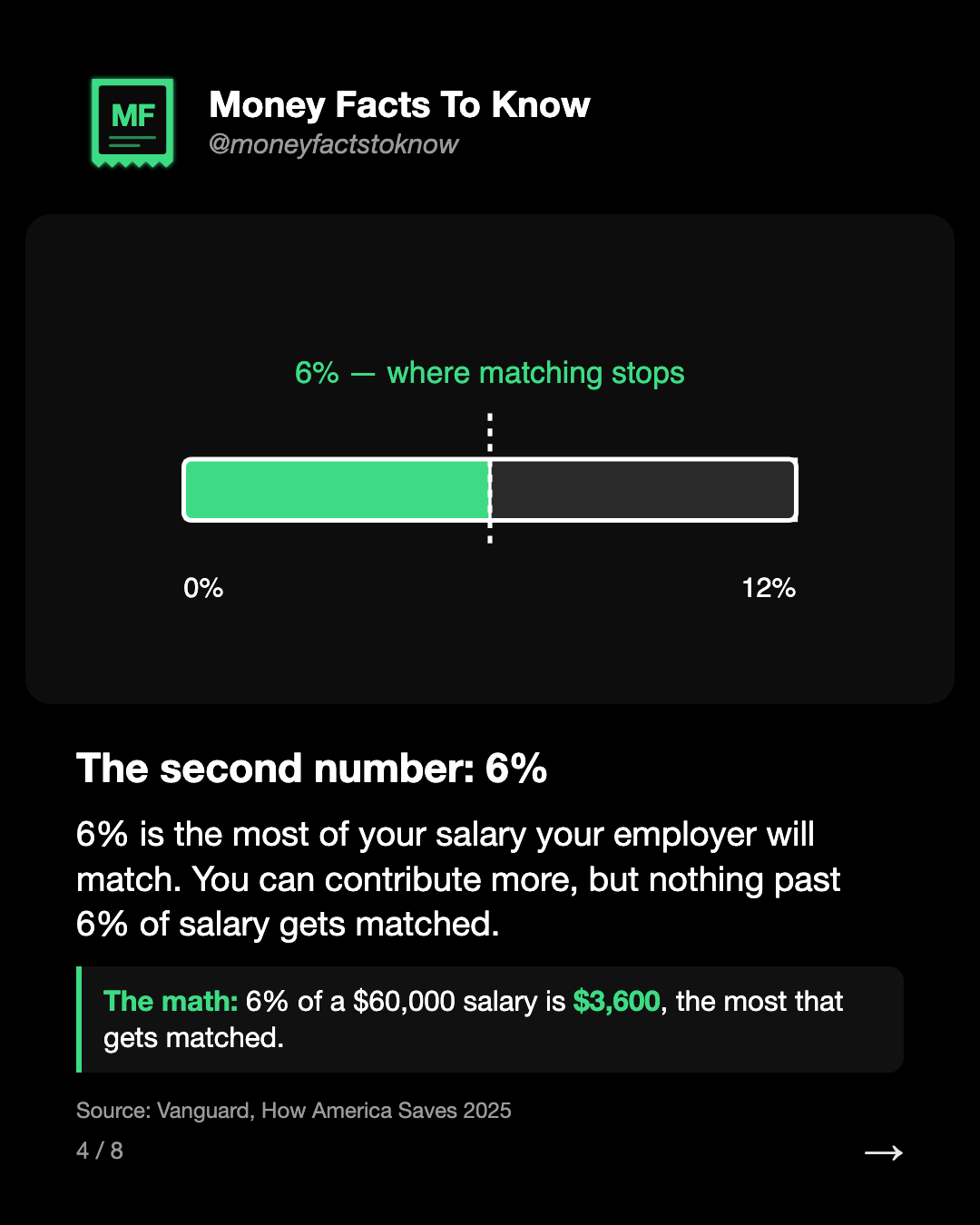
The second number: 6%
6% is the most of your salary your employer will match. You can contribute more, but nothing past 6% of salary gets matched.
The math: 6% of a $60,000 salary is $3,600, the most that gets matched.
Source: Vanguard, How America Saves 2025
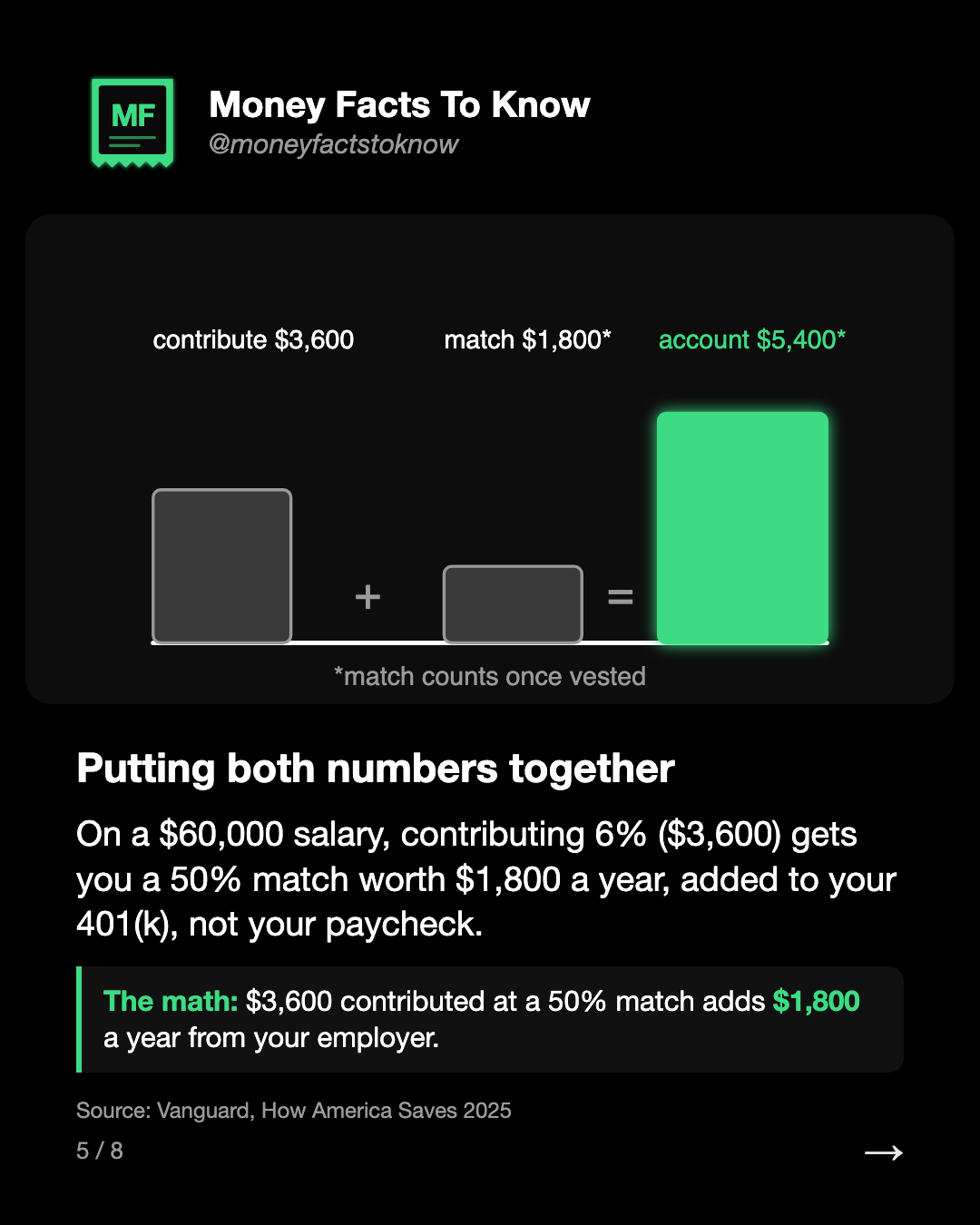
Putting both numbers together
On a $60,000 salary, contributing 6% ($3,600) gets you a 50% match worth $1,800 a year, added to your 401(k), not your paycheck.
The math: $3,600 contributed at a 50% match adds $1,800 a year from your employer.
Source: Vanguard, How America Saves 2025
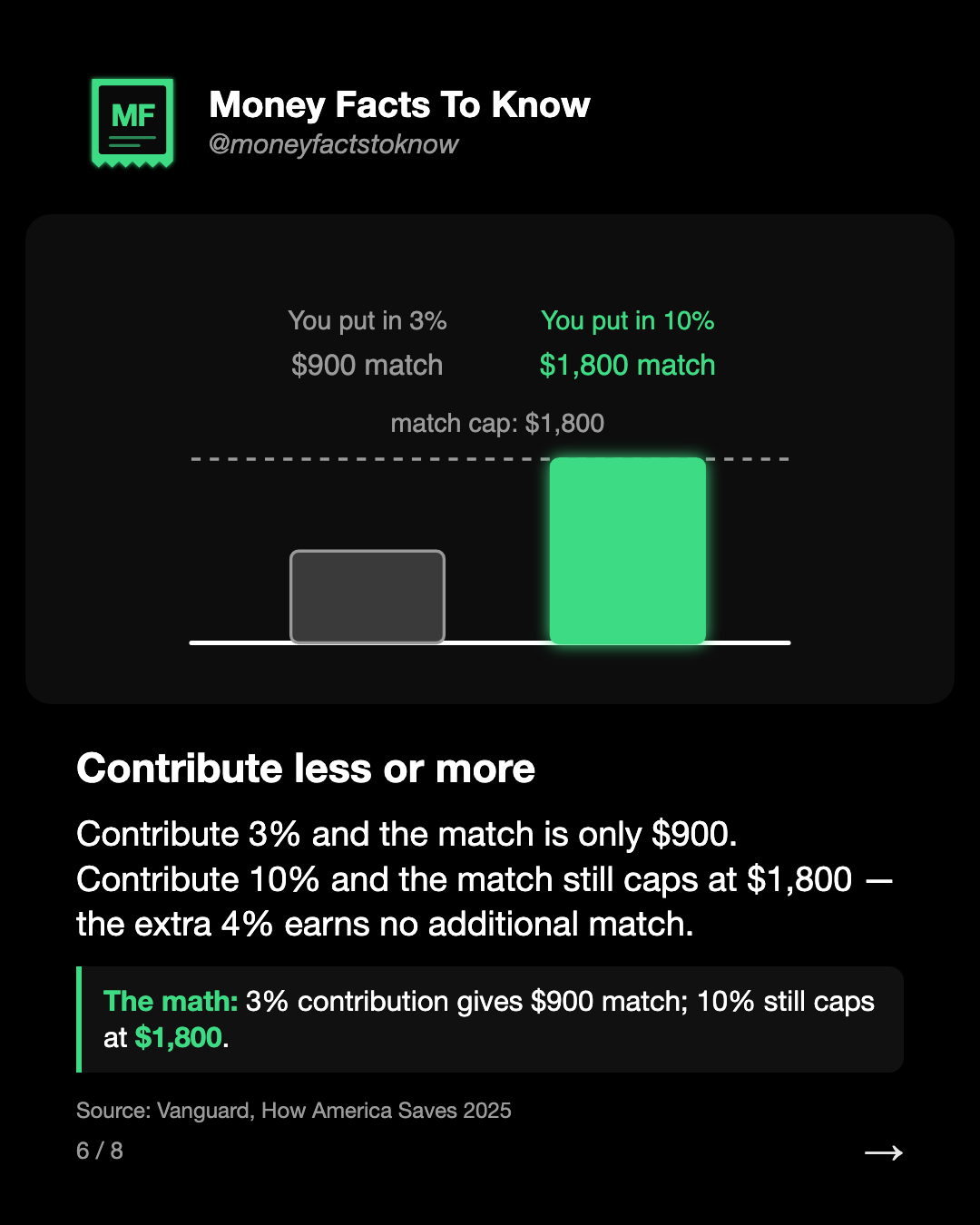
Contribute less or more
Contribute 3% and the match is only $900. Contribute 10% and the match still caps at $1,800 — the extra 4% earns no additional match.
The math: 3% contribution gives $900 match; 10% still caps at $1,800.
Source: Vanguard, How America Saves 2025
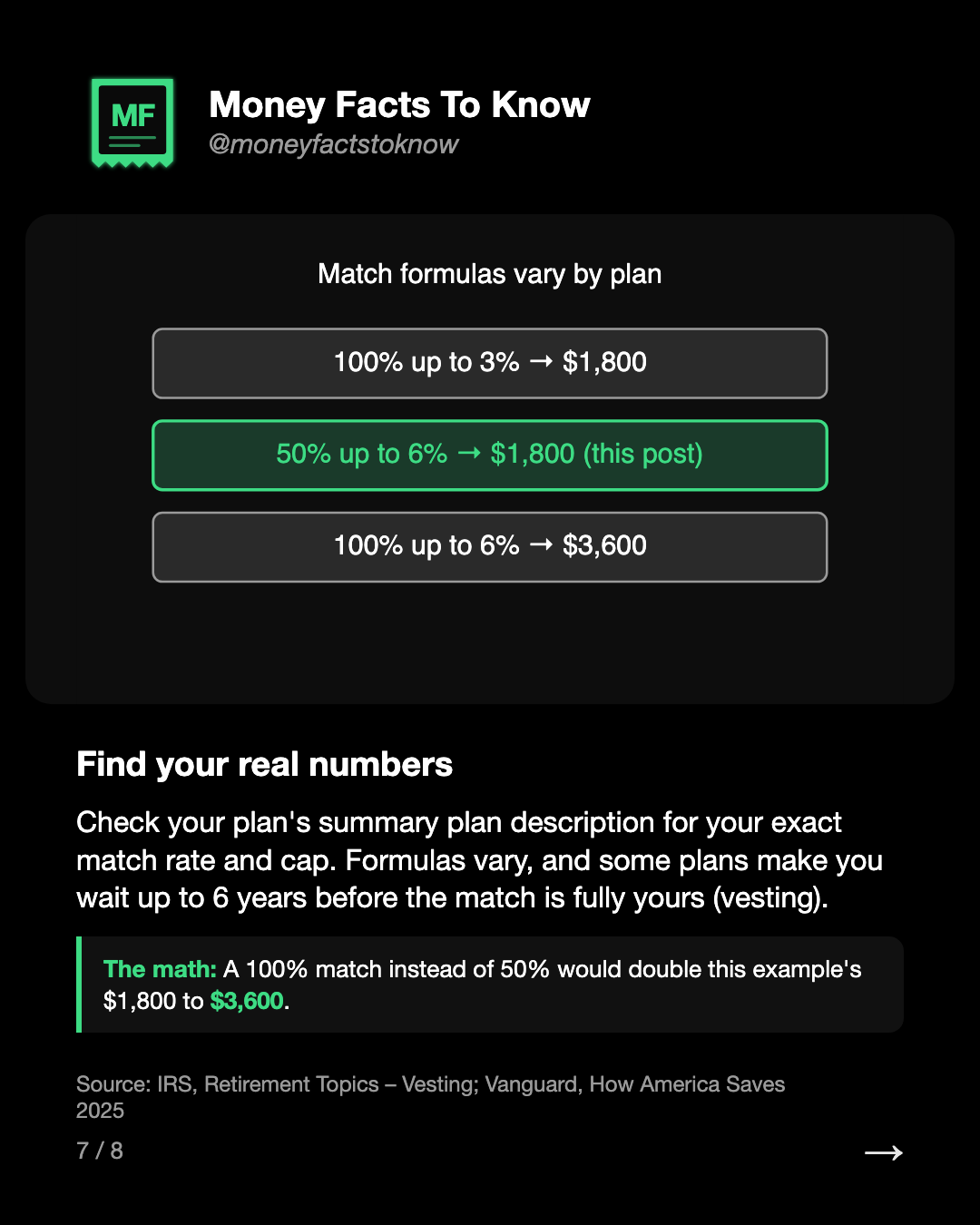
Find your real numbers
Check your plan's summary plan description for your exact match rate and cap. Formulas vary, and some plans make you wait up to 6 years before the match is fully yours (vesting).
The math: A 100% match instead of 50% would double this example's $1,800 to $3,600.
Source: IRS, Retirement Topics – Vesting; Vanguard, How America Saves 2025
Save this
- 50% = 50¢ added per $1 you put in
- 6% = most of your pay that gets matched
- Below 6%? Part of the match goes unclaimed
- Above 6%? No extra match
- Check your plan for your real numbers