 Money Facts To Know
$800 tax bill, $1,000 credit. Why it might be worth only $800


What most people assume
A $1,000 credit should mean $1,000 off your taxes or added to your refund — dollar for dollar, every time.
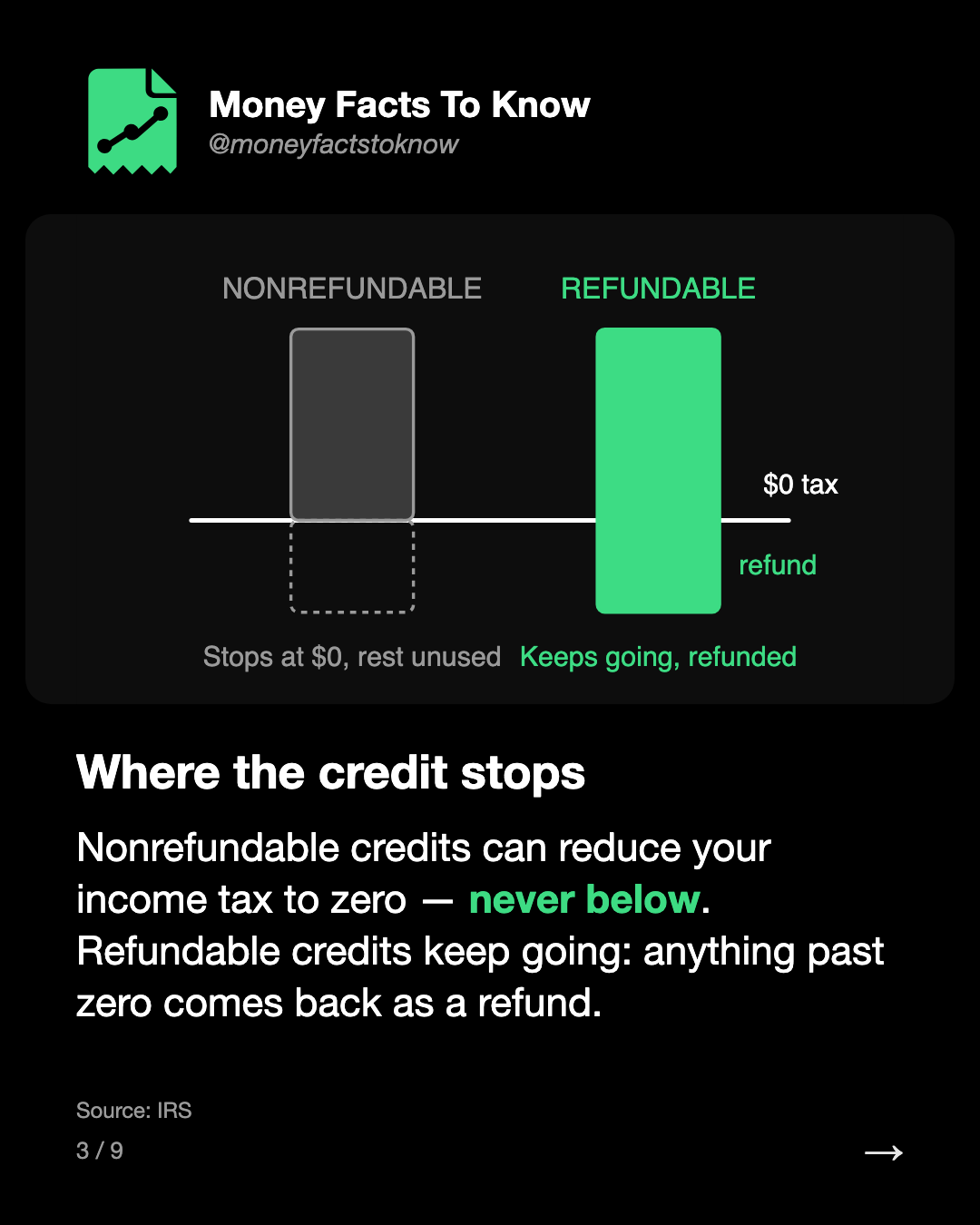
Where the credit stops
Nonrefundable credits can reduce your income tax to zero — never below. Refundable credits keep going: anything past zero comes back as a refund.
Source: IRS
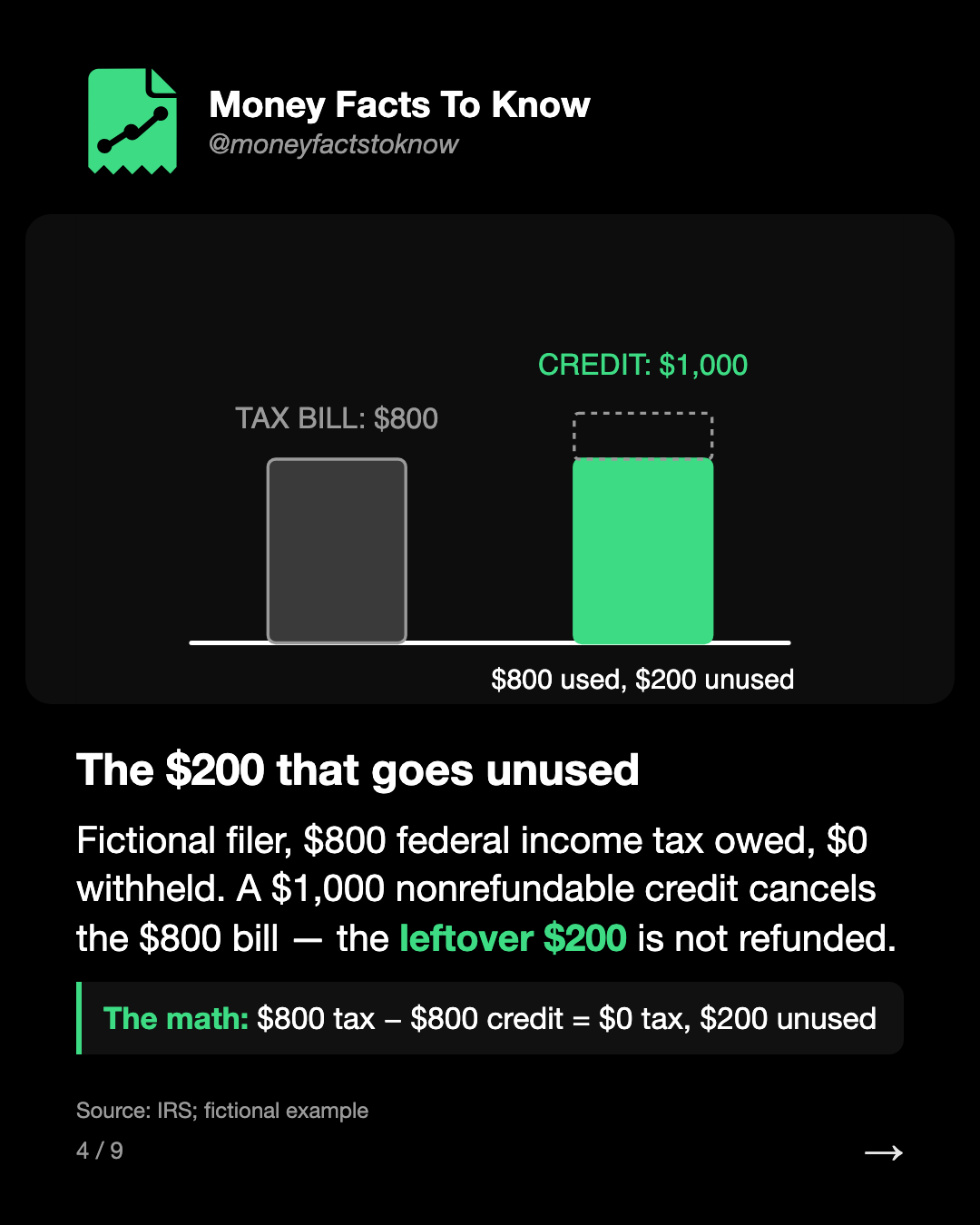
The $200 that goes unused
Fictional filer, $800 federal income tax owed, $0 withheld. A $1,000 nonrefundable credit cancels the $800 bill — the leftover $200 is not refunded.
The math: $800 tax − $800 credit = $0 tax, $200 unused
Source: IRS; fictional example
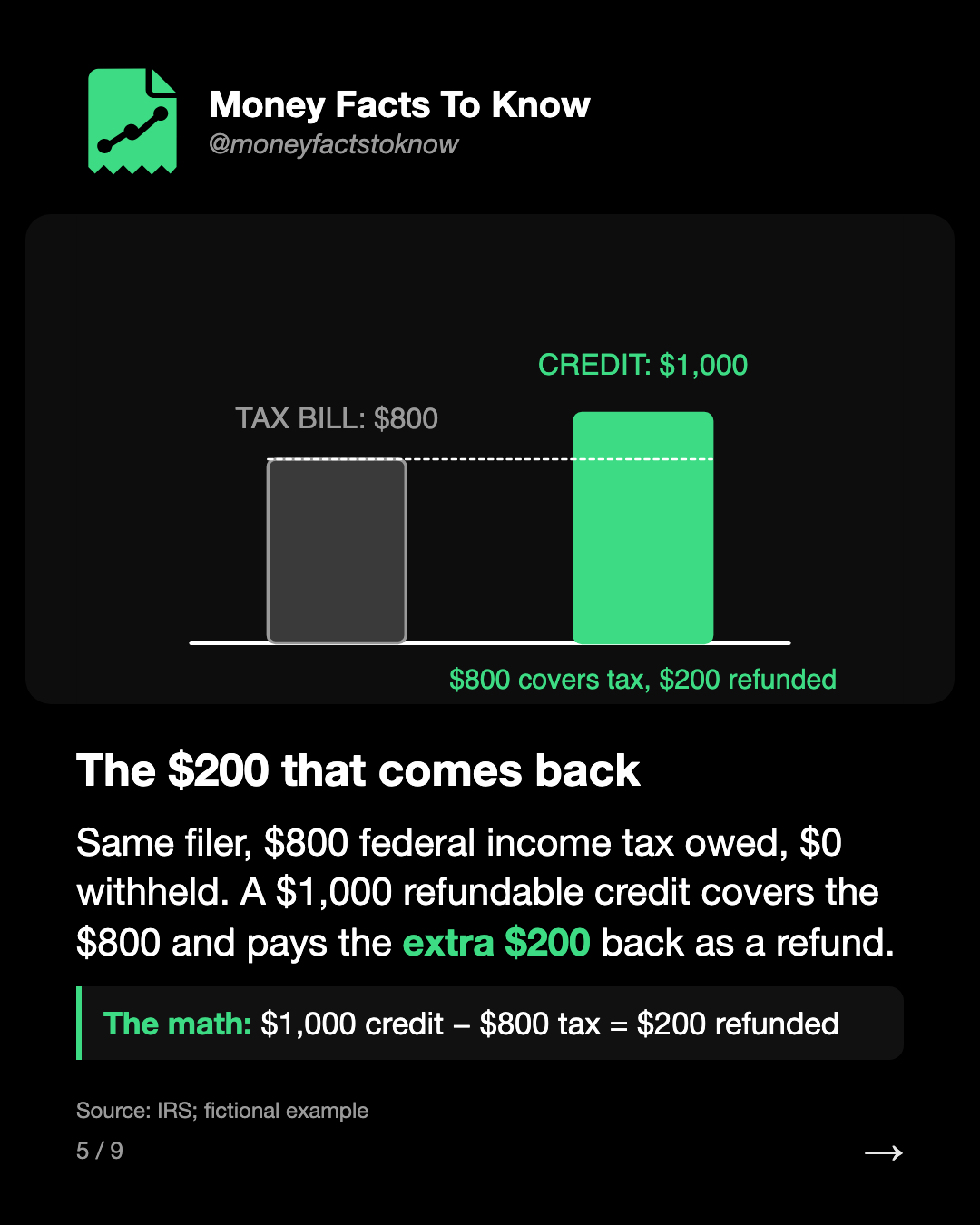
The $200 that comes back
Same filer, $800 federal income tax owed, $0 withheld. A $1,000 refundable credit covers the $800 and pays the extra $200 back as a refund.
The math: $1,000 credit − $800 tax = $200 refunded
Source: IRS; fictional example
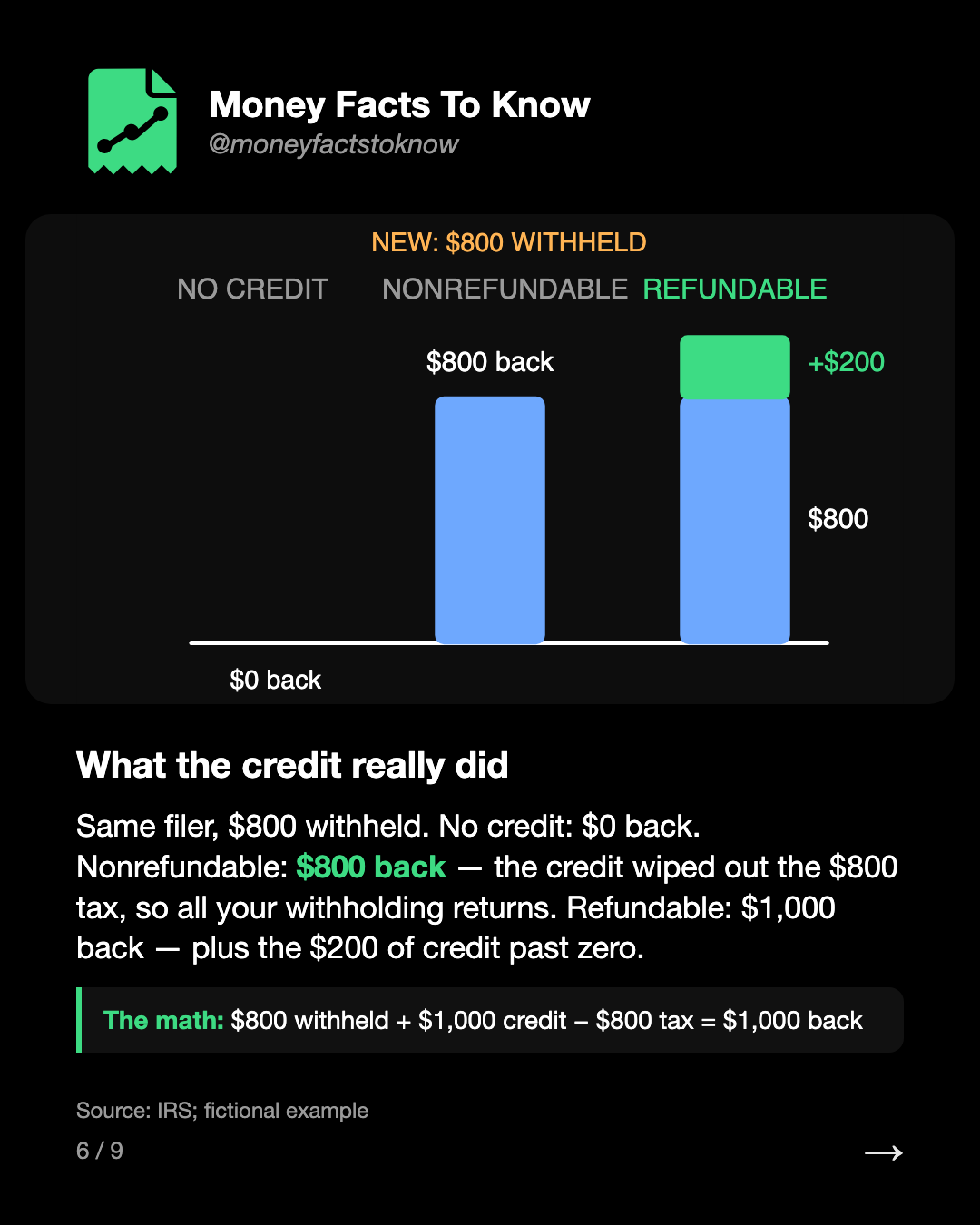
What the credit really did
Same filer, $800 withheld. No credit: $0 back. Nonrefundable: $800 back — the credit wiped out the $800 tax, so all your withholding returns. Refundable: $1,000 back — plus the $200 of credit past zero.
The math: $800 withheld + $1,000 credit − $800 tax = $1,000 back
Source: IRS; fictional example
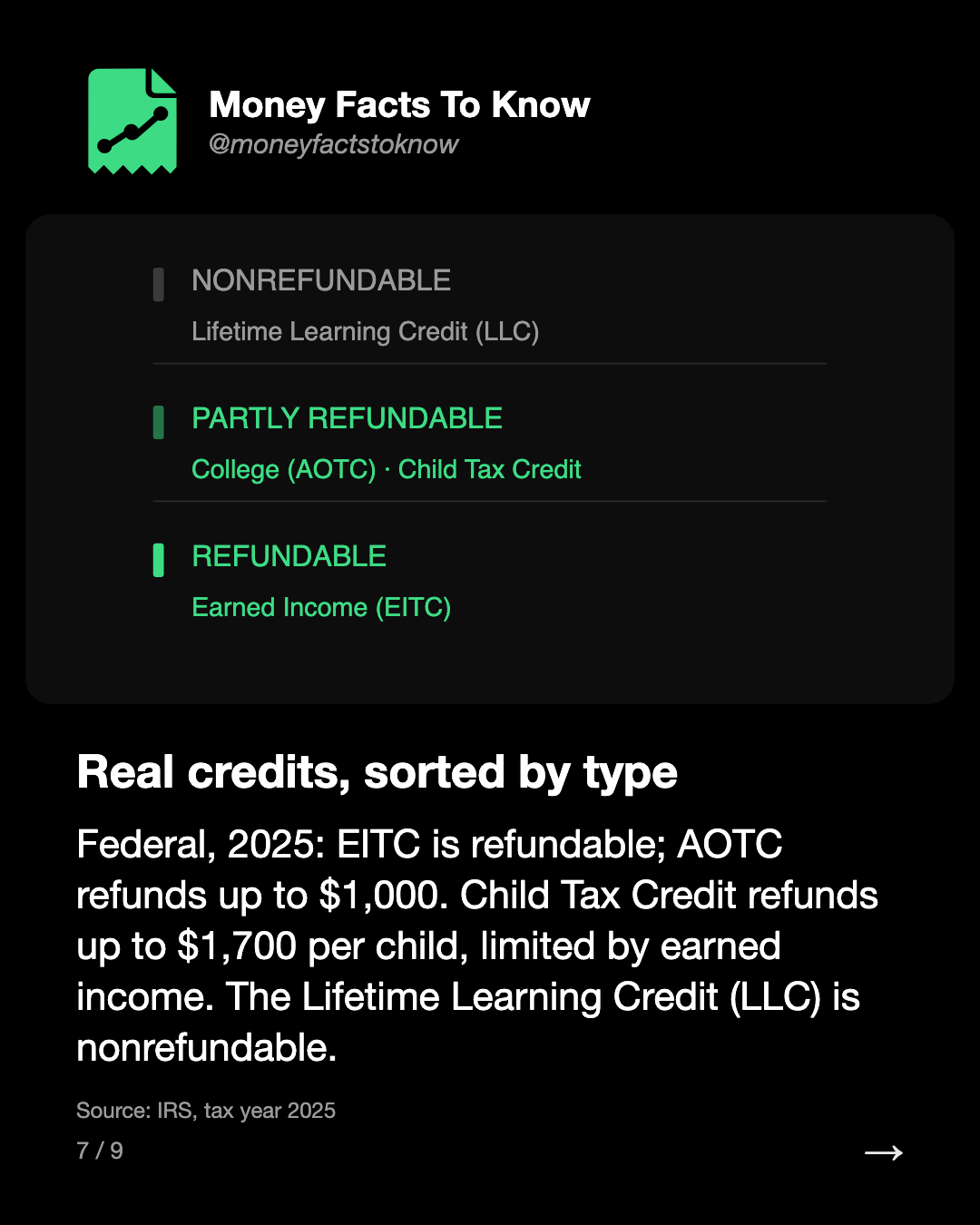
Real credits, sorted by type
Federal, 2025: EITC is refundable; AOTC refunds up to $1,000. Child Tax Credit refunds up to $1,700 per child, limited by earned income. The Lifetime Learning Credit (LLC) is nonrefundable.
Source: IRS, tax year 2025
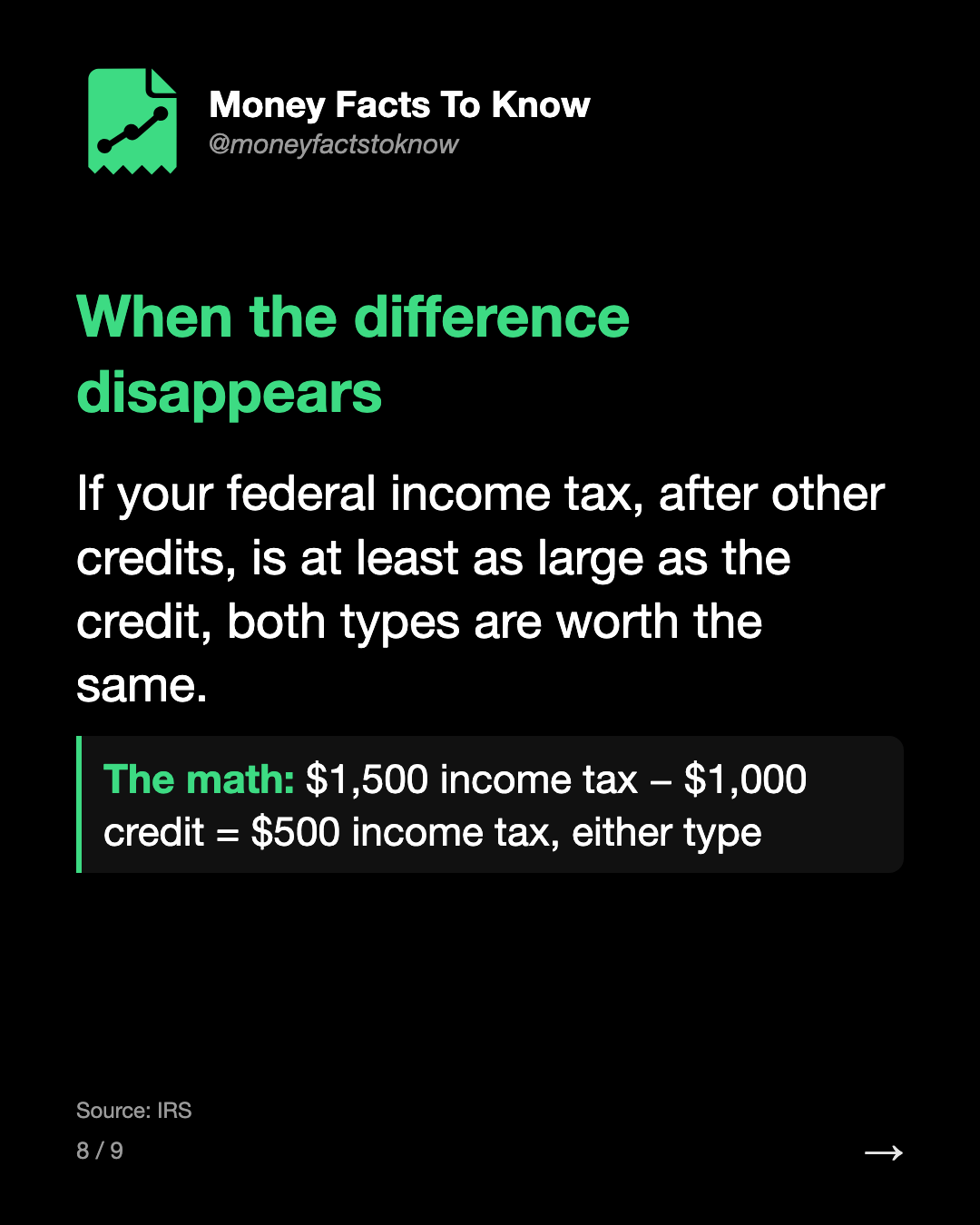
When the difference disappears
If your federal income tax, after other credits, is at least as large as the credit, both types are worth the same.
The math: $1,500 income tax − $1,000 credit = $500 income tax, either type
Source: IRS
Sources and assumptions
- IRS Newsroom: Tax credits for individuals: What they mean and how they can help refunds: A credit reduces tax owed dollar-for-dollar. A refundable credit beyond the tax owed is paid as a refund. With a nonrefundable credit, once liability is zero the taxpayer gets no leftover back. EITC is refundable; AOTC is partially refundable (40% up to $1,000); up to $1,700 per qualifying child of the Child Tax Credit is refundable for 2025 as the ACTC. (checked 2026-09-29)
- IRS: Refundable tax credits: Refundable credits can produce a refund when the credit is more than the tax owed; the EITC and ACTC are refundable credits. (checked 2026-09-29)
- IRS Internal Revenue Manual 21.6.3 Credits: A nonrefundable credit can only reduce tax liability to zero and the excess is not refunded; a refundable credit is treated as a payment, and any amount above liability is refundable. (checked 2026-09-29)
- IRS: Education credits, AOTC and LLC: AOTC is worth up to $2,500 and 40% of it (up to $1,000) can be refunded. The Lifetime Learning Credit is nonrefundable, worth up to $2,000 per return. (checked 2026-09-29)
- IRS Newsroom: Understanding the Credit for Other Dependents: The Credit for Other Dependents is a $500 nonrefundable credit for dependents who don't qualify for the child tax credit. (checked 2026-09-29)
Assumptions:
- The filer is fictional; their federal income tax liability, before credits, is $800
- Both credits are fictional $1,000 credits that differ only in refundability
- Slides 4–5: $0 withheld and no other payments or credits, so any refund comes only from the credit
- Slide 6: $800 withheld from paychecks, with every other input unchanged
- Unused nonrefundable credit is shown as not refunded; some nonrefundable credits allow a carryforward, which the slides mention as a thing to check rather than a figure
- Named-credit amounts are federal, tax year 2025 (returns filed in 2026), and subject to income limits and eligibility rules not modeled here
The short version
- Nonrefundable credits stop at zero tax.
- Refundable credits pay the extra back.
- Nonrefundable credits can still raise your refund.
- Always check: is this credit refundable?