 Money Facts To Know
A fictional $4,000 trade-in gap can follow you into the next loan

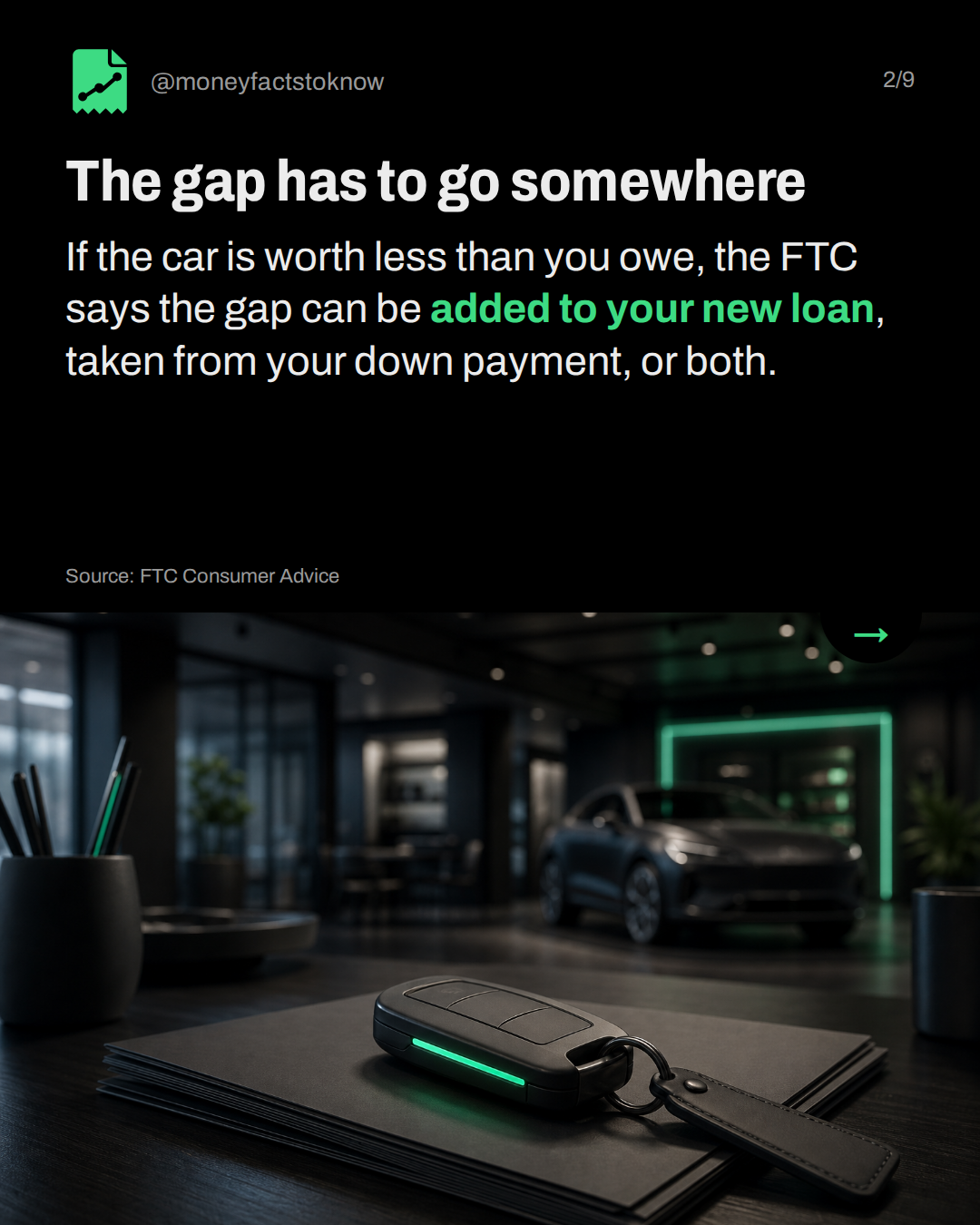
The gap has to go somewhere
If the car is worth less than you owe, the FTC says the gap can be added to your new loan, taken from your down payment, or both.
Source: FTC Consumer Advice
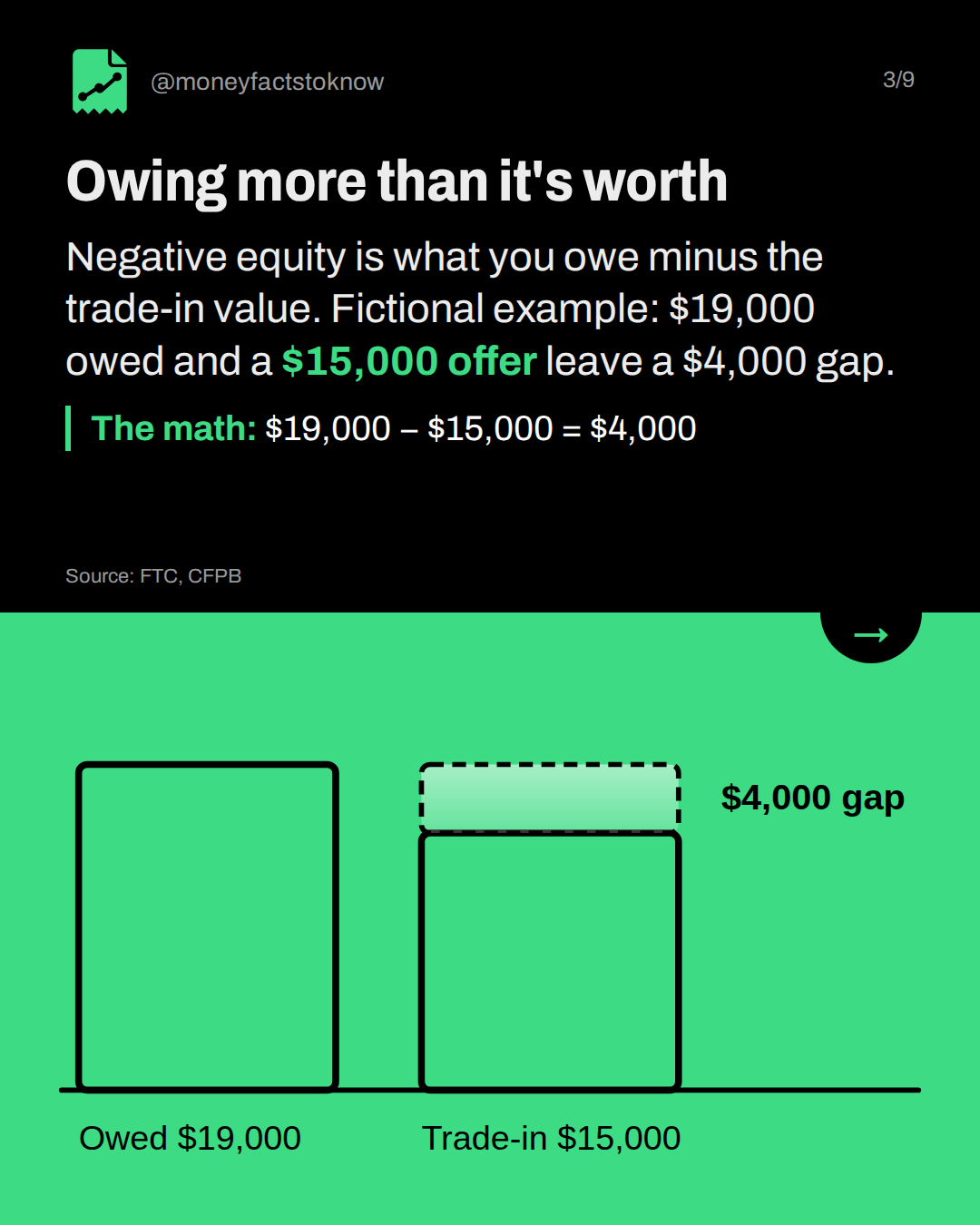
Owing more than it's worth
Negative equity is what you owe minus the trade-in value. Fictional example: $19,000 owed and a $15,000 offer leave a $4,000 gap.
The math: $19,000 − $15,000 = $4,000
Source: FTC, CFPB
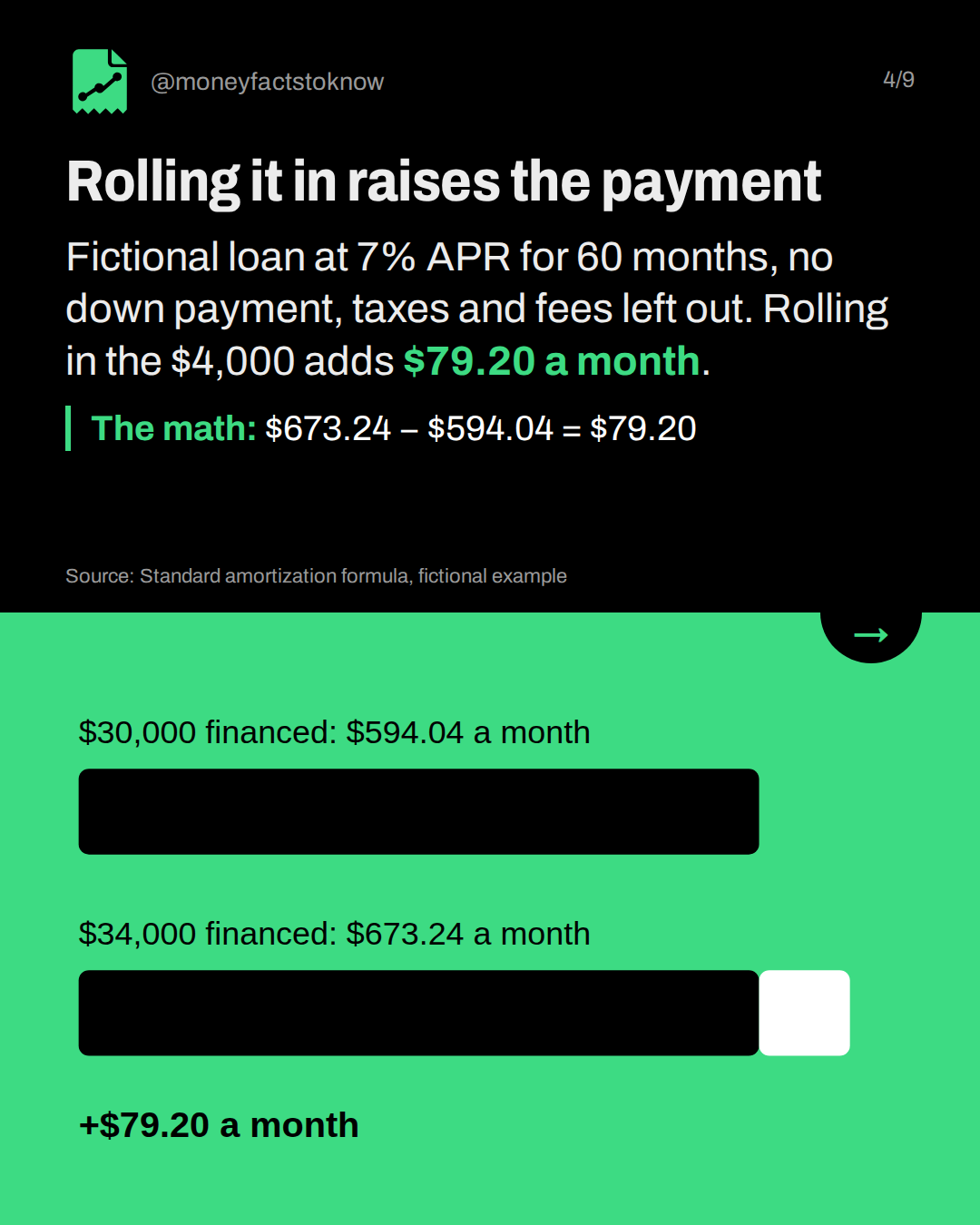
Rolling it in raises the payment
Fictional loan at 7% APR for 60 months, no down payment, taxes and fees left out. Rolling in the $4,000 adds $79.20 a month.
The math: $673.24 − $594.04 = $79.20
Source: Standard amortization formula, fictional example
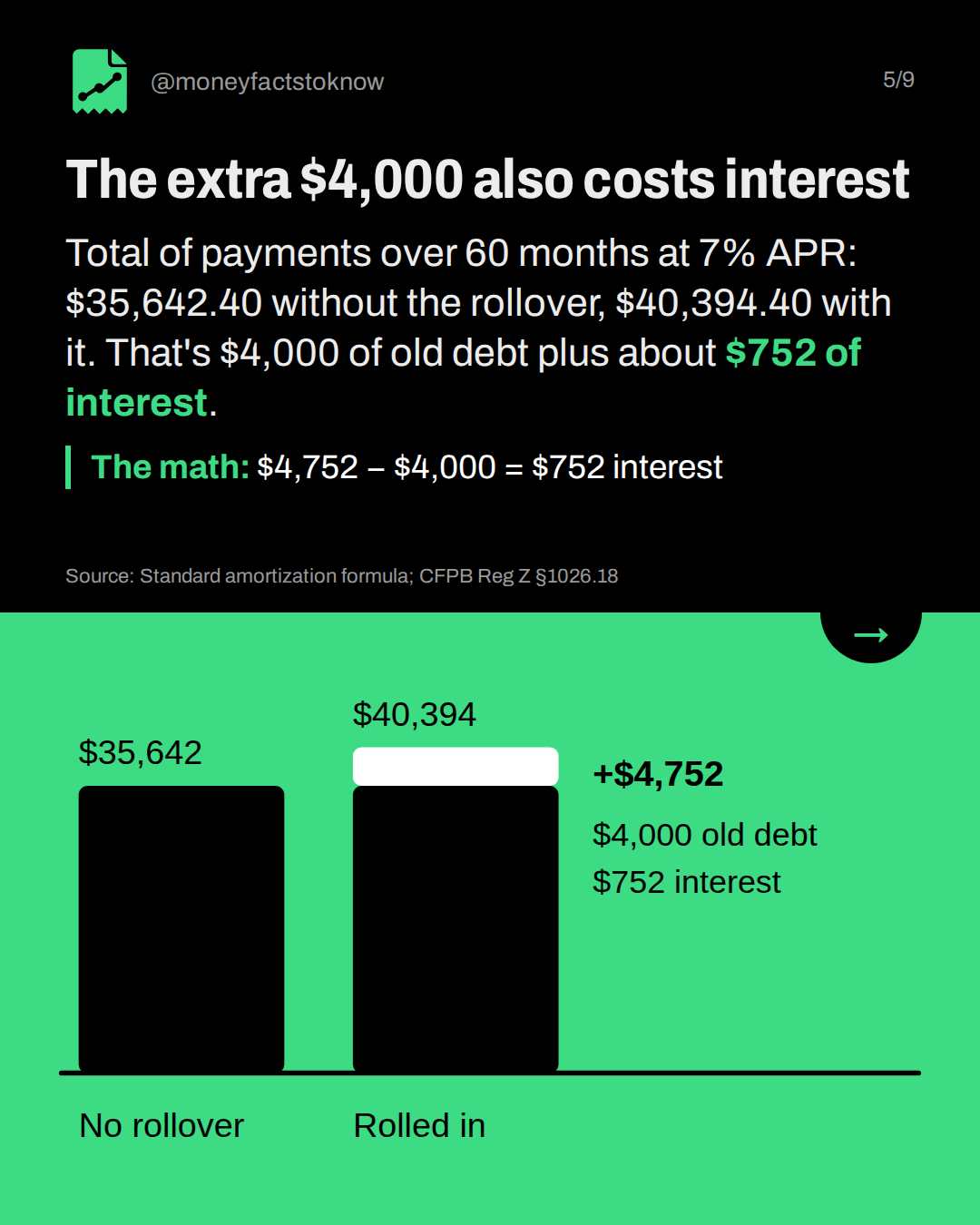
The extra $4,000 also costs interest
Total of payments over 60 months at 7% APR: $35,642.40 without the rollover, $40,394.40 with it. That's $4,000 of old debt plus about $752 of interest.
The math: $4,752 − $4,000 = $752 interest
Source: Standard amortization formula; CFPB Reg Z §1026.18
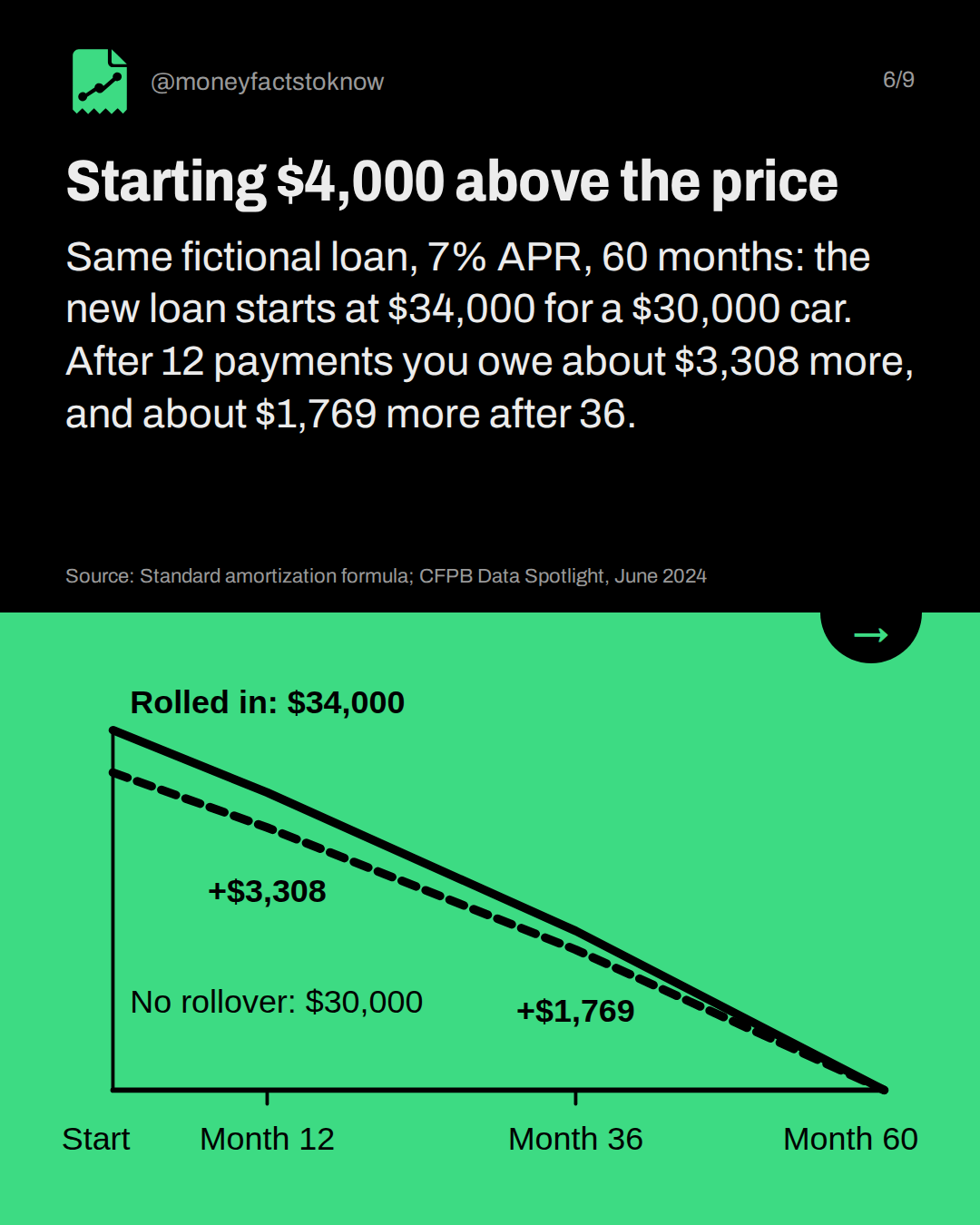
Starting $4,000 above the price
Same fictional loan, 7% APR, 60 months: the new loan starts at $34,000 for a $30,000 car. After 12 payments you owe about $3,308 more, and about $1,769 more after 36.
Source: Standard amortization formula; CFPB Data Spotlight, June 2024
When these numbers change
A different APR, term, down payment, taxes, fees or trade-in offer changes every figure. At the same APR, a longer term lowers the payment but adds interest. Paying the gap in cash means none of it is financed.
Source: Standard amortization formula, fictional example; FTC
What to check before signing
In the federal disclosure box, check Amount Financed, Finance Charge and Total of Payments; elsewhere, check the trade-in payoff and allowance lines. The FTC says promising to pay off your loan, then rolling it in, is illegal.
Source: CFPB Reg Z §1026.18; FTC
Sources and assumptions
- FTC Consumer Advice: Auto Trade-Ins and Negative Equity: When You Owe More than Your Car is Worth: Definition of negative equity (owe more than the car is worth, e.g. worth $15,000, owe $18,000 = $3,000); dealers may add it to the new loan, take it from the down payment, or both; you pay interest on it; read the amount financed and down payment on the installment contract; promising to pay off the loan and then rolling it in is illegal and can be reported to the FTC (checked 2026-10-06)
- CFPB Data Spotlight: Negative Equity Findings from the Auto Finance Data Pilot (June 17, 2024): CFPB definition: the trade-in value offered is less than the outstanding loan balance and the unpaid balance is rolled into the new loan; it can leave consumers further underwater on the next loan (checked 2026-10-06)
- CFPB blog: Servicemembers, arm yourself with basic car buying skills: Be smart when trading in your car (Dec 6, 2018): Dealers may add negative equity to the financing or deduct it from the down payment, which increases total cost and monthly payments; before signing, understand how the negative equity is being treated, the total amount borrowed and the monthly payment (checked 2026-10-06)
- CFPB Regulation Z §1026.18 (closed-end credit disclosures): Required disclosure terms: Amount Financed ('the amount of credit provided to you or on your behalf'), Finance Charge ('the dollar amount the credit will cost you'), Annual Percentage Rate, Total of Payments ('the amount you will have paid when you have made all scheduled payments'), Total Sale Price (checked 2026-10-06)
Assumptions:
- Fictional buyer and fictional numbers throughout; no real dealer, lender or car
- Old car: trade-in offer $15,000, loan payoff $19,000, so $4,000 negative equity
- New car: $30,000 financed with no down payment; sales tax, title, registration, dealer fees and add-ons are left out
- New loan: 7% APR, fixed, 60 monthly payments, standard amortization with monthly rate 7%/12, interest on the full rolled-in amount
- Total of payments = 60 × the payment rounded to the cent; a real contract may adjust the final payment by a few cents
- Balances after 12 and 36 payments come from the same unrounded amortization; no depreciation of the new car is modeled
The short version
- Trade-in debt can move to the new loan
- Fictional $4,000 added about $79 a month
- It also added about $752 in interest
- The loan started $4,000 above the price
- Check Amount Financed and Total of Payments