 Money Facts To Know
Same $10,000 pre-tax 401(k) rollover. One way gets $2,000 withheld.


Leaving a job has four paths
Leaving a job doesn't mean the money has to come out, and not every rollover works the same way. There are four paths, and how the money moves matters.
Source: FINRA, 401(k) Rollovers
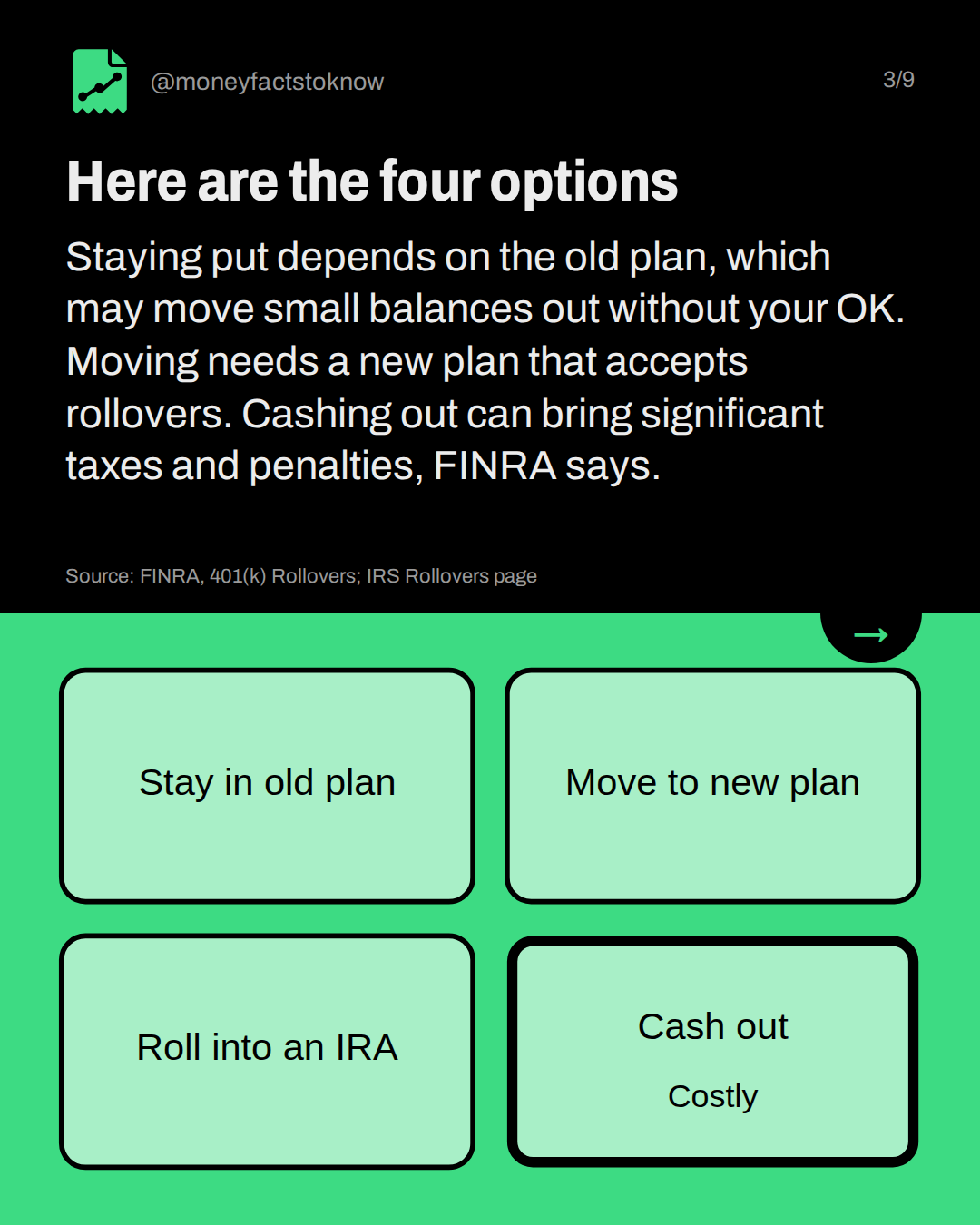
Here are the four options
Staying put depends on the old plan, which may move small balances out without your OK. Moving needs a new plan that accepts rollovers. Cashing out can bring significant taxes and penalties, FINRA says.
Source: FINRA, 401(k) Rollovers; IRS Rollovers page
How the money moves changes what arrives
A direct rollover sends the money straight to the new plan or IRA, with nothing withheld. A check made out to you generally has 20% of the taxable amount withheld, even if you'll roll it over.
Source: IRS Topic No. 413, as of 2026
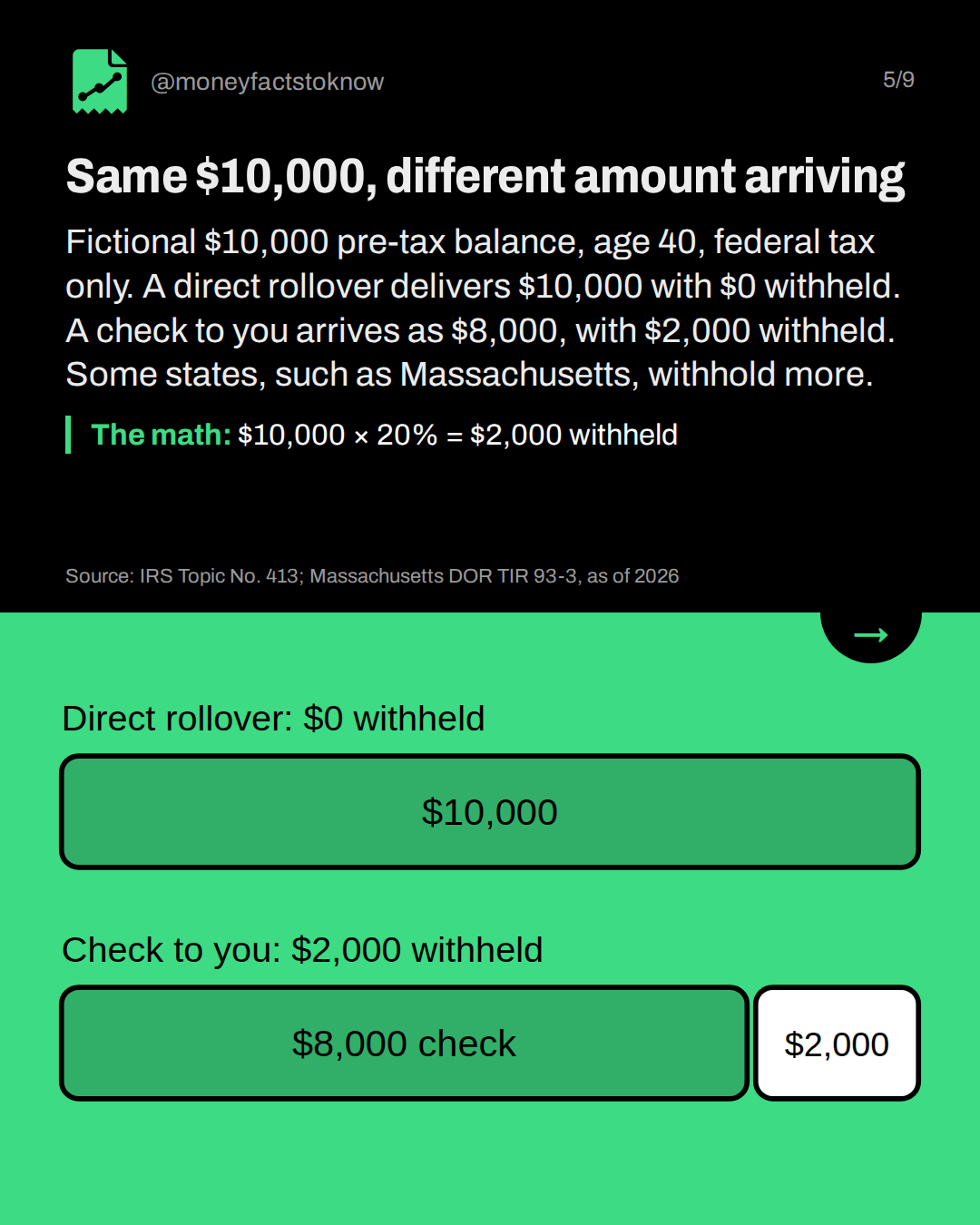
Same $10,000, different amount arriving
Fictional $10,000 pre-tax balance, age 40, federal tax only. A direct rollover delivers $10,000 with $0 withheld. A check to you arrives as $8,000, with $2,000 withheld. Some states, such as Massachusetts, withhold more.
The math: $10,000 × 20% = $2,000 withheld
Source: IRS Topic No. 413; Massachusetts DOR TIR 93-3, as of 2026
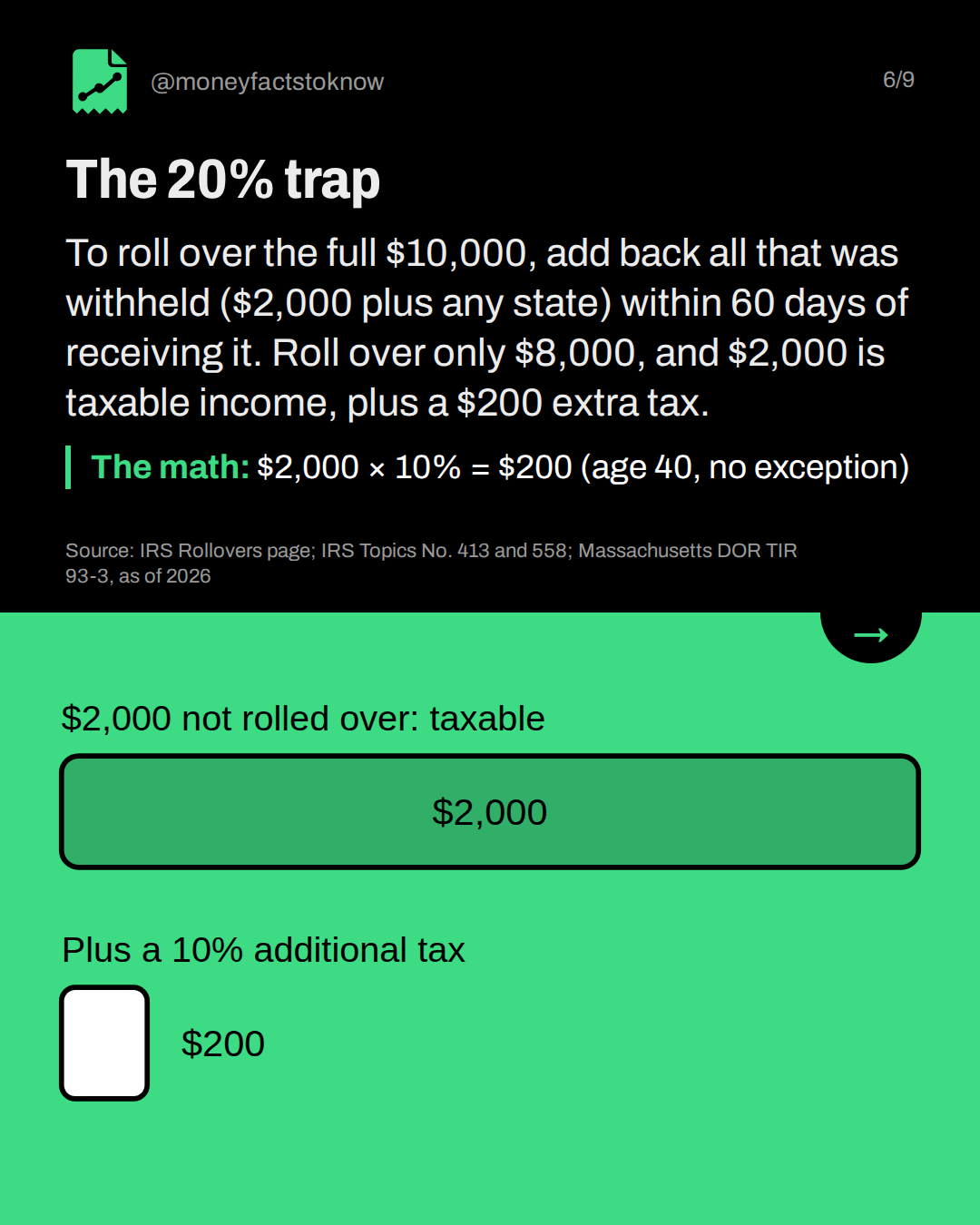
The 20% trap
To roll over the full $10,000, add back all that was withheld ($2,000 plus any state) within 60 days of receiving it. Roll over only $8,000, and $2,000 is taxable income, plus a $200 extra tax.
The math: $2,000 × 10% = $200 (age 40, no exception)
Source: IRS Rollovers page; IRS Topics No. 413 and 558; Massachusetts DOR TIR 93-3, as of 2026
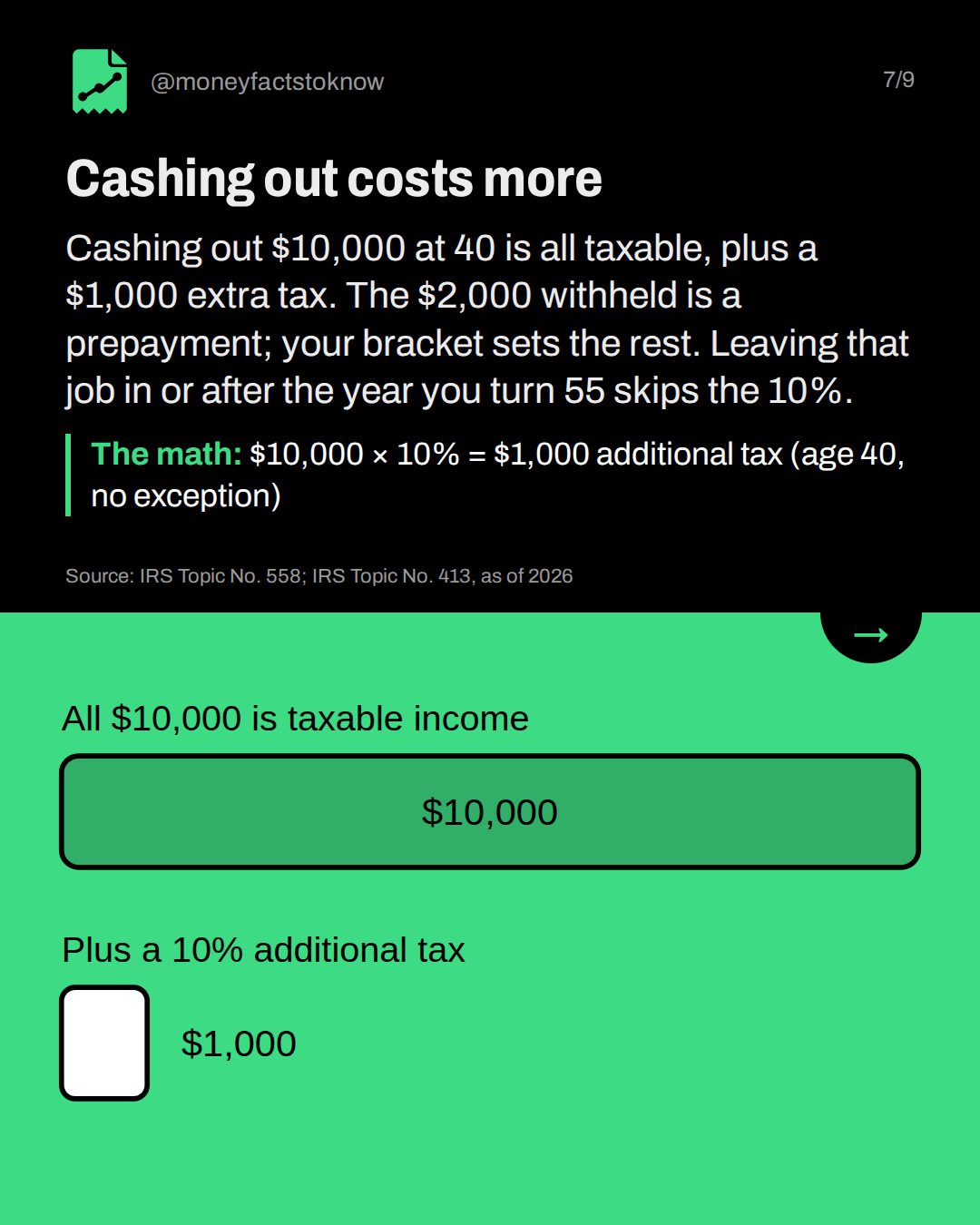
Cashing out costs more
Cashing out $10,000 at 40 is all taxable, plus a $1,000 extra tax. The $2,000 withheld is a prepayment; your bracket sets the rest. Leaving that job in or after the year you turn 55 skips the 10%.
The math: $10,000 × 10% = $1,000 additional tax (age 40, no exception)
Source: IRS Topic No. 558; IRS Topic No. 413, as of 2026
What to check on the form
Find the direct rollover box. Check whether the new plan accepts rollovers and the old plan lets you stay. If a check arrives, note the 60-day date; the IRS can waive a miss only in certain situations.
Source: IRS Topic No. 413, as of 2026
Sources and assumptions
- FINRA, 401(k) Rollovers: Four options when changing jobs: leave money in the current employer's plan; roll to the new employer's plan if it accepts transfers; roll into an existing or new IRA; take the cash value. Cashing out 'is costly, potentially involving significant taxes and early withdrawal penalties.' (checked 2026-10-05)
- IRS Topic No. 413, Rollovers from retirement plans: Direct rollover (the payer transfers directly to another plan or IRA); taxable eligible rollover distributions paid to you have mandatory withholding, generally 20%; 60 days from receipt to roll over; you must add other funds equal to the amount withheld to defer tax on the whole amount; self-certified waiver of the 60-day limit (Rev. Procs. 2020-46 and 2016-47); the taxable portion not rolled over may face the 10% additional tax if you're under 59½. Last reviewed 24-Sep-2026. (checked 2026-10-05)
- IRS, Rollovers of retirement plan and IRA distributions: A distribution paid to you has mandatory 20% withholding even if you intend to roll it over; you must use other funds to make up the withheld amount; amounts not rolled over are taxable and may face the 10% additional tax; the IRS may waive the 60-day requirement in certain situations; a plan may move small balances into an IRA if you don't elect. Worked example: a $10,000 distribution with $2,000 withheld. Rolling over only $8,000 means reporting $2,000 as taxable income and $2,000 as taxes paid, plus the 10% additional tax. Rolling over the full $10,000 with other funds means $10,000 nontaxable and $2,000 as taxes paid. Last reviewed 31-May-2026. (checked 2026-10-05)
- IRS Topic No. 558, Additional tax on early distributions from retirement plans other than IRAs: 10% additional tax on the includible portion of distributions before age 59½; exception for distributions after separation from service in or after the year you reach age 55. Last reviewed 24-Sep-2026. (checked 2026-10-05)
- Massachusetts DOR TIR 93-3, Massachusetts Income Tax Withholding on Eligible Rollover Distributions from I.R.C. § 401 Qualified Plans and § 403(b) Annuities: "Eligible rollover distributions subject to federal 20% withholding are also subject to Massachusetts personal income tax withholding, unless such eligible rollover distributions would never be subject to Massachusetts personal income taxation independent of the facts and circumstances of a taxpayer's particular tax situation." Direct trustee-to-trustee transfers are not subject to the 20% withholding. Issued March 9, 1993. Quoted from mass.gov's indexed text because a direct fetch returned HTTP 403. (checked 2026-10-05)
Assumptions:
- Fictional worker, age 40 (under 59½ and under 55, so no age exception applies), leaving a job in 2026
- Fictional $10,000 balance, all pre-tax (traditional) 401(k) money; no Roth 401(k) or after-tax amounts
- The dollar math is federal only. Some states (for example Massachusetts, DOR TIR 93-3) also withhold on eligible rollover distributions paid to you. That makes the check smaller than $8,000, and the amount you need to add back to roll over the full $10,000 bigger. State income tax is not computed
- The distribution is an eligible rollover distribution, so 20% mandatory withholding applies
- Ordinary income tax on a cash-out depends on the person's bracket and is not computed; only the withholding and the 10% additional tax are shown in dollars
- No exception to the 10% additional tax applies
The short version
- Four paths, and two depend on plan rules
- A direct rollover has nothing withheld
- A check to you generally has 20% withheld
- Add back what was withheld within 60 days