 Money Facts To Know
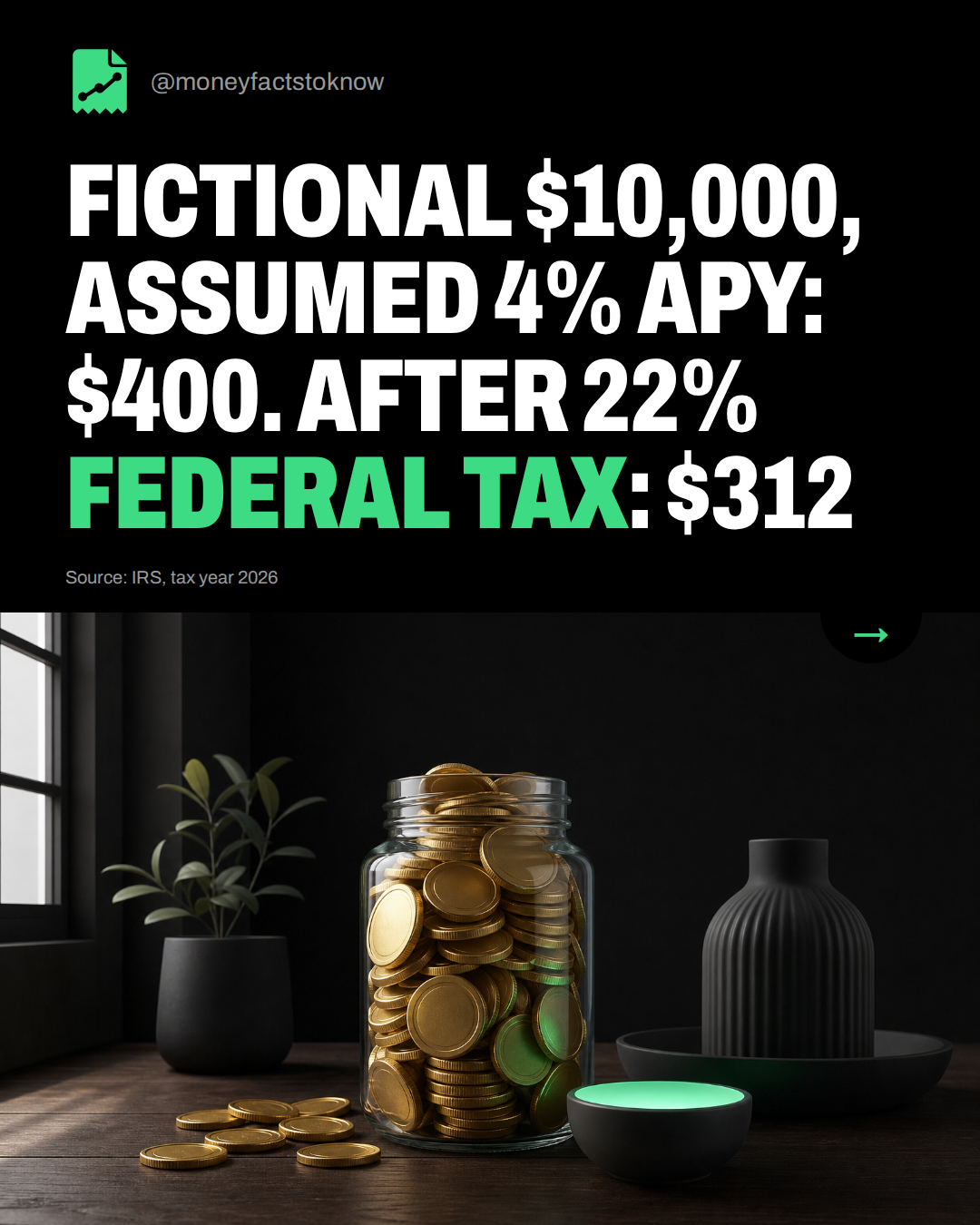
Fictional $10,000, assumed 4% APY: $400. After 22% federal tax: $312

The APY isn't what you keep
Many savers treat the APY as what they earn. The IRS treats savings interest as ordinary income, so part of it can go to federal tax.
Source: IRS Topic 403
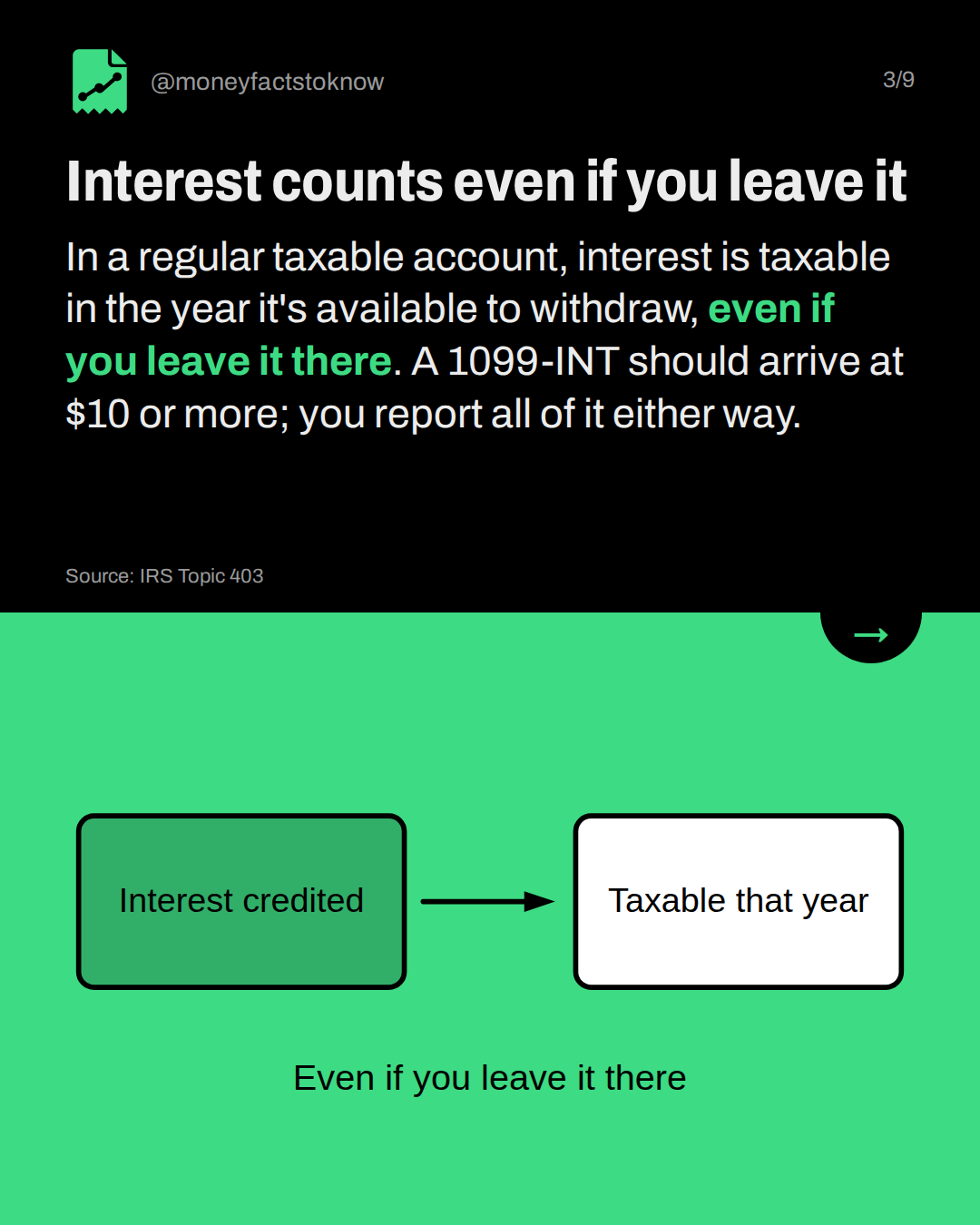
Interest counts even if you leave it
In a regular taxable account, interest is taxable in the year it's available to withdraw, even if you leave it there. A 1099-INT should arrive at $10 or more; you report all of it either way.
Source: IRS Topic 403
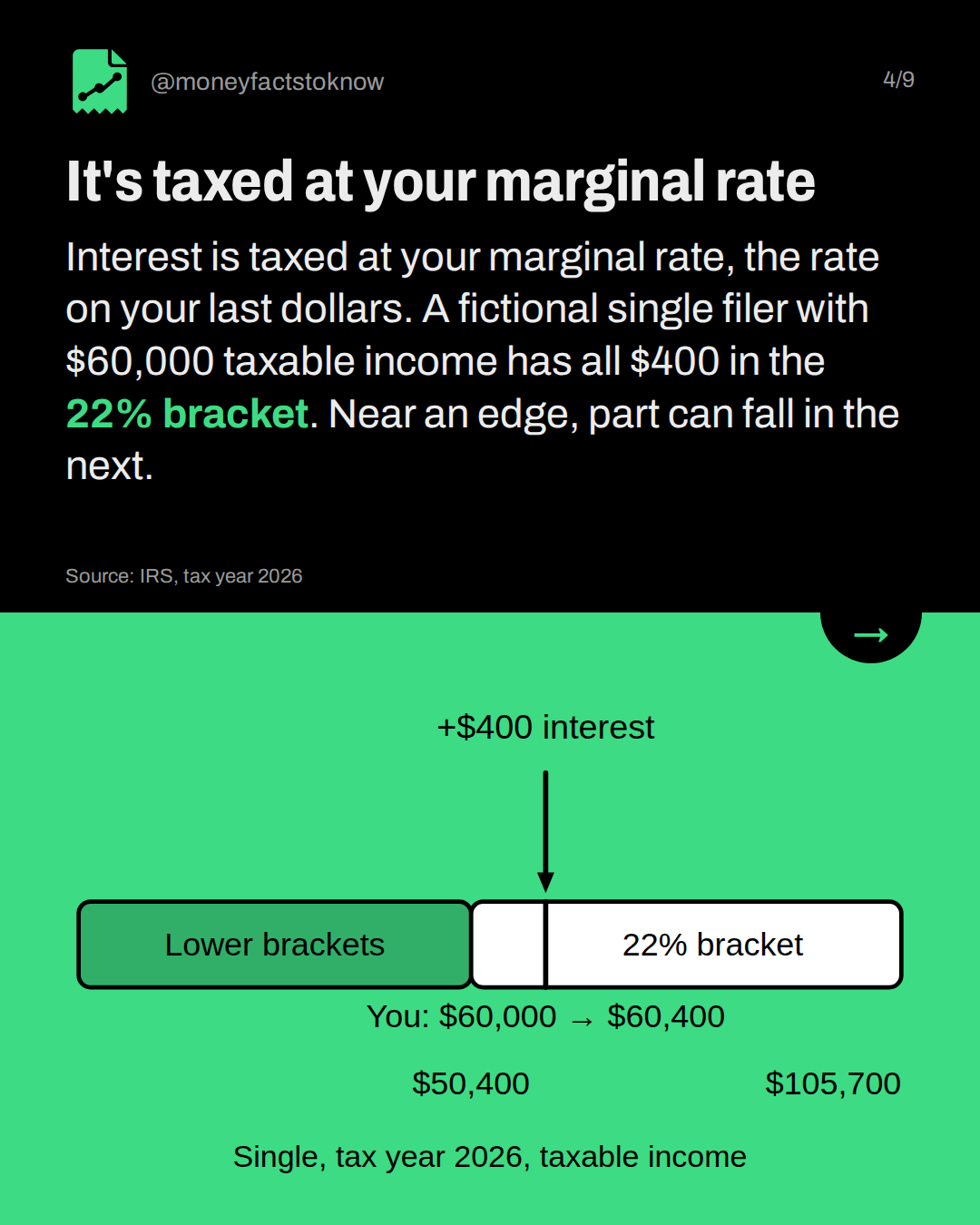
It's taxed at your marginal rate
Interest is taxed at your marginal rate, the rate on your last dollars. A fictional single filer with $60,000 taxable income has all $400 in the 22% bracket. Near an edge, part can fall in the next.
Source: IRS, tax year 2026
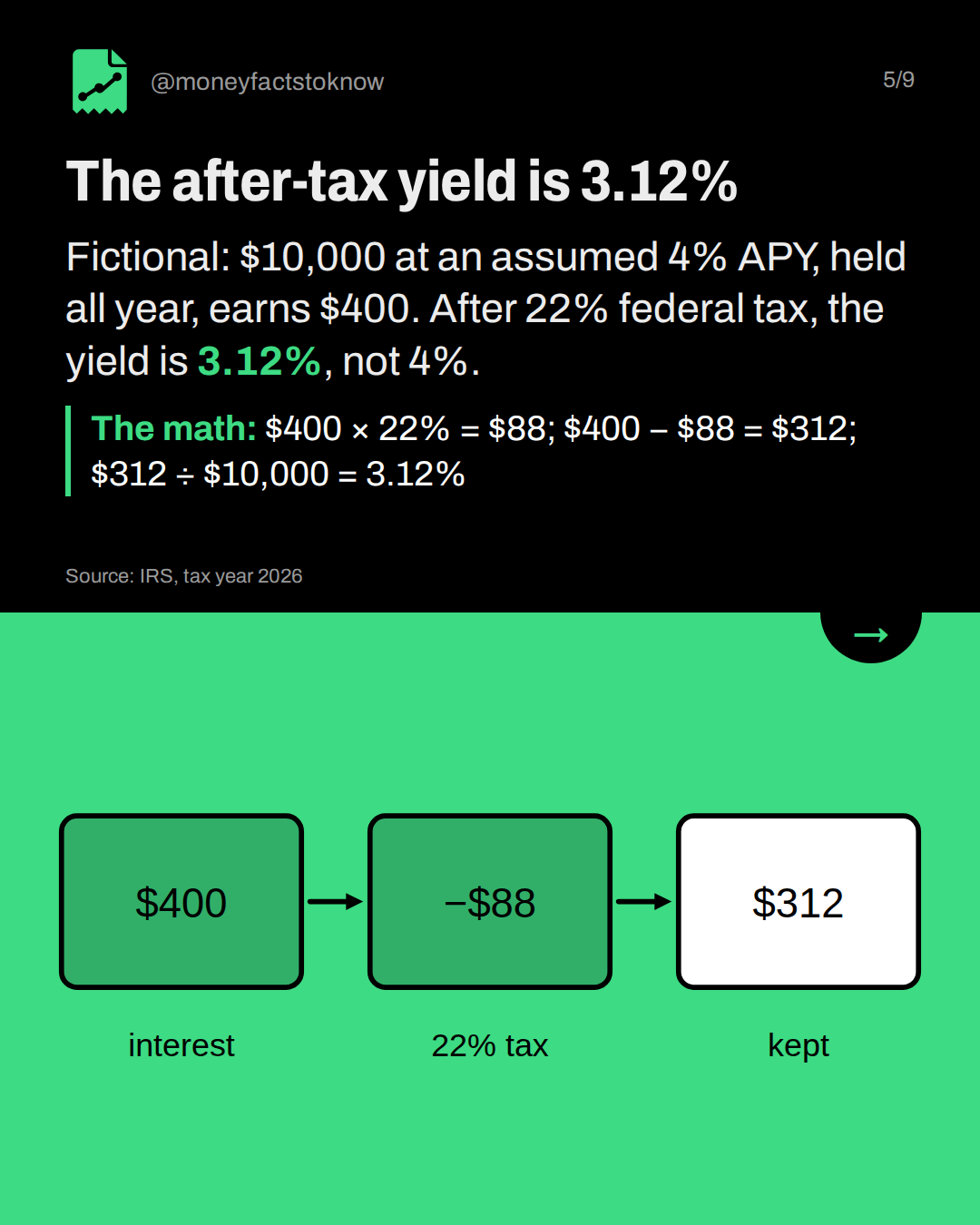
The after-tax yield is 3.12%
Fictional: $10,000 at an assumed 4% APY, held all year, earns $400. After 22% federal tax, the yield is 3.12%, not 4%.
The math: $400 × 22% = $88; $400 − $88 = $312; $312 ÷ $10,000 = 3.12%
Source: IRS, tax year 2026
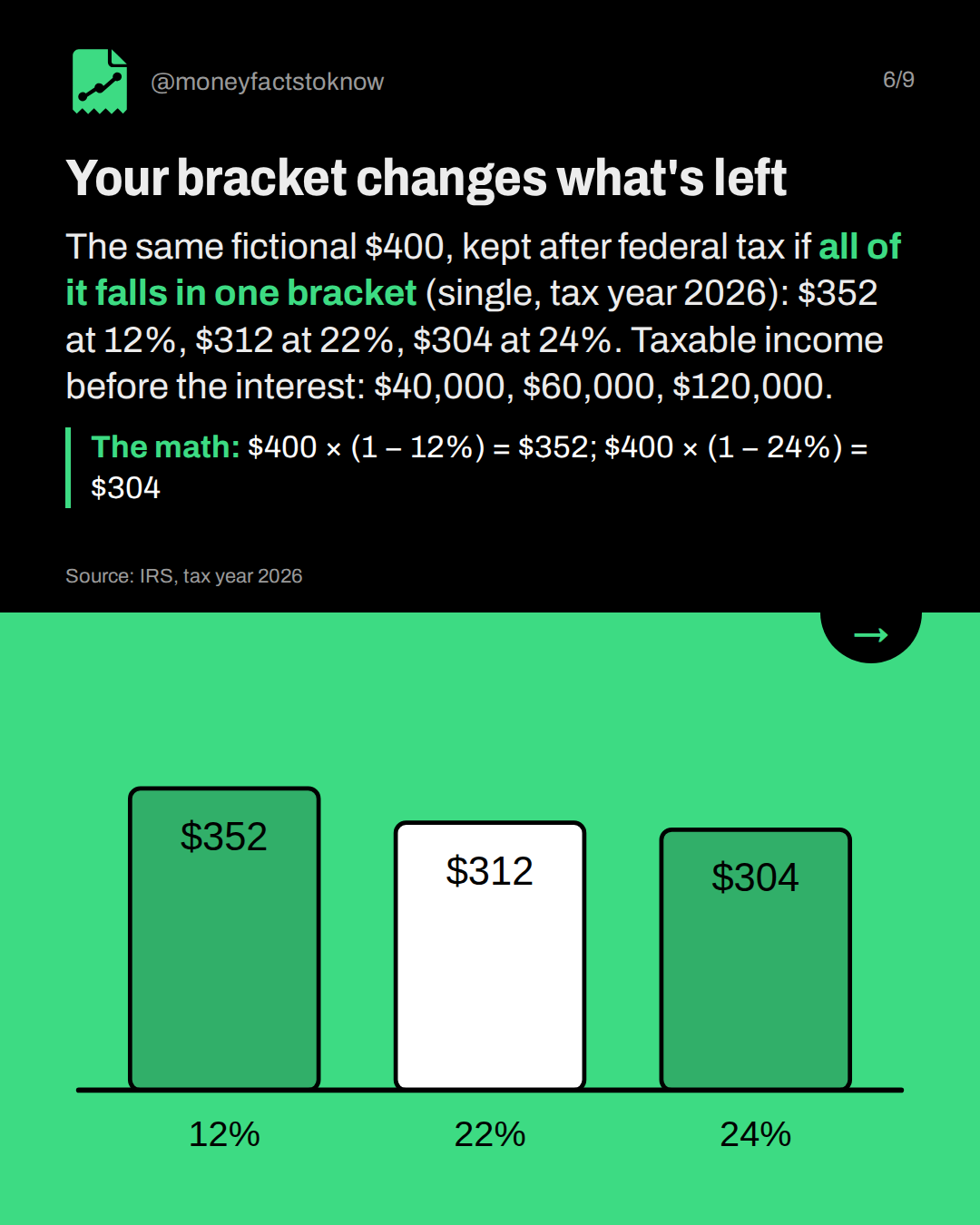
Your bracket changes what's left
The same fictional $400, kept after federal tax if all of it falls in one bracket (single, tax year 2026): $352 at 12%, $312 at 22%, $304 at 24%. Taxable income before the interest: $40,000, $60,000, $120,000.
The math: $400 × (1 − 12%) = $352; $400 × (1 − 24%) = $304
Source: IRS, tax year 2026
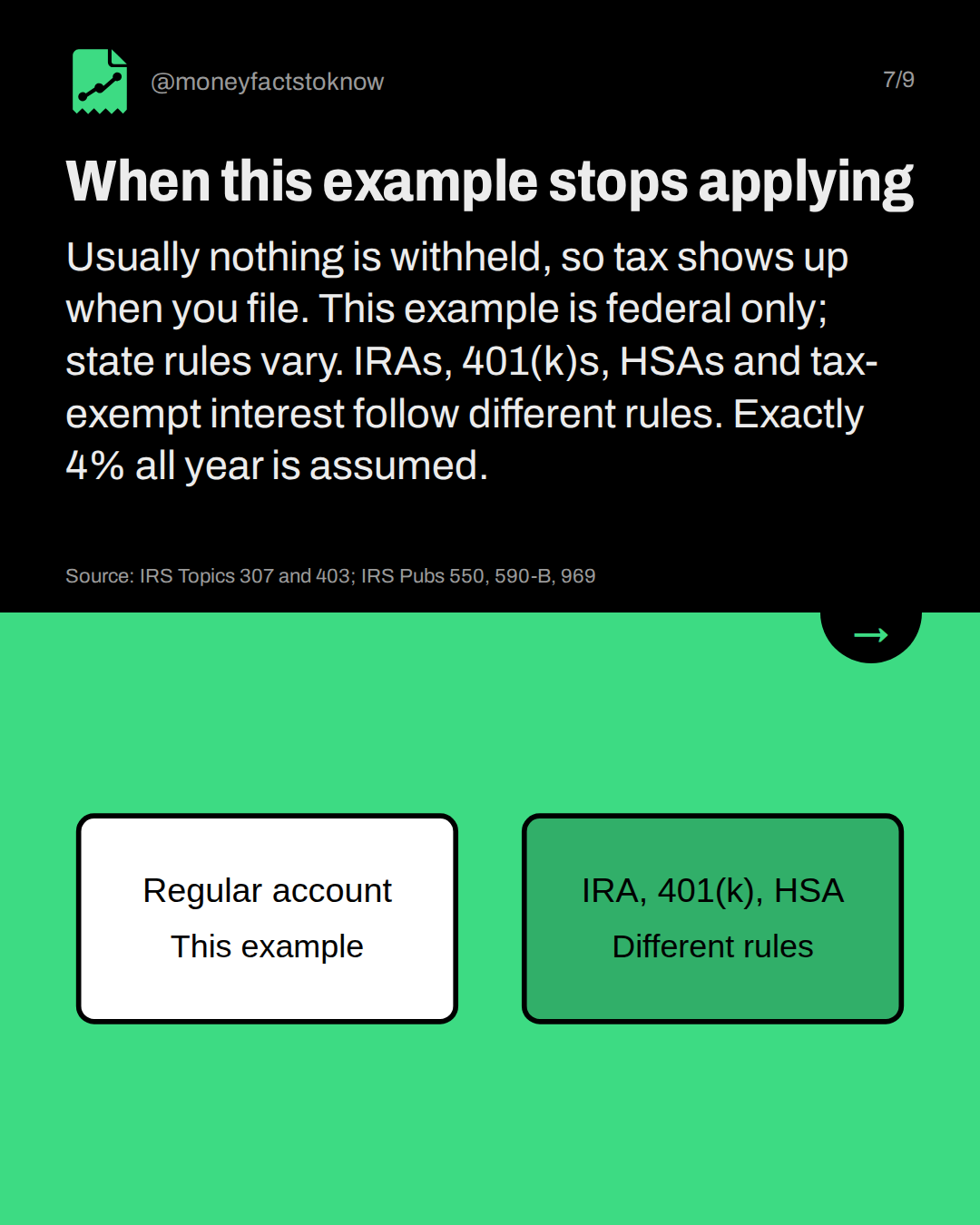
When this example stops applying
Usually nothing is withheld, so tax shows up when you file. This example is federal only; state rules vary. IRAs, 401(k)s, HSAs and tax-exempt interest follow different rules. Exactly 4% all year is assumed.
Source: IRS Topics 307 and 403; IRS Pubs 550, 590-B, 969
What to check before you compare
Check your 1099-INT, bracket and state. To estimate the yield after federal tax when all interest falls in one bracket, multiply the APY by (1 − your federal marginal rate). Any state tax lowers it further.
Source: IRS, tax year 2026 (Rev. Proc. 2025-32); IRS Topic 403
Sources and assumptions
- IRS Topic No. 403, Interest received: Interest credited to an account you can withdraw from without penalty is taxable income in the year it becomes available; 1099-INT is issued for interest of $10 or more; all taxable interest must be reported even without a 1099-INT (page last reviewed 24-Sep-2026) (checked 2026-10-06)
- IRS newsroom: tax year 2026 inflation adjustments, including amendments from the One Big Beautiful Bill (Rev. Proc. 2025-32): Tax year 2026 single brackets: 10% up to $12,400; 12% over $12,400; 22% over $50,400; 24% over $105,700; 32% over $201,775; 35% over $256,225; 37% over $640,600. MFJ 22% over $100,800, 24% over $211,400. Standard deduction $16,100 single, $32,200 MFJ (checked 2026-10-06)
- IRS Topic No. 307, Backup withholding: Interest and dividend income is normally not subject to withholding; backup withholding at a flat 24% applies only in specific cases (e.g., missing or incorrect TIN, IRS notice for underreporting) (checked 2026-10-06)
- CFPB Regulation DD (Truth in Savings), 12 CFR 1030.2: APY definition: the total interest paid based on the interest rate and the compounding frequency over 365 days; a variable-rate account's rate may change after the account is opened (checked 2026-10-06)
- IRS Publication 550, Investment Income and Expenses: "The rules in this publication do not apply to investments held in individual retirement arrangements (IRAs), section 401(k) plans, and other qualified retirement plans." (checked 2026-10-06)
- IRS Publication 590-B, Distributions from Individual Retirement Arrangements (IRAs): "Generally, amounts in your IRA (including earnings and gains) aren't taxed until distributed." (checked 2026-10-06)
- IRS Publication 969, Health Savings Accounts and Other Tax-Favored Health Plans: "Earnings on amounts in an HSA aren't included in your income while held in the HSA." / "The interest or other earnings on the assets in the account are tax free." (checked 2026-10-06)
- IRS Topic No. 559, Net investment income tax: "A 3.8 percent net investment income tax (NIIT) applies to individuals, estates, and trusts that have net investment income above applicable threshold amounts." Net investment income includes "interest, dividends, certain annuities, royalties, and rents". Thresholds: $250,000 MFJ or qualifying surviving spouse, $125,000 MFS, $200,000 single or head of household (checked 2026-10-06)
Assumptions:
- Fictional saver; the $10,000 balance and 4% APY are assumed, not a real product
- The balance stays at $10,000 for the full 365 days and the rate does not change (savings rates are usually variable), so interest = $10,000 × 4% = $400
- Fictional single filer, tax year 2026, $60,000 of taxable income (after deductions) before the interest; $60,400 with it stays inside the 22% bracket ($50,400–$105,700), so all $400 is taxed at 22%
- The 12% comparison assumes $40,000 of taxable income ($40,400 with interest, inside $12,400–$50,400); the 24% case assumes income inside the 24% bracket
- Federal income tax only; state and local income tax are excluded
- No backup withholding; the account is a regular taxable account (not an IRA/HSA)
The short version
- Savings interest in a regular account is taxable income.
- It counts in the year it's credited.
- Your marginal bracket sets the tax.
- Fictional $400 at 22% leaves $312.