 Money Facts To Know
In this example, splitting $10,000 changes the odds, not the average.


What diversifying doesn't promise
Many people hear that diversifying means you can't lose. The SEC says diversification can't guarantee that your investments won't suffer if the market drops.
Source: SEC, Roadmap to Saving and Investing
A fictional $10,000 for one year
Take $10,000 for one year, with no fees or taxes. Investments A and B each either gain 20% or lose 10%, at 50/50 odds, and move independently. All numbers are assumed. Nominal dollars, inflation ignored.
Source: Assumed numbers, fictional example
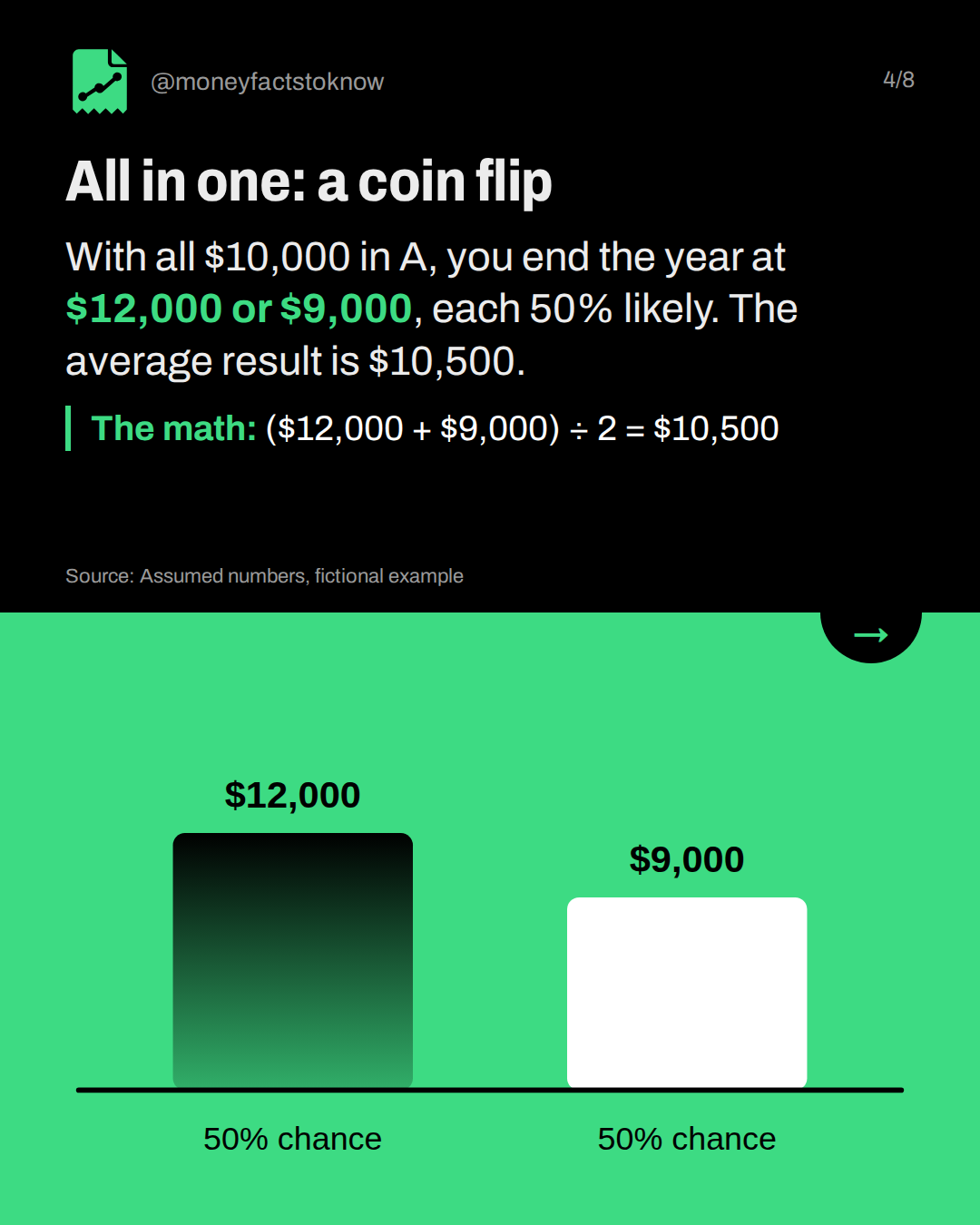
All in one: a coin flip
With all $10,000 in A, you end the year at $12,000 or $9,000, each 50% likely. The average result is $10,500.
The math: ($12,000 + $9,000) ÷ 2 = $10,500
Source: Assumed numbers, fictional example
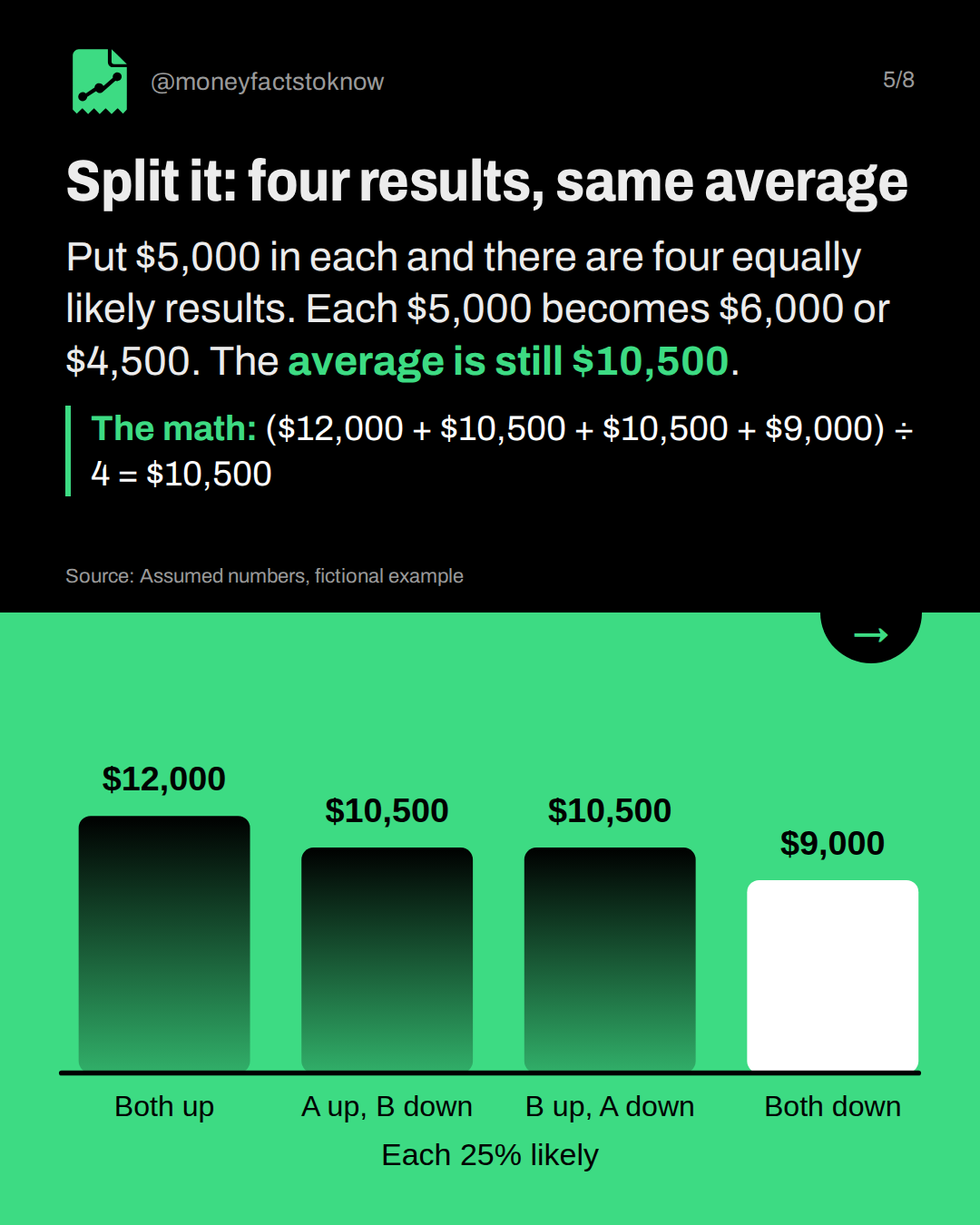
Split it: four results, same average
Put $5,000 in each and there are four equally likely results. Each $5,000 becomes $6,000 or $4,500. The average is still $10,500.
The math: ($12,000 + $10,500 + $10,500 + $9,000) ÷ 4 = $10,500
Source: Assumed numbers, fictional example
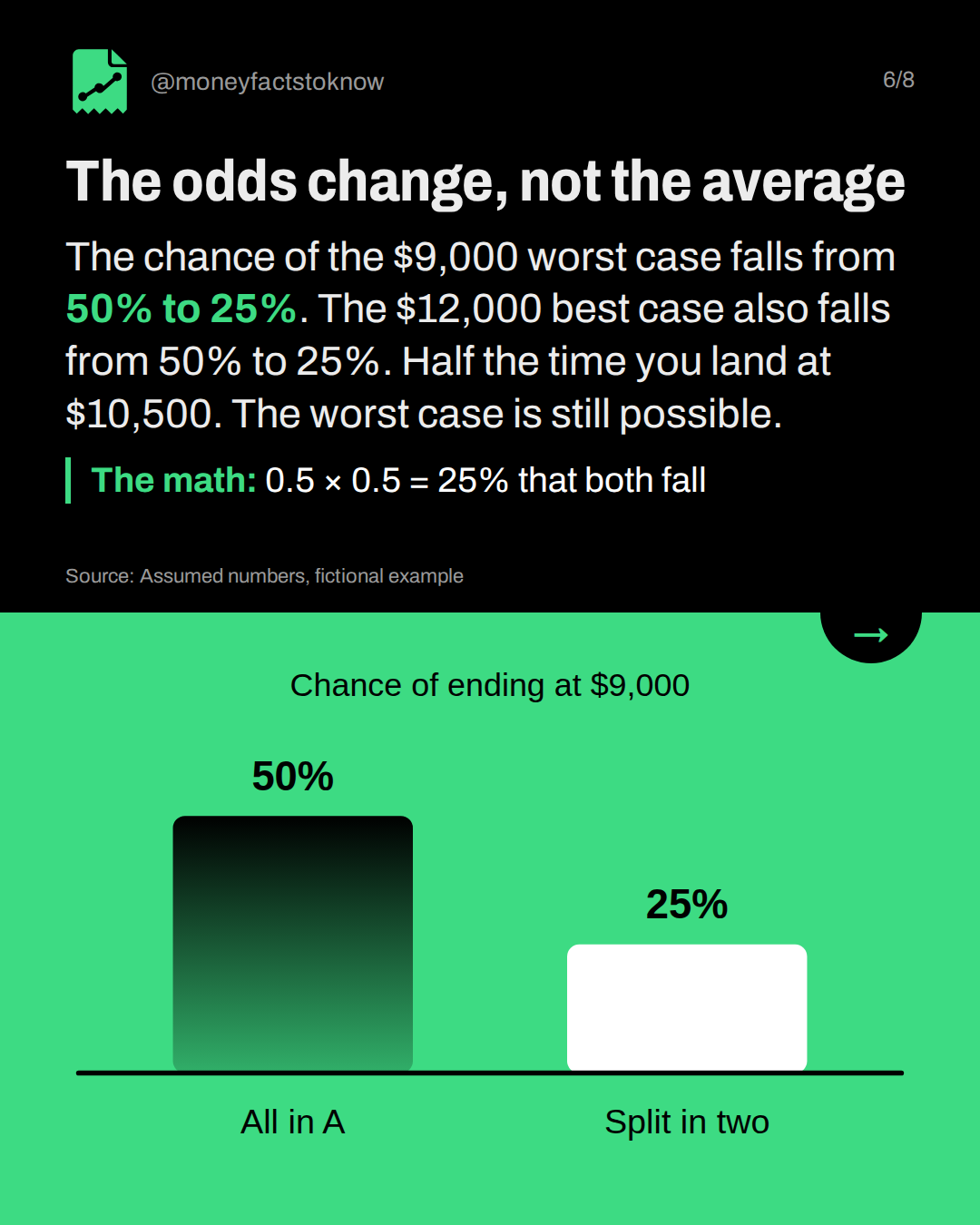
The odds change, not the average
The chance of the $9,000 worst case falls from 50% to 25%. The $12,000 best case also falls from 50% to 25%. Half the time you land at $10,500. The worst case is still possible.
The math: 0.5 × 0.5 = 25% that both fall
Source: Assumed numbers, fictional example
When splitting stops helping
If A and B move together, the split is the same $12,000-or-$9,000 flip. The SEC says mixing investments that move differently can protect against significant losses. If one returns less, the average changes.
The math: Ask: do these holdings tend to move together?
Source: SEC, Beginners' Guide to Asset Allocation; assumed numbers, fictional example
Sources and assumptions
- SEC, Roadmap to Saving and Investing: Risk and diversification: 'Diversification can't guarantee that your investments won't suffer if the market drops. But it can improve the chances that you won't lose money, or that if you do, it won't be as much as if you weren't diversified.' Also: spreading money so that if one investment loses, others may make up for it. (checked 2026-10-04)
- SEC, Beginners' Guide to Asset Allocation, Diversification, and Rebalancing: Definition: 'The practice of spreading money among different investments to reduce risk is known as diversification.' Also: 'limit your losses and reduce the fluctuations of investment returns'. (checked 2026-10-04)
- FINRA, Asset Allocation and Diversification: Diversification reduces the risk of major losses from over-emphasizing one security or asset class, especially when assets are 'uncorrelated', meaning they react to events independently of each other. (checked 2026-10-04)
Assumptions:
- Fictional example: $10,000 invested for one year, no fees, taxes, or additional contributions
- Two fictional investments, A and B: each either gains 20% or loses 10% in the year, each with a 50% chance (assumed returns, not historical)
- A and B move independently (uncorrelated), so the four combined results are equally likely at 25% each
- The split case is exactly $5,000 in each
- Nominal dollars only; inflation is not considered
- Standard deviation is the population SD across equally likely outcomes
The short version
- In the fictional example: same $10,000, same $10,500 average.
- Worst-case odds: 50% down to 25%.
- The worst case is still possible.
- Holdings that move together add little.