 Money Facts To Know
Fictional card: a $500 cash advance costs about $37–$38 in 30 days
Why purchases feel free
Purchases usually get a grace period: if you paid last month's balance in full and pay this one in full by the due date, you pay no purchase interest.
Source: CFPB
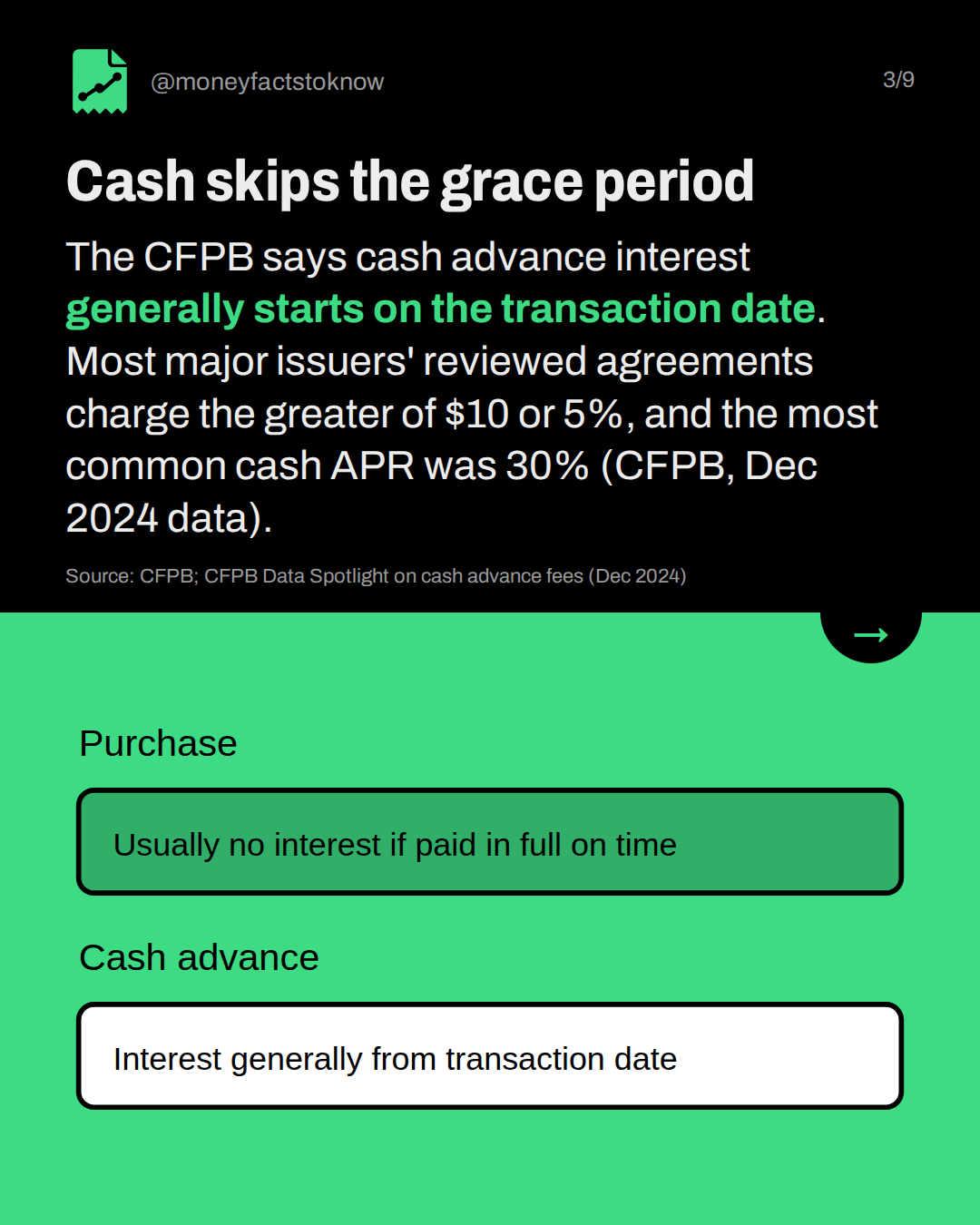
Cash skips the grace period
The CFPB says cash advance interest generally starts on the transaction date. Most major issuers' reviewed agreements charge the greater of $10 or 5%, and the most common cash APR was 30% (CFPB, Dec 2024 data).
Source: CFPB; CFPB Data Spotlight on cash advance fees (Dec 2024)
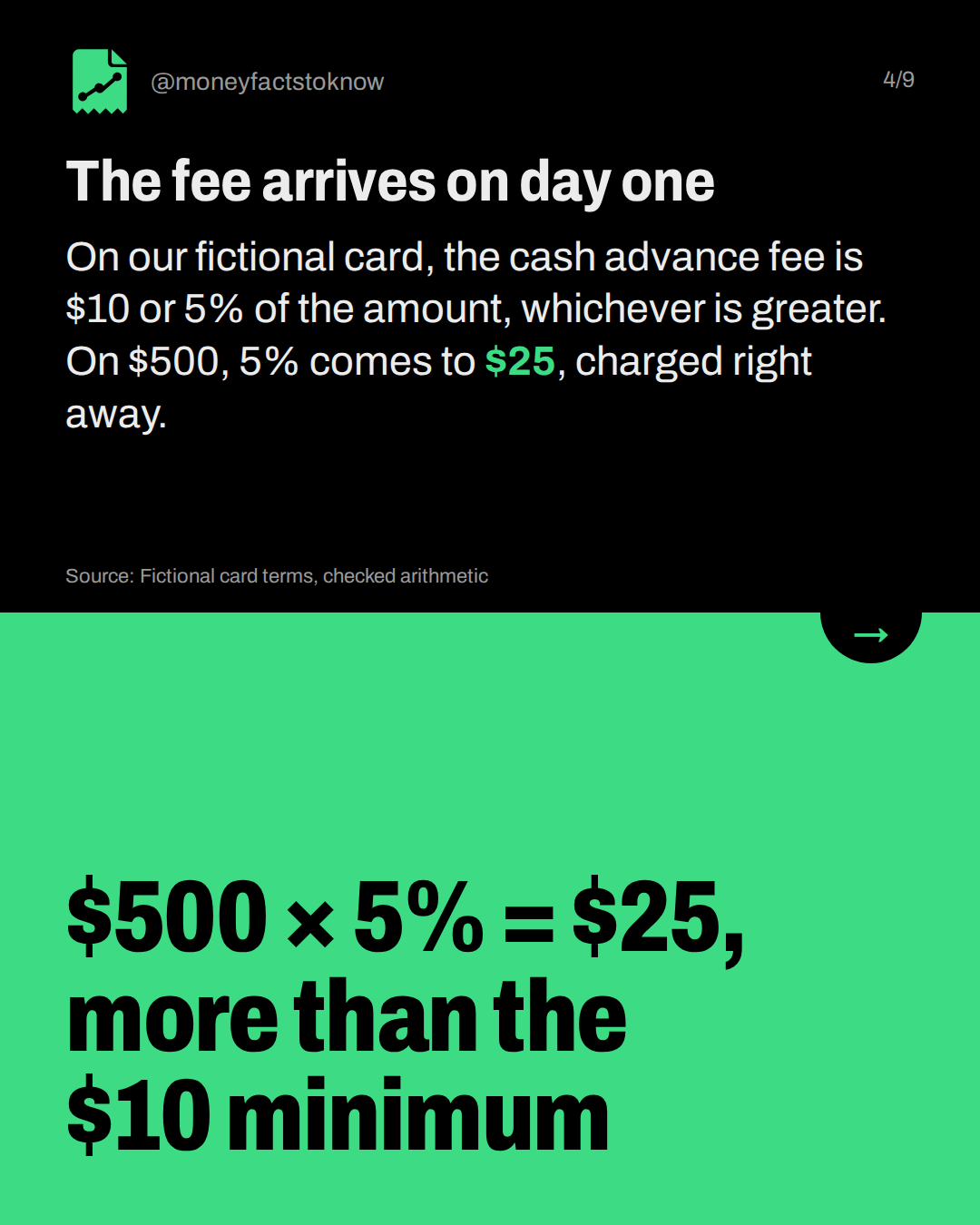
The fee arrives on day one
On our fictional card, the cash advance fee is $10 or 5% of the amount, whichever is greater. On $500, 5% comes to $25, charged right away.
The math: $500 × 5% = $25, more than the $10 minimum
Source: Fictional card terms, checked arithmetic
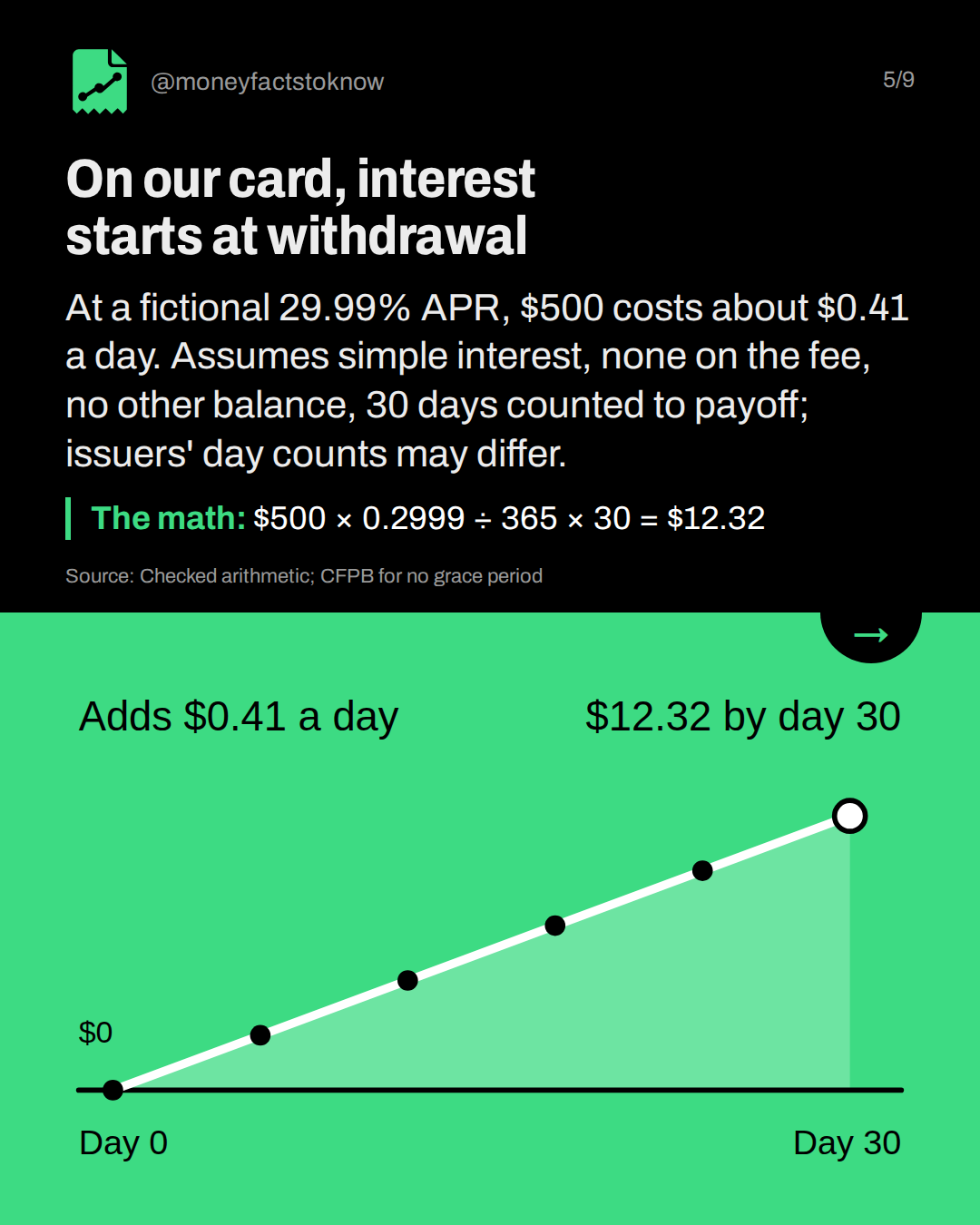
On our card, interest starts at withdrawal
At a fictional 29.99% APR, $500 costs about $0.41 a day. Assumes simple interest, none on the fee, no other balance, 30 days counted to payoff; issuers' day counts may differ.
The math: $500 × 0.2999 ÷ 365 × 30 = $12.32
Source: Checked arithmetic; CFPB for no grace period
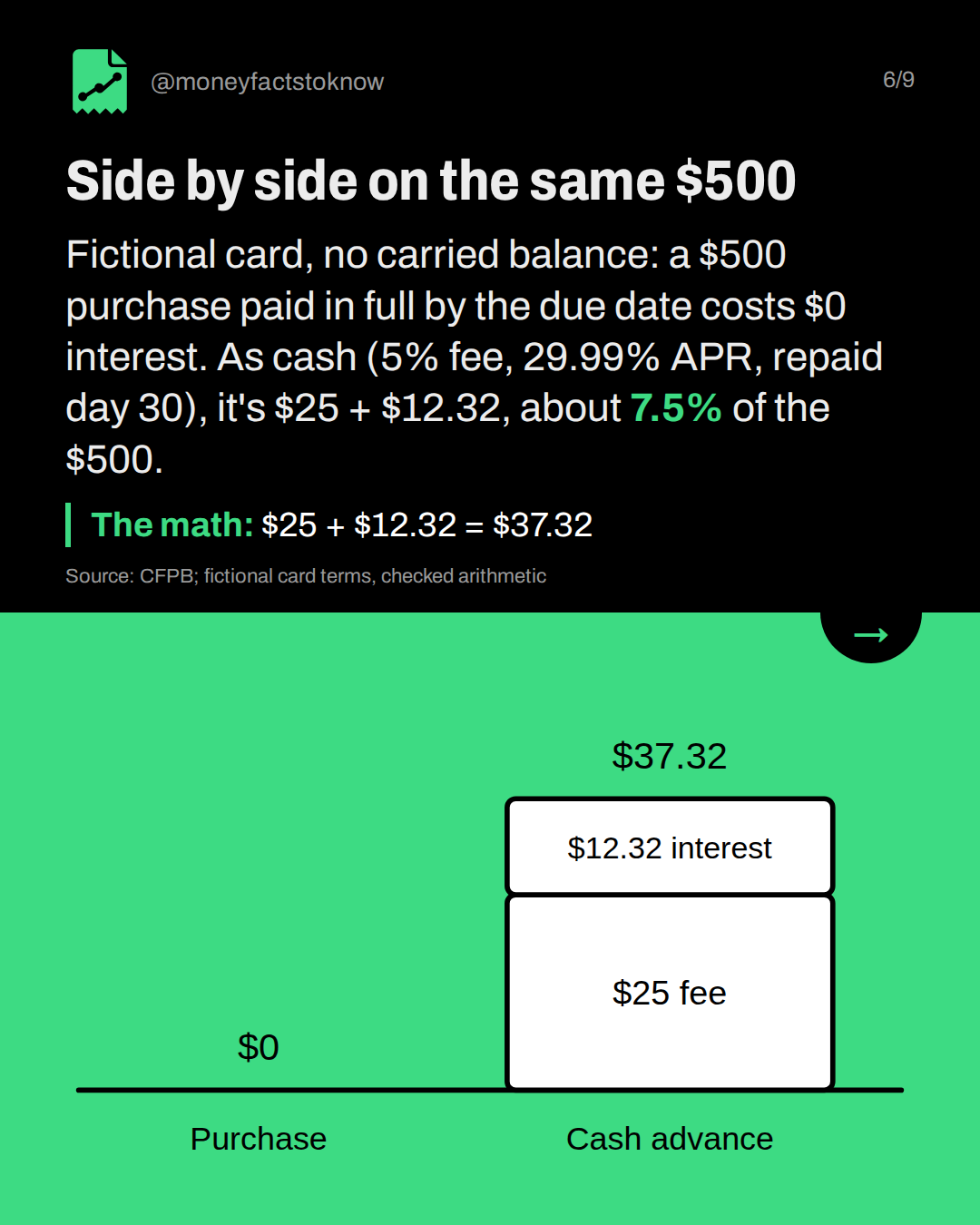
Side by side on the same $500
Fictional card, no carried balance: a $500 purchase paid in full by the due date costs $0 interest. As cash (5% fee, 29.99% APR, repaid day 30), it's $25 + $12.32, about 7.5% of the $500.
The math: $25 + $12.32 = $37.32
Source: CFPB; fictional card terms, checked arithmetic
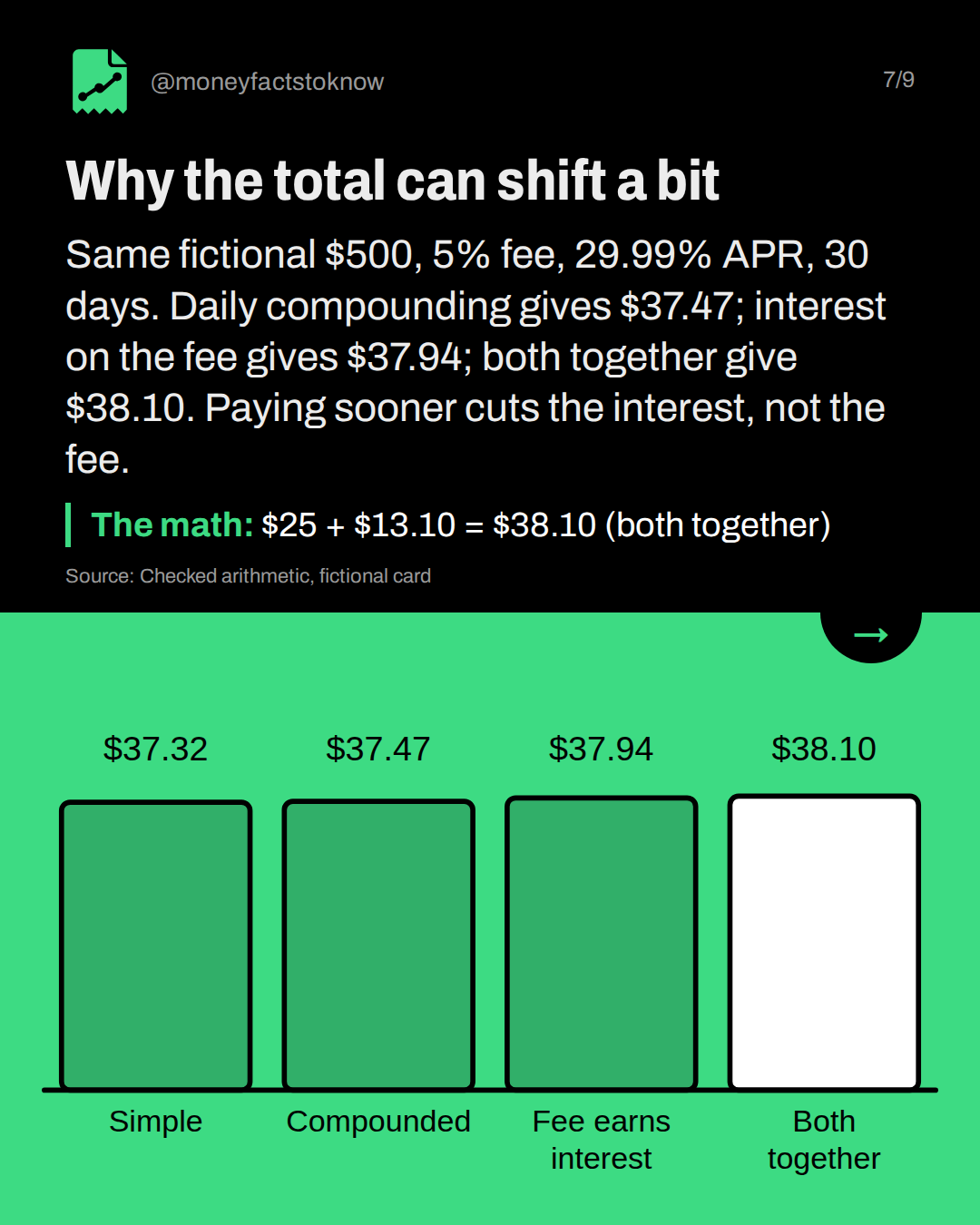
Why the total can shift a bit
Same fictional $500, 5% fee, 29.99% APR, 30 days. Daily compounding gives $37.47; interest on the fee gives $37.94; both together give $38.10. Paying sooner cuts the interest, not the fee.
The math: $25 + $13.10 = $38.10 (both together)
Source: Checked arithmetic, fictional card
Two lines to find first
Find the APR for Cash Advances and the cash advance fee in your card's rates and fees table, your cardholder agreement, or your statement. The grace period listed there is for purchases; cash advances generally accrue interest from the transaction date.
Source: CFPB, Reg Z §1026.60; CFPB Ask CFPB grace period; CFPB Credit Card Agreement Database
Sources and assumptions
- CFPB, Ask CFPB: What is a grace period for a credit card?: The grace period is the time between the end of the billing cycle and the payment due date, with no interest if the full balance is paid by the due date. For a cash advance, 'generally you must start paying interest as of the date of the transaction.' (checked 2026-10-03)
- Capital One, What Is a Cash Advance on a Credit Card?: The cash advance fee 'typically ranges from 3% to 5% of the amount of money you're taking out or a flat amount, whichever is greater.' The cash advance interest rate is 'typically higher compared to that on standard purchases.' Interest 'typically begins to accrue immediately.' (checked 2026-10-03)
- Bank of America Better Money Habits, What is a credit card cash advance: Cash advances carry a transaction fee (a percentage, a flat amount, or both). The cash-advance APR is often higher than the purchase APR. Cash advances often accrue interest from the time of withdrawal with no grace period. It also advises checking the card agreement. (checked 2026-10-03)
- CFPB, Regulation Z §1026.60(b), credit card application and solicitation disclosures: The required table must disclose each periodic rate for purchases, cash advances and balance transfers (b)(1), the cash advance fee (b)(8), and the grace period for purchases, including the fact if no grace period is provided (b)(5). (checked 2026-10-03)
- CFPB Credit Card Agreement Database: The CFPB keeps a database of credit card agreements from hundreds of issuers, including pricing and fee information, collected quarterly. (checked 2026-10-03)
- CFPB, Data Spotlight: Credit card cash advance fees spike after legalization of sports gambling (Dec 2024): Published Dec 16, 2024. Of agreements reviewed from seven major issuers (Chase, Discover, American Express, Citi, Capital One, Bank of America, Wells Fargo), 'most charge cash advance fees based on the "greater of $10 or 5%."' 'The most common cash advance APR in reviewed agreements is 30 percent.' (checked 2026-10-03)
Assumptions:
- The card is fictional: cash advance fee of $10 or 5% of the amount, whichever is greater; cash advance APR of 29.99%.
- The $500 cash advance is the only balance on the card and is repaid in full on day 30.
- Interest is simple daily interest: APR ÷ 365 × days × $500. It is not compounded, and no interest is charged on the $25 fee.
- The comparison purchase of $500 is paid in full by the due date, so the grace period applies and purchase interest is $0.
- No ATM operator fee is included.
- Terms are as of October 2026; real cards set their own fee and APR, and both can change.
The short version
- Purchases usually get a grace period if paid in full.
- Cash advance interest generally starts the day you take it.
- Fictional card: 5% of $500 is $25, day one.
- Fictional 29.99% APR, 30 days: purchase $0, cash advance about $37–$38.
- Check the cash APR and fee in your agreement.