 Money Facts To Know
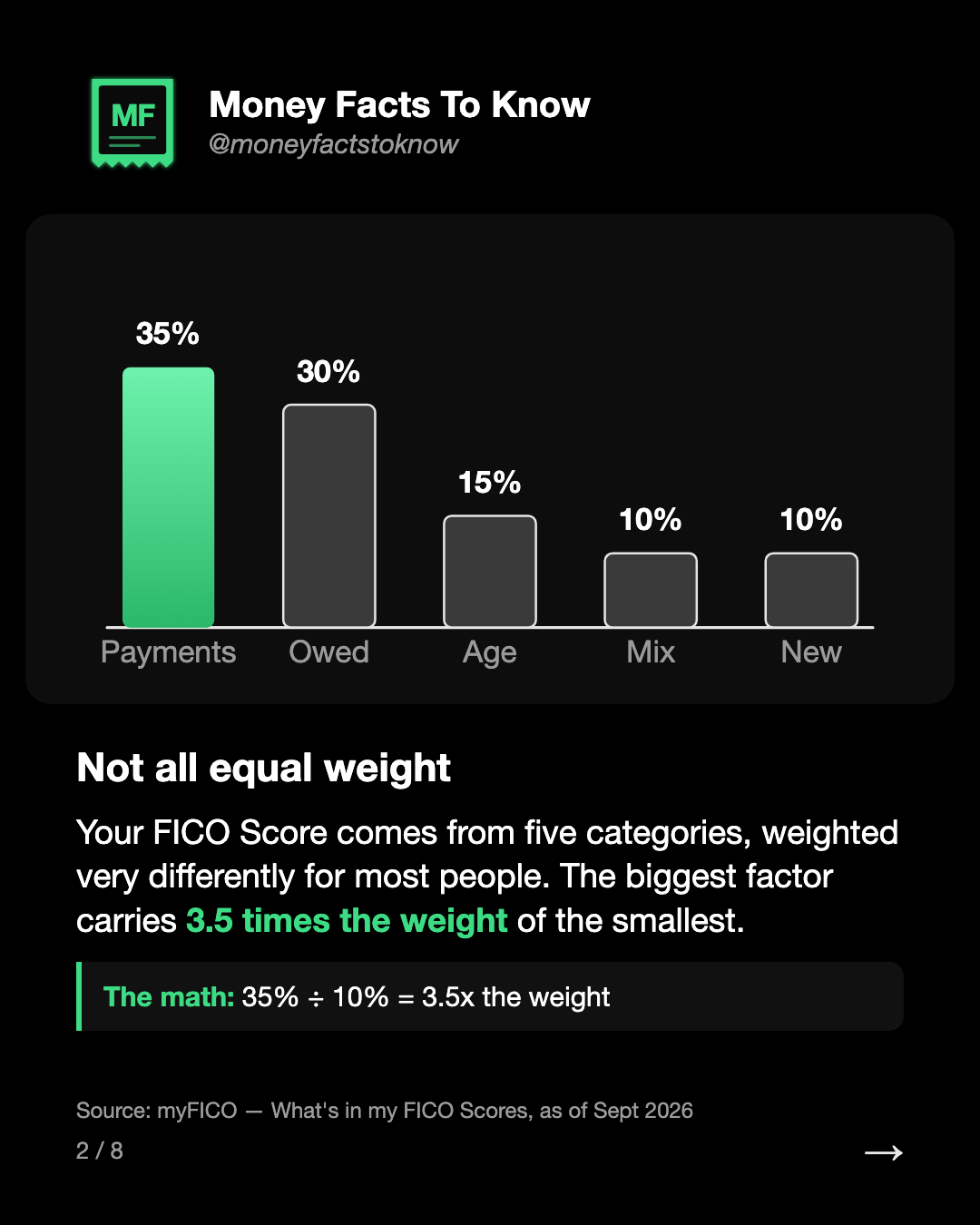
The 5 factors in your FICO Score, ranked by weight

Not all equal weight
Your FICO Score comes from five categories, weighted very differently for most people. The biggest factor carries 3.5 times the weight of the smallest.
The math: 35% ÷ 10% = 3.5x the weight
Source: myFICO — What's in my FICO Scores, as of Sept 2026
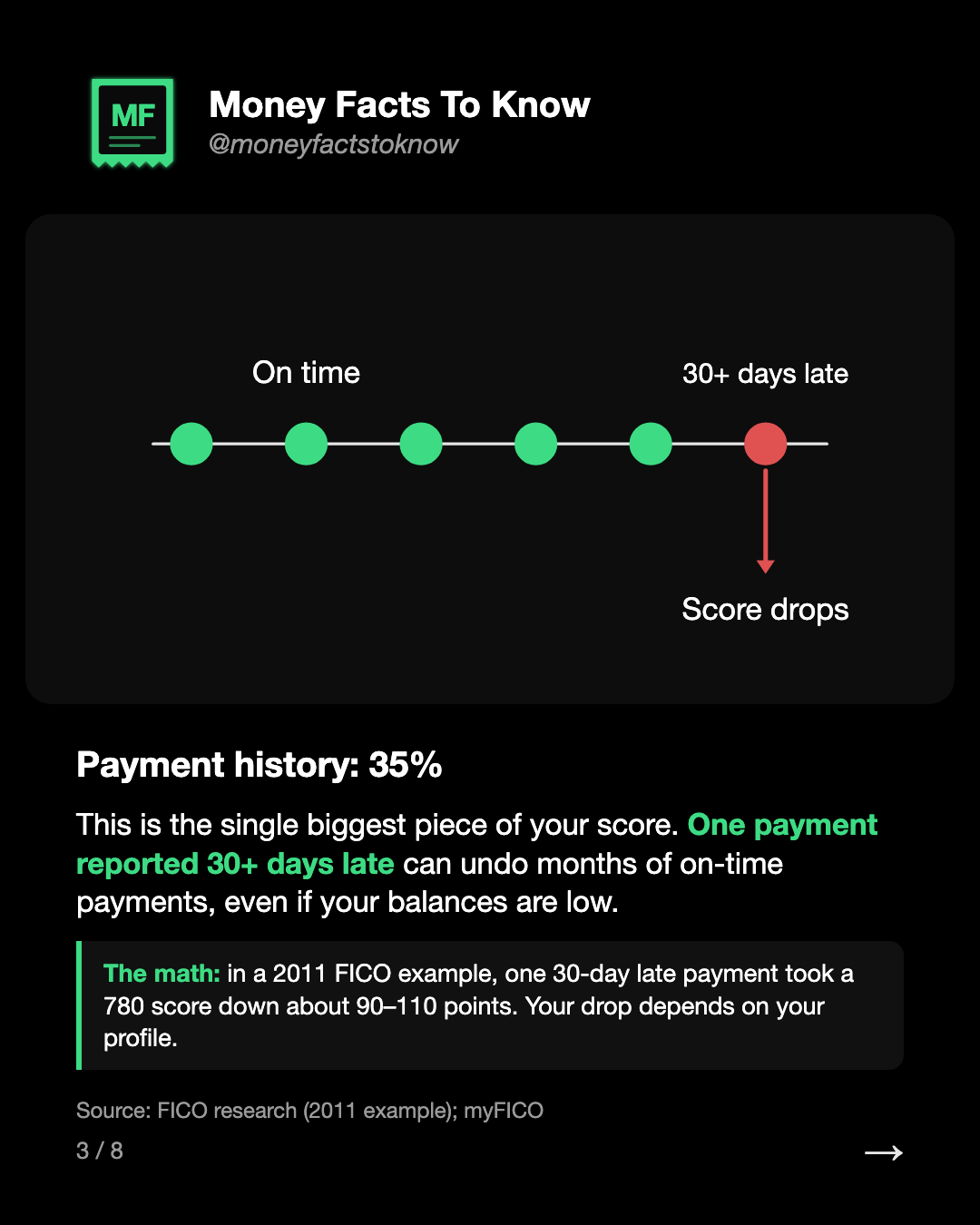
Payment history: 35%
This is the single biggest piece of your score. One payment reported 30+ days late can undo months of on-time payments, even if your balances are low.
The math: in a 2011 FICO example, one 30-day late payment took a 780 score down about 90–110 points. Your drop depends on your profile.
Source: FICO research (2011 example); myFICO
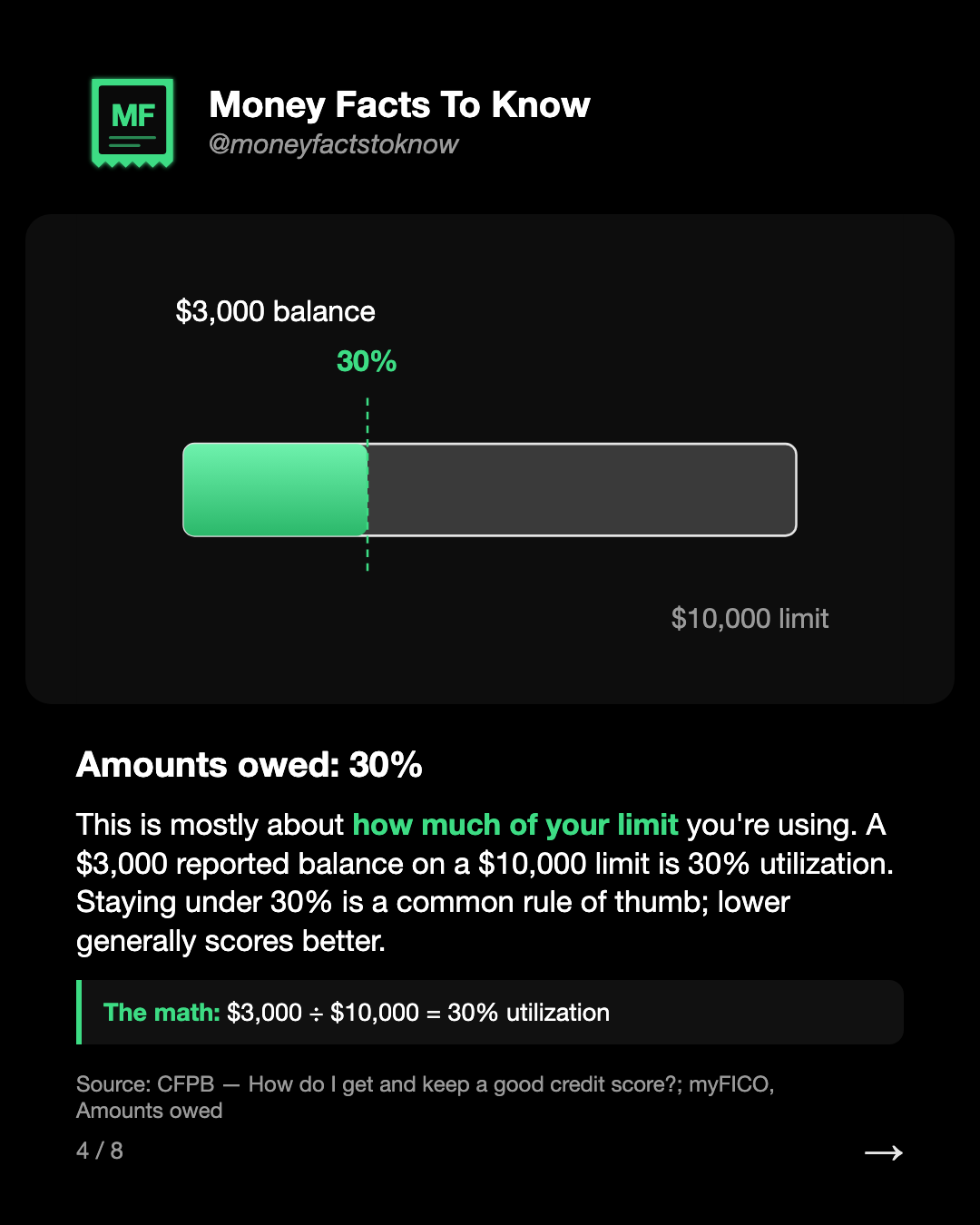
Amounts owed: 30%
This is mostly about how much of your limit you're using. A $3,000 reported balance on a $10,000 limit is 30% utilization. Staying under 30% is a common rule of thumb; lower generally scores better.
The math: $3,000 ÷ $10,000 = 30% utilization
Source: CFPB — How do I get and keep a good credit score?; myFICO, Amounts owed
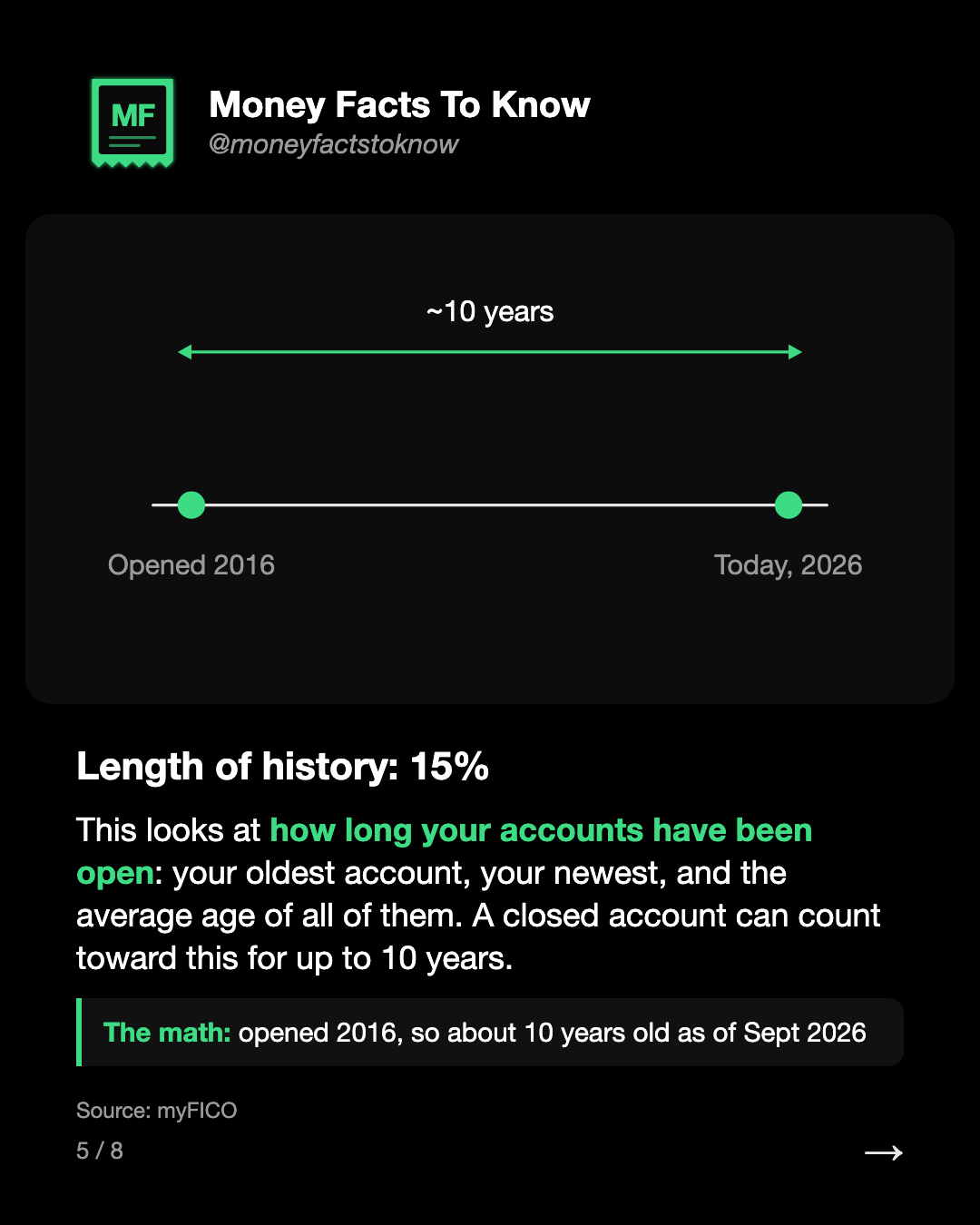
Length of history: 15%
This looks at how long your accounts have been open: your oldest account, your newest, and the average age of all of them. A closed account can count toward this for up to 10 years.
The math: opened 2016, so about 10 years old as of Sept 2026
Source: myFICO
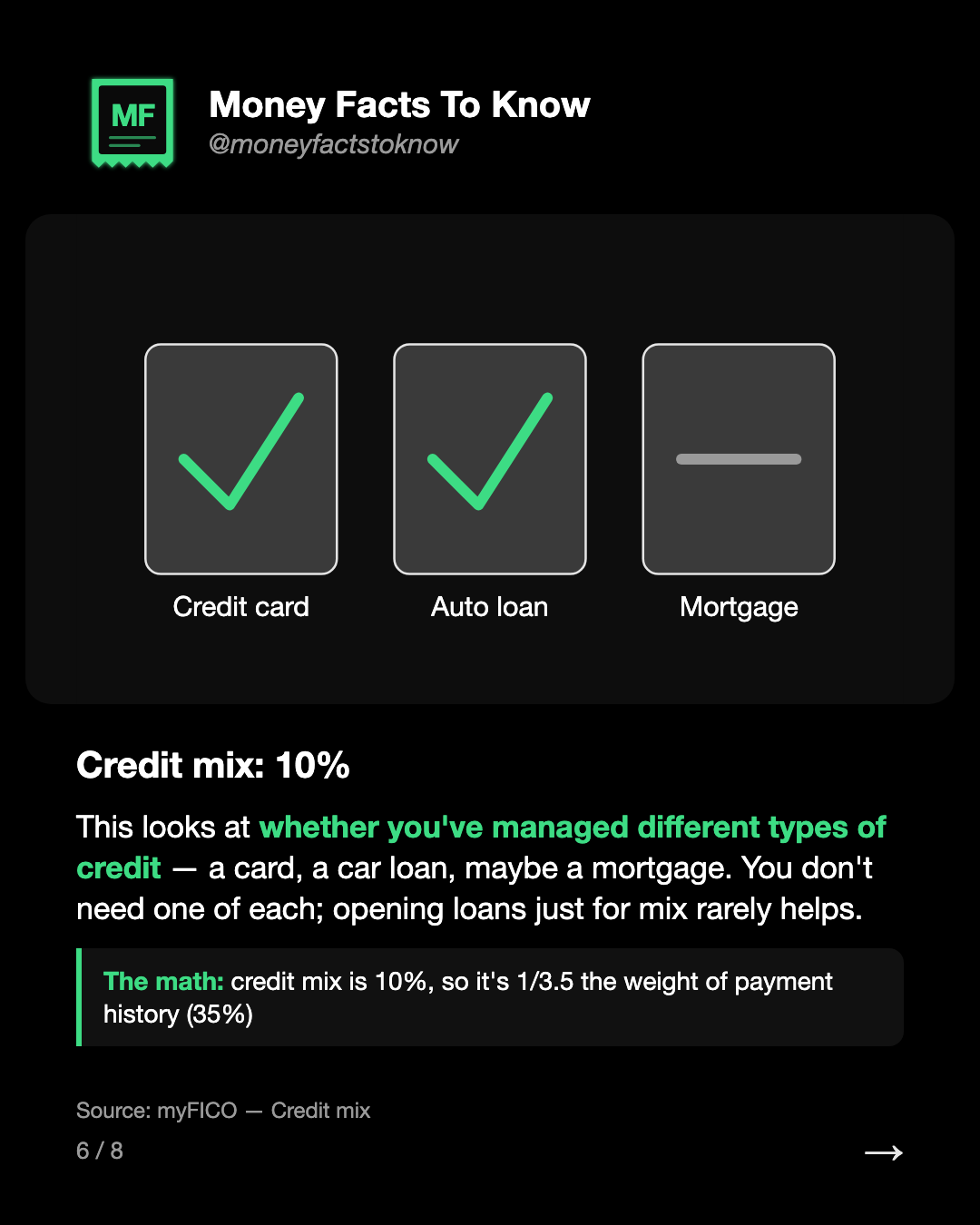
Credit mix: 10%
This looks at whether you've managed different types of credit — a card, a car loan, maybe a mortgage. You don't need one of each; opening loans just for mix rarely helps.
The math: credit mix is 10%, so it's 1/3.5 the weight of payment history (35%)
Source: myFICO — Credit mix
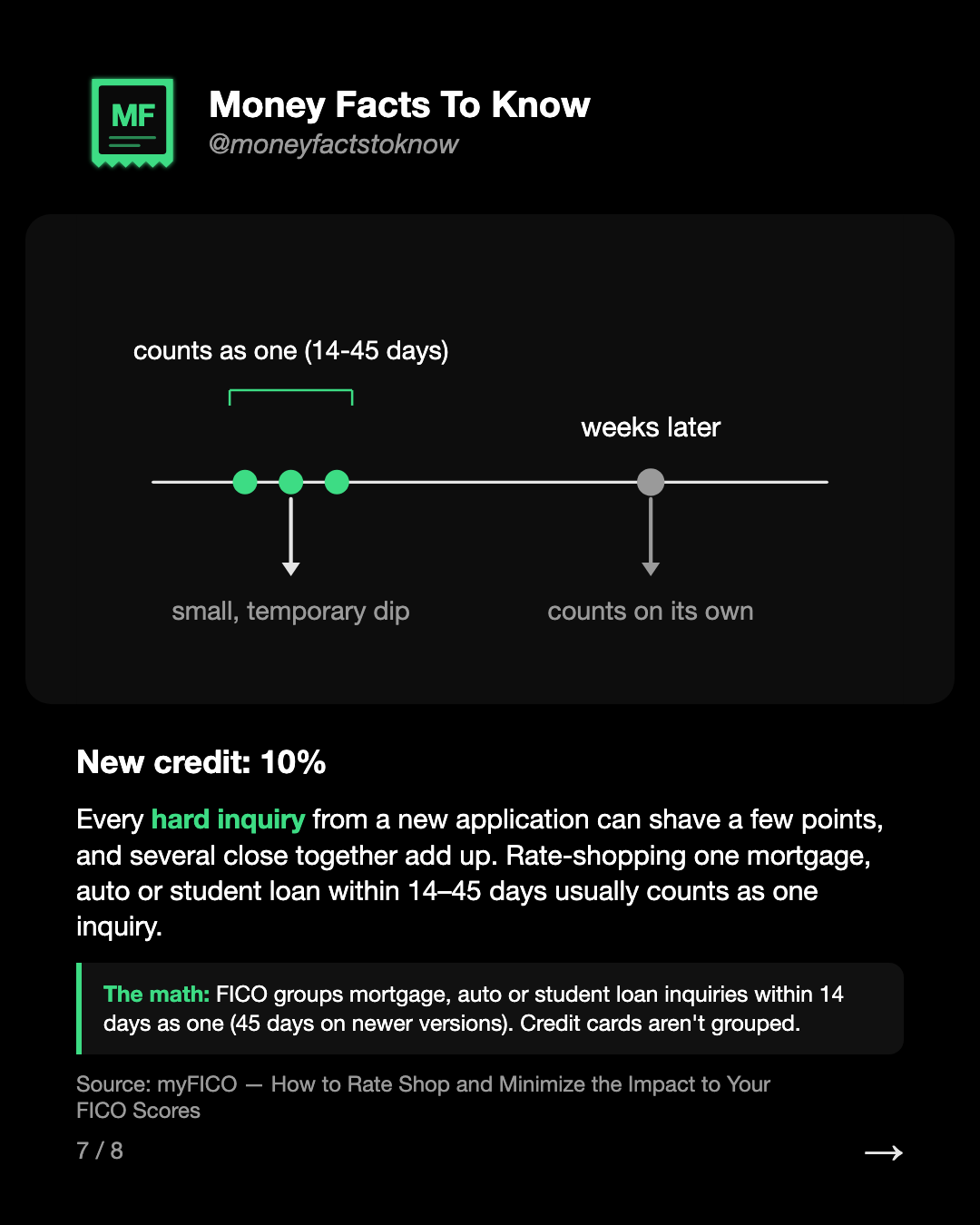
New credit: 10%
Every hard inquiry from a new application can shave a few points, and several close together add up. Rate-shopping one mortgage, auto or student loan within 14–45 days usually counts as one inquiry.
The math: FICO groups mortgage, auto or student loan inquiries within 14 days as one (45 days on newer versions). Credit cards aren't grouped.
Source: myFICO — How to Rate Shop and Minimize the Impact to Your FICO Scores
Sources and assumptions
- myFICO, What's in my FICO Scores: The 35/30/15/10/10 weights, "for the general population", which may differ by credit profile (checked 2026-09-29)
- myFICO, How to rate shop: 14-day (older) and 45-day (newer) windows for mortgage, auto and student loan inquiries (checked 2026-09-29)
- CFPB, How do I get and keep a good credit score?: Experts advise keeping credit use at no more than 30% of total limits (checked 2026-09-29)
Assumptions:
- Weights are FICO's general-population figures; individual profiles differ
- Point-drop figures are from a FICO simulation reported around 2011
Save this
- Payment history (35%): late payments weigh most
- Amounts owed (30%): lower utilization scores better
- Length of history (15%): older accounts, and a higher average age, help
- Credit mix (10%): a small boost for variety
- New credit (10%): several applications close together add up