
Money Facts To Know
← All posts

A $1,000 tax credit and a $1,000 deduction do not save you the same amount

· View on Instagram · View on Facebook

A $1,000 tax credit and a $1,000 deduction do not save you the same amount
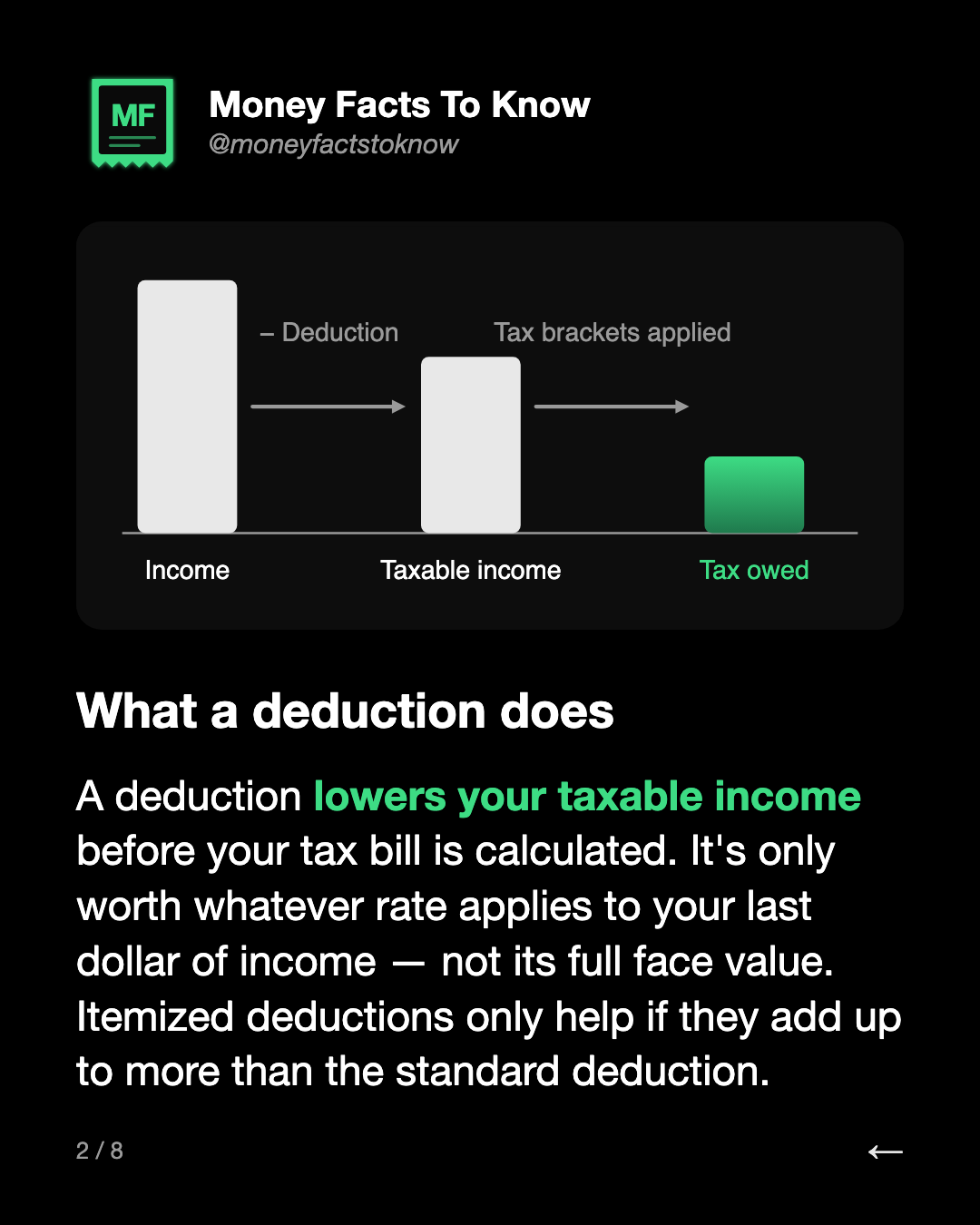
What a deduction does. A deduction lowers your taxable income before your tax bill is calculated. It's only worth whatever rate applies to your last dollar of income — not its full face value. Itemized deductions only help if they add up to more than the standard deduction.

What a deduction does

A deduction lowers your taxable income before your tax bill is calculated. It's only worth whatever rate applies to your last dollar of income — not its full face value. Itemized deductions only help if they add up to more than the standard deduction.

What a credit does. A credit subtracts directly from the tax you owe, dollar for dollar, after your bill is calculated. A $1,000 credit cuts up to $1,000 off your tax. Many credits can only bring your bill to $0, and many have income limits.
What a credit does

A credit subtracts directly from the tax you owe, dollar for dollar, after your bill is calculated. A $1,000 credit cuts up to $1,000 off your tax. Many credits can only bring your bill to $0, and many have income limits.

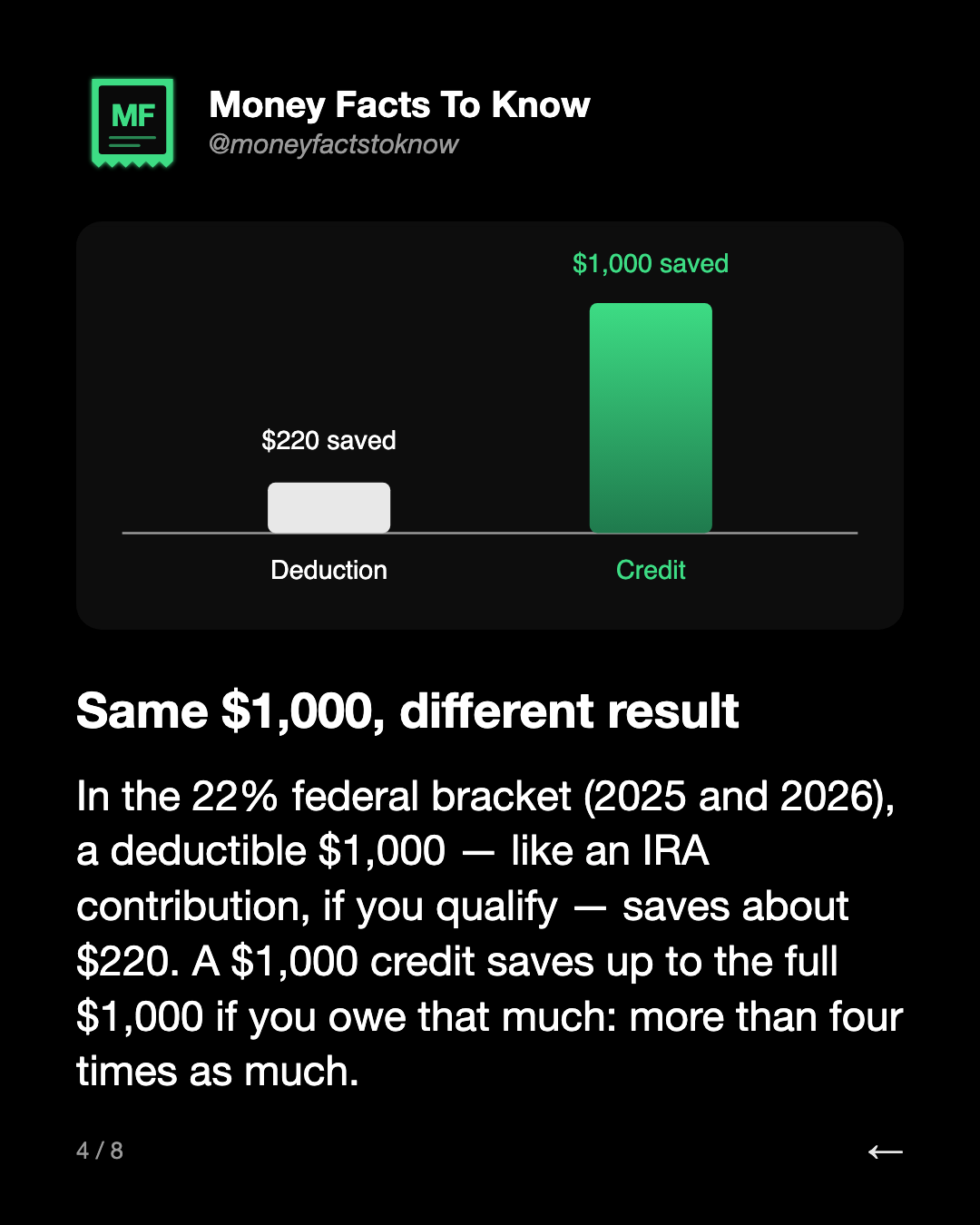
Same $1,000, different result. In the 22% federal bracket (2025 and 2026), a deductible $1,000 — like an IRA contribution, if you qualify — saves about $220. A $1,000 credit saves up to the full $1,000 if you owe that much: more than four times as much.
Same $1,000, different result

In the 22% federal bracket (2025 and 2026), a deductible $1,000 — like an IRA contribution, if you qualify — saves about $220. A $1,000 credit saves up to the full $1,000 if you owe that much: more than four times as much.

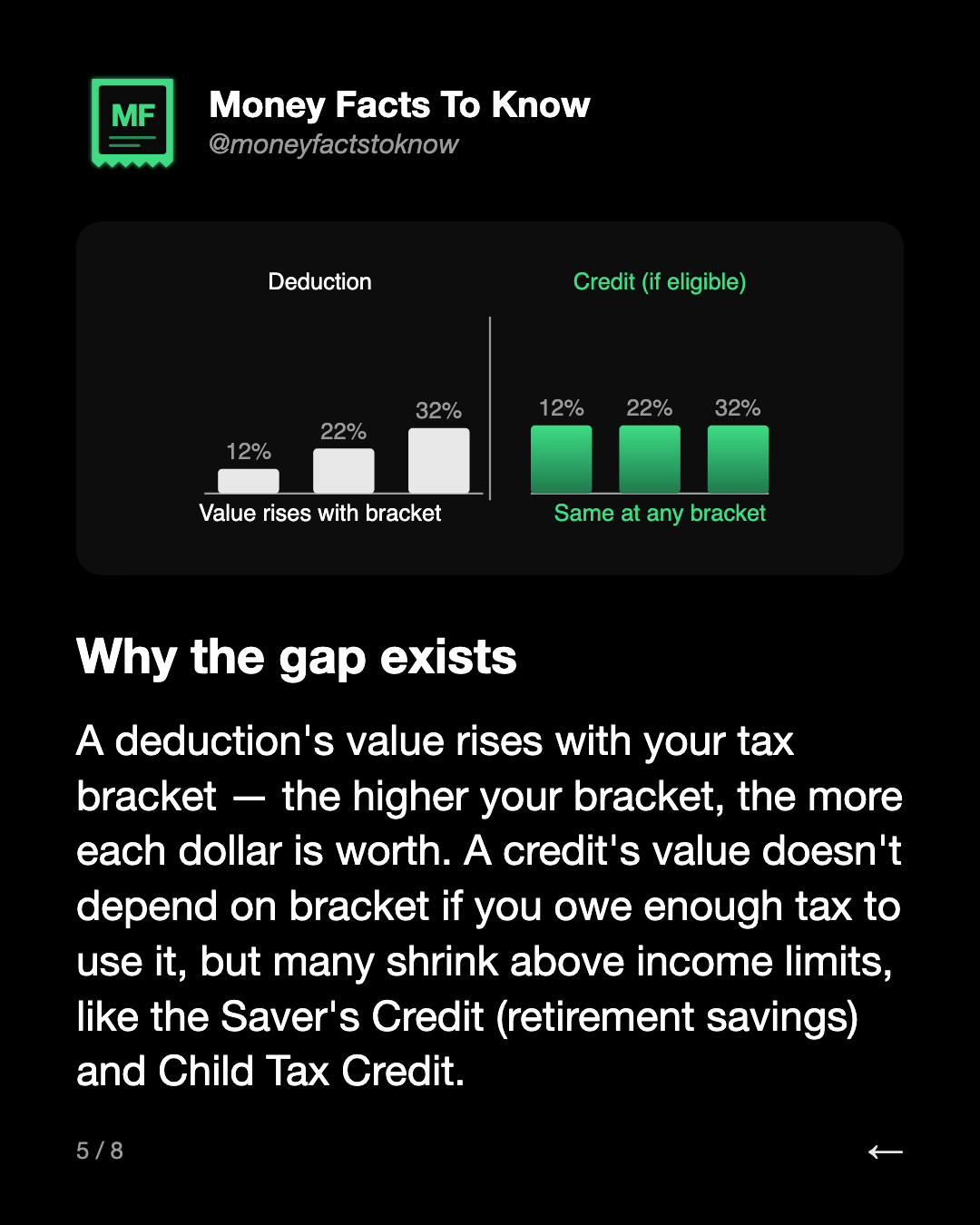
Why the gap exists. A deduction's value rises with your tax bracket — the higher your bracket, the more each dollar is worth. A credit's value doesn't depend on bracket if you owe enough tax to use it, but many shrink above income limits, like the Saver's Credit (retirement savings) and Child Tax Cr

Why the gap exists

A deduction's value rises with your tax bracket — the higher your bracket, the more each dollar is worth. A credit's value doesn't depend on bracket if you owe enough tax to use it, but many shrink above income limits, like the Saver's Credit (retirement savings) and Child Tax Credit.

Where you'll see each one. Student loan interest and traditional IRA (individual retirement account) contributions are common deductions. The Child Tax Credit and the Saver's Credit are credits, though both kinds have income limits. Refundable credits can pay you the difference if they exceed what y

Where you'll see each one

Student loan interest and traditional IRA (individual retirement account) contributions are common deductions. The Child Tax Credit and the Saver's Credit are credits, though both kinds have income limits. Refundable credits can pay you the difference if they exceed what you owe.

The takeaway. Dollar for dollar, a credit is worth more than a deduction of the same size. Credits and deductions can stack, though you still choose standard vs. itemized, and one expense can't count twice. What you save depends on your income, filing status, and whether the credit is refundable.


The takeaway

Dollar for dollar, a credit is worth more than a deduction of the same size. Credits and deductions can stack, though you still choose standard vs. itemized, and one expense can't count twice. What you save depends on your income, filing status, and whether the credit is refundable.

Follow @moneyfactstoknowSave this post on Instagram

More posts