 Money Facts To Know
The minimum payment on $5,000 could take 40+ years to clear
It Looks Manageable
Every credit card statement with a balance shows a minimum payment — the smallest amount that keeps your account current. It looks manageable, but how it's calculated is where the real cost of carrying a balance hides.
The First Month Broken Down
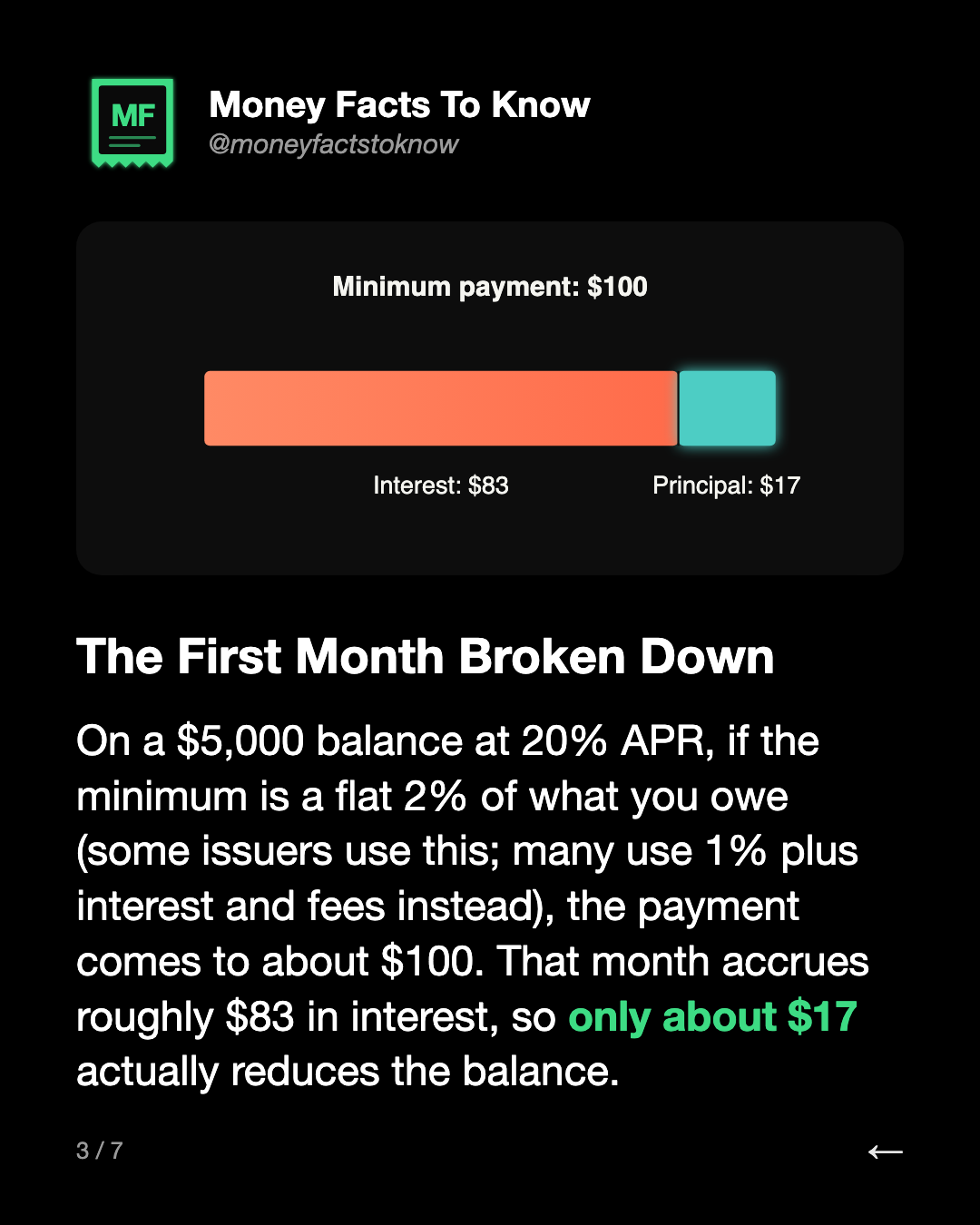
On a $5,000 balance at 20% APR, if the minimum is a flat 2% of what you owe (some issuers use this; many use 1% plus interest and fees instead), the payment comes to about $100. That month accrues roughly $83 in interest, so only about $17 actually reduces the balance.
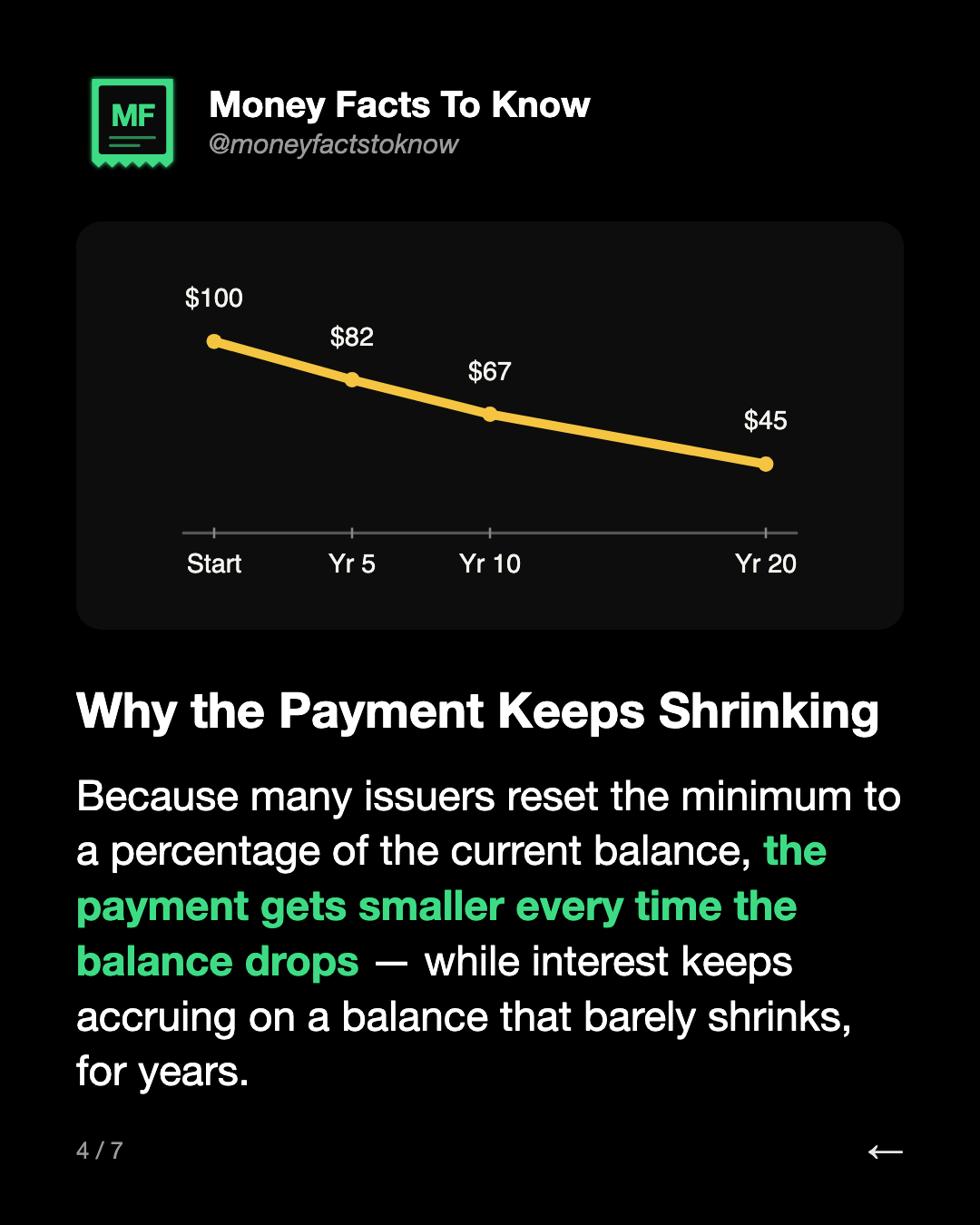
Why the Payment Keeps Shrinking
Because many issuers reset the minimum to a percentage of the current balance, the payment gets smaller every time the balance drops — while interest keeps accruing on a balance that barely shrinks, for years.
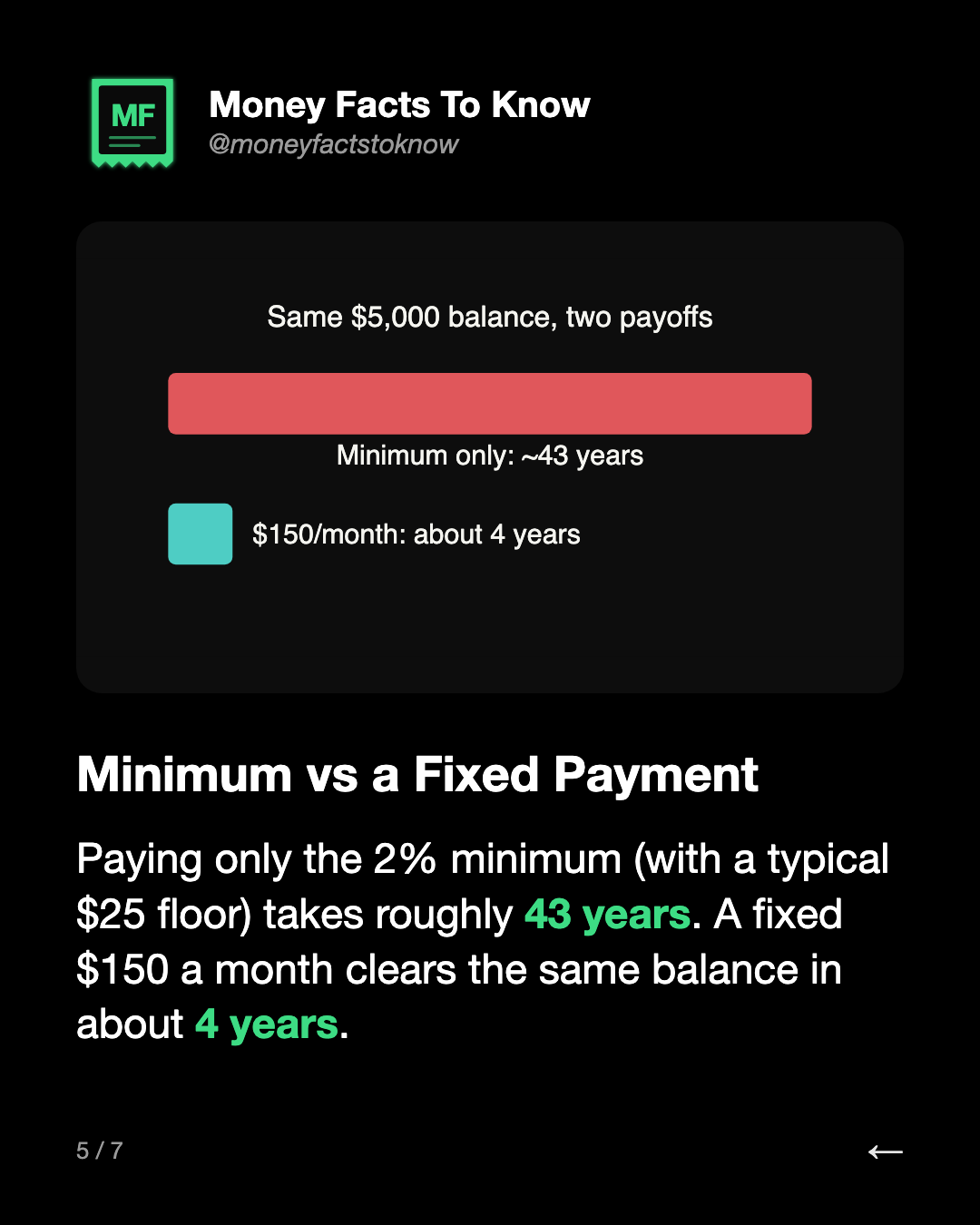
Minimum vs a Fixed Payment
Paying only the 2% minimum (with a typical $25 floor) takes roughly 43 years. A fixed $150 a month clears the same balance in about 4 years.
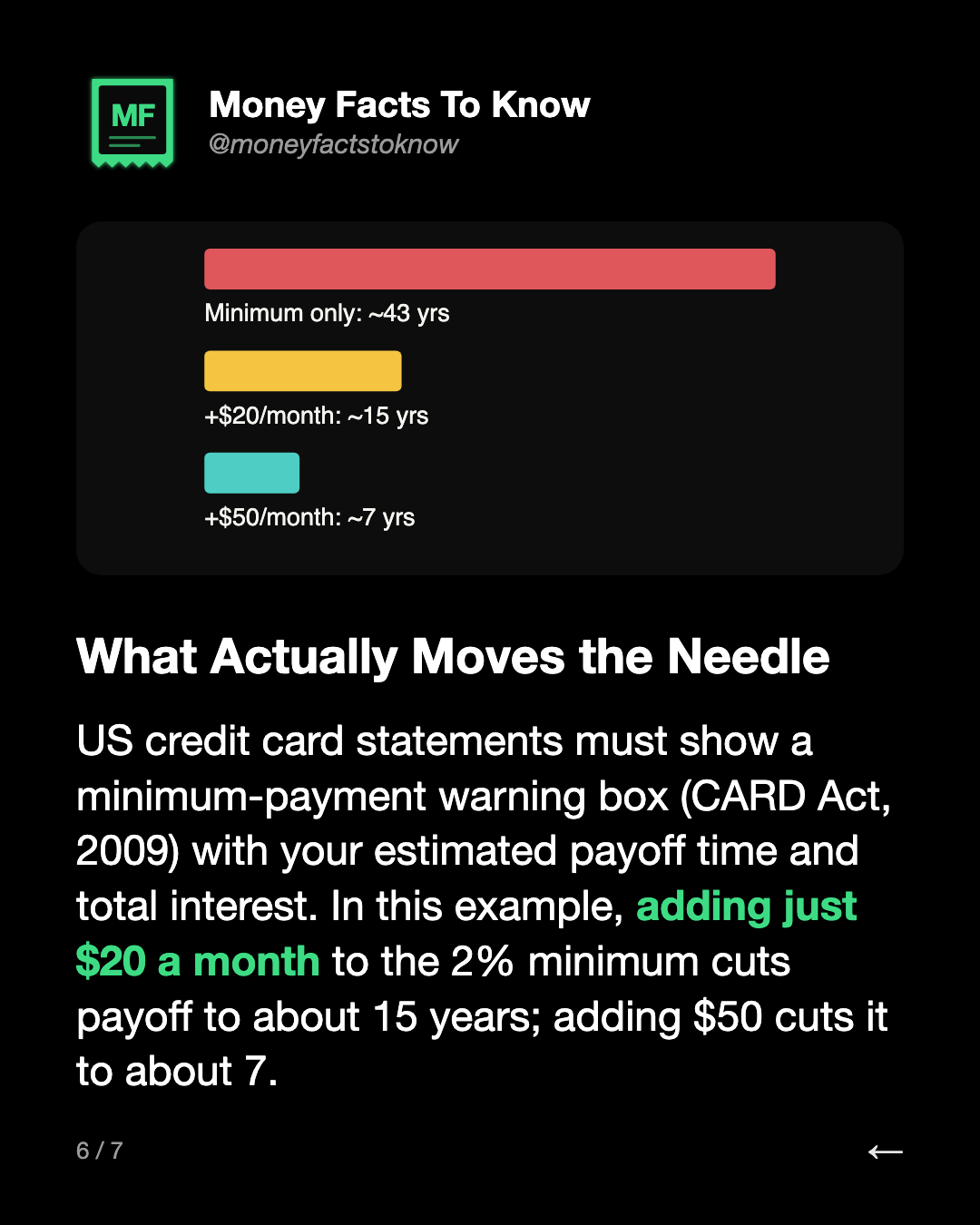
What Actually Moves the Needle
US credit card statements must show a minimum-payment warning box (CARD Act, 2009) with your estimated payoff time and total interest. In this example, adding just $20 a month to the 2% minimum cuts payoff to about 15 years; adding $50 cuts it to about 7.
Sources and assumptions
- CFPB, Regulation Z Appendix M1 (repayment disclosures): Issuers' payoff warnings use each card's own minimum-payment formula, so formulas vary (checked 2026-09-29)
- CFPB, Understanding minimum payments: A minimum is typically a percentage of the balance or a fixed dollar amount, whichever is greater (checked 2026-09-29)
Assumptions:
- $5,000 balance, 20% APR charged monthly (20% ÷ 12), no fees, no new purchases, no penalty APR
- Minimum = 2% of the prior month's balance, at least $25; the last payment clears the balance
- Results from our month-by-month calculation: 524 months and about $20,210 interest at the minimum; 163 months with +$20; 82 months with +$50; 50 months at a fixed $150