 Money Facts To Know
Gave your kid $30,000? The gift tax is probably $0

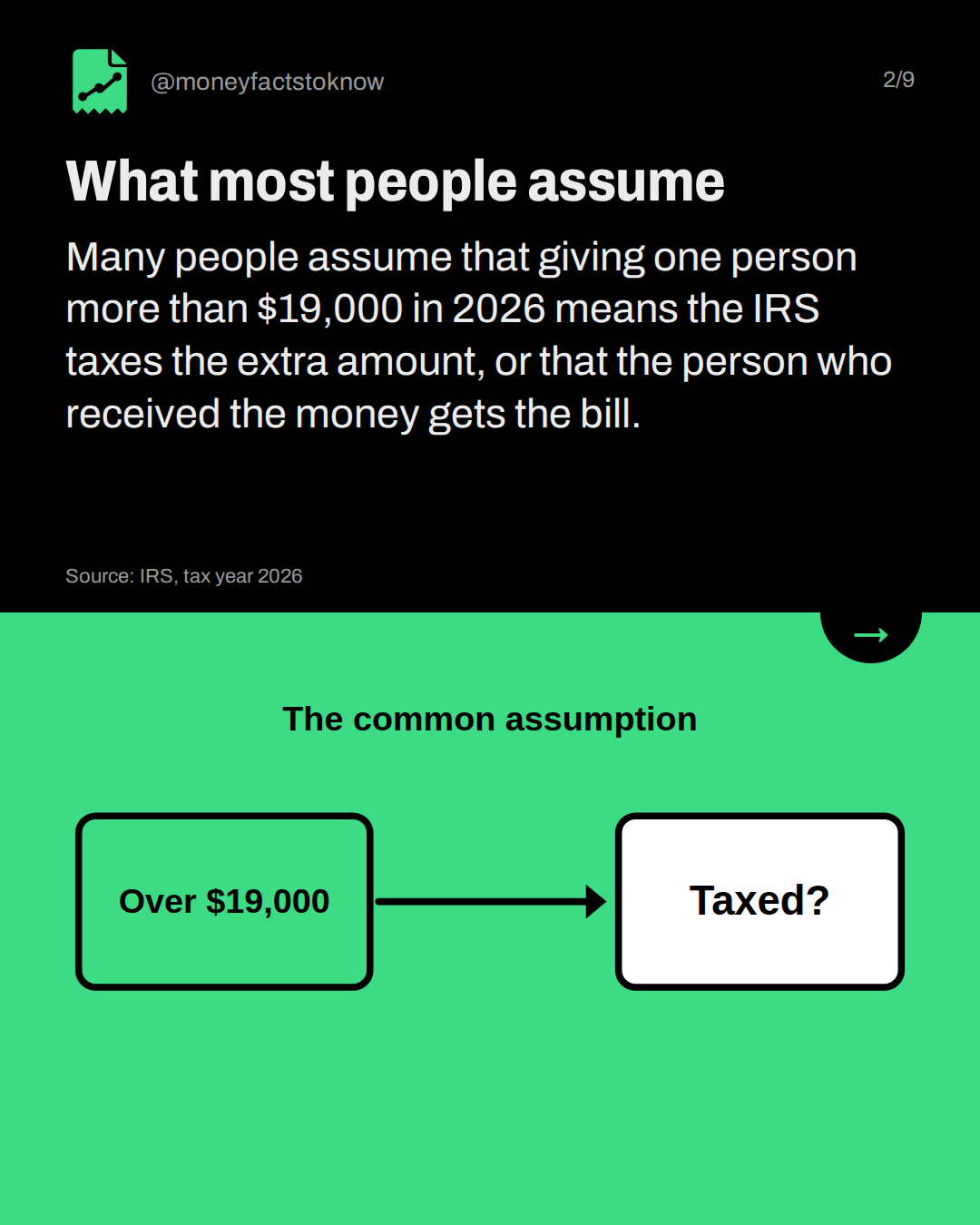
What most people assume
Many people assume that giving one person more than $19,000 in 2026 means the IRS taxes the extra amount, or that the person who received the money gets the bill.
Source: IRS, tax year 2026
The $19,000 is a reporting line
In 2026, you can give up to $19,000 to any one person in cash or other present-interest gifts without reporting it. Any gift tax is generally the giver's to pay, not the recipient's.
Source: IRS, tax year 2026
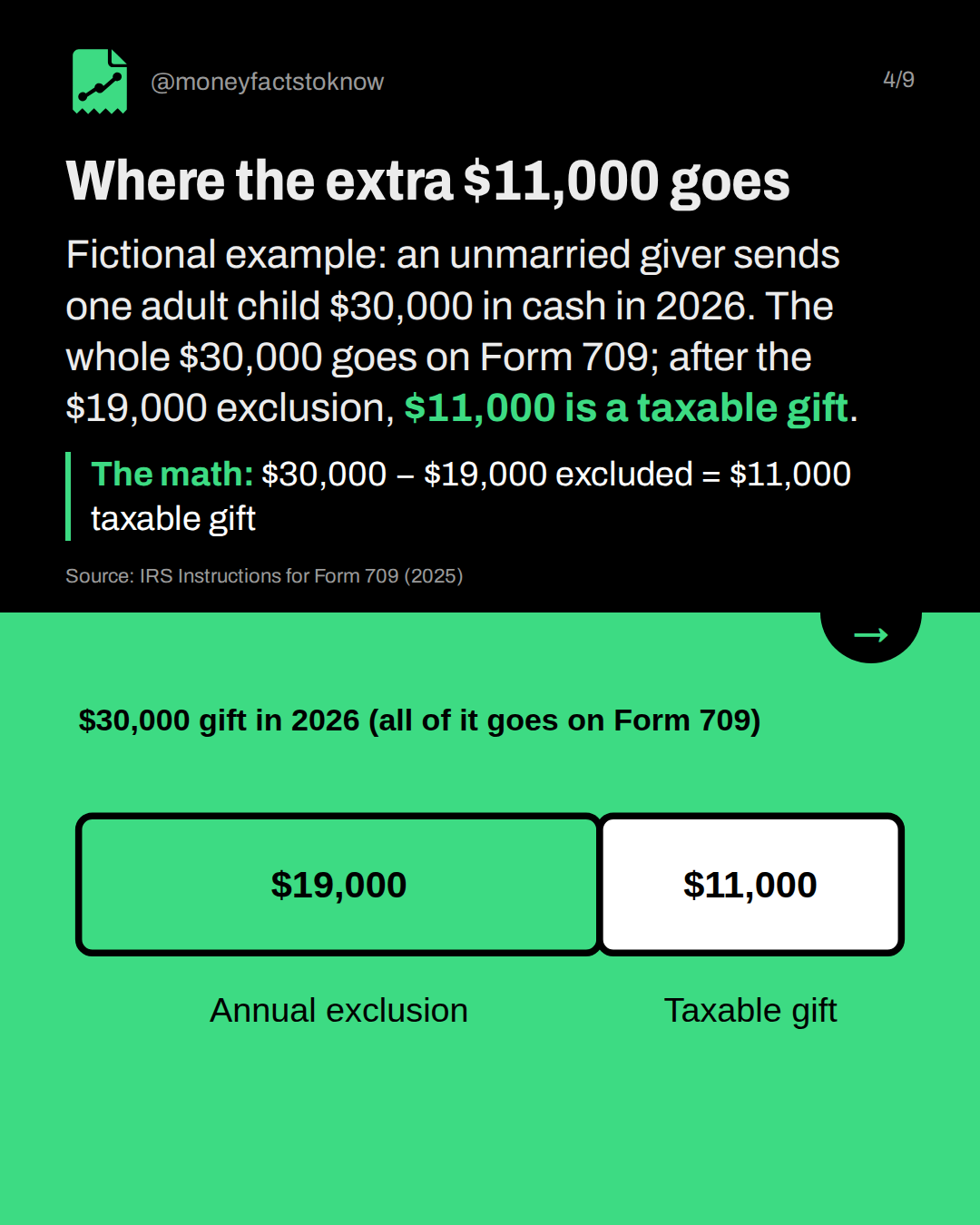
Where the extra $11,000 goes
Fictional example: an unmarried giver sends one adult child $30,000 in cash in 2026. The whole $30,000 goes on Form 709; after the $19,000 exclusion, $11,000 is a taxable gift.
The math: $30,000 − $19,000 excluded = $11,000 taxable gift
Source: IRS Instructions for Form 709 (2025)
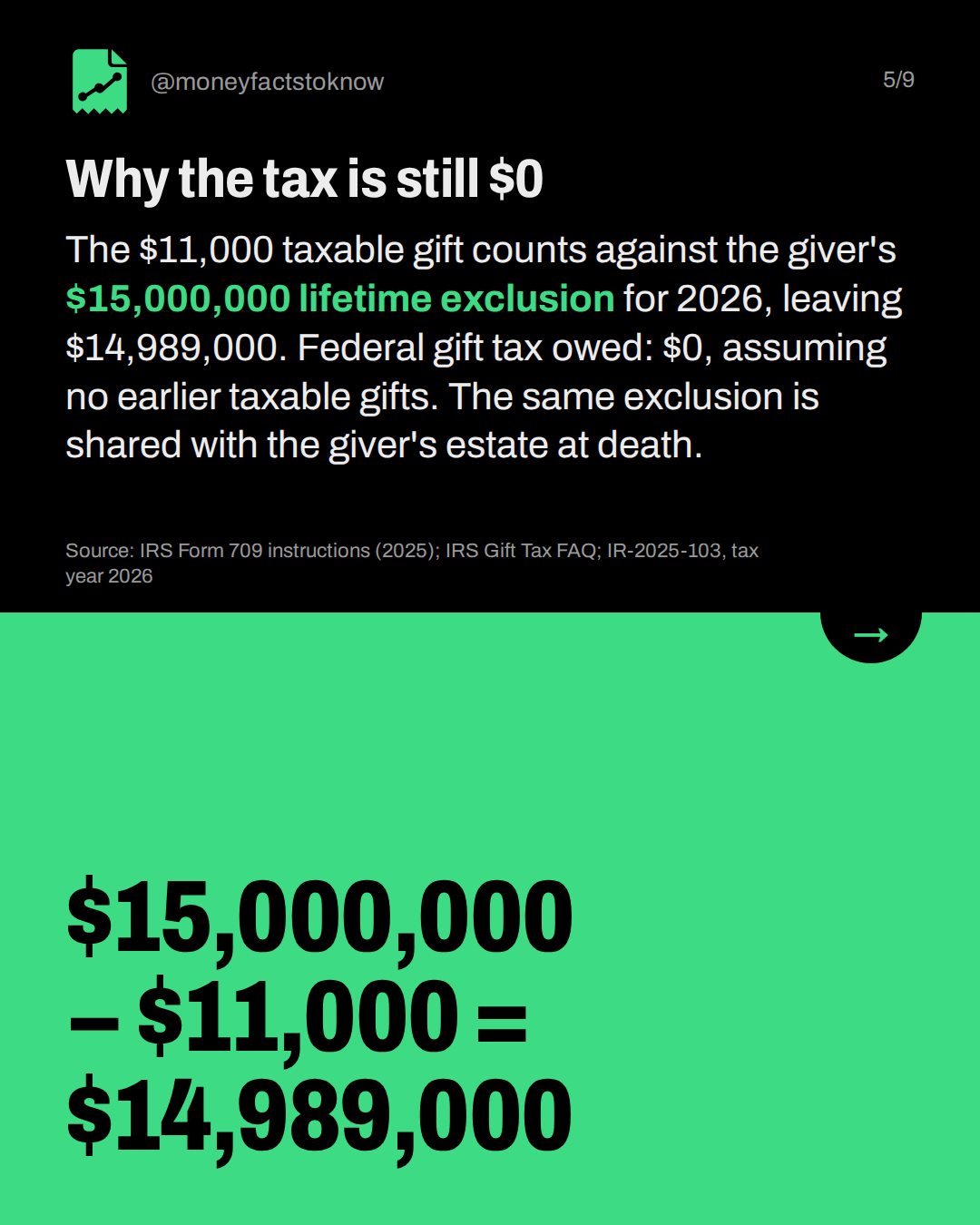
Why the tax is still $0
The $11,000 taxable gift counts against the giver's $15,000,000 lifetime exclusion for 2026, leaving $14,989,000. Federal gift tax owed: $0, assuming no earlier taxable gifts. The same exclusion is shared with the giver's estate at death.
The math: $15,000,000 − $11,000 = $14,989,000
Source: IRS Form 709 instructions (2025); IRS Gift Tax FAQ; IR-2025-103, tax year 2026
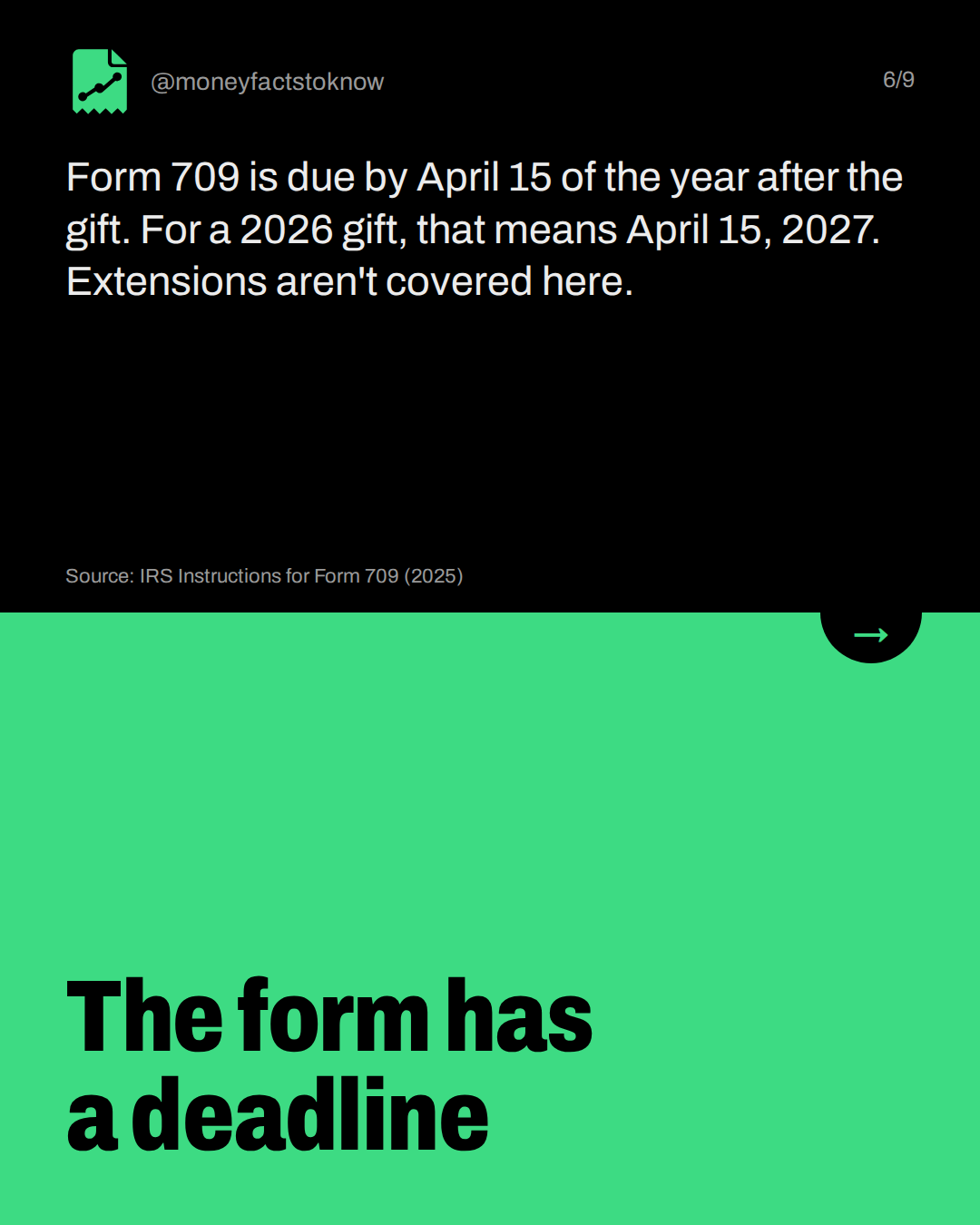
The form has a deadline
Form 709 is due by April 15 of the year after the gift. For a 2026 gift, that means April 15, 2027. Extensions aren't covered here.
Source: IRS Instructions for Form 709 (2025)
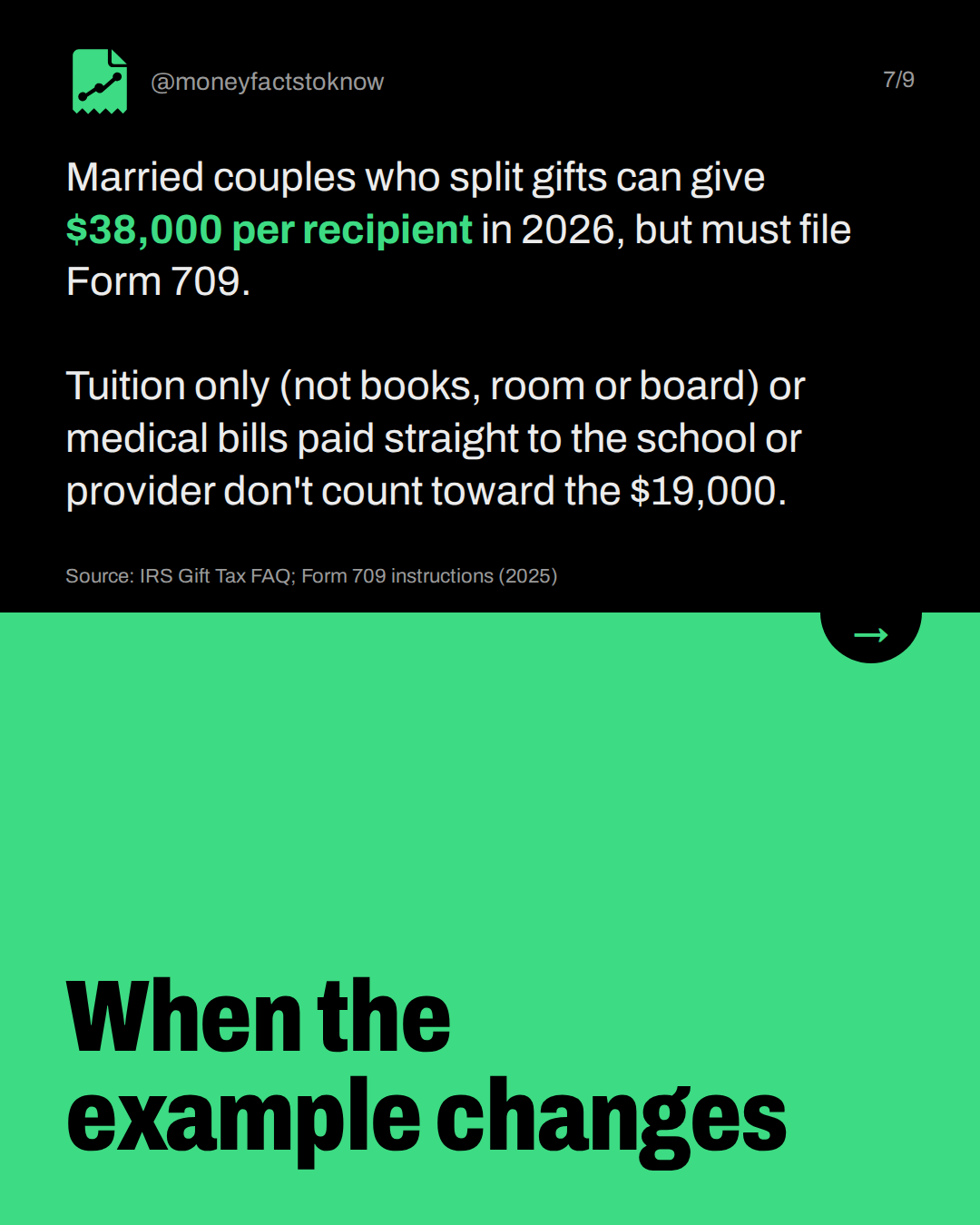
When the example changes
Married couples who split gifts can give $38,000 per recipient in 2026, but must file Form 709.
Tuition only (not books, room or board) or medical bills paid straight to the school or provider don't count toward the $19,000.
Source: IRS Gift Tax FAQ; Form 709 instructions (2025)

What to check before you give
Check the total you've given each person this calendar year, whether a spouse is splitting, and whether a payment can go straight to the school or provider. For large or non-cash gifts, a tax professional can confirm the details.
Sources and assumptions
- IRS, Frequently asked questions on gift taxes: 2026 annual exclusion $19,000 per donee; $38,000 per donee when spouses split; donor generally responsible for paying gift tax; gifts over the exclusion reduce the basic exclusion amount; basic exclusion $15,000,000 for gifts in calendar year 2026 under Public Law 119-21; tuition and medical exclusions; gifts not deductible (checked 2026-10-10)
- IRS newsroom, IRS releases tax inflation adjustments for tax year 2026 (IR-2025-103): 'For tax year 2026, the annual exclusion for gifts remains at $19,000.' Basic exclusion amount $15,000,000 for 2026, up from $13,990,000 for 2025 (checked 2026-10-10)
- IRS, Instructions for Form 709 (2025): Must generally file Form 709 when gifts to one person (other than a spouse) total more than the annual exclusion; due no later than April 15 of the year after the gift; gift splitting requires a gift tax return regardless of amount; education payments must go directly to the educational organization and medical payments to the care provider (checked 2026-10-10)
- IRS, Gift tax: Definition: a gift is giving property (including money) without expecting to receive something of at least equal value in return (checked 2026-10-10)
Assumptions:
- Fictional giver, unmarried, gives $30,000 cash to one adult child in calendar year 2026, with no other gifts to that person that year
- The giver has made no earlier taxable gifts, so the full $15,000,000 basic exclusion is available
- Federal rules only; state gift or inheritance rules are not covered
- The recipient is not the giver's spouse
- The 2026 due-date convention (April 15 of the following year) is taken from the 2025 Form 709 instructions and assumed unchanged; extensions are not covered
- The gift-splitting example assumes both spouses consent and each files Form 709
The short version
- $19,000 in 2026 is a reporting line
- Over it, you file Form 709
- The extra counts against $15,000,000
- Tax owed in our example: $0
- Splitting or direct payments change the math


