 Money Facts To Know
Roth or traditional? At the same tax rate, they can tie.


Both slogans skip the comparison
You'll hear that Roth is better because withdrawals are tax-free, or that traditional is better because you save tax now. Each claim leaves out the comparison that matters.

Tax is taken once, either way
With a traditional account, a deductible contribution skips tax now, and the withdrawal is taxed as ordinary income. With a Roth you pay tax now, and qualified withdrawals are tax-free.
Source: IRS Traditional IRAs; IRS Roth IRAs; IRS Pub 590-B (2025)
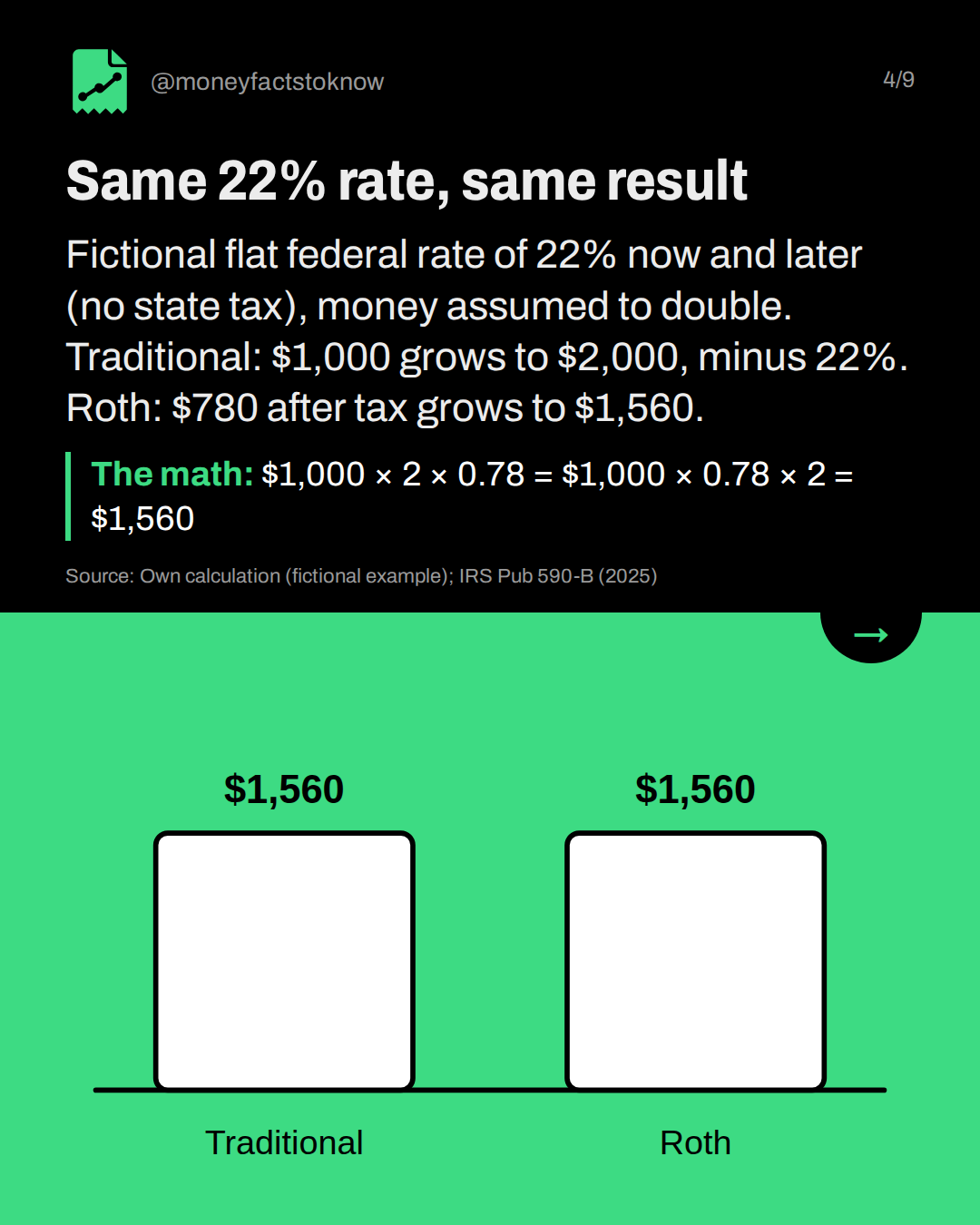
Same 22% rate, same result
Fictional flat federal rate of 22% now and later (no state tax), money assumed to double. Traditional: $1,000 grows to $2,000, minus 22%. Roth: $780 after tax grows to $1,560.
The math: $1,000 × 2 × 0.78 = $1,000 × 0.78 × 2 = $1,560
Source: Own calculation (fictional example); IRS Pub 590-B (2025)

The tie needs the $220 invested
The tie only holds if the traditional saver puts in the full $1,000, so the $220 tax saving is invested, not spent. Taking 22% before or after the doubling gives $1,560.
Source: Own calculation (fictional example); IRS Pub 590-B (2025)
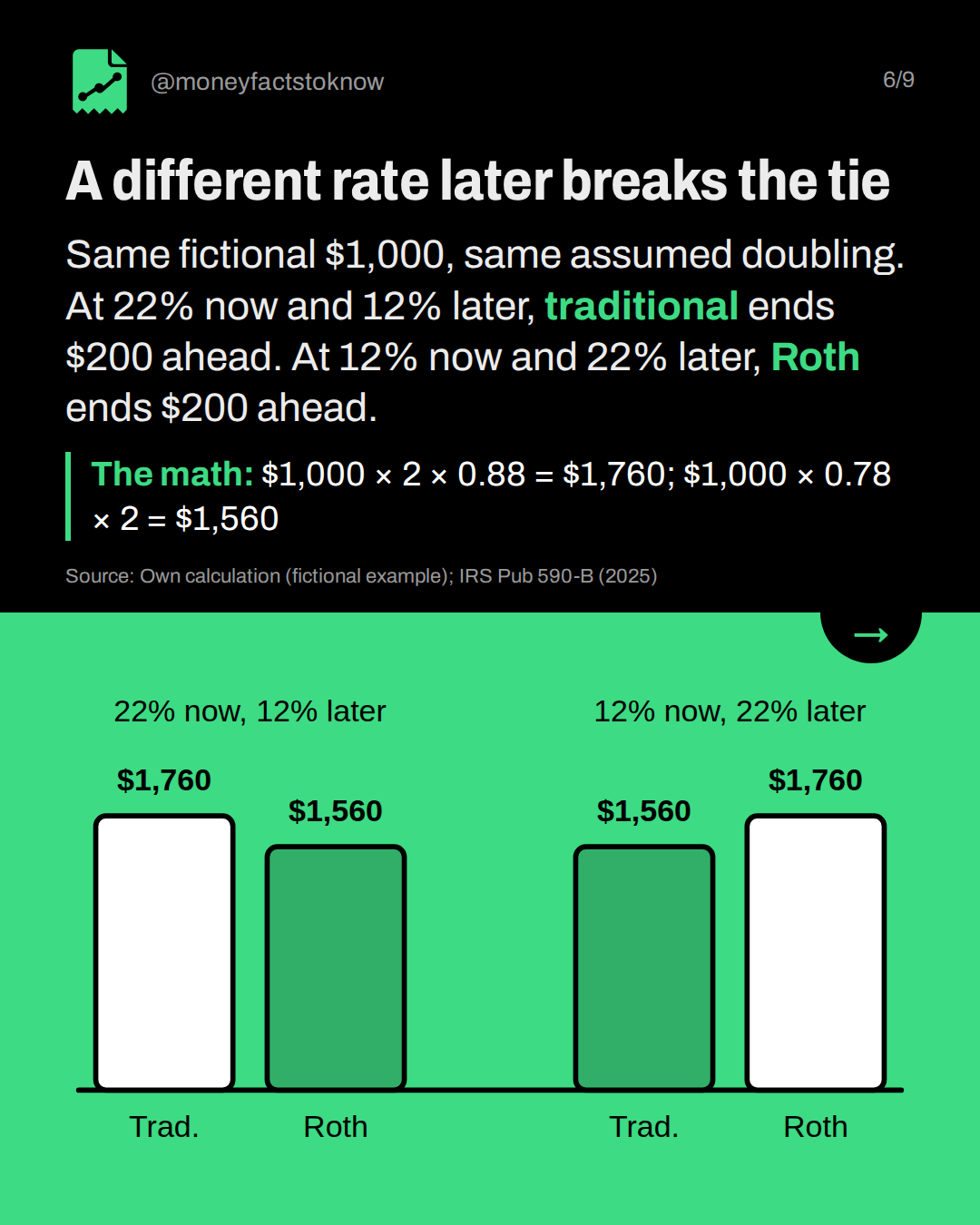
A different rate later breaks the tie
Same fictional $1,000, same assumed doubling. At 22% now and 12% later, traditional ends $200 ahead. At 12% now and 22% later, Roth ends $200 ahead.
The math: $1,000 × 2 × 0.88 = $1,760; $1,000 × 0.78 × 2 = $1,560
Source: Own calculation (fictional example); IRS Pub 590-B (2025)
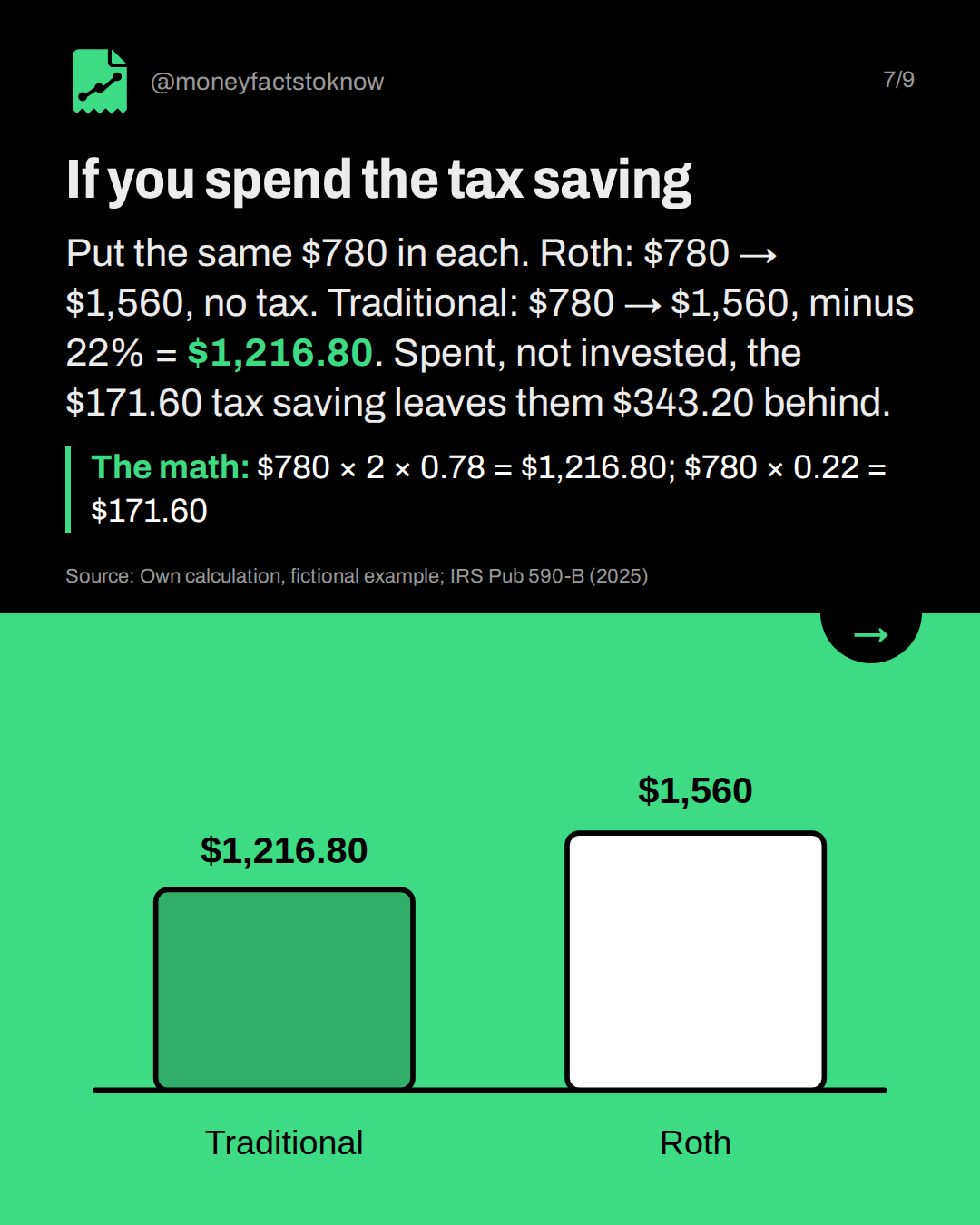
If you spend the tax saving
Put the same $780 in each. Roth: $780 → $1,560, no tax. Traditional: $780 → $1,560, minus 22% = $1,216.80. Spent, not invested, the $171.60 tax saving leaves them $343.20 behind.
The math: $780 × 2 × 0.78 = $1,216.80; $780 × 0.22 = $171.60
Source: Own calculation, fictional example; IRS Pub 590-B (2025)

What to compare before choosing
Compare your tax rate on this money today with your best estimate for retirement. Check whether you'd invest the traditional tax saving, whether you're at the contribution limit, and what rate withdrawals would face.
Sources and assumptions
- IRS — Roth IRAs: "You cannot deduct contributions to a Roth IRA"; qualified distributions are tax-free (checked 2026-10-05)
- IRS — Traditional IRAs: Traditional contributions may be fully or partially deductible depending on filing status and income; amounts including earnings aren't taxed until distributed (checked 2026-10-05)
- IRS Publication 590-B (2025), Distributions from IRAs: Traditional IRA distributions are taxed as ordinary income (fully taxable when all contributions were deductible); a qualified Roth distribution requires the 5-year period plus age 59½, disability, death or a first-time home purchase, and isn't taxed (checked 2026-10-05)
- Fidelity Viewpoints — Roth IRA or traditional IRA or 401(k): "Assuming your income will be the same now and when you take withdrawals, traditional IRAs and Roth IRAs provide the same tax savings"; the traditional saver must invest the tax refund to realize the benefit (checked 2026-10-05)
Assumptions:
- Fictional saver; all figures are illustrative.
- The 22% and 12% rates are fictional flat rates on this money at contribution and at withdrawal (they match two federal bracket rates, but a real person's rate depends on income and filing status). Federal only, no state tax.
- The money is assumed to double in both accounts (growth factor 2.0). This is an assumption, not a forecast or historical return, and it's the same investment in both accounts.
- Main example (slides 4–6): the same $1,000 of pre-tax pay goes in each way: $1,000 into traditional (fully deductible), or $780 after 22% tax into Roth. In other words, the traditional tax saving is effectively invested. Slide 7 variant: the same $780 goes into each account, so the traditional deduction saves $171.60 (780 × 0.22), and that saving is spent rather than invested.
- The traditional contribution is fully deductible and the withdrawal is fully taxable; the Roth withdrawal is a qualified distribution (no tax, no penalty).
- No contribution limits bind; no fees; no early-withdrawal penalties.
The short version
- At the same rate now and later: a tie
- Traditional taxes the withdrawal; Roth taxes now
- In the example, a lower later rate favored traditional
- A higher later rate favored Roth
- Spending the tax saving breaks the tie


