 Money Facts To Know
Fictional: unpaid $10,000 401(k) loan, $3,200 federal tax unless put back
Borrowing from your 401(k) feels like paying yourself back. But your plan can require the full loan balance repaid when you leave.
Source: IRS, Retirement topics – Loans
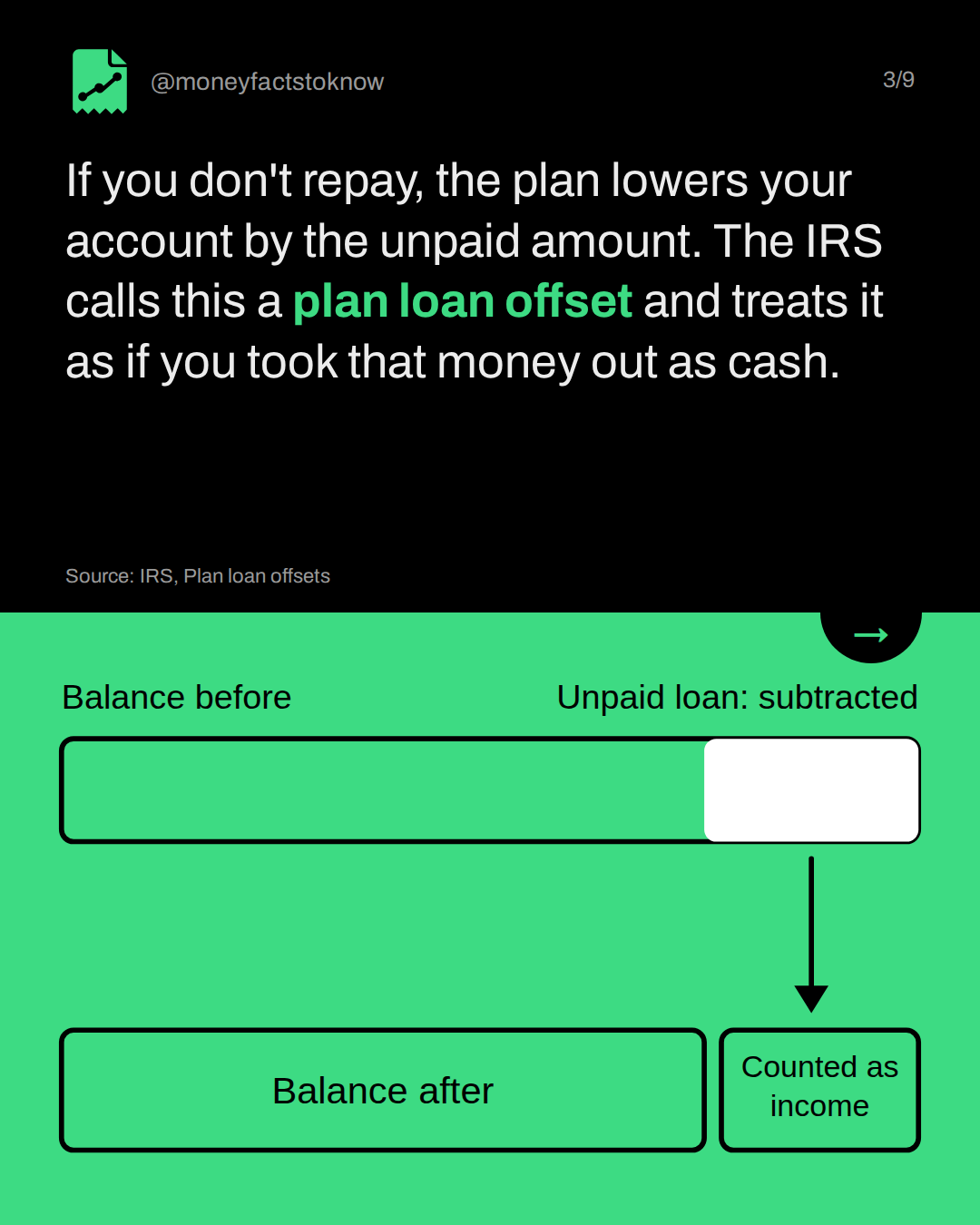
If you don't repay, the plan lowers your account by the unpaid amount. The IRS calls this a plan loan offset and treats it as if you took that money out as cash.
Source: IRS, Plan loan offsets
You get no cash, so usually no tax is taken out ahead of time. The bill shows up when you file your tax return.
Source: 26 CFR 31.3405(c)-1; IRS
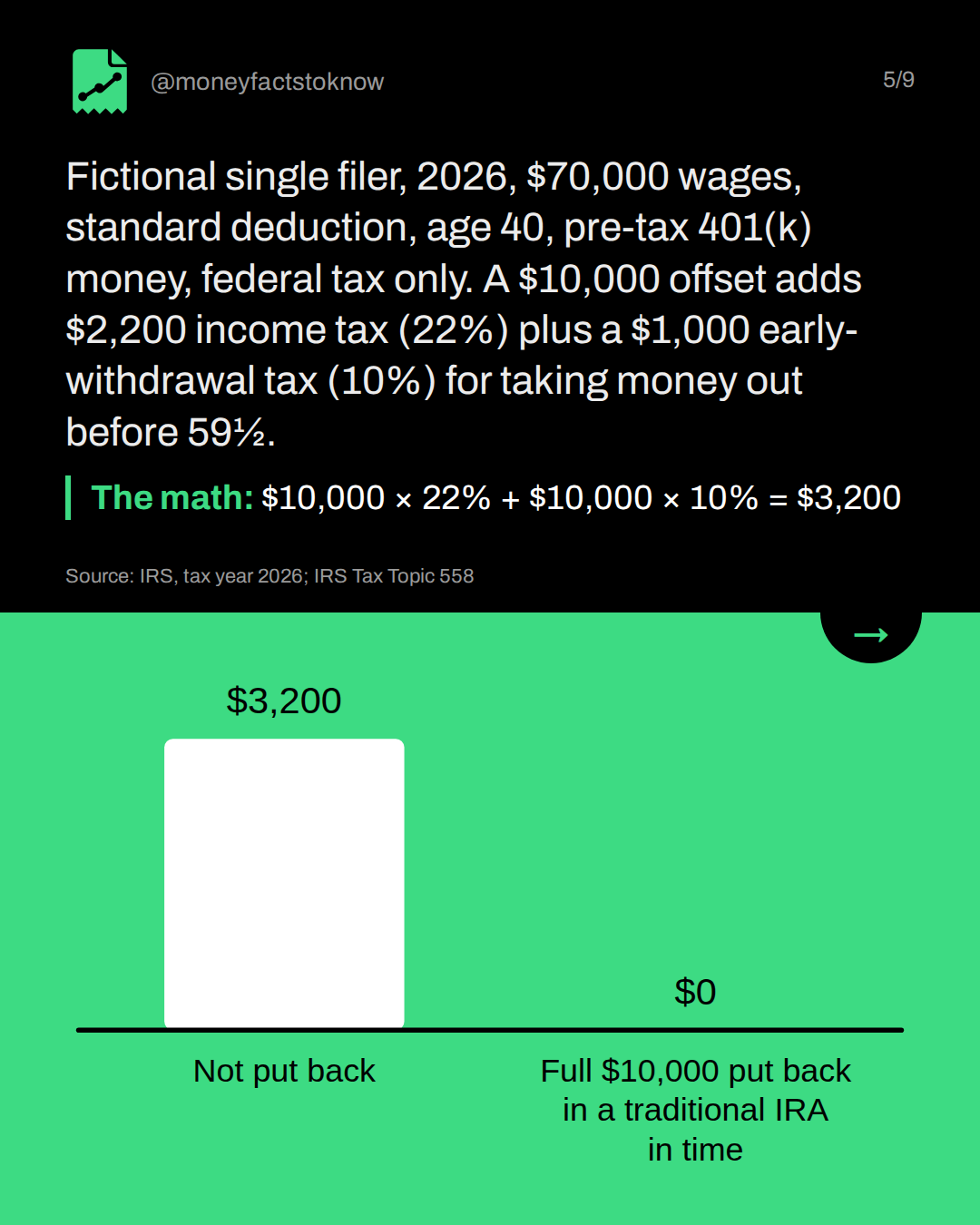
Fictional single filer, 2026, $70,000 wages, standard deduction, age 40, pre-tax 401(k) money, federal tax only. A $10,000 offset adds $2,200 income tax (22%) plus a $1,000 early-withdrawal tax (10%) for taking money out before 59½.
The math: $10,000 × 22% + $10,000 × 10% = $3,200
Source: IRS, tax year 2026; IRS Tax Topic 558
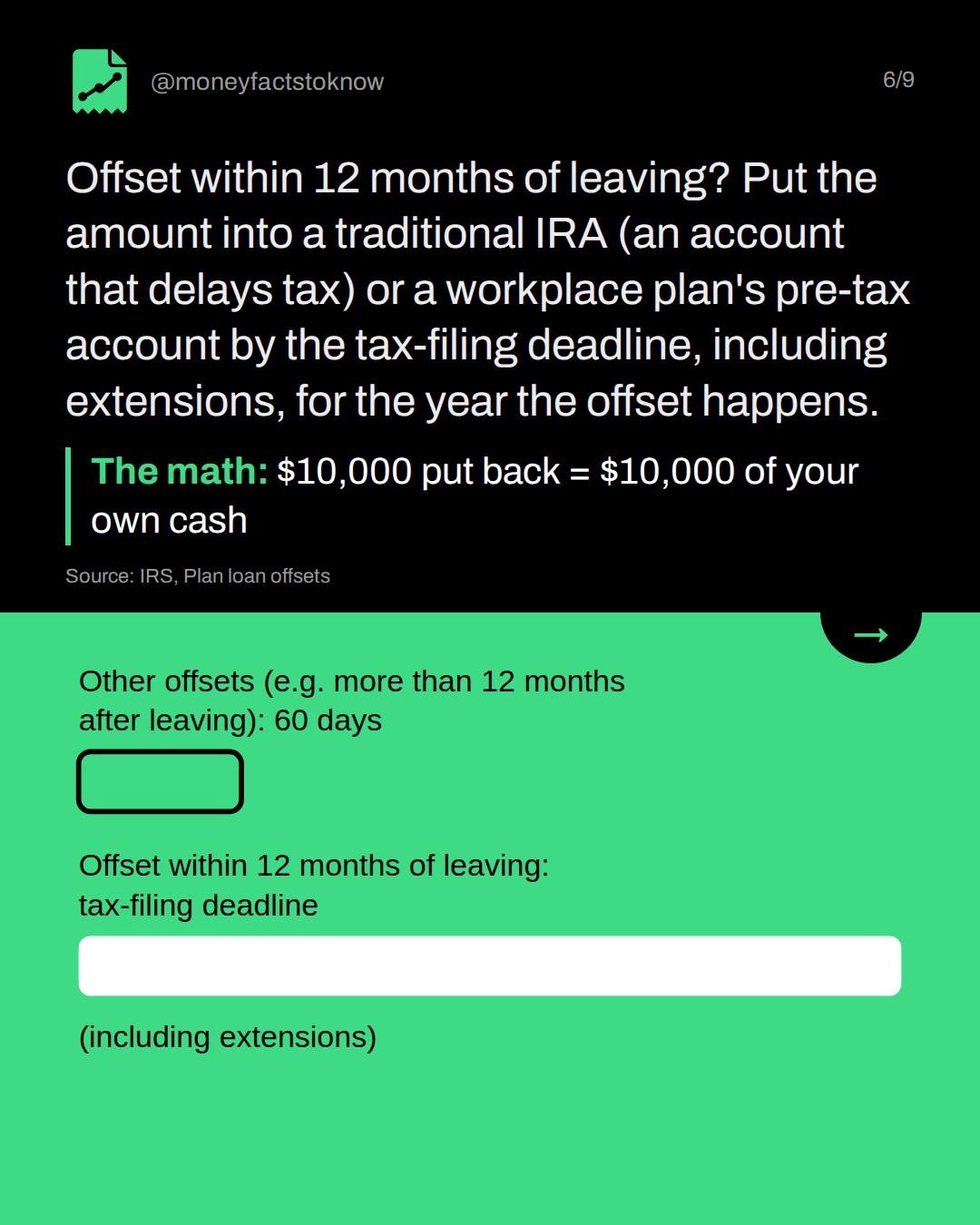
Offset within 12 months of leaving? Put the amount into a traditional IRA (an account that delays tax) or a workplace plan's pre-tax account by the tax-filing deadline, including extensions, for the year the offset happens.
The math: $10,000 put back = $10,000 of your own cash
Source: IRS, Plan loan offsets
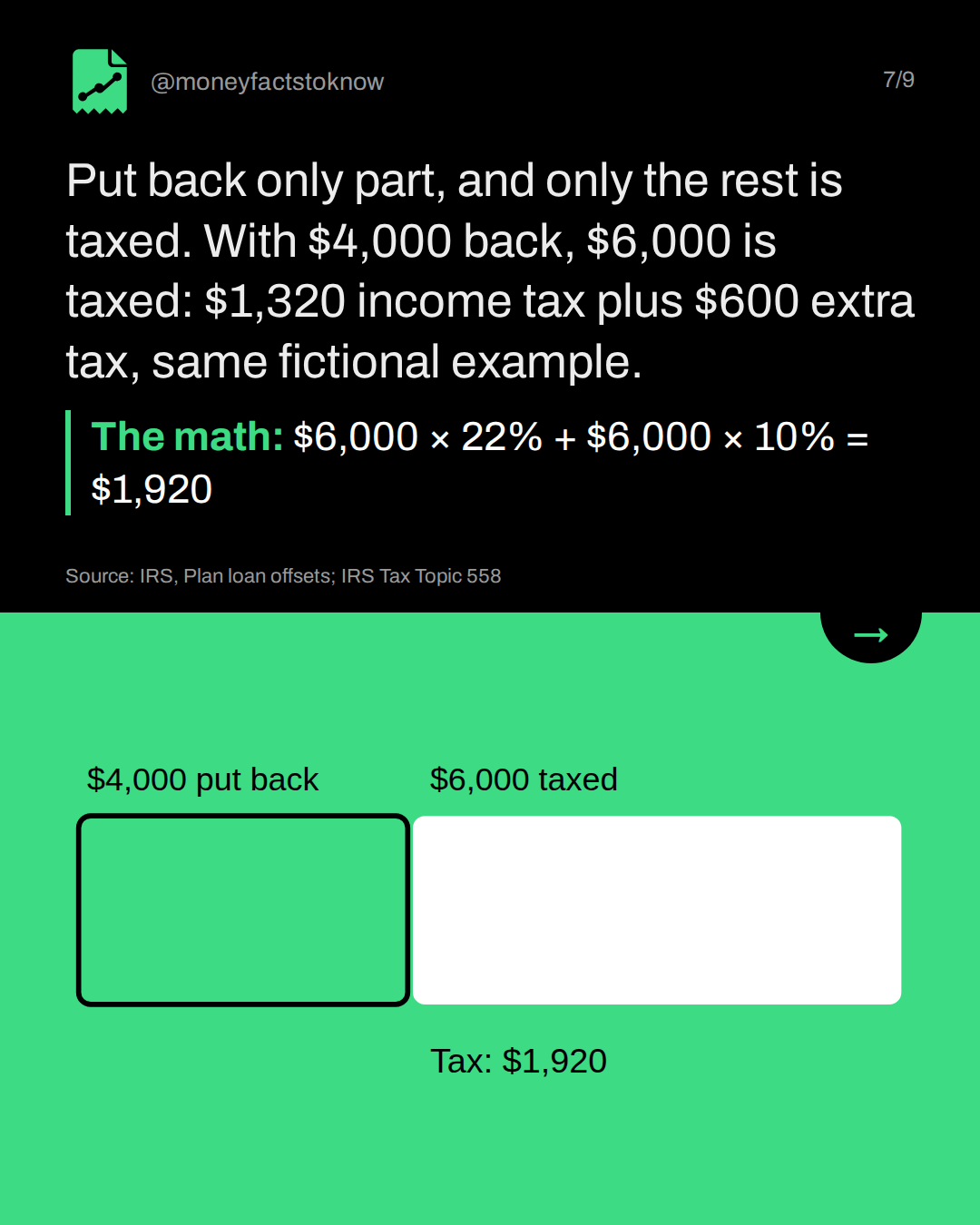
Put back only part, and only the rest is taxed. With $4,000 back, $6,000 is taxed: $1,320 income tax plus $600 extra tax, same fictional example.
The math: $6,000 × 22% + $6,000 × 10% = $1,920
Source: IRS, Plan loan offsets; IRS Tax Topic 558
Leaving in or after the year you turn 55 removes the 10% extra tax on that plan, another bracket changes the 22%, and state tax is extra. Your 1099-R tax form shows code M in box 7.
Source: IRS Tax Topic 558; IRS, Plan loan offsets
Sources and assumptions
- IRS: Plan loan offsets: A plan loan offset happens when the account balance is reduced to pay a defaulted loan and is an actual distribution. A qualified plan loan offset (QPLO) comes from the plan ending or from failing to repay because of severance from employment, and must occur within the period from severance to its first anniversary. A QPLO can be rolled over by the tax-filing due date including extensions; other offsets get the 60-day period. The rollover must use other resources (Example 1: taxed 'unless Employee A transfers $3,000 from other resources'). Reported with Code M in box 7 of Form 1099-R. Page last updated 27-Jun-2026. (checked 2026-10-31)
- IRS: Retirement plans FAQs regarding loans: Plans are not required to offer loans and set their own procedures. A plan loan offset amount is treated as an actual distribution for rollover purposes, with the rollover deadline at the tax return due date including extensions since January 1, 2018. Loan limit is the lesser of $50,000 or the greater of $10,000 or 50% of the vested balance. Repaid within 5 years, at least quarterly. (checked 2026-10-31)
- IRS: Retirement topics – Loans: 'Plan sponsors may require an employee to repay the full outstanding balance of a loan if he or she terminates employment or if the plan is terminated.' An unpaid balance is taxed as a distribution and may be subject to the 10% early distribution tax. (checked 2026-10-31)
- IRS Tax Topic 558, Additional tax on early distributions from retirement plans other than IRAs: 10% additional tax on the taxable part of a distribution before age 59½. Exception: distributions after separating from service with your employer after reaching age 55. Last updated 24-Sep-2026. (checked 2026-10-31)
- 26 CFR 31.3405(c)-1, Q&A-11 (Cornell LII): Withholding can't exceed the cash and property received. 'If the only portion of an eligible rollover distribution that is not paid in a direct rollover consists of employer securities or a plan loan offset amount, withholding is not required.' (checked 2026-10-31)
- IRS: Tax inflation adjustments for tax year 2026 (including OBBB amendments): 2026 single standard deduction $16,100. 22% applies over $50,400 and 24% over $105,700 for single filers. (checked 2026-10-31)
Assumptions:
- Fictional single filer, tax year 2026, $70,000 of wages, no other income, standard deduction $16,100, no credits; federal income tax only (state tax not included).
- Age 40 at departure (under 59½, and not leaving in or after the year they turn 55), so the 10% additional tax applies.
- $10,000 unpaid loan, offset by the plan after the worker leaves and within 12 months of leaving, so it is a qualified plan loan offset. The rest of the account is moved straight to an IRA or left in the plan, so no tax is withheld on the offset.
- The loan met the IRS loan rules before the worker left. Whether and when the plan offsets depends on that plan's own terms.
- The whole $10,000 falls inside the 22% bracket: taxable income goes from $53,900 to $63,900, between $50,400 and $105,700.
- A rollover of the offset uses the worker's other money, deposited by the 2026 return's due date including extensions.
The short version
- An unpaid loan becomes taxable income when offset
- Usually no tax is withheld
- Putting it back uses your own money
- Offset within 12 months of leaving: tax-filing date deadline
- Most other offsets get only 60 days


