 Money Facts To Know
One example: same $1,000 payment, $9.86 less interest. Only the date changed
If you pay once a month, near the due date, it's easy to think only the amount matters. Fictional card: $2,000 owed, 24% APR (the yearly rate), 30-day cycle, no new purchases.
Source: CFPB
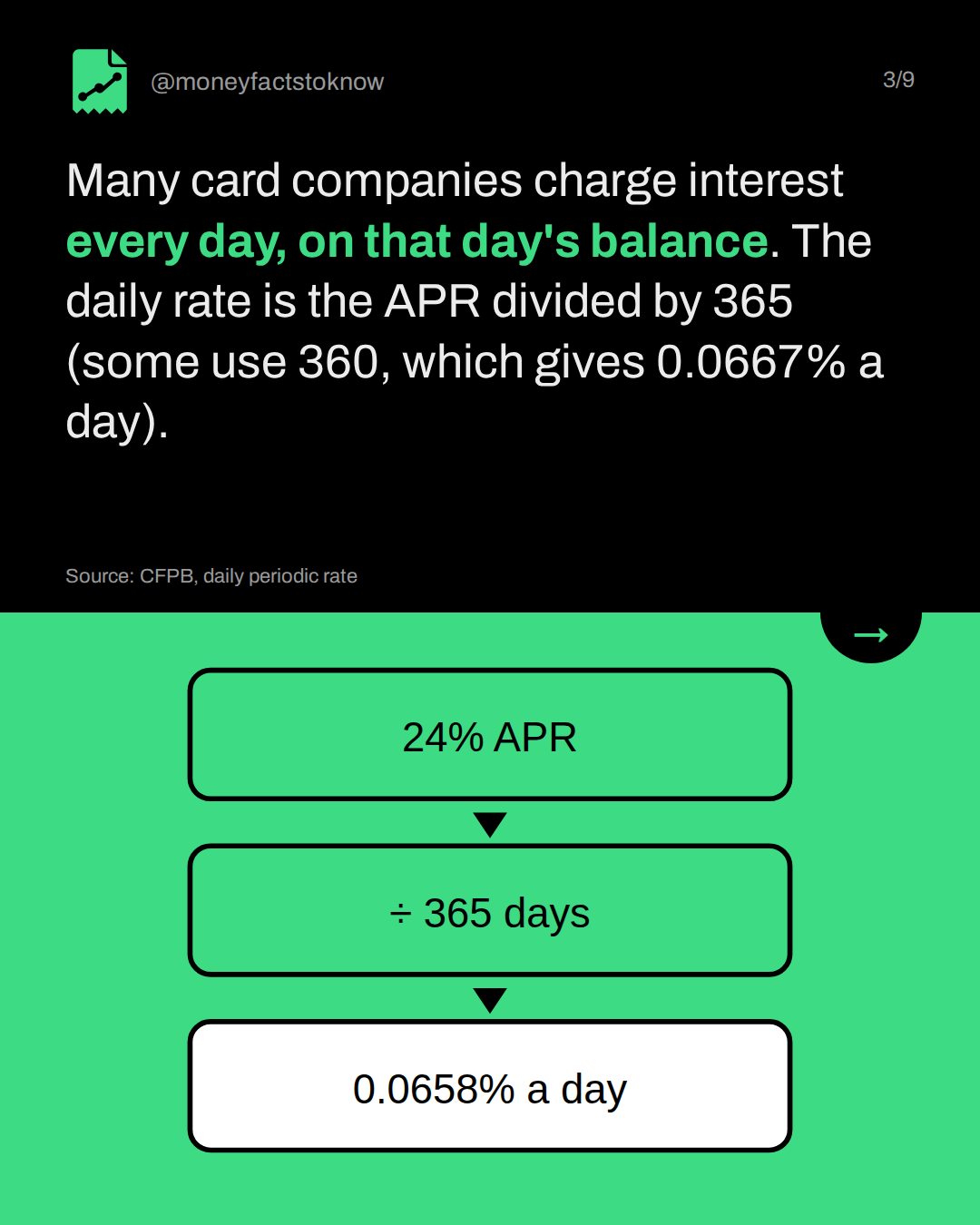
Many card companies charge interest every day, on that day's balance. The daily rate is the APR divided by 365 (some use 360, which gives 0.0667% a day).
Source: CFPB, daily periodic rate
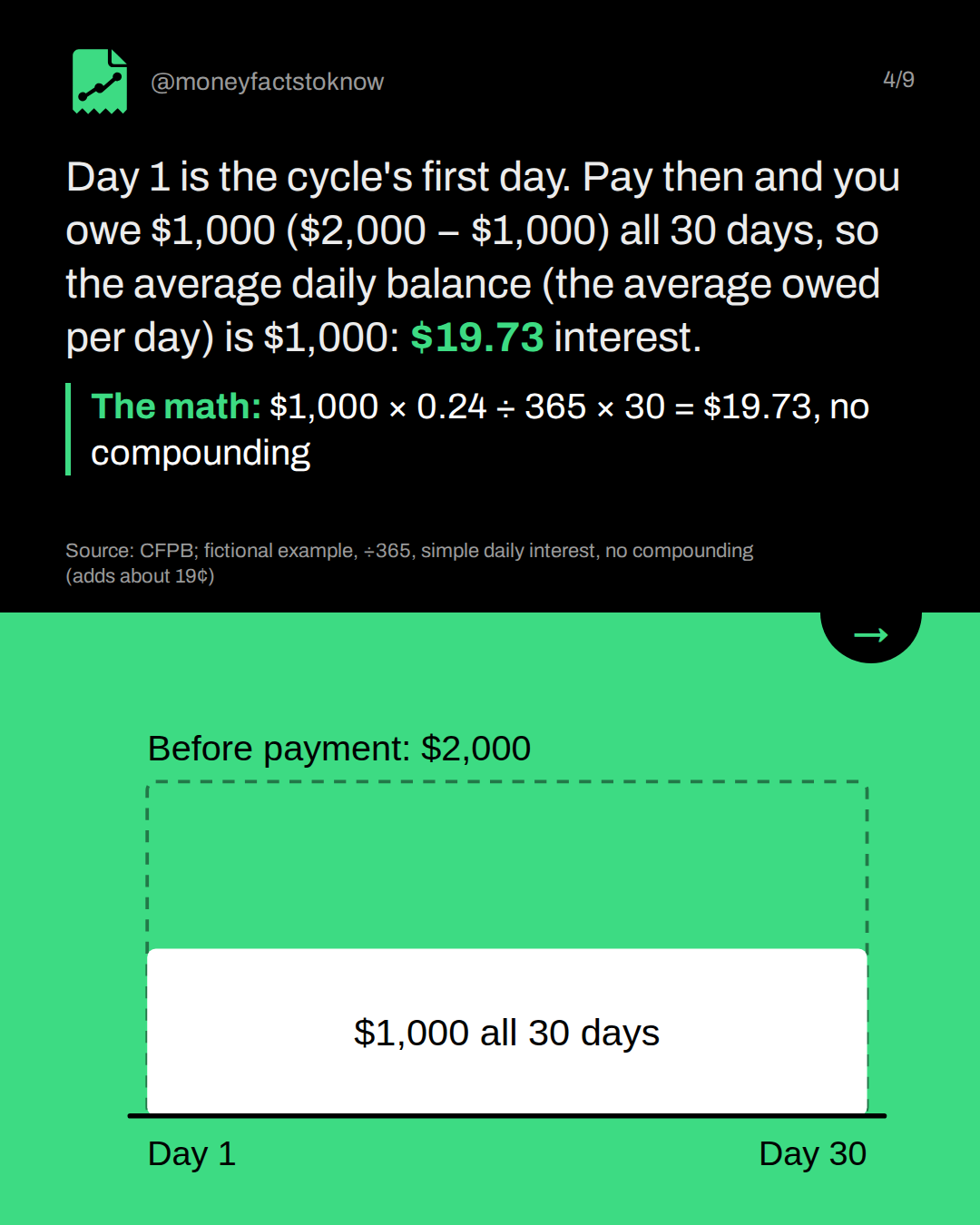
Day 1 is the cycle's first day. Pay then and you owe $1,000 ($2,000 − $1,000) all 30 days, so the average daily balance (the average owed per day) is $1,000: $19.73 interest.
The math: $1,000 × 0.24 ÷ 365 × 30 = $19.73, no compounding
Source: CFPB; fictional example, ÷365, simple daily interest, no compounding (adds about 19¢)
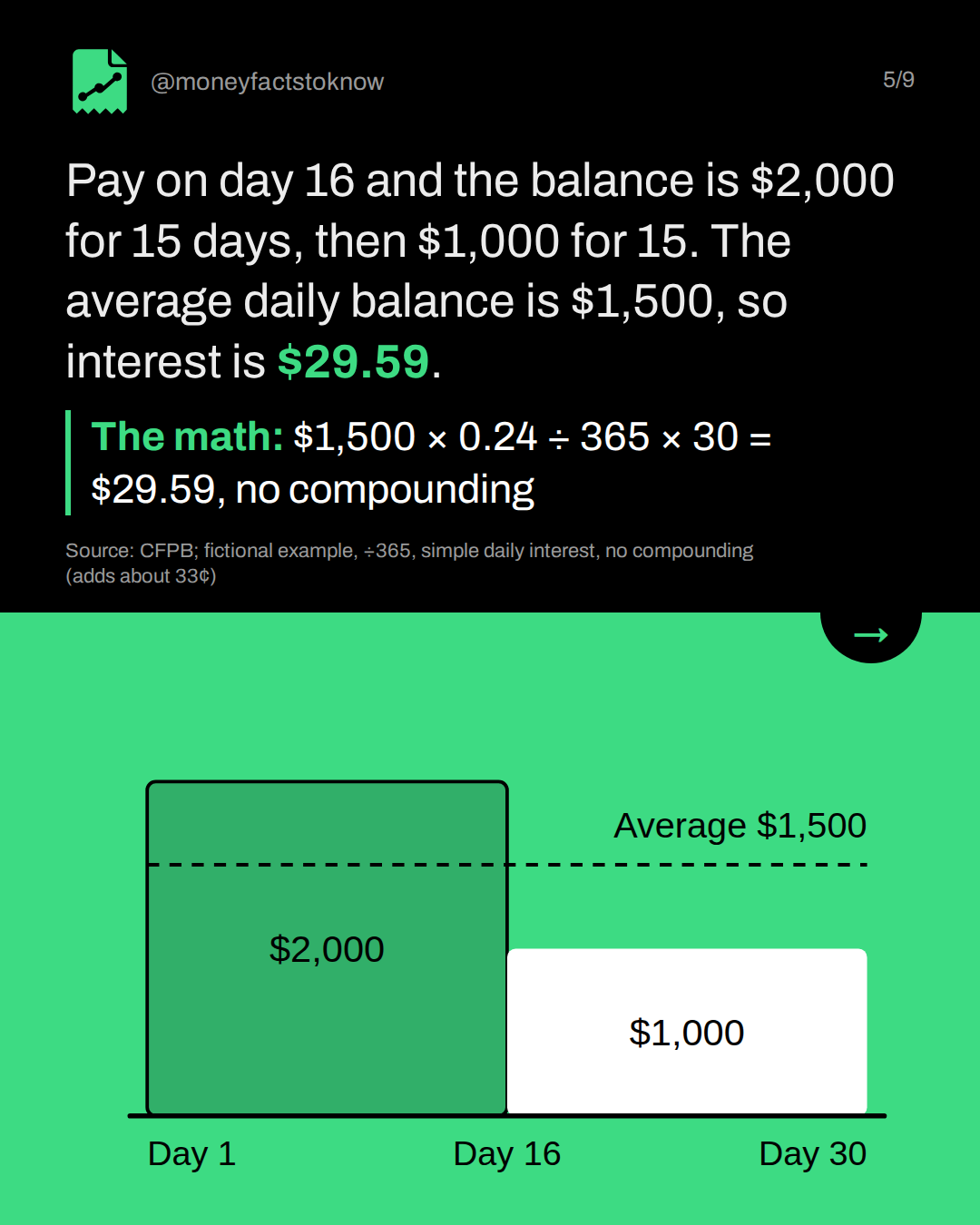
Pay on day 16 and the balance is $2,000 for 15 days, then $1,000 for 15. The average daily balance is $1,500, so interest is $29.59.
The math: $1,500 × 0.24 ÷ 365 × 30 = $29.59, no compounding
Source: CFPB; fictional example, ÷365, simple daily interest, no compounding (adds about 33¢)
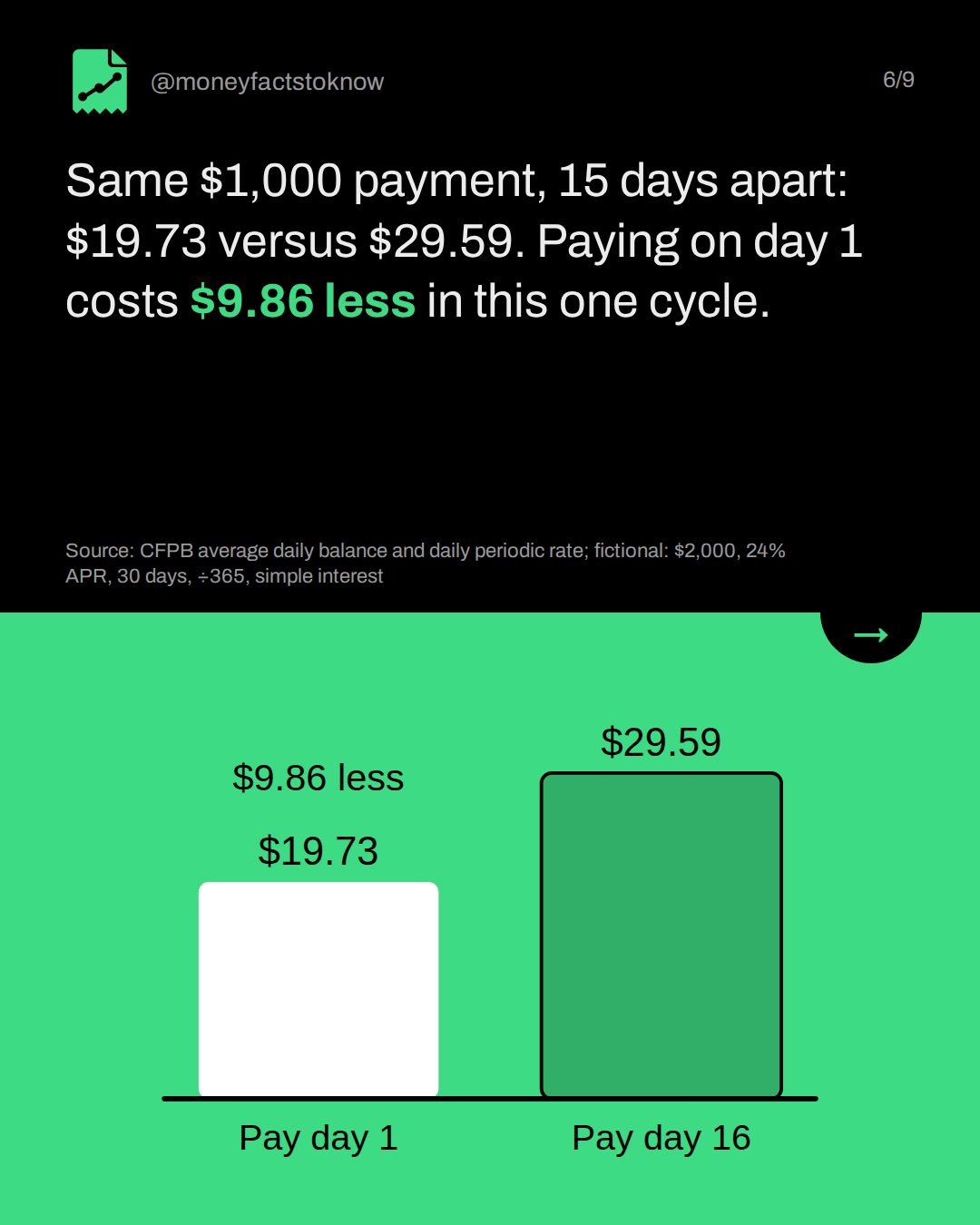
Same $1,000 payment, 15 days apart: $19.73 versus $29.59. Paying on day 1 costs $9.86 less in this one cycle.
Source: CFPB average daily balance and daily periodic rate; fictional: $2,000, 24% APR, 30 days, ÷365, simple interest
Pay the full statement balance by the due date and a grace period (an interest-free window on new purchases) usually means no purchase interest. This example is about cards already carrying a balance.
Source: CFPB, grace period
A payment counts on the day the card company receives it, if it beats the cut-off time (no earlier than 5 p.m. on the due date). That's Regulation Z, the federal credit card rule. Check your card agreement.
Source: Regulation Z, 12 CFR 1026.10; CFPB
Sources and assumptions
- CFPB: How is the interest on my credit card calculated?: 'Many credit card companies calculate the interest you owe daily, based on your average daily account balance.' 'The interest charged daily is called the daily periodic rate.' The grace period usually applies only to new purchases and only if you weren't already carrying a balance. 'The sooner you pay off all or some of your balance, the less interest you will pay.' (checked 2026-10-31)
- CFPB: What is a daily periodic rate?: 'The daily periodic interest rate generally can be calculated by dividing the annual percentage rate, or APR, by either 360 or 365, depending on the card issuer'; it's used by multiplying the rate by the amount owed at the end of each day. (checked 2026-10-31)
- CFPB: What is a grace period for a credit card?: You may not be charged interest during the grace period if you pay your balance in full by the due date. If you don't pay in full, you're charged interest on the unpaid portion and lose the grace period on new purchases, possibly for that month and the next. (checked 2026-10-31)
- Regulation Z, 12 CFR 1026.10 Payments (CFPB): 'A creditor shall credit a payment to the consumer's account as of the date of receipt' (1026.10(a)); cut-off times can be no earlier than 5 p.m. on the payment due date (1026.10(b)(2)(ii)). (checked 2026-10-31)
- Regulation Z, 12 CFR 1026.5 General disclosure requirements (CFPB): For credit card accounts, creditors must adopt procedures to ensure that 'periodic statements are mailed or delivered at least 21 days prior to the payment due date disclosed on the statement' (1026.5(b)(2)(ii)(A)(1)) (checked 2026-10-31)
Assumptions:
- Fictional card and balance: $2,000 owed at the start of a 30-day billing cycle, and no new purchases, fees or other payments during the cycle
- 24% APR, a single APR on the whole balance
- No grace period, because the cardholder is already carrying a balance from the prior month
- Daily periodic rate = APR ÷ 365 (some issuers use 360)
- Average daily balance method with simple daily interest (no daily compounding inside the cycle). The CFPB says card interest is generally compounded daily. With daily compounding, the example costs $19.92 and $29.92, a $10.00 difference
- The $1,000 payment counts on the day it's received (day 1 = counted from the first day of the cycle; day 16 = the balance is $2,000 on days 1–15 and $1,000 on days 16–30)
- Federal (US) rules; actual card terms vary by issuer
The short version
- Carrying a balance means interest counts every day
- An earlier payment lowers the average balance
- Same $1,000: $19.73 vs $29.59 here
- Check your card's balance method


