 Money Facts To Know
Paying your mortgage every 2 weeks saves mostly through one extra payment
A biweekly plan means paying half your monthly payment every two weeks. The loan stays the same. What changes is how much you pay in a year.
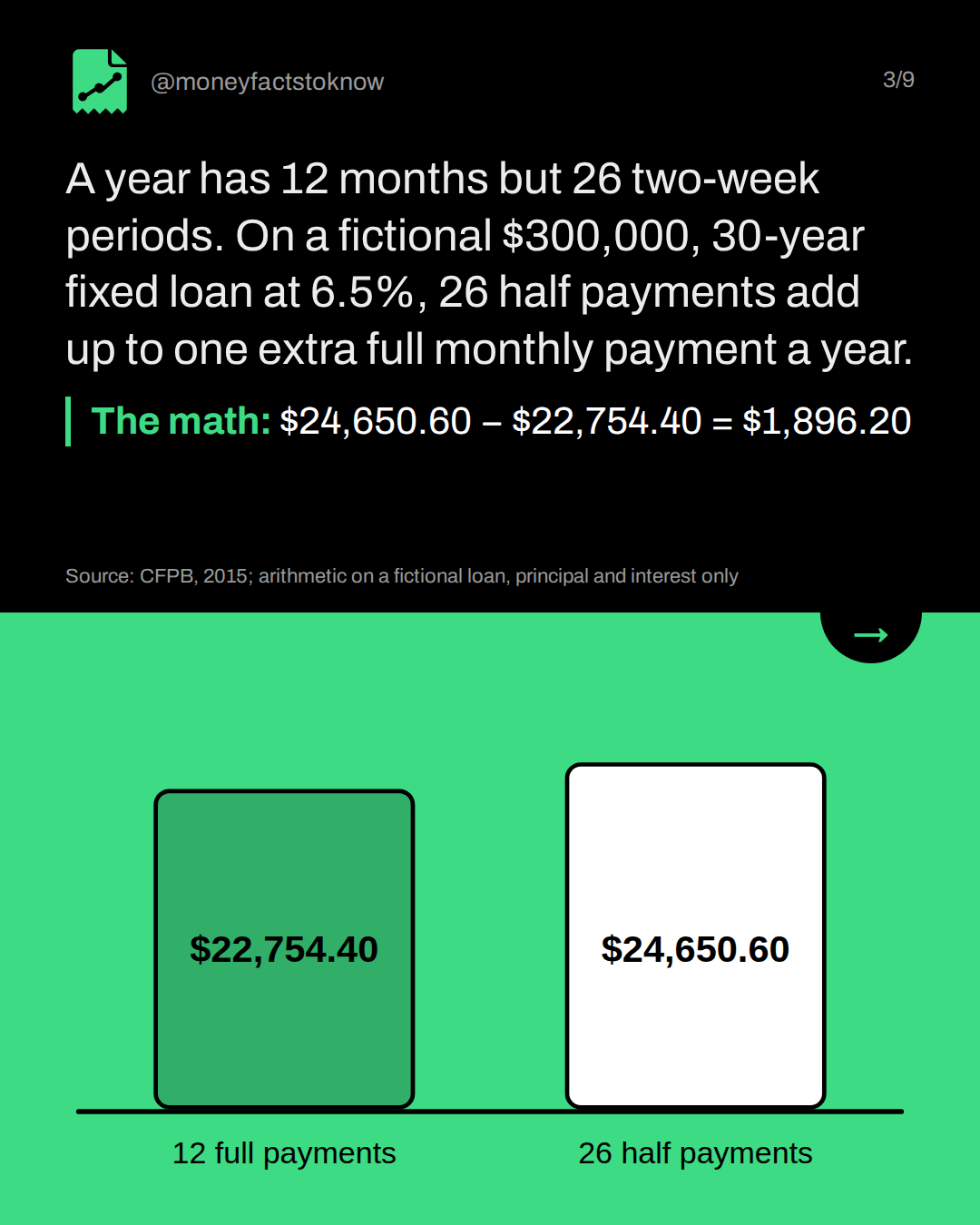
A year has 12 months but 26 two-week periods. On a fictional $300,000, 30-year fixed loan at 6.5%, 26 half payments add up to one extra full monthly payment a year.
The math: $24,650.60 − $22,754.40 = $1,896.20
Source: CFPB, 2015; arithmetic on a fictional loan, principal and interest only
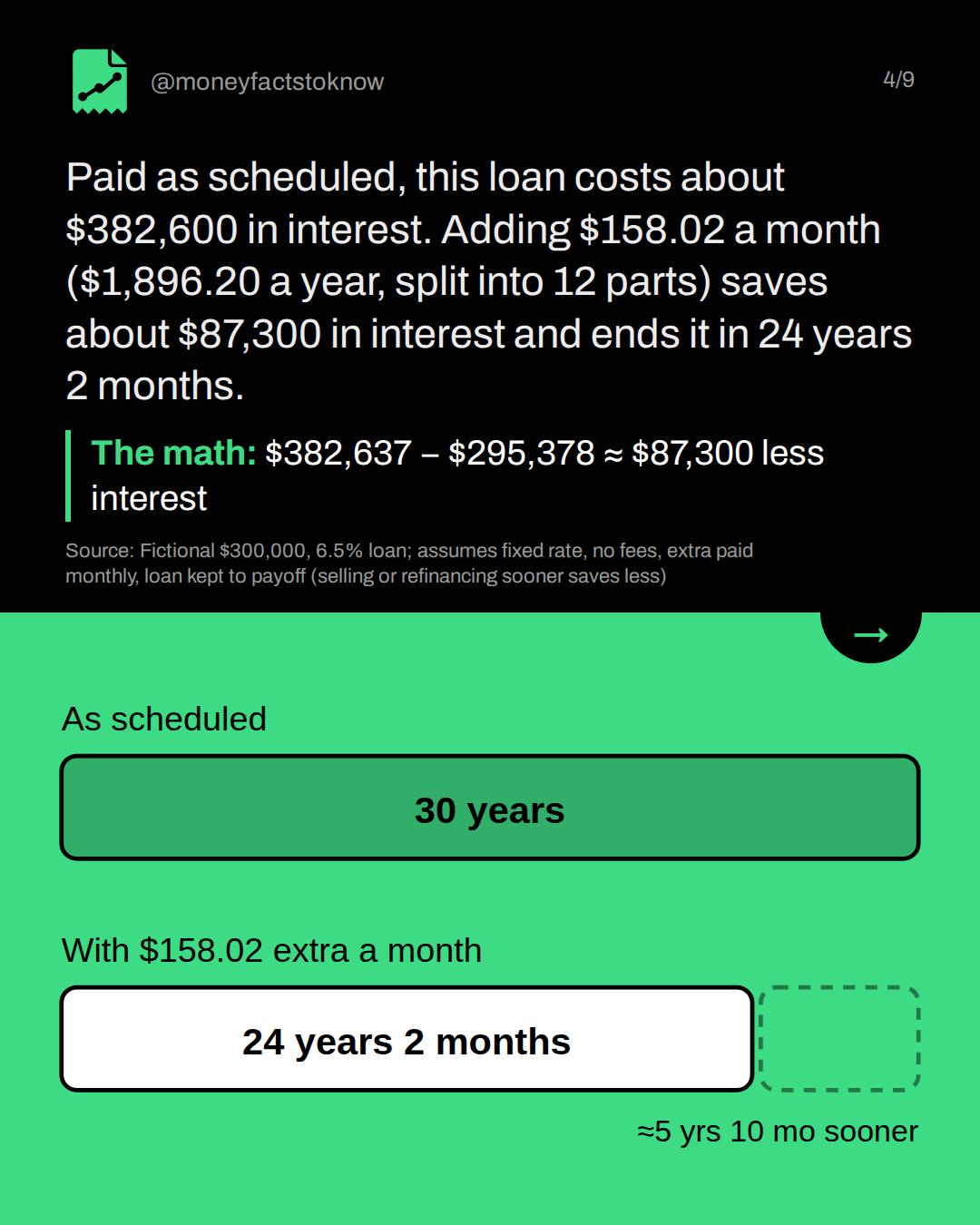
Paid as scheduled, this loan costs about $382,600 in interest. Adding $158.02 a month ($1,896.20 a year, split into 12 parts) saves about $87,300 in interest and ends it in 24 years 2 months.
The math: $382,637 − $295,378 ≈ $87,300 less interest
Source: Fictional $300,000, 6.5% loan; assumes fixed rate, no fees, extra paid monthly, loan kept to payoff (selling or refinancing sooner saves less)
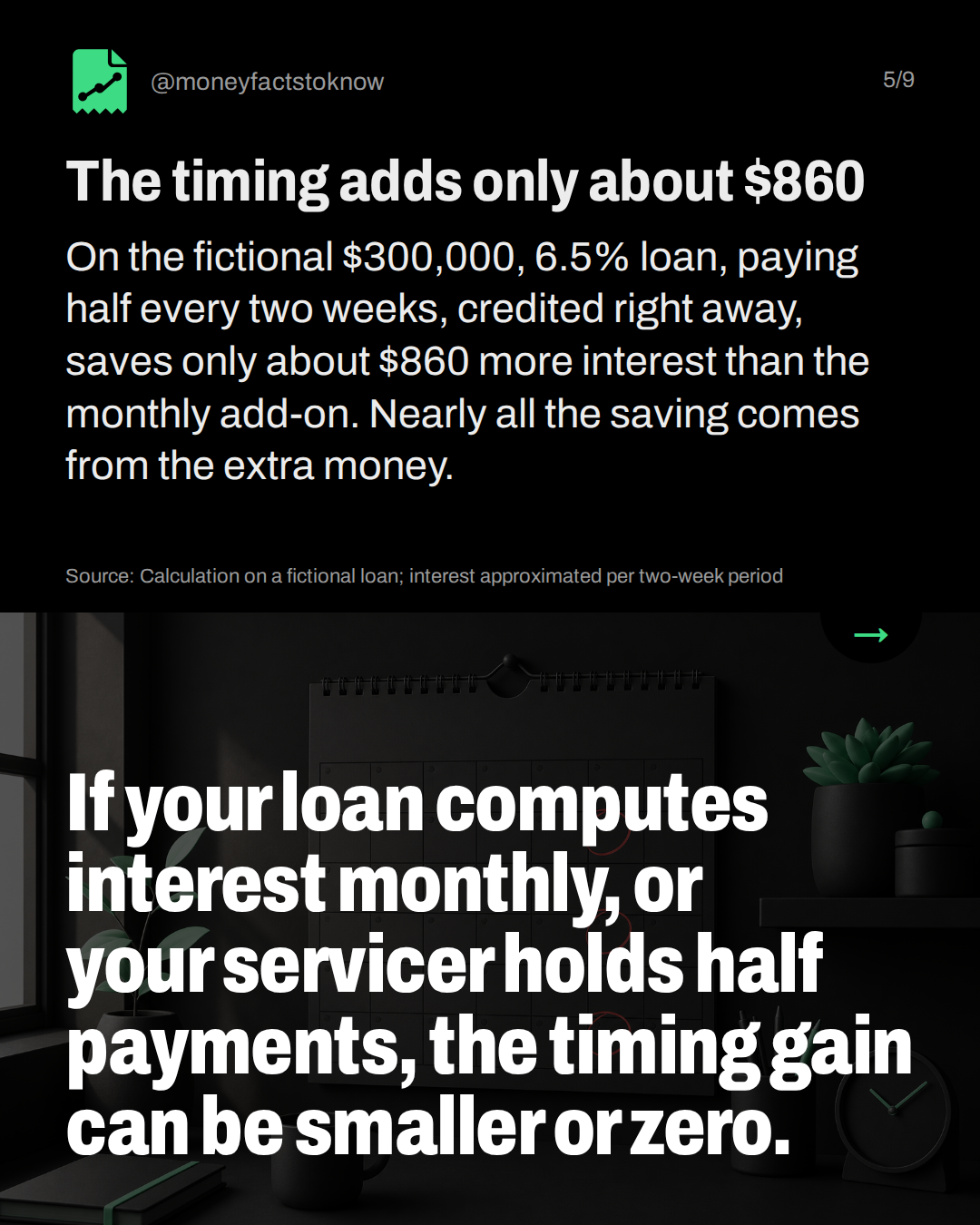
The timing adds only about $860
On the fictional $300,000, 6.5% loan, paying half every two weeks, credited right away, saves only about $860 more interest than the monthly add-on. Nearly all the saving comes from the extra money.
The math: If your loan computes interest monthly, or your servicer holds half payments, the timing gain can be smaller or zero.
Source: Calculation on a fictional loan; interest approximated per two-week period
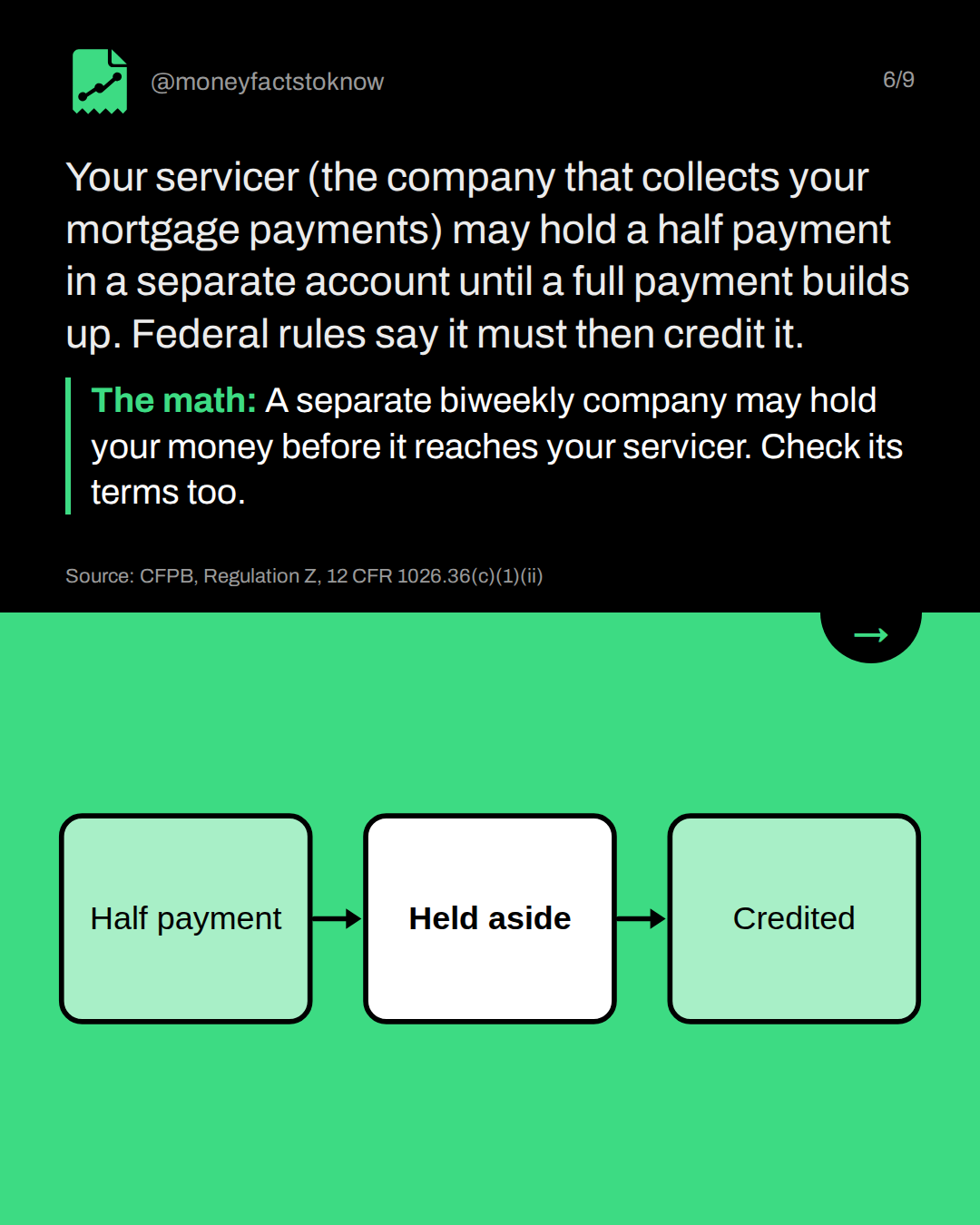
Your servicer (the company that collects your mortgage payments) may hold a half payment in a separate account until a full payment builds up. Federal rules say it must then credit it.
The math: A separate biweekly company may hold your money before it reaches your servicer. Check its terms too.
Source: CFPB, Regulation Z, 12 CFR 1026.36(c)(1)(ii)
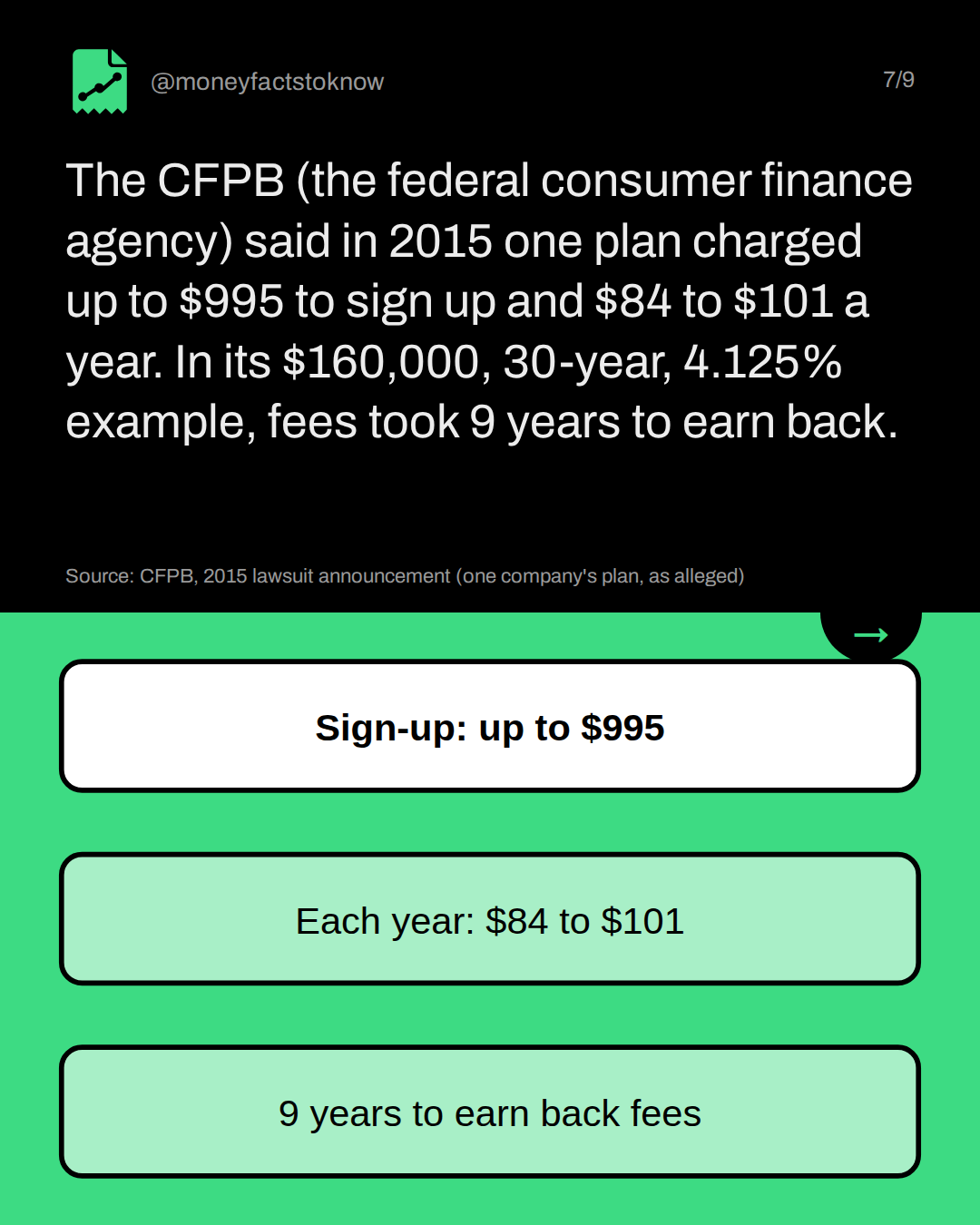
The CFPB (the federal consumer finance agency) said in 2015 one plan charged up to $995 to sign up and $84 to $101 a year. In its $160,000, 30-year, 4.125% example, fees took 9 years to earn back.
Source: CFPB, 2015 lawsuit announcement (one company's plan, as alleged)
What to check before paying extra
Check if extra payments are free and applied right away, if a plan charges fees, and if a prepayment penalty (a fee for paying early) applies. They don't lower monthly payment. Compare 6.5% with other debts' rates.
The math: Money sent in can't come back out without selling, refinancing or borrowing against the home.
Source: CFPB, prepayment penalty guidance; CFPB, How does paying down a mortgage work?
Sources and assumptions
- CFPB newsroom: CFPB Files Suit Against Nationwide Biweekly for Luring Consumers With False Promises of Mortgage Savings (May 11, 2015): Paying half the monthly payment every two weeks is 'effectively making one additional monthly payment per year'. Set-up fee 'up to $995', with the first extra biweekly payment kept as the set-up fee. Processing fees of $84 to $101 a year. In the CFPB's example ($160,000, 4.125%, 30 years), a borrower needs 9 years to recoup the fees and has paid more than $1,200 in fees by then. (checked 2026-10-30)
- CFPB enforcement action page: Nationwide Biweekly Administration: The 'Interest Minimizer Program'. A $7.93 million civil money penalty imposed August 29, 2024, affirmed by the Ninth Circuit November 17, 2025, with certiorari (Supreme Court review) denied March 23, 2026. (checked 2026-10-30)
- CFPB Ask CFPB: What is a prepayment penalty?: Prepayment penalties 'do not normally apply if you pay extra principal on your mortgage in small chunks at a time', but check with the lender. Penalties typically apply to full payoff within usually 3 or 5 years. (checked 2026-10-30)
- CFPB Regulation Z, 12 CFR 1026.36(c)(1)(ii): A servicer may hold a partial payment (less than a full periodic payment) in a suspense or unapplied funds account. It must show the amount on the periodic statement and treat the funds as a periodic payment once they add up to a full payment. (checked 2026-10-30)
- CFPB Ask CFPB: How does paying down a mortgage work?: 'With a typical fixed-rate loan, the combined principal and interest payment does not change over the life of your loan, but the amounts that go to principal rather than interest do change.' 'The part of your payment that goes to principal reduces the amount you owe on the loan and builds your equity.' Last reviewed May 28, 2024. (checked 2026-10-30)
- CFPB Ask CFPB: What is a home equity loan?: Equity is 'the amount your property is currently worth, minus the amount of any existing mortgage on your property.' A home equity loan 'allows you to borrow money using the equity in your home as collateral.' Last reviewed Sept 11, 2024. (checked 2026-10-30)
- CFPB Ask CFPB: What is a home equity line of credit (HELOC)?: 'A Home Equity Line of Credit (HELOC) is a line of credit, like a credit card, except you are borrowing against the equity of your home.' Last reviewed Aug 28, 2026. (checked 2026-10-30)
- CFPB Office of Research blog: A look at cash-out refinance mortgages and their borrowers between 2013 to 2023 (Dec 18, 2023): 'Cash-out refinances – where a homeowner borrows an amount substantially greater than what they owe on their existing mortgage' (checked 2026-10-30)
Assumptions:
- Fictional loan: $300,000, 30-year fixed rate of 6.5%, monthly payment of principal and interest only (taxes, insurance and escrow excluded).
- Monthly interest = balance × 6.5%/12, rounded to the cent. Scheduled payment = standard amortization formula, $1,896.20 (rounded down to the cent, so the scheduled loan ends with a final payment a few dollars larger).
- Total interest when paid as scheduled: about $382,637 (computed month by month), shown as 'about $382,600'.
- Monthly add-on scenario: an extra $158.02 (= $1,896.20 / 12) goes to principal every month starting with payment 1, with no fees.
- Biweekly comparison: each $948.10 half payment is credited when paid, with interest at 6.5%/26 per two-week period (an approximation; real servicers compute interest monthly and may hold half payments until a full payment builds up). The biweekly saving is only ~$864 more than the monthly add-on.
- 26 two-week periods in most years (some calendar years have 27 biweekly dates).
- No prepayment penalty on the loan.
- Fee figures are one company's program as described in a 2015 CFPB lawsuit, not a typical or current price. The CFPB's own example used a $160,000 loan at 4.125% over 30 years.
The short version
- 26 half payments make one extra monthly payment.
- The extra money does the work.
- In our example, timing added only about $860.
- Check fees and how payments are applied.


