 Money Facts To Know
Joint return, no paycheck? Your spouse's pay can fund your 2026 IRA


No paycheck, no IRA?
Many couples assume a spouse with no paycheck can't have an IRA (an individual retirement account, a savings account for retirement). For one person filing alone, that's right: you can't contribute more than your own taxable pay.
Source: IRS, IRA contribution limits
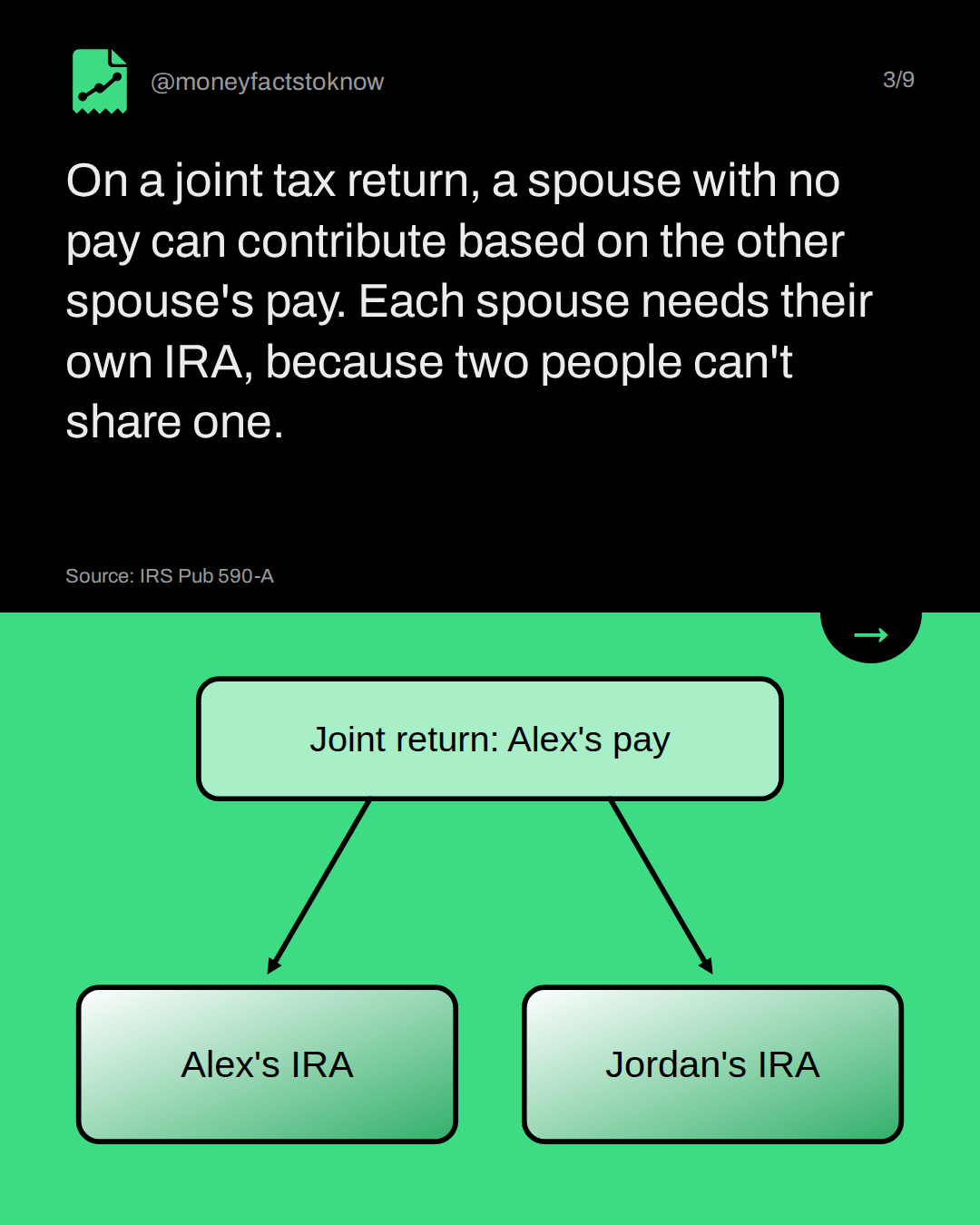
On a joint tax return, a spouse with no pay can contribute based on the other spouse's pay. Each spouse needs their own IRA, because two people can't share one.
Source: IRS Pub 590-A
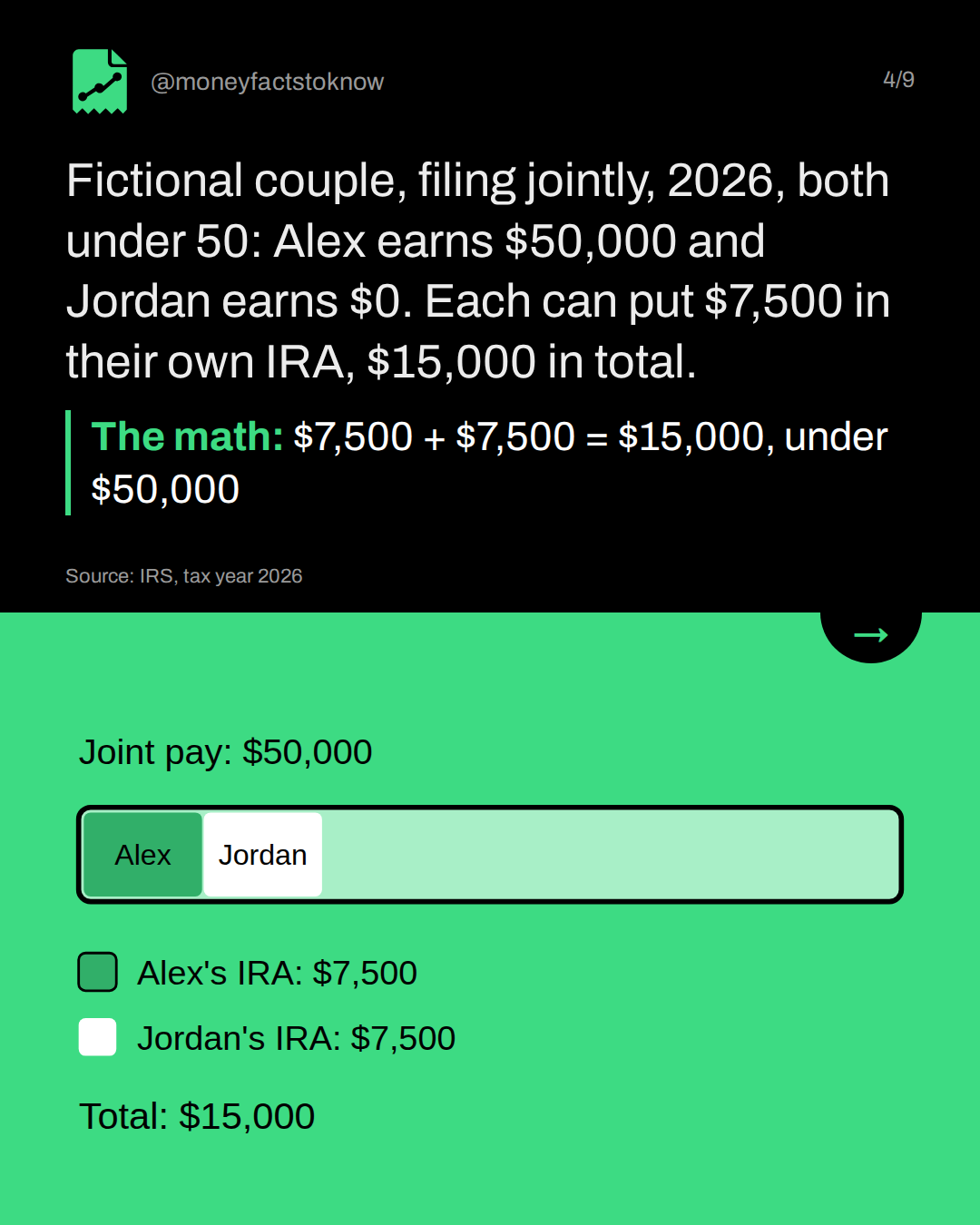
Fictional couple, filing jointly, 2026, both under 50: Alex earns $50,000 and Jordan earns $0. Each can put $7,500 in their own IRA, $15,000 in total.
The math: $7,500 + $7,500 = $15,000, under $50,000
Source: IRS, tax year 2026
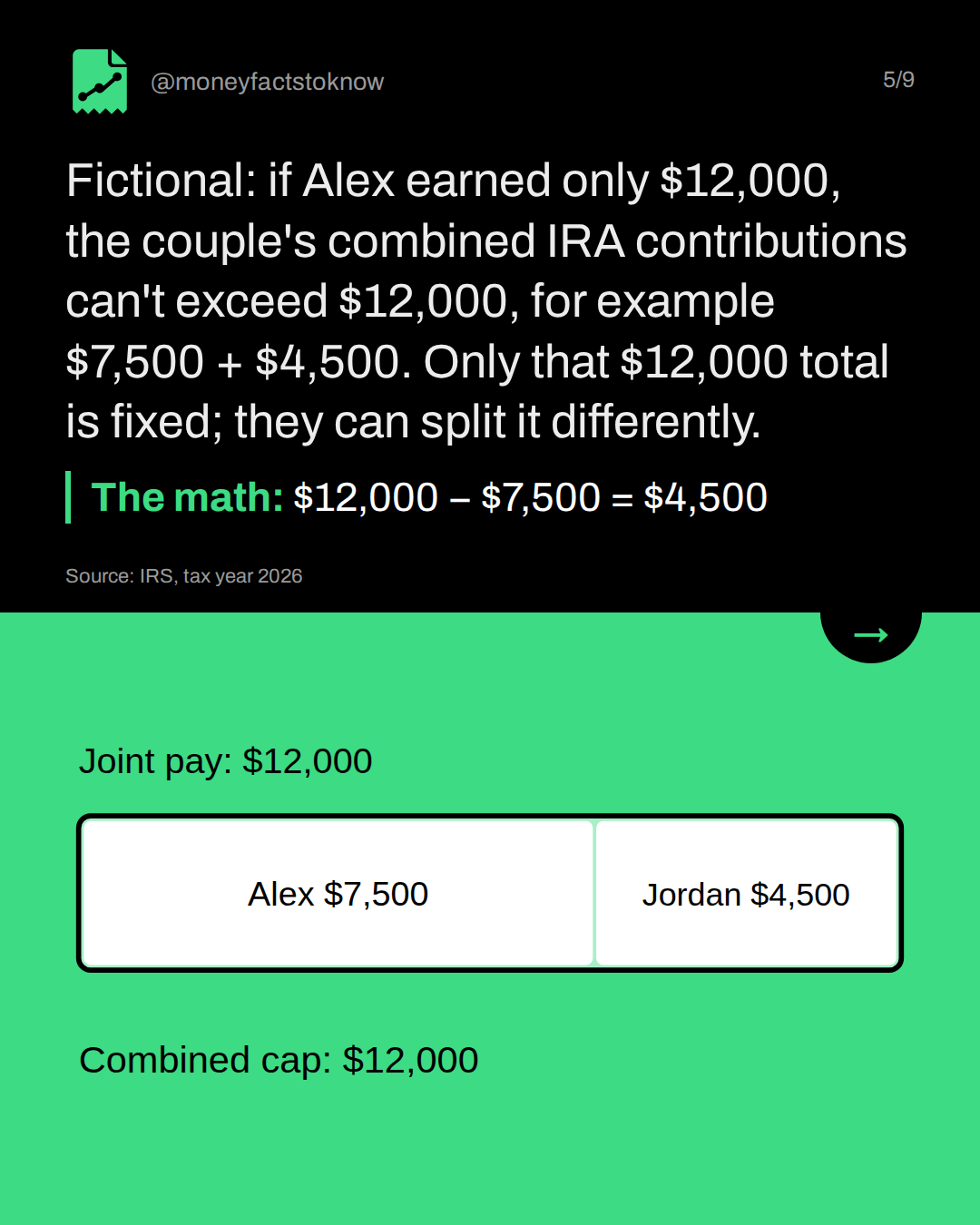
Fictional: if Alex earned only $12,000, the couple's combined IRA contributions can't exceed $12,000, for example $7,500 + $4,500. Only that $12,000 total is fixed; they can split it differently.
The math: $12,000 − $7,500 = $4,500
Source: IRS, tax year 2026

Only some income counts as pay
Taxable wages, salaries, tips, bonuses and net self-employment earnings count. Interest, dividends and pension or annuity income don't.
Source: IRS Pub 590-A
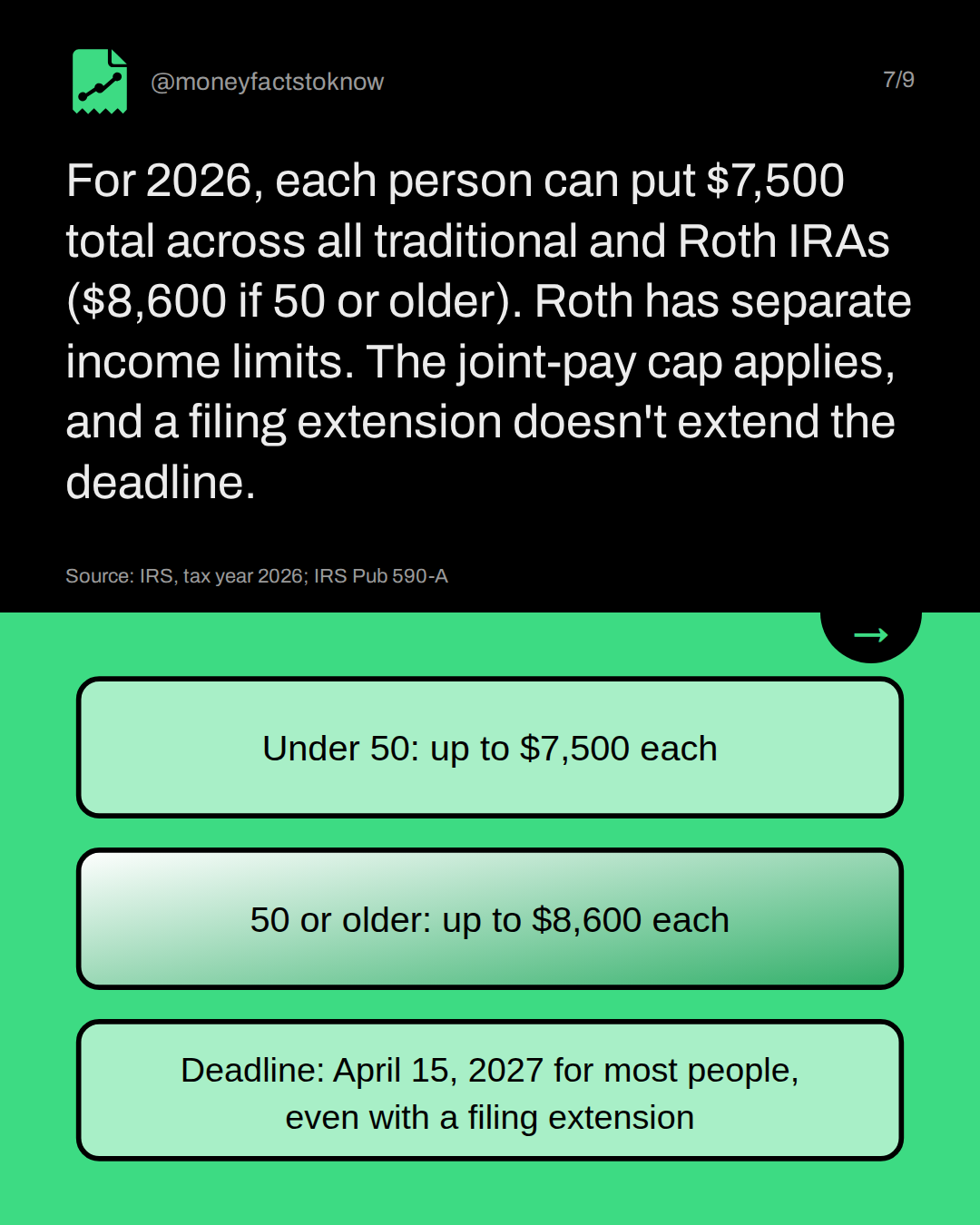
For 2026, each person can put $7,500 total across all traditional and Roth IRAs ($8,600 if 50 or older). Roth has separate income limits. The joint-pay cap applies, and a filing extension doesn't extend the deadline.
Source: IRS, tax year 2026; IRS Pub 590-A
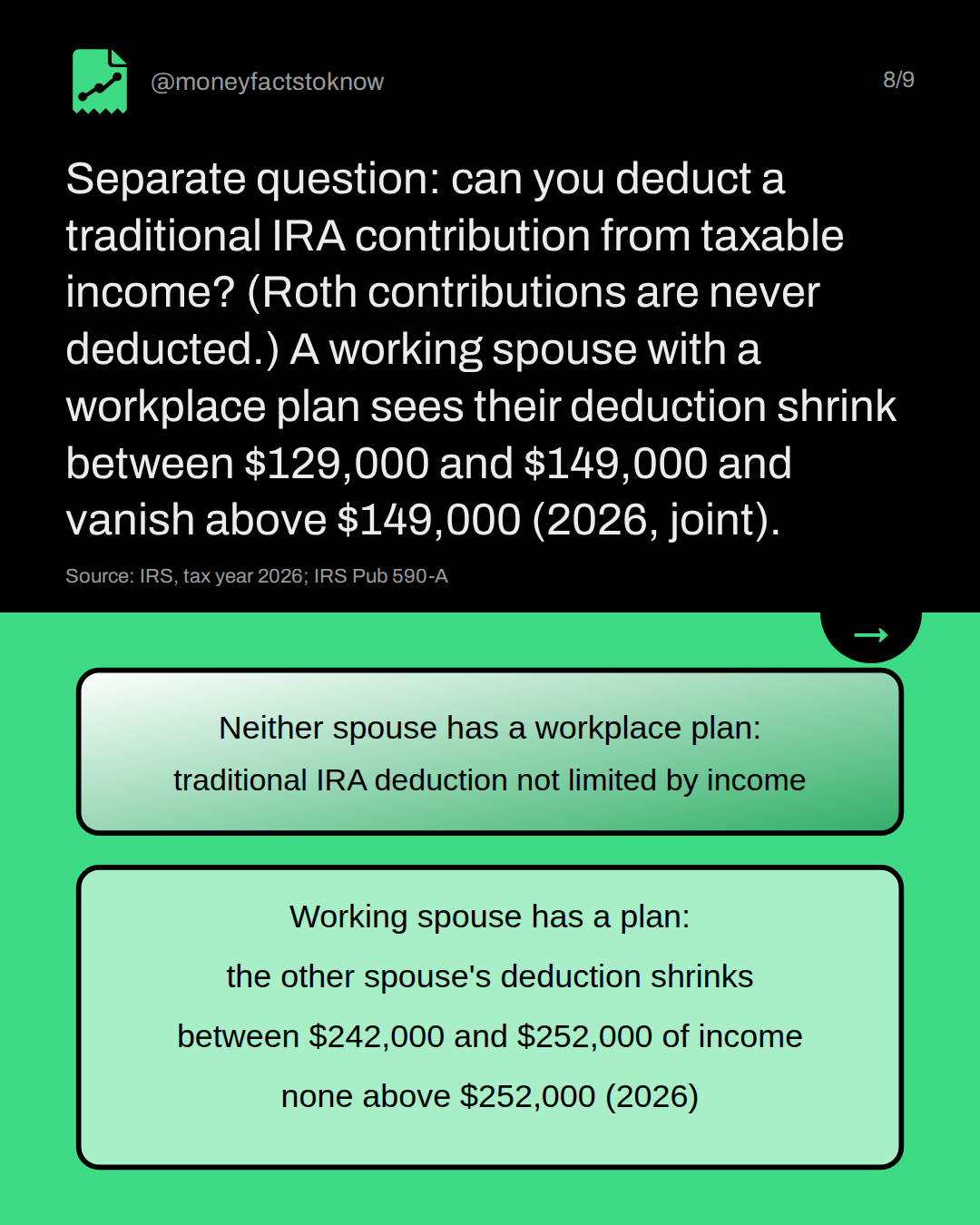
Separate question: can you deduct a traditional IRA contribution from taxable income? (Roth contributions are never deducted.) A working spouse with a workplace plan sees their deduction shrink between $129,000 and $149,000 and vanish above $149,000 (2026, joint).
Source: IRS, tax year 2026; IRS Pub 590-A
Sources and assumptions
- IRS newsroom: 401(k) limit increases to $24,500 for 2026, IRA limit increases to $7,500: 2026 IRA limit $7,500; 2026 IRA catch-up for 50+ is $1,100; 2026 deduction phaseouts: single covered $81,000–$91,000, MFJ covered spouse $129,000–$149,000, not covered but spouse covered $242,000–$252,000 (checked 2026-10-30)
- IRS: Retirement topics – IRA contribution limits: Joint filers may contribute even without taxable compensation if the spouse had it; 'the total of your combined contributions can't be more than the taxable compensation reported on your joint return'; 2026 limit $7,500 ($8,600 if 50 or older); the limit is the dollar cap or, if less, your taxable compensation (checked 2026-10-30)
- IRS Publication 590-A (2025 returns edition): Kay Bailey Hutchison Spousal IRA Limit (smaller of the dollar limit or both spouses' compensation reduced by the other spouse's traditional and Roth IRA contributions); 'You can't both participate in the same IRA'; compensation includes wages, salaries, tips, professional fees, bonuses and self-employment income and excludes interest, dividends, pension or annuity income; contributions due by the return due date, not including extensions; when neither spouse is covered by a workplace plan, the deduction is up to the contribution limit with no income phaseout (checked 2026-10-30)
- IRS: Roth IRAs: 'You cannot deduct contributions to a Roth IRA.' (checked 2026-10-30)
Assumptions:
- Fictional couple Alex and Jordan, married filing jointly, tax year 2026
- Alex has $50,000 of W-2 wages; Jordan has $0 of earned income (no wages or self-employment income)
- Both are under 50, so no catch-up applies in the main example
- Neither has made other traditional or Roth IRA contributions for 2026
- The low-income variant assumes Alex earns $12,000 of wages and contributes $7,500 first
- For the deduction, assume neither spouse is covered by a workplace retirement plan (so no phaseout applies); the slide names the 2026 phaseout for the other case
- Pub 590-A wording comes from the 2025-returns edition; the 2026 dollar figures come from the IRS 2026 limits notice and the IRS contribution-limits page
- Federal rules only; state tax treatment not covered; Roth IRA income limits not covered
The short version
- Only on a joint return
- Each spouse has their own IRA
- Up to $7,500 each in 2026
- The total can't top joint taxable pay


