 Money Facts To Know
A fund bought at your bank isn't FDIC-insured


Picture a fictional saver at one FDIC-insured bank with single-owner accounts: $60,000 in savings, a $20,000 CD and a $50,000 mutual fund from the bank's investment desk. That's $130,000.

FDIC insures deposits, not investments
Checking, savings and CDs are covered up to $250,000 per depositor, per bank, per ownership category. Mutual funds, stocks, bonds, annuities, life insurance and crypto aren't, even when an insured bank sells them.
Source: FDIC, as of Oct 2026

Federal interagency guidance says banks selling these products should disclose that they're not FDIC-insured, not guaranteed by the bank, and can lose principal. Look for a label like this one.
Source: Federal Reserve, Interagency Statement, 1994
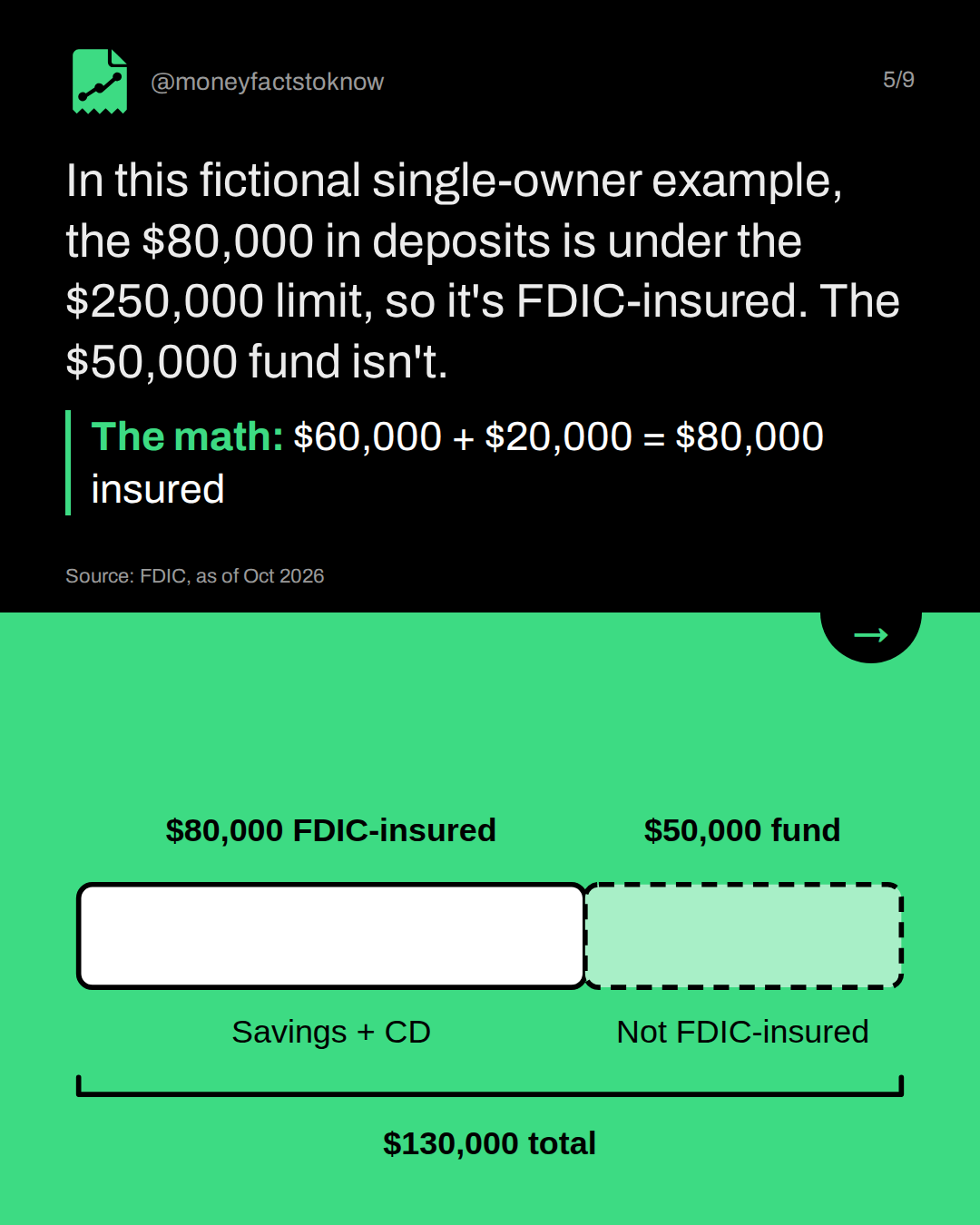
In this fictional single-owner example, the $80,000 in deposits is under the $250,000 limit, so it's FDIC-insured. The $50,000 fund isn't.
The math: $60,000 + $20,000 = $80,000 insured
Source: FDIC, as of Oct 2026
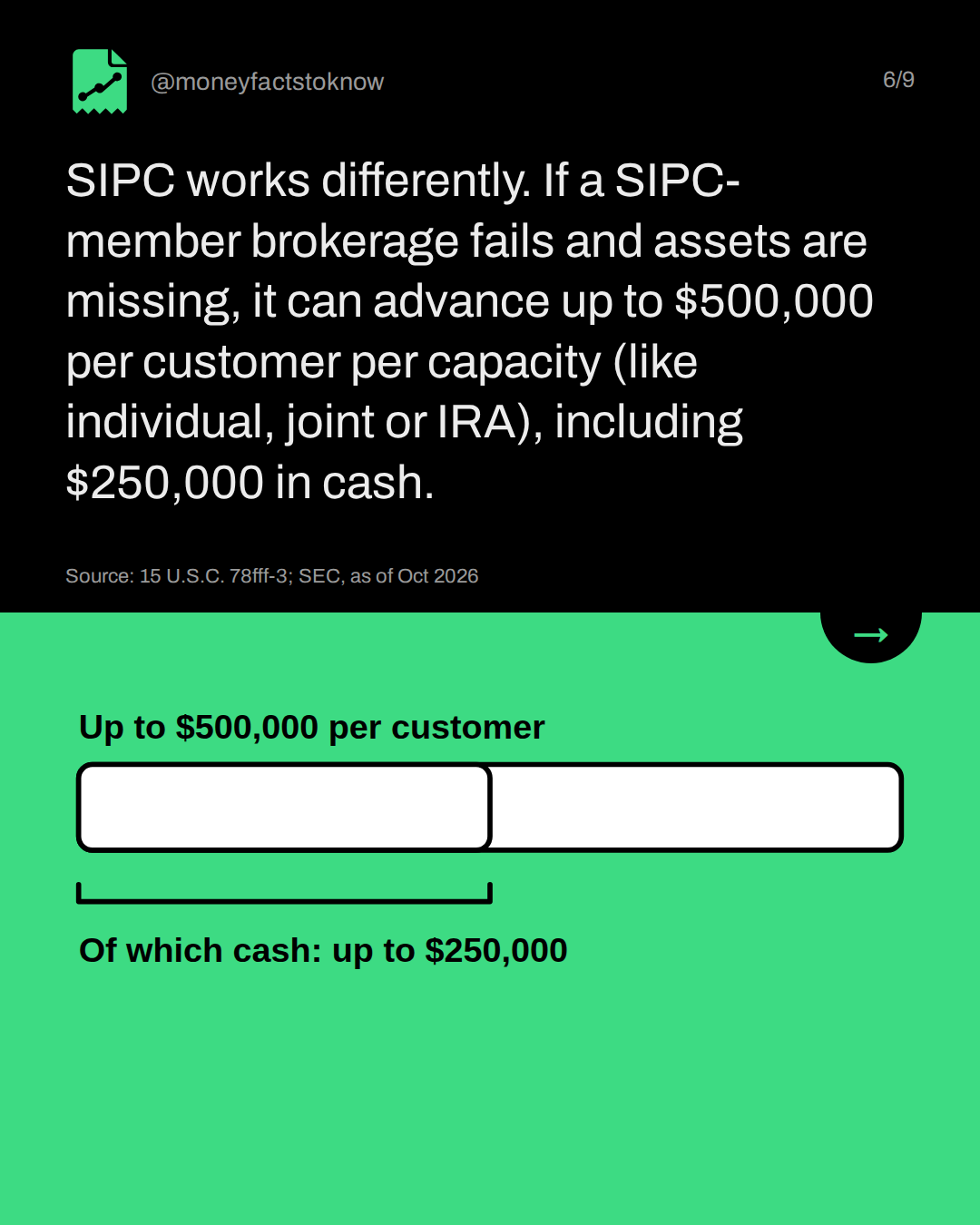
SIPC works differently. If a SIPC-member brokerage fails and assets are missing, it can advance up to $500,000 per customer per capacity (like individual, joint or IRA), including $250,000 in cash.
Source: 15 U.S.C. 78fff-3; SEC, as of Oct 2026

A market drop isn't a missing asset. In an assumed 20% fall (an illustration, not a forecast), a $50,000 fund becomes $40,000, and neither FDIC nor SIPC replaces the $10,000.
The math: $50,000 × 20% = $10,000
Source: FDIC; 15 U.S.C. 78fff-3 and 78lll, as of Oct 2026

Two things to check
Check whether the product is labeled a deposit or 'not FDIC-insured,' and which firm holds the account. Then check that the firm is a SIPC member.
Source: FDIC; 15 U.S.C. 78fff-3
Sources and assumptions
- FDIC: Understanding Deposit Insurance: $250,000 per depositor, per FDIC-insured bank, for each account ownership category. Covers checking, NOW, savings, money market deposit accounts, CDs and official items. Does NOT cover stock, bond or mutual fund investments, annuities, life insurance policies, safe deposit boxes, U.S. Treasury bills/bonds/notes, municipal securities or crypto assets. Does not cover non-deposit investment products, even those offered by FDIC-insured banks. (checked 2026-10-29)
- FDIC: Financial Products That Are Insured: Not all products offered by banks are covered by FDIC insurance. Coverage is automatic for deposit products. (checked 2026-10-29)
- Federal Reserve: Interagency Statement on Retail Sales of Nondeposit Investment Products (1994): Banks selling nondeposit investment products must disclose that they are 'not insured by the FDIC', 'not a deposit or other obligation of, or guaranteed by, the depository institution', and 'subject to investment risks, including possible loss of the principal amount invested'. (checked 2026-10-29)
- Securities Investor Protection Act, 15 U.S.C. 78fff-3 (Cornell LII): SIPC advances up to $500,000 for each customer to satisfy net equity claims. Cash claims are capped at the standard maximum cash advance amount, $250,000, which the SIPC Board may adjust for inflation every 5 years. (checked 2026-10-29)
- SEC Release SIPA-184 (March 26, 2021): SEC approved the SIPC Board's determination not to adjust the standard maximum cash advance amount for inflation (stays $250,000 for the 5-year period from 2022). (checked 2026-10-29)
- SEC Release SIPA-185 notice (Jan 14, 2026); Federal Register 2026-06145 (Mar 2026): 2026 inflation-adjustment determination: the SIPC Board kept the standard maximum cash advance amount at $250,000 for the 5-year period beginning January 1, 2027. The SEC page title and date were confirmed. The PDF text couldn't be extracted here, so the $250,000 outcome rests on the search summary and the policyrisk.com digest of FR 2026-01093/2026-06145. (checked 2026-10-29)
- American Banker: What financial advisors should know about SIPC coverage (Oct 19, 2026): $500,000 per customer per separate capacity with a $250,000 cash sublimit. SIPC President/CEO Michael Post: SIPC 'does not protect against security value declines or losses from investment advice'. sipc.org itself could not be opened from the research machine (TLS certificate error), so this quote of SIPC's CEO is the opened source for the decline-in-value exclusion. (checked 2026-10-29)
- Securities Investor Protection Act definitions, 15 U.S.C. 78lll (Cornell LII): (11) 'net equity' means 'the dollar amount of the account or accounts of a customer, to be determined by calculating the sum which would have been owed by the debtor to such customer if the debtor had liquidated, by sale or purchase on the filing date, all securities positions of such customer'. (4) 'customer property' means 'cash and securities ... at any time received, acquired, or held by or for the account of a debtor from or for the securities accounts of a customer'. (checked 2026-10-29)
Assumptions:
- Fictional saver, single-owner accounts, all at one FDIC-insured bank: $60,000 savings, $20,000 CD, $50,000 mutual fund bought through the bank's investment desk.
- The fund shares are held in an account at a SIPC-member broker-dealer (often the bank's affiliate). If held elsewhere, the SIPC part depends on that firm's membership.
- The 20% fall is an assumed illustration of a market decline, not a forecast or historical figure.
- FDIC limits as of Oct 2026. SIPC cash limit $250,000 as of Oct 2026, kept at that level for the period starting Jan 1, 2027.
The short version
- FDIC covers deposits, up to $250,000
- A bank-sold fund is not FDIC-insured
- SIPC covers missing assets at a failed broker
- Neither one covers market losses


