 Money Facts To Know
Unemployment benefits are federally taxable. Nothing is withheld unless you ask
No withholding doesn't mean no tax
It's easy to assume that if no tax came out of the payments, none is owed. The IRS says you generally must include all unemployment compensation in income.
Source: IRS Topic no. 418
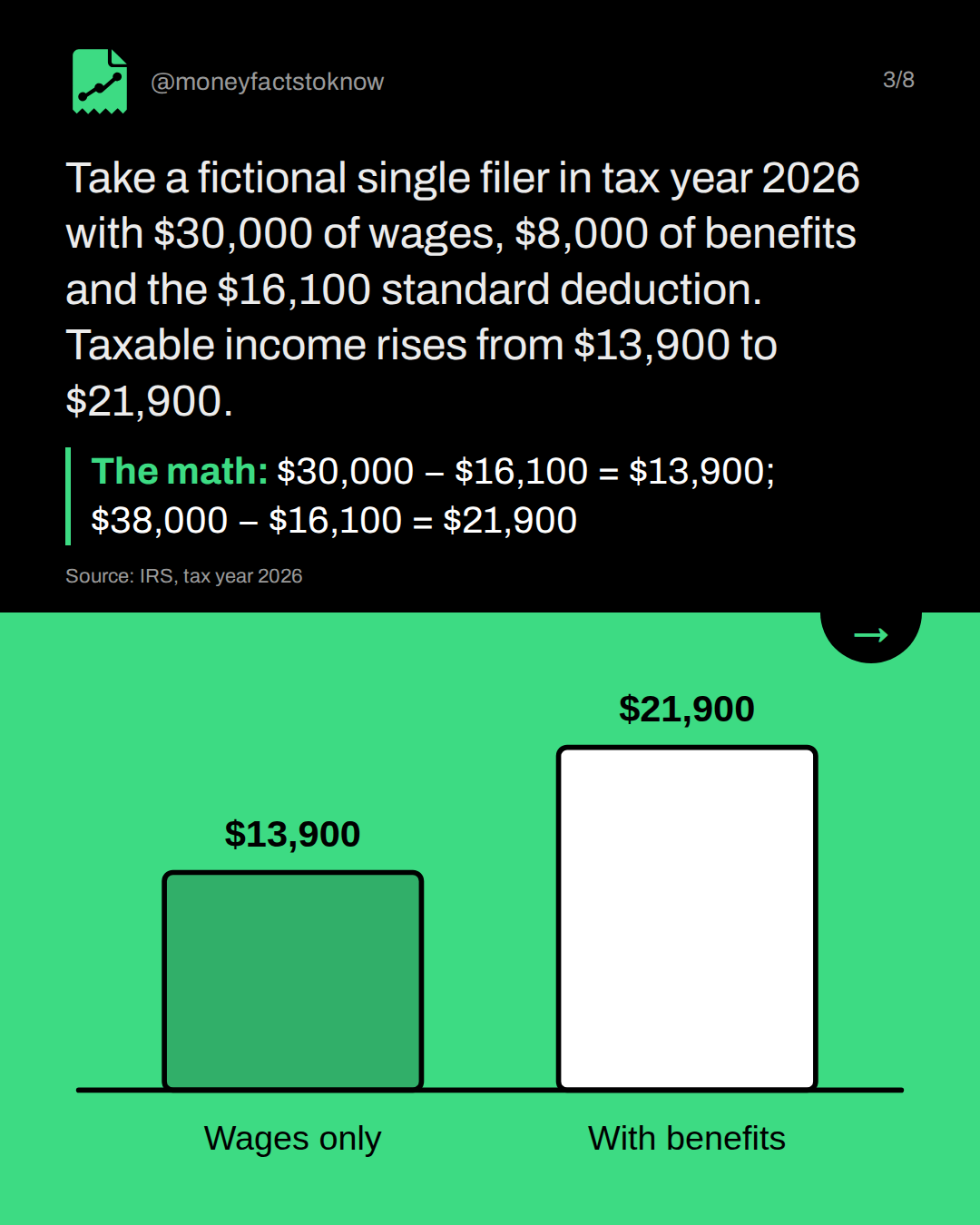
Take a fictional single filer in tax year 2026 with $30,000 of wages, $8,000 of benefits and the $16,100 standard deduction. Taxable income rises from $13,900 to $21,900.
The math: $30,000 − $16,100 = $13,900; $38,000 − $16,100 = $21,900
Source: IRS, tax year 2026
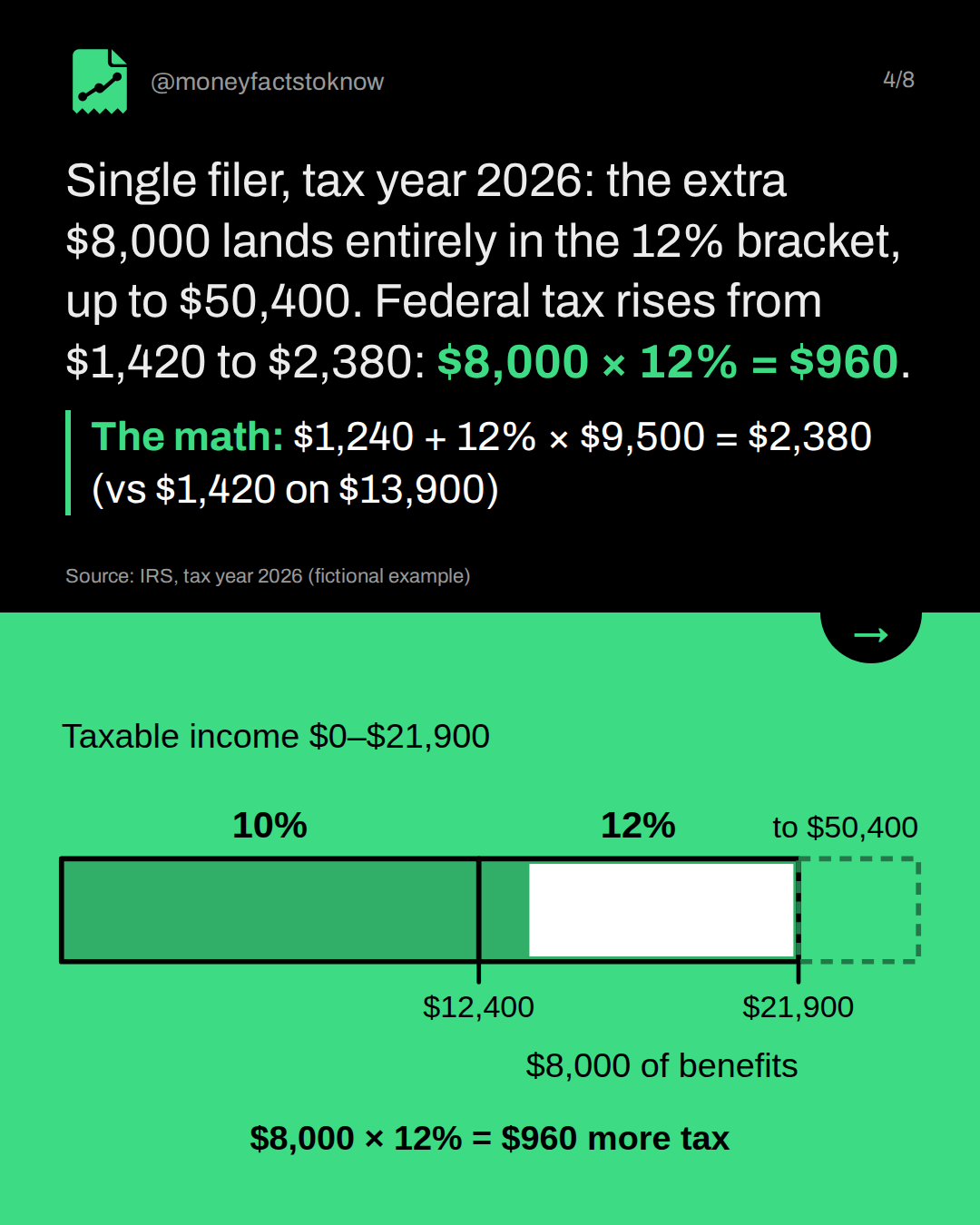
Single filer, tax year 2026: the extra $8,000 lands entirely in the 12% bracket, up to $50,400. Federal tax rises from $1,420 to $2,380: $8,000 × 12% = $960.
The math: $1,240 + 12% × $9,500 = $2,380 (vs $1,420 on $13,900)
Source: IRS, tax year 2026 (fictional example)
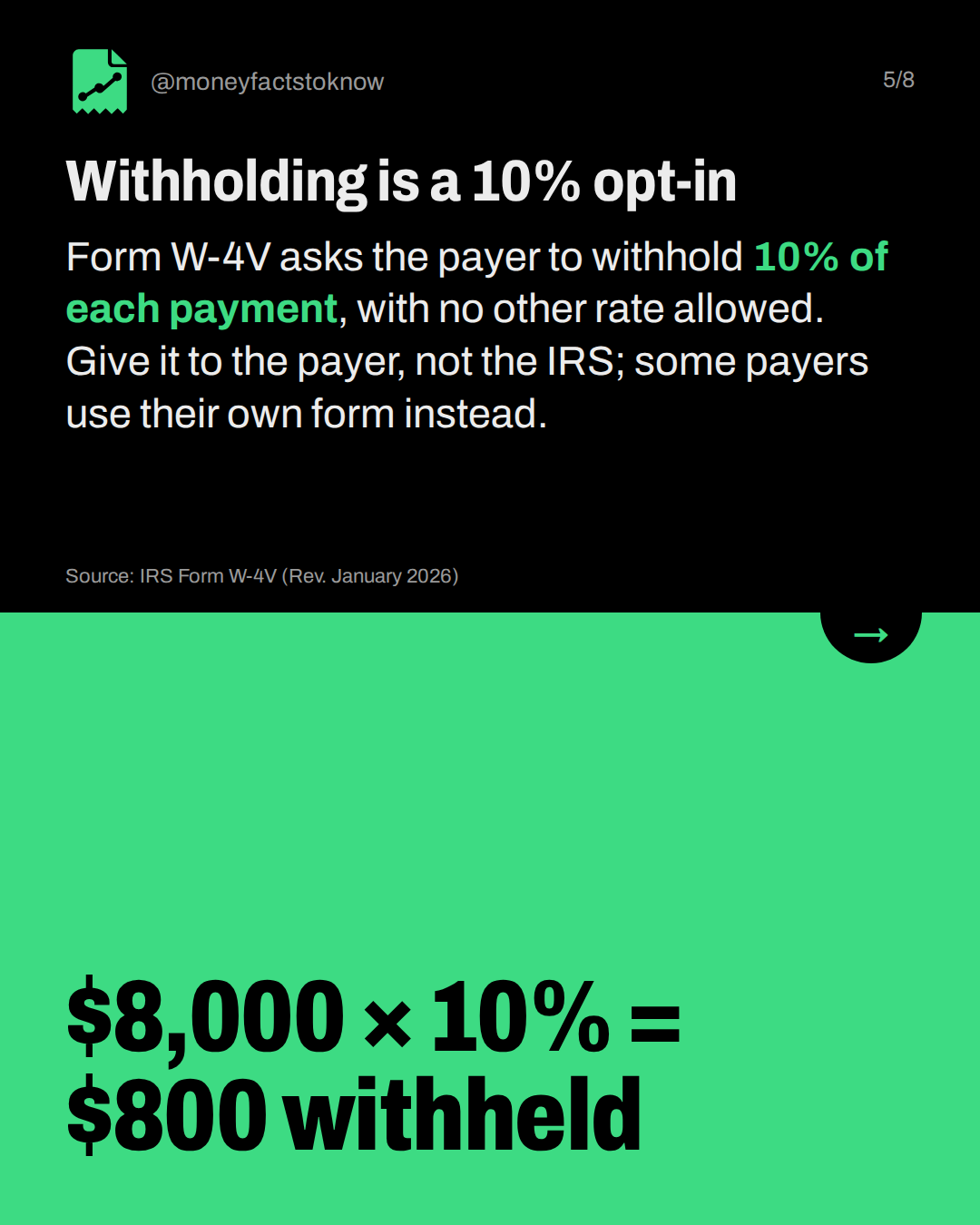
Withholding is a 10% opt-in
Form W-4V asks the payer to withhold 10% of each payment, with no other rate allowed. Give it to the payer, not the IRS; some payers use their own form instead.
The math: $8,000 × 10% = $800 withheld
Source: IRS Form W-4V (Rev. January 2026)
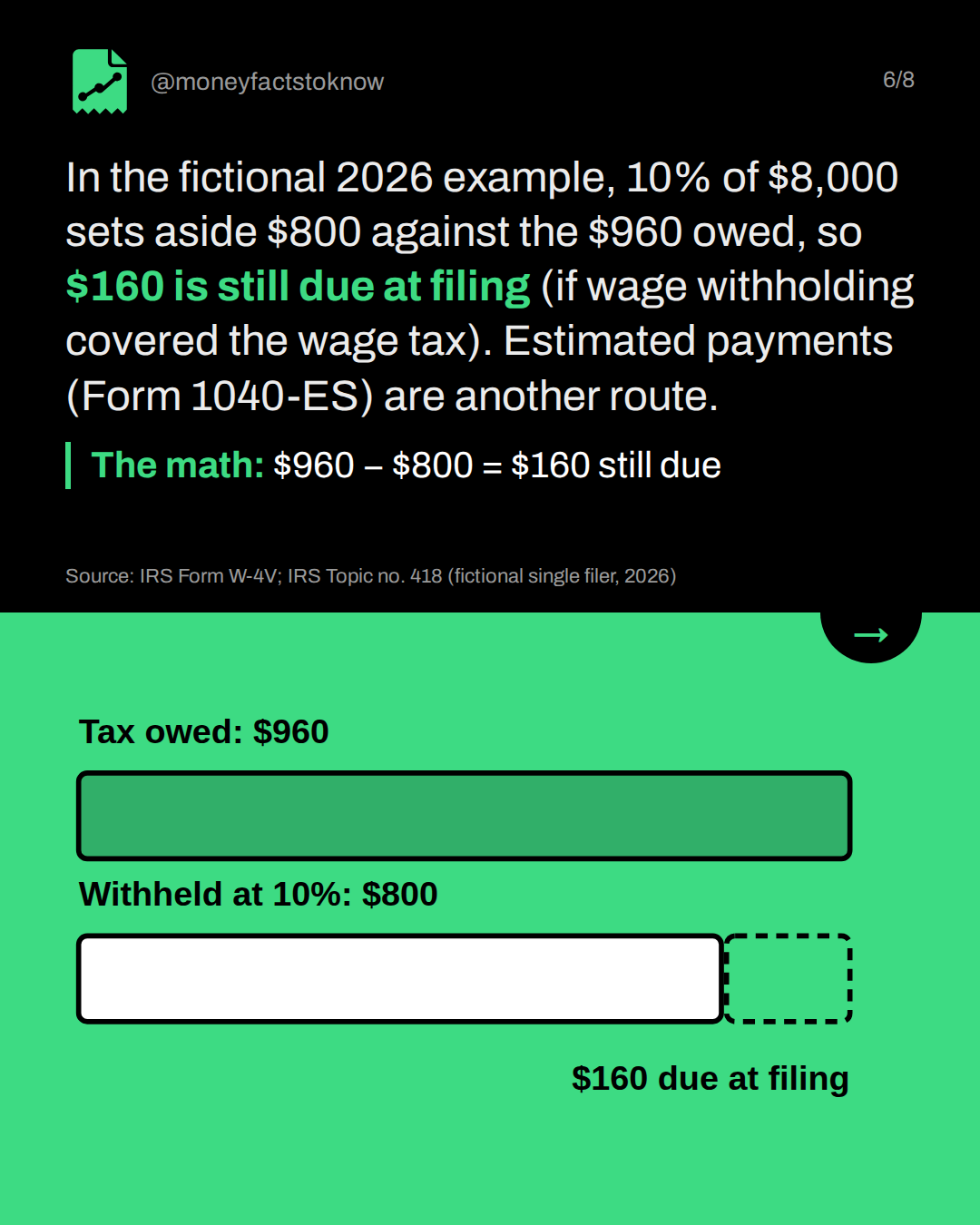
In the fictional 2026 example, 10% of $8,000 sets aside $800 against the $960 owed, so $160 is still due at filing (if wage withholding covered the wage tax). Estimated payments (Form 1040-ES) are another route.
The math: $960 − $800 = $160 still due
Source: IRS Form W-4V; IRS Topic no. 418 (fictional single filer, 2026)
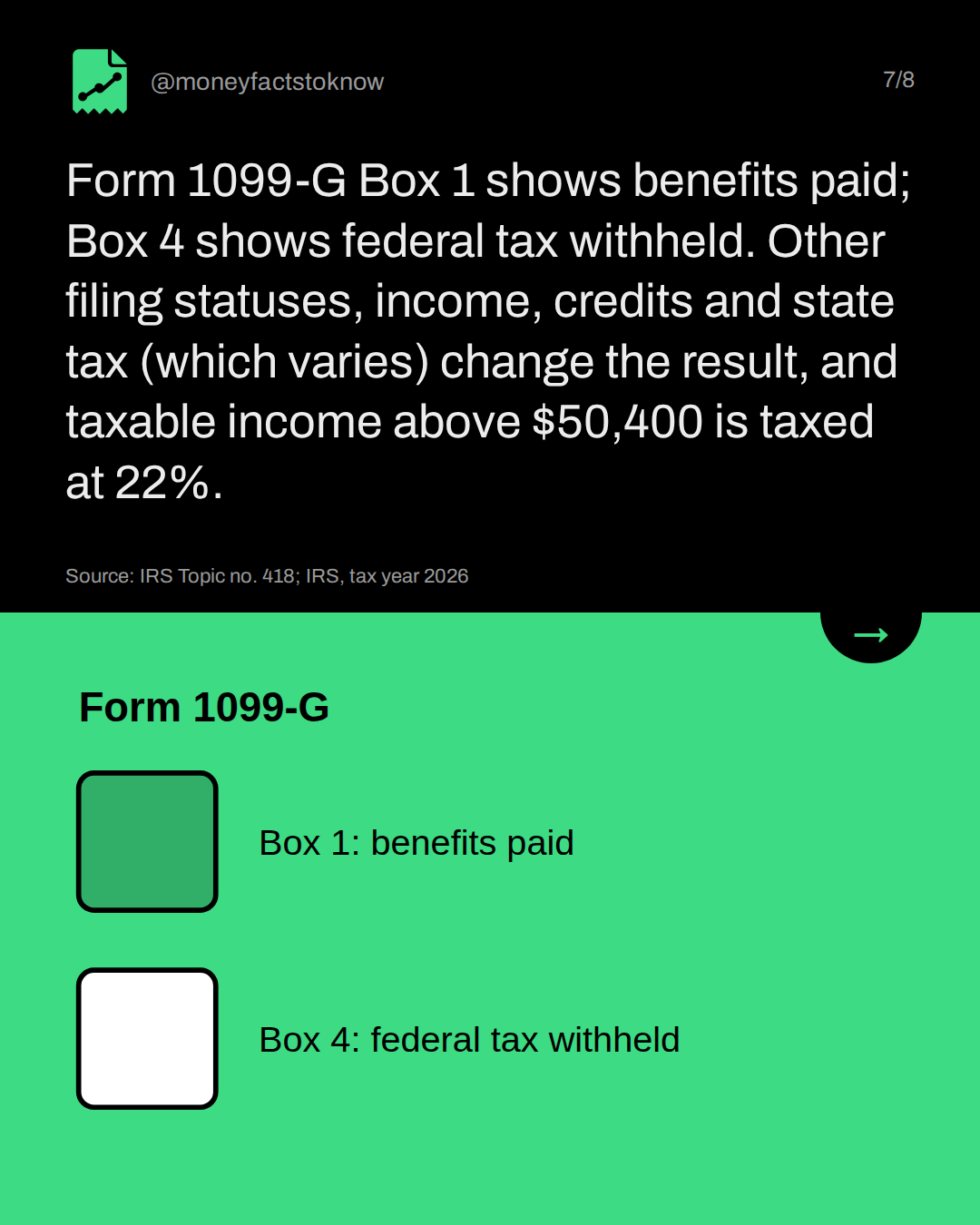
Form 1099-G Box 1 shows benefits paid; Box 4 shows federal tax withheld. Other filing statuses, income, credits and state tax (which varies) change the result, and taxable income above $50,400 is taxed at 22%.
Source: IRS Topic no. 418; IRS, tax year 2026
Sources and assumptions
- IRS Topic no. 418, Unemployment compensation: Unemployment compensation is generally includible in income. Form 1099-G Box 1 shows the amount paid and Box 4 shows federal income tax withheld. You can choose withholding with Form W-4V. You may be required to make quarterly estimated tax payments. (checked 2026-10-29)
- IRS Form W-4V (Rev. January 2026), Voluntary Withholding Request: For unemployment compensation the payer is permitted to withhold 10% from each payment and no other percentage or amount is allowed. Withholding is voluntary. You give the form to the payer, not the IRS. Estimated tax payments (Form 1040-ES) are the alternative. (checked 2026-10-29)
- IRS newsroom: IRS releases tax inflation adjustments for tax year 2026, including amendments from the One, Big, Beautiful Bill: 2026 single standard deduction is $16,100. Single brackets: 10% up to $12,400, 12% over $12,400, 22% over $50,400. (checked 2026-10-29)
Assumptions:
- Fictional single filer, tax year 2026, federal income tax only
- $30,000 of wages and $8,000 of unemployment benefits, no other income
- Takes the 2026 standard deduction of $16,100, no other deductions or credits
- Wage withholding is assumed to cover the tax on the wages alone, so the gap comes only from the benefits
- No federal tax withheld from the benefits unless Form W-4V is filed. With W-4V, 10% of every payment
- State income tax is excluded and varies by state
- Ignores any underpayment penalty and interest
The short version
- Unemployment benefits are generally taxable
- Nothing is withheld unless you ask
- Form W-4V withholds a flat 10%
- Fictional: $960 owed, $800 withheld, $160 due
- Check Box 1 and Box 4 on the 1099-G


