 Money Facts To Know
Deposited a $10,000 personal check? Only $275 is due next day

Neither guess is quite right
Many people assume the whole deposit is there tomorrow, or that a bank can hold it as long as it wants. A federal rule, Regulation CC, sets the usual limits on how long a bank may wait.
Source: Federal Reserve and CFPB, 12 CFR 229
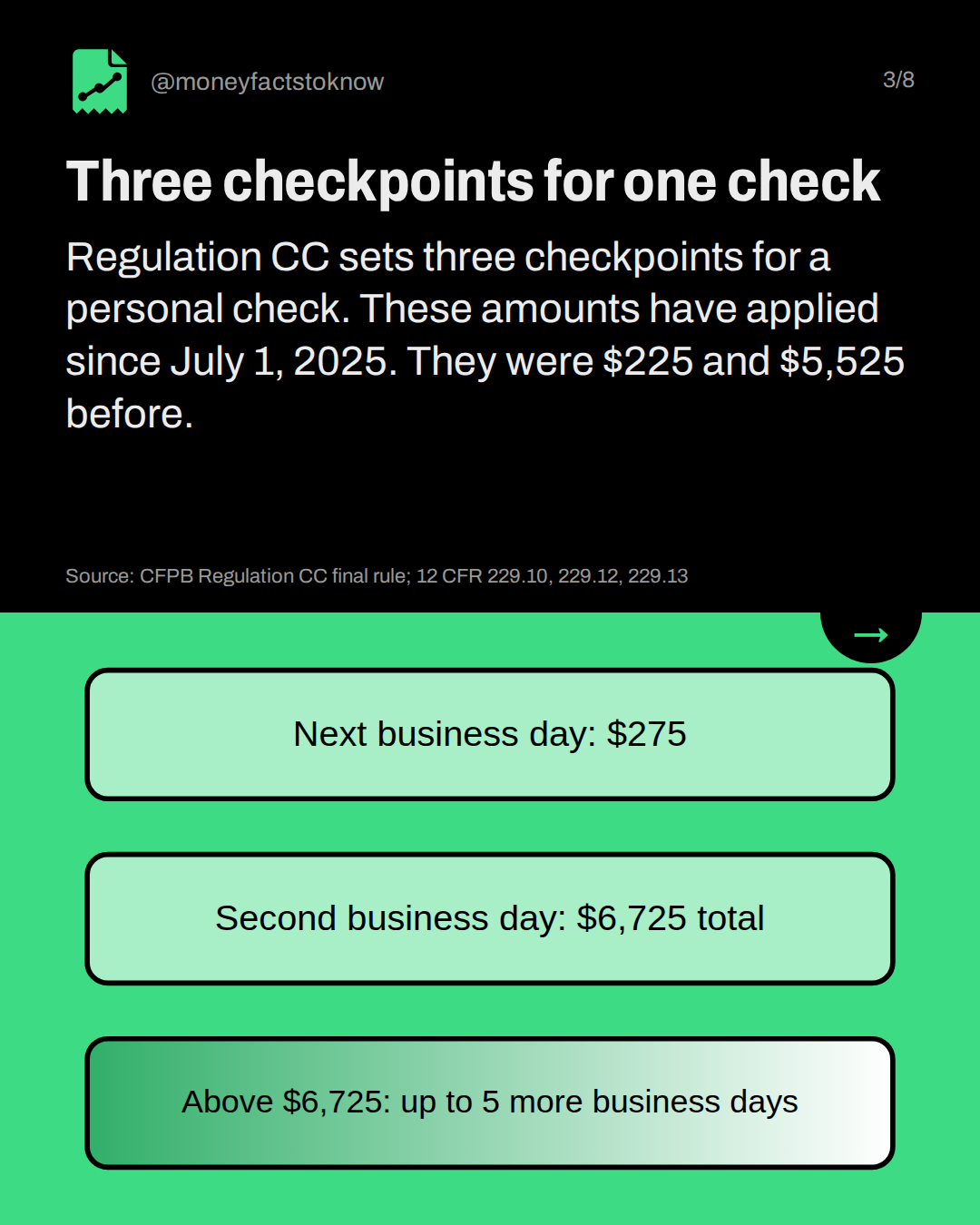
Three checkpoints for one check
Regulation CC sets three checkpoints for a personal check. These amounts have applied since July 1, 2025. They were $225 and $5,525 before.
Source: CFPB Regulation CC final rule; 12 CFR 229.10, 229.12, 229.13
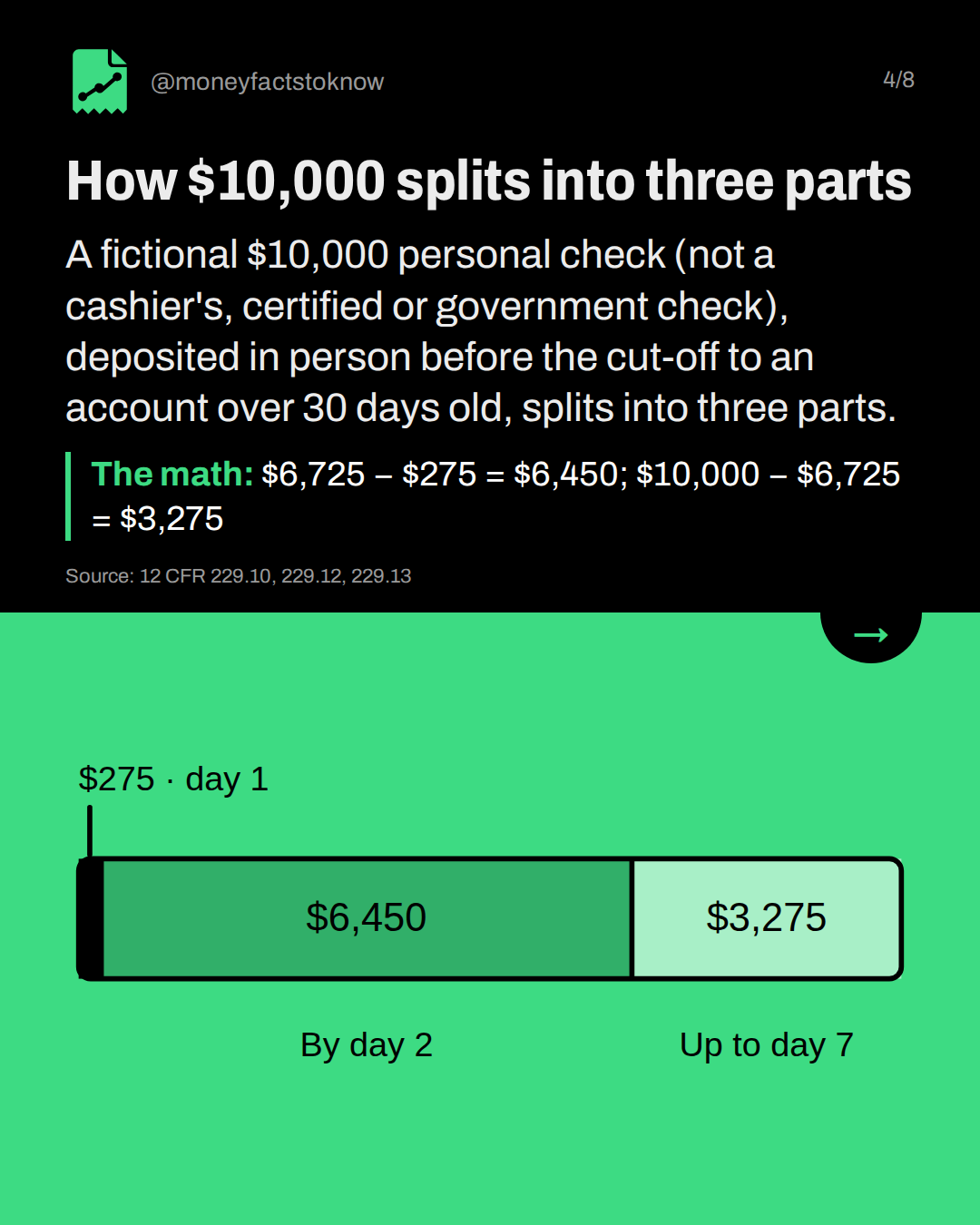
How $10,000 splits into three parts
A fictional $10,000 personal check (not a cashier's, certified or government check), deposited in person before the cut-off to an account over 30 days old, splits into three parts.
The math: $6,725 − $275 = $6,450; $10,000 − $6,725 = $3,275
Source: 12 CFR 229.10, 229.12, 229.13
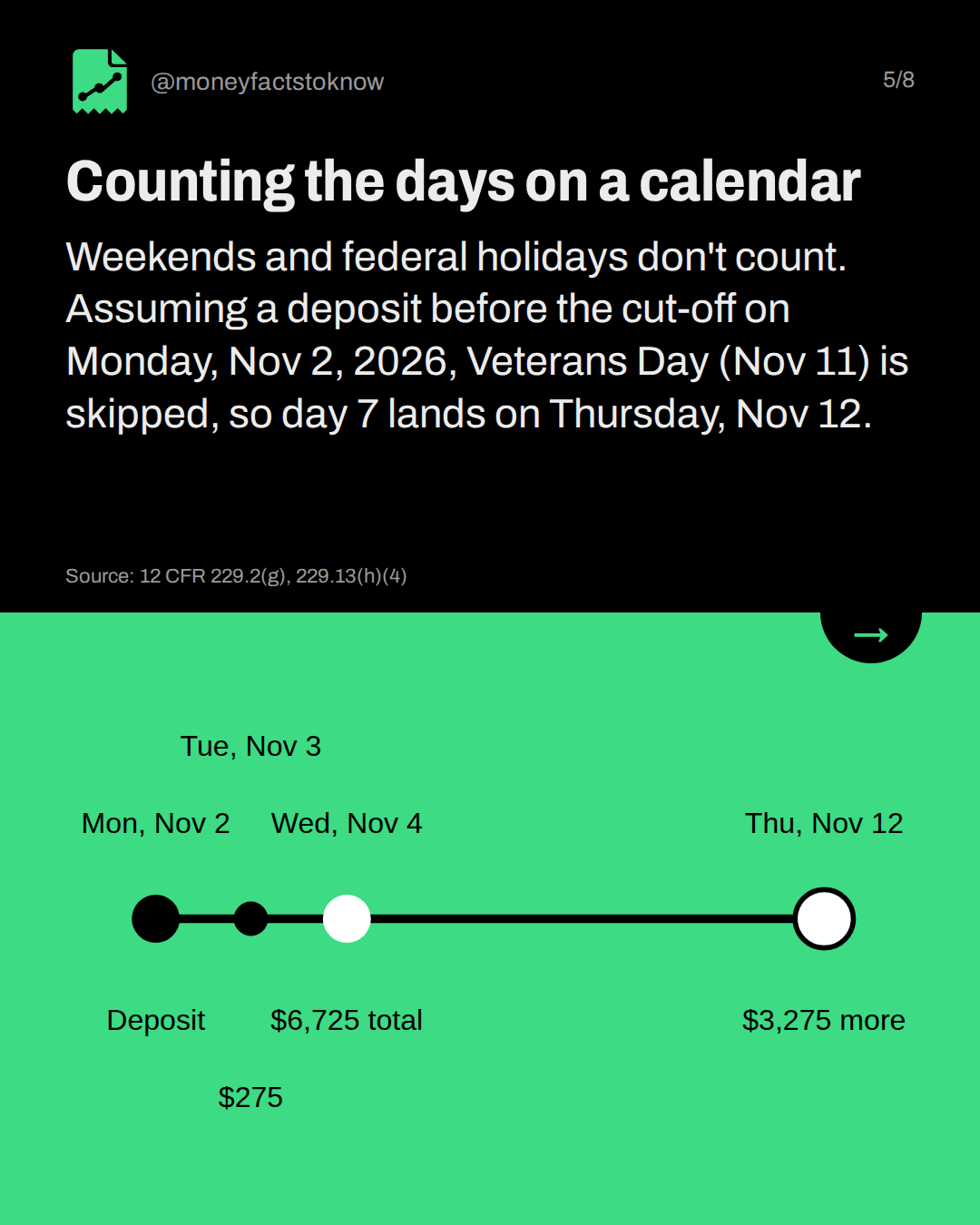
Counting the days on a calendar
Weekends and federal holidays don't count. Assuming a deposit before the cut-off on Monday, Nov 2, 2026, Veterans Day (Nov 11) is skipped, so day 7 lands on Thursday, Nov 12.
Source: 12 CFR 229.2(g), 229.13(h)(4)
These are usual limits, not promises
Cashier's, certified, teller's and government checks deposited in person, and checks drawn on your own bank, get next-day availability up to $6,725. Banks can hold longer than five business days only if they can show it's reasonable.
The math: The cut-off is no earlier than 2 p.m. at a branch, noon at an ATM.
Source: 12 CFR 229.10(c)(1), 229.13(b), (h)(4); CFPB
What to check when you deposit
Check your bank's funds-availability policy. If a hold applies, the notice should show the amount held and the date it will be available. Look for both on the hold notice.
Source: 12 CFR 229.16
Sources and assumptions
- eCFR, 12 CFR 229.10(c)(1)(vii), Regulation CC next-day availability: Next-business-day availability of 'the lesser of $275, or the aggregate amount deposited on any one banking day' (checked 2026-10-28)
- eCFR, 12 CFR 229.12(b), availability schedule for checks: Funds deposited by check must be available 'not later than the second business day following the banking day on which funds are deposited' (checked 2026-10-28)
- eCFR, 12 CFR 229.13, exceptions (large deposits, new accounts, notice, reasonable period): 229.13(b): 229.10(c) and 229.12 do not apply to aggregate check deposits 'to the extent that the aggregate amount is in excess of $6,725 on any one banking day'. 229.13(h)(4): the 'reasonable period' is up to five business days for checks under 229.12(b)(1)-(4), and a longer one is allowed only if the bank can establish it's reasonable. 229.13(a): an account is new for its first 30 calendar days. 229.13(g): written notice is required when an exception is used. (checked 2026-10-28)
- eCFR, 12 CFR 229.2(f)-(g), definitions: Business day = any day except Saturday, Sunday and the listed federal holidays (including November 11). Banking day = the part of a business day the office is open for substantially all banking functions. (checked 2026-10-28)
- eCFR, 12 CFR 229.16, availability policy disclosure and hold notice: Banks must disclose when deposited funds are available. A hold notice must give the amount delayed and the date funds will be available, either at the time of deposit or mailed/delivered by the next business day. (checked 2026-10-28)
- CFPB, final rule: Availability of Funds and Collection of Checks (Regulation CC) threshold adjustments: Federal Reserve Board and CFPB rule issued May 13, 2024, effective July 1, 2025: minimum amount $275, cash withdrawal amount $550, large-deposit threshold $6,725, new-account amount $6,725. Based on the 21.8% CPI-W increase from July 2018 to July 2023. Adjusted every five years. (checked 2026-10-28)
- Federal Reserve press release attachment (final rule PDF): The same final rule. Search results show the 2025 adjustment date and adjustments every fifth year after 2025. The PDF wouldn't parse, so it's cited only alongside the CFPB page. (checked 2026-10-28)
- CFPB Ask CFPB: How quickly can I get money after I deposit a check: Consumer explanation of the structure: next-day amount, then the rest up to the threshold within two business days, and amounts over the threshold 'generally available within seven business days'. Cut-off no earlier than 2:00 p.m. at physical locations and noon at an ATM. Lists the other hold reasons (new account, repeated overdrafts, doubt of collection, emergencies). NOTE: as of its Aug 31, 2026 update, this page still shows the pre-July-2025 amounts ($225/$5,525), so the slides use the regulation's $275/$6,725. (checked 2026-10-28)
Assumptions:
- The $10,000 check is fictional: one ordinary personal check drawn on another bank (a 229.12(b) check), not cash, a cashier's, certified, teller's, Treasury or government check, and not an electronic payment. Those have other next-day rules.
- It's deposited in person on a banking day before the bank's cut-off time. A deposit after the cut-off counts as made on the next banking day.
- The account is more than 30 days old, isn't repeatedly overdrawn, and the bank has no reasonable doubt it can collect the check. Otherwise other exceptions can lengthen the hold.
- It's the only check deposited that banking day. Both the $275 and the $6,725 apply to the day's total check deposits.
- The bank uses the large-deposit exception and the full 5-business-day 'reasonable period'. Many banks' own policies release funds sooner, and a longer hold is allowed only if the bank can show it's reasonable.
- 'Day 1, day 2, day 7' count business days after the banking day of deposit. Weekends and federal holidays (Reg CC's list in 229.2(g)) don't count.
- Dollar thresholds are those effective July 1, 2025. The next scheduled adjustment is July 1, 2030.
The short version
- $275 of a personal check is due next day.
- $6,725 in total is due by day 2.
- Above that, up to 5 more business days.
- Cashier's and government checks follow other rules.
- A hold notice shows the amount and date.


