 Money Facts To Know
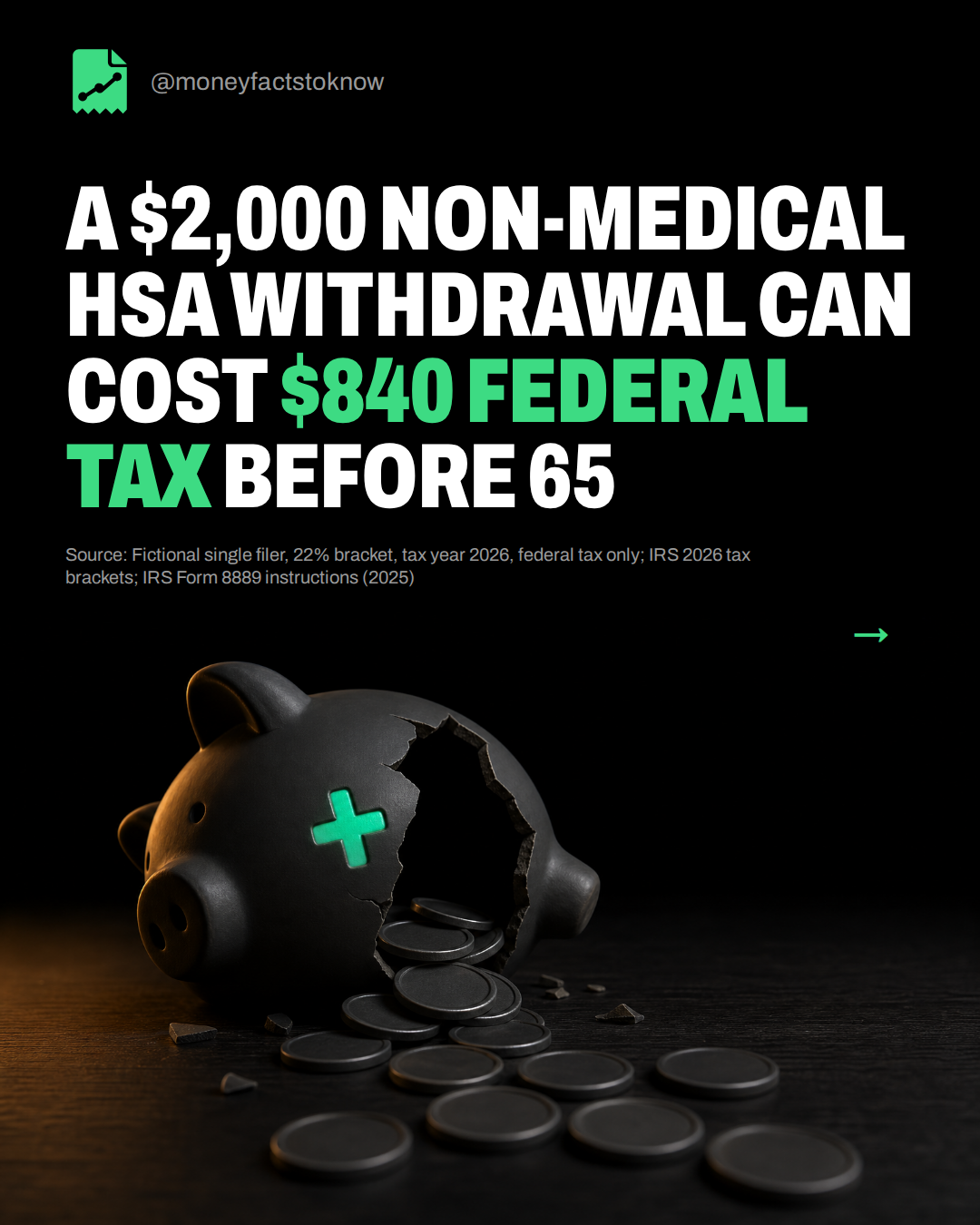
A $2,000 non-medical HSA withdrawal can cost $840 federal tax before 65
It's your money, but taxed differently
Many people treat a Health Savings Account (HSA) like savings they can tap for anything. You can withdraw the money, but how it's taxed depends on what it pays for.
Medical is tax-free; everything else isn't
Money for qualified medical expenses comes out federal tax-free. Anything else is added to your taxable income, plus a 20% additional tax unless you're 65+, disabled, or it's made after death.
Source: IRS Pub 969 (2025); IRS Form 8889 instructions (2025); 26 U.S.C. § 223(f)
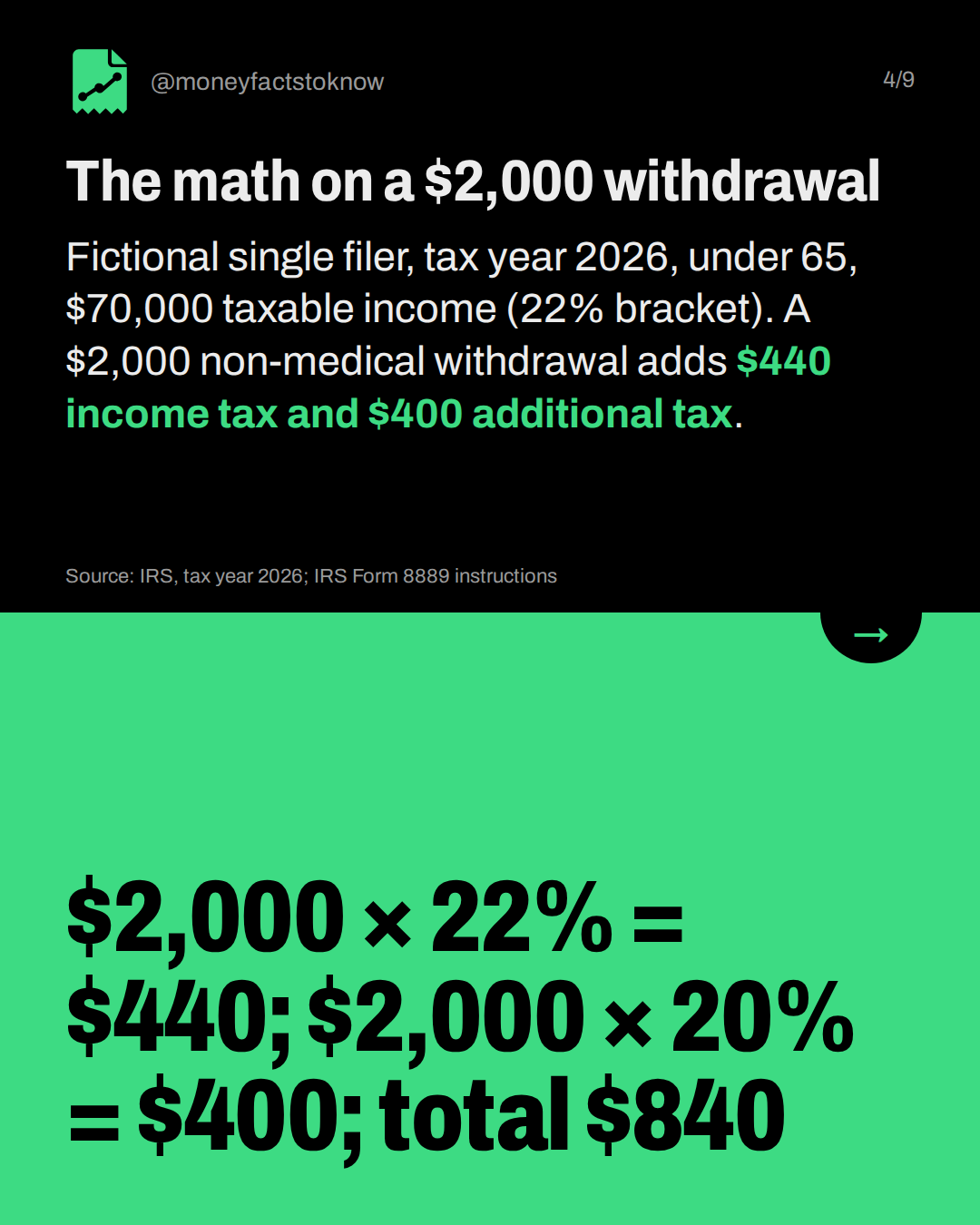
The math on a $2,000 withdrawal
Fictional single filer, tax year 2026, under 65, $70,000 taxable income (22% bracket). A $2,000 non-medical withdrawal adds $440 income tax and $400 additional tax.
The math: $2,000 × 22% = $440; $2,000 × 20% = $400; total $840
Source: IRS, tax year 2026; IRS Form 8889 instructions
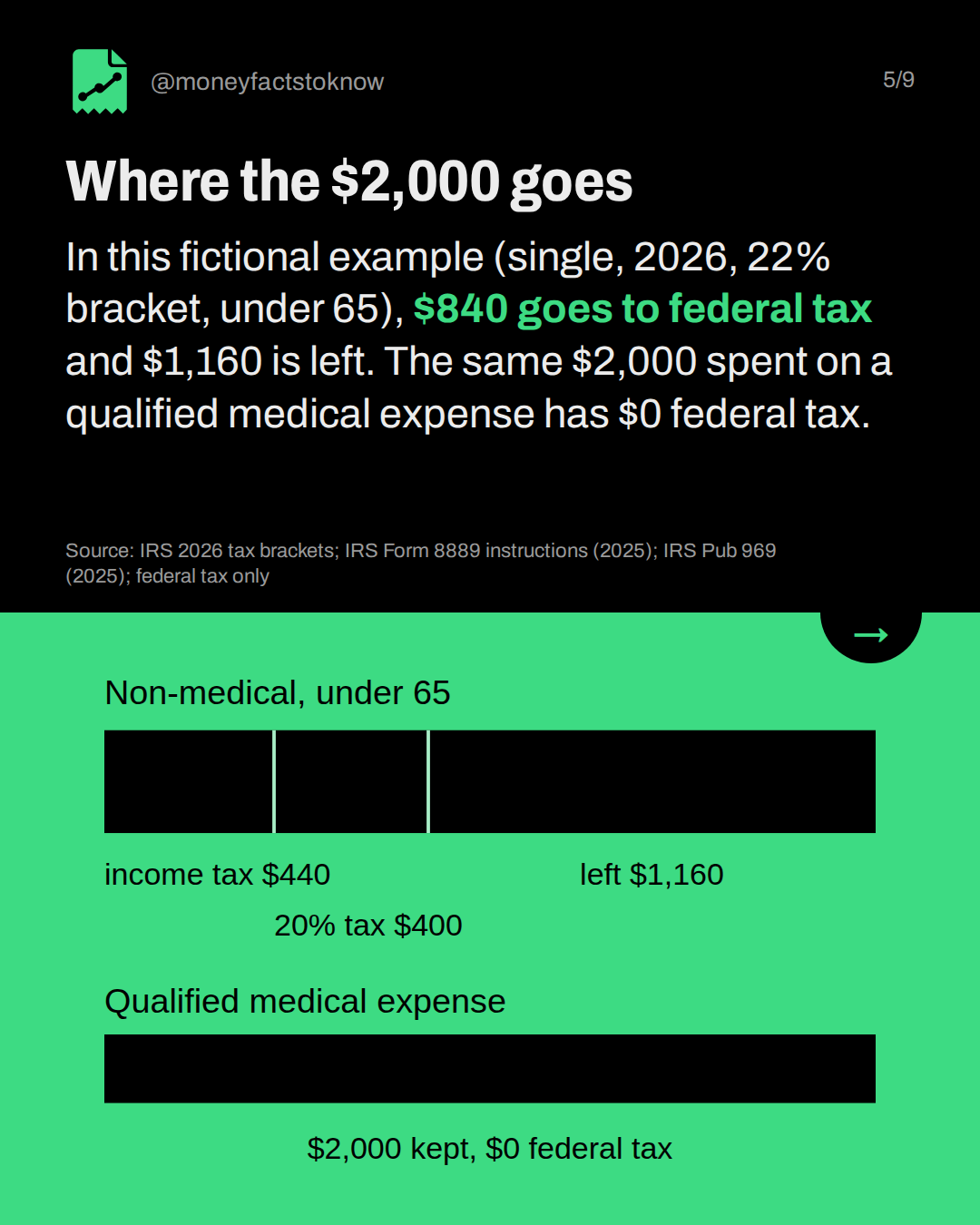
Where the $2,000 goes
In this fictional example (single, 2026, 22% bracket, under 65), $840 goes to federal tax and $1,160 is left. The same $2,000 spent on a qualified medical expense has $0 federal tax.
Source: IRS 2026 tax brackets; IRS Form 8889 instructions (2025); IRS Pub 969 (2025); federal tax only
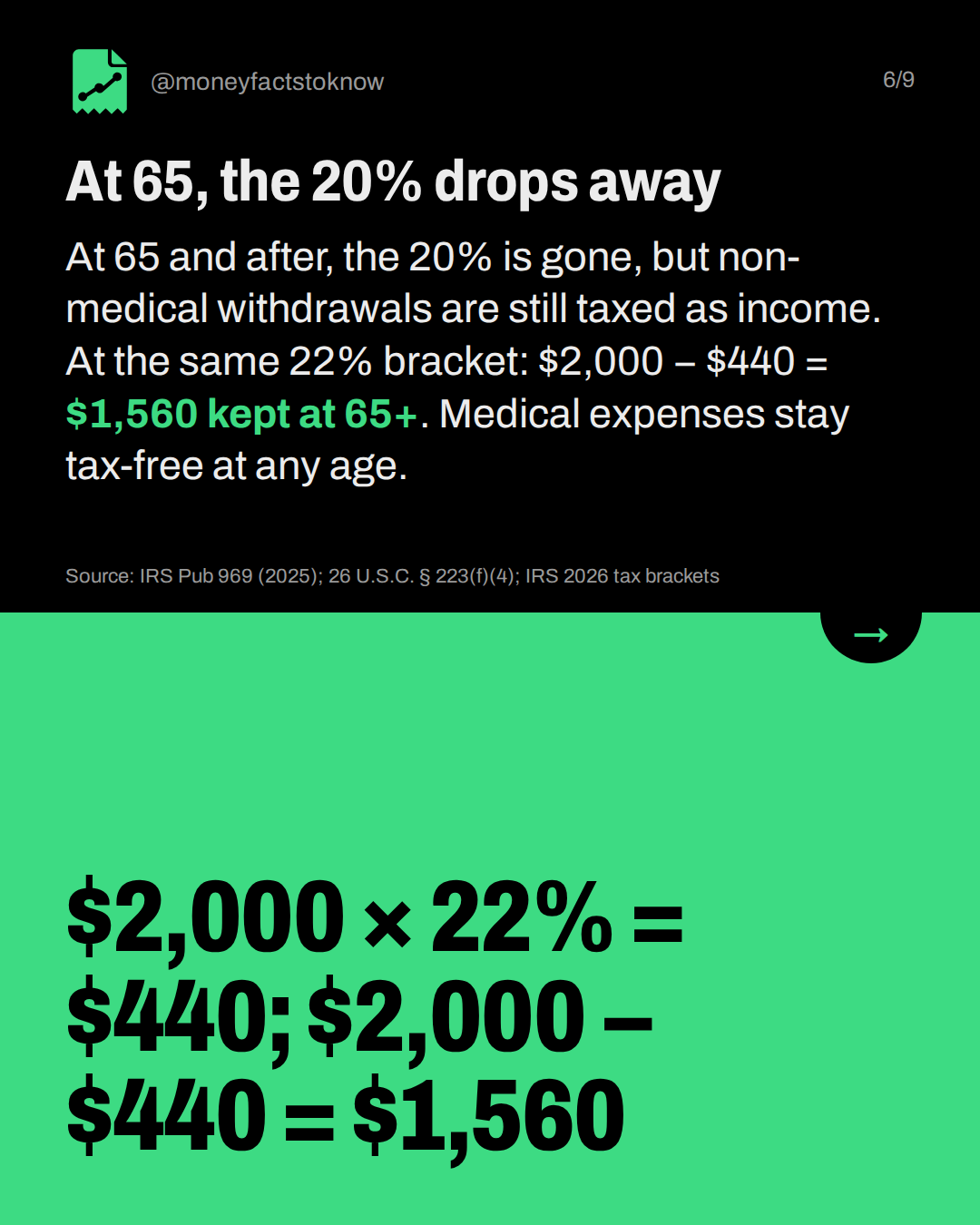
At 65, the 20% drops away
At 65 and after, the 20% is gone, but non-medical withdrawals are still taxed as income. At the same 22% bracket: $2,000 − $440 = $1,560 kept at 65+. Medical expenses stay tax-free at any age.
The math: $2,000 × 22% = $440; $2,000 − $440 = $1,560
Source: IRS Pub 969 (2025); 26 U.S.C. § 223(f)(4); IRS 2026 tax brackets
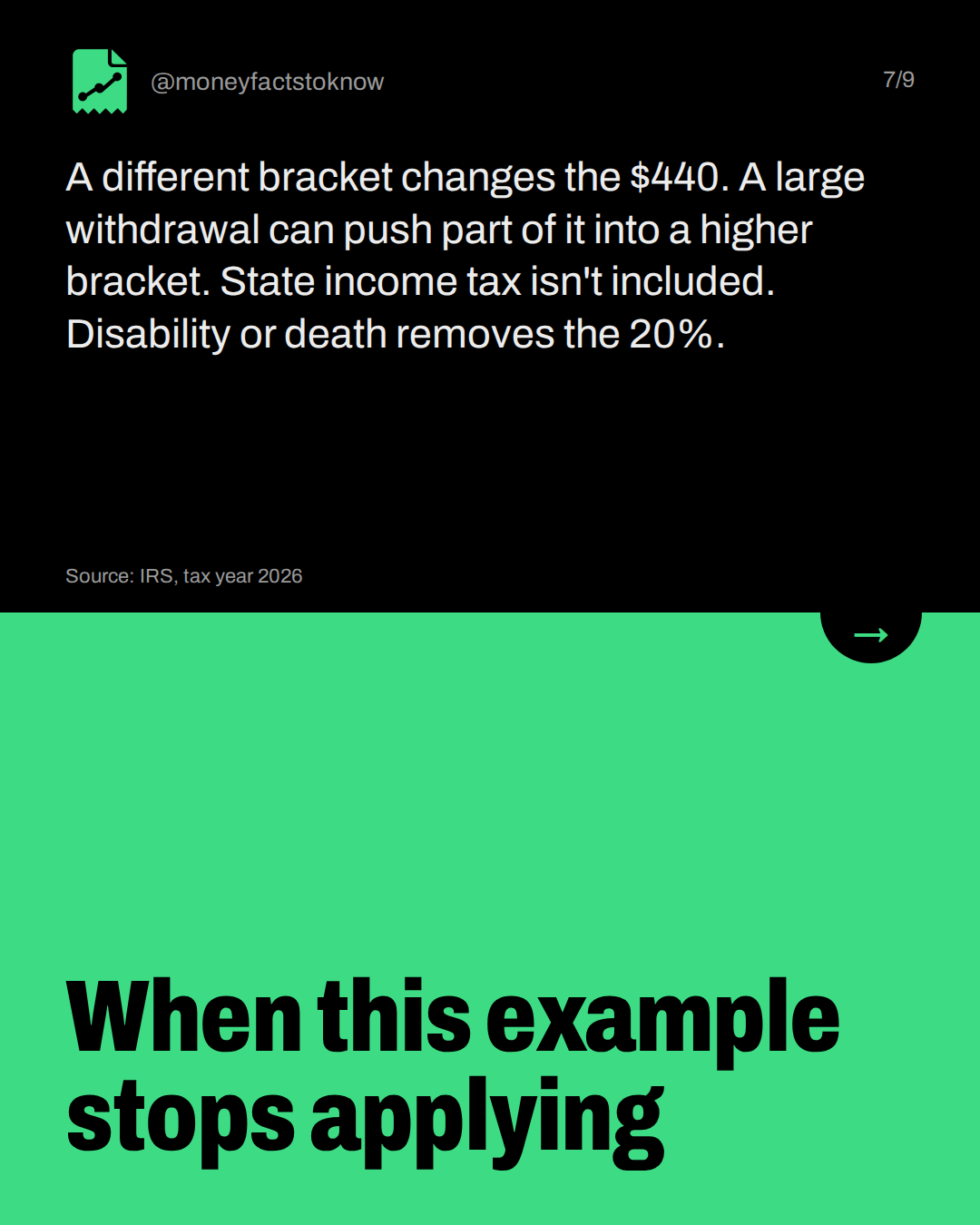
When this example stops applying
A different bracket changes the $440. A large withdrawal can push part of it into a higher bracket. State income tax isn't included. Disability or death removes the 20%.
Source: IRS, tax year 2026
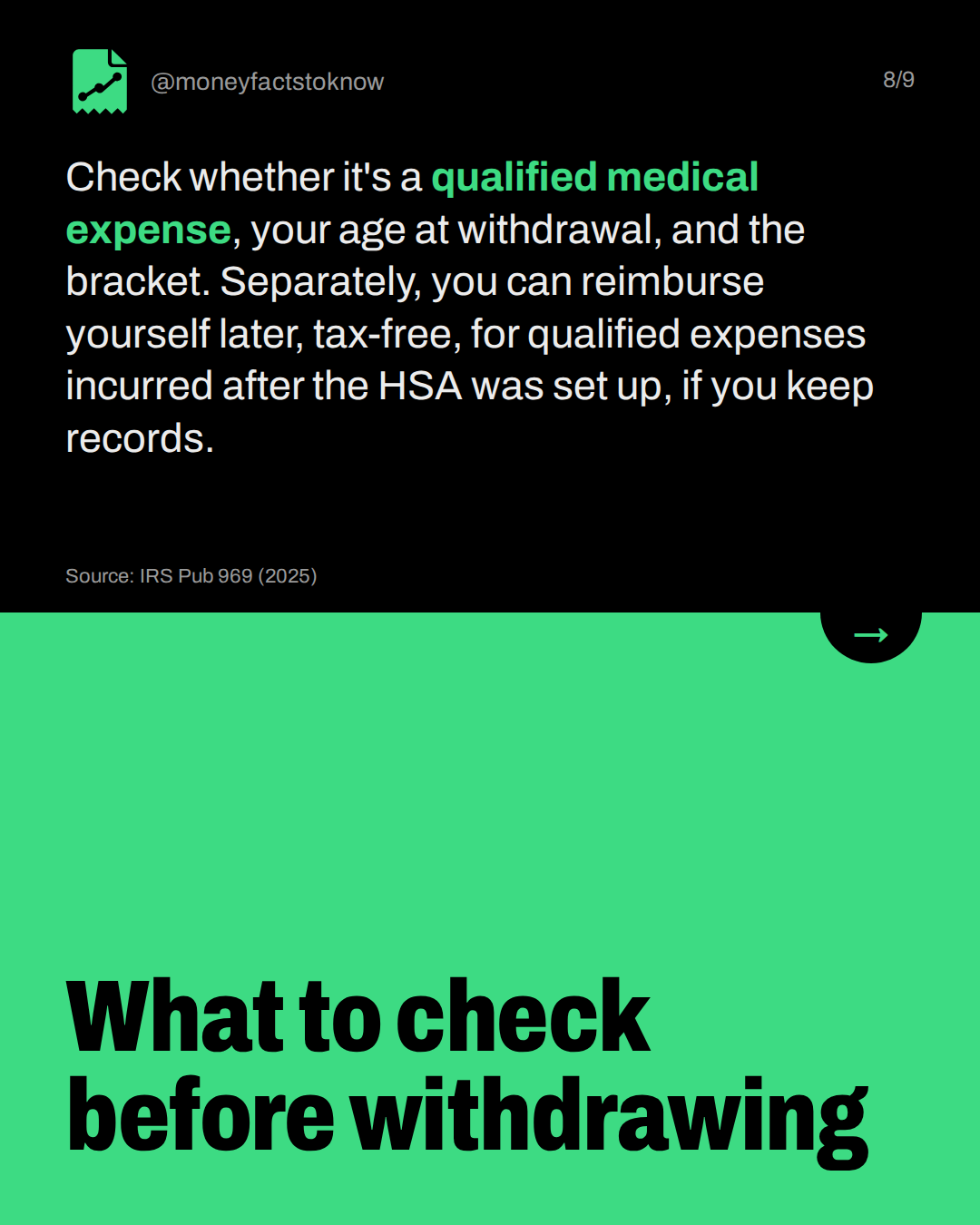
What to check before withdrawing
Check whether it's a qualified medical expense, your age at withdrawal, and the bracket. Separately, you can reimburse yourself later, tax-free, for qualified expenses incurred after the HSA was set up, if you keep records.
Source: IRS Pub 969 (2025)
Sources and assumptions
- IRS Publication 969 (2025), Health Savings Accounts and Other Tax-Favored Health Plans: Distributions for qualified medical expenses can be tax-free; non-qualified distributions are subject to income tax and may be subject to an additional 20% tax; no additional tax after you are disabled, reach age 65, or die; you can reimburse expenses incurred after the HSA was established, with no time limit (checked 2026-10-28)
- IRS Instructions for Form 8889 (2025): HSA distributions included in income (line 16) are subject to an additional 20% tax unless the beneficiary dies, becomes disabled or turns 65; line 17b = 20% of the amount; taxable amount goes on Schedule 1, the additional tax on Schedule 2 (checked 2026-10-28)
- 26 U.S. Code § 223(f)(2), (f)(4) (Cornell LII): Statute: non-qualified distributions are included in gross income; tax increased by 20 percent of the includible amount; exceptions for disability, death, and reaching Medicare eligibility age (65) (checked 2026-10-28)
- IRS: tax inflation adjustments for tax year 2026, including amendments from the One, Big, Beautiful Bill: 2026 single-filer brackets: 22% for taxable income over $50,400 up to $105,700 (24% above $105,700) (checked 2026-10-28)
Assumptions:
- The example is fictional: a single filer, tax year 2026, under 65, not disabled
- $70,000 of taxable income before the withdrawal, so the full $2,000 stays in the 22% bracket ($50,400–$105,700); $72,000 after the withdrawal
- The $2,000 isn't used for any qualified medical expense
- Federal income tax only: state income tax and credits aren't included
- No other exception applies (disability, death)
The short version
- Medical expenses: $0 federal tax
- Non-medical: added to your taxable income
- Before 65: plus a 20% additional tax
- At 65+: income tax only


