 Money Facts To Know
A fictional $500,000 IRA at 75 has a $20,325 minimum in 2026

Which IRAs have a forced withdrawal
Traditional, SEP and SIMPLE IRAs require a yearly minimum. It starts at 73 if born 1951–1959 or 75 if born 1960 or later. Roth IRAs have none during the owner's life.
Source: IRS RMD FAQs; 26 U.S.C. 401(a)(9)(C)(v); CRS IF12750 (1959 per proposed regs)
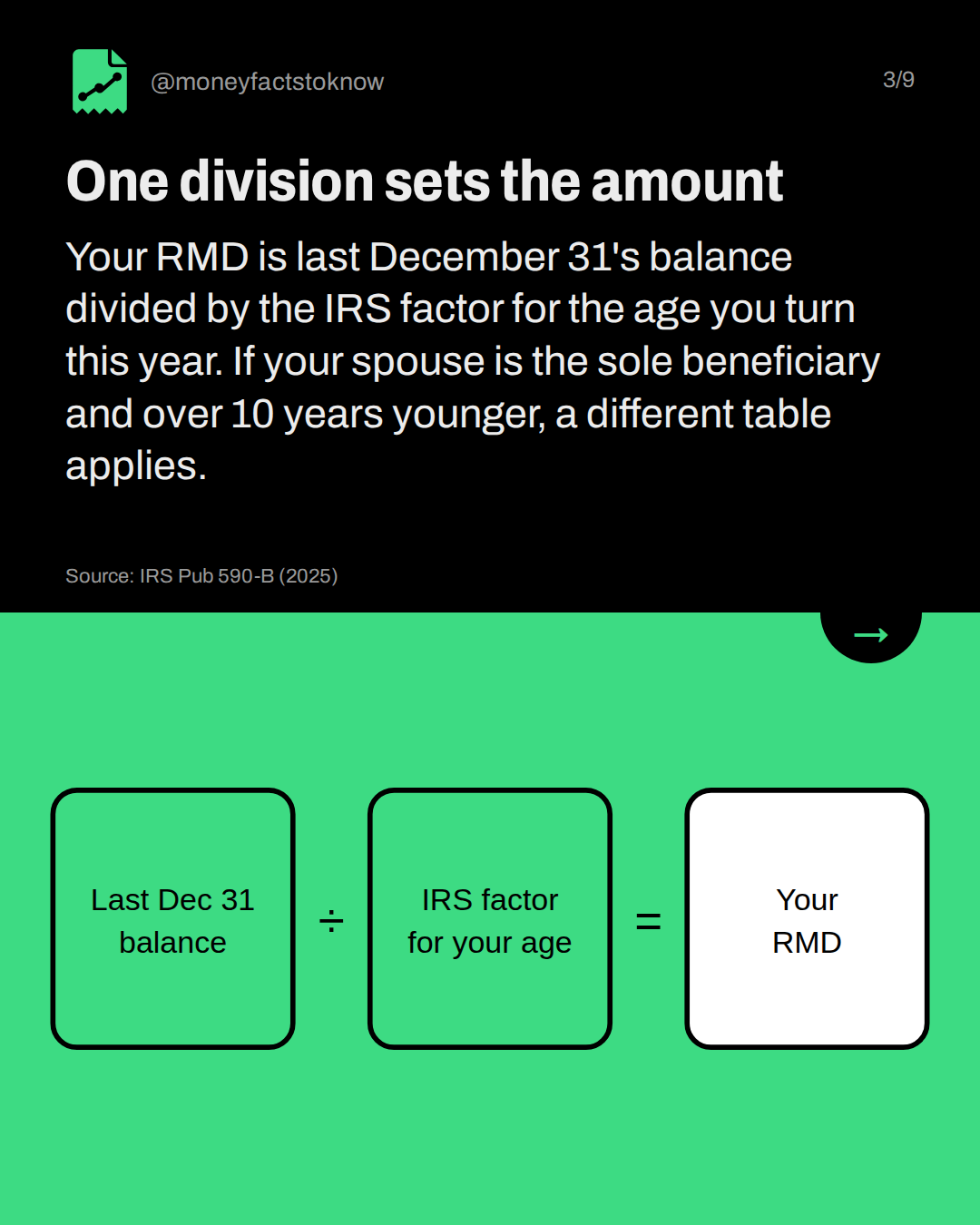
One division sets the amount
Your RMD is last December 31's balance divided by the IRS factor for the age you turn this year. If your spouse is the sole beneficiary and over 10 years younger, a different table applies.
Source: IRS Pub 590-B (2025)
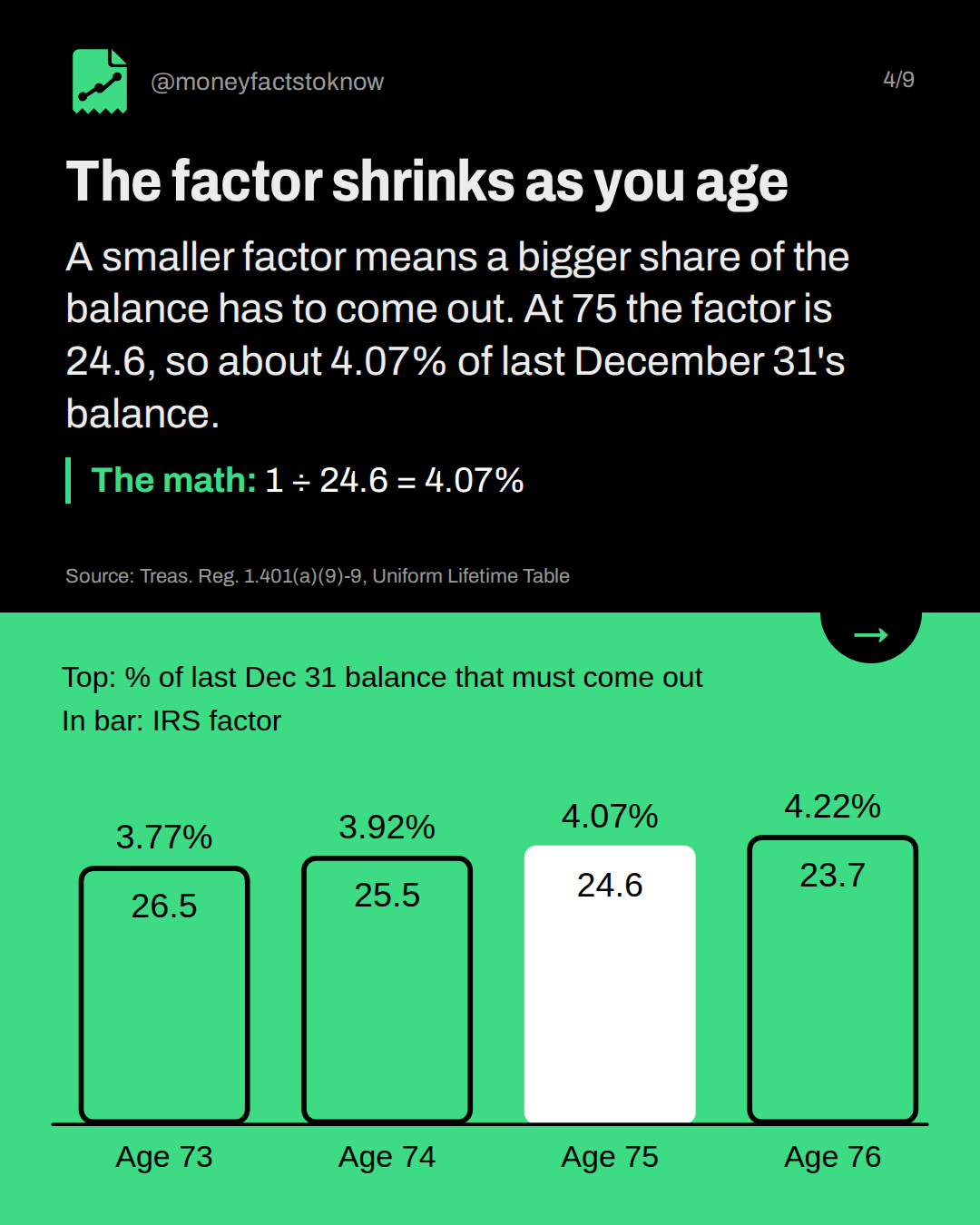
The factor shrinks as you age
A smaller factor means a bigger share of the balance has to come out. At 75 the factor is 24.6, so about 4.07% of last December 31's balance.
The math: 1 ÷ 24.6 = 4.07%
Source: Treas. Reg. 1.401(a)(9)-9, Uniform Lifetime Table
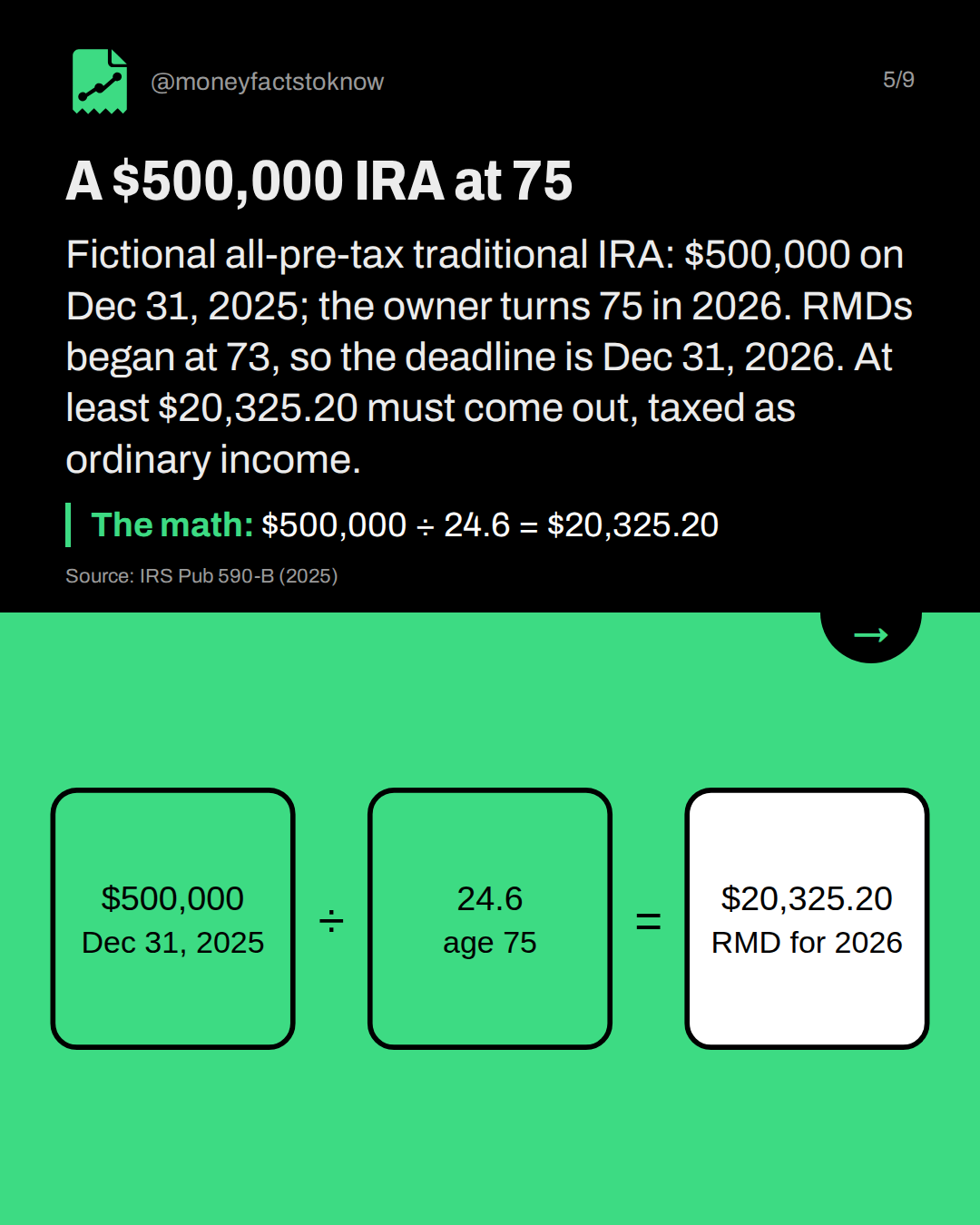
A $500,000 IRA at 75
Fictional all-pre-tax traditional IRA: $500,000 on Dec 31, 2025; the owner turns 75 in 2026. RMDs began at 73, so the deadline is Dec 31, 2026. At least $20,325.20 must come out, taxed as ordinary income.
The math: $500,000 ÷ 24.6 = $20,325.20
Source: IRS Pub 590-B (2025)
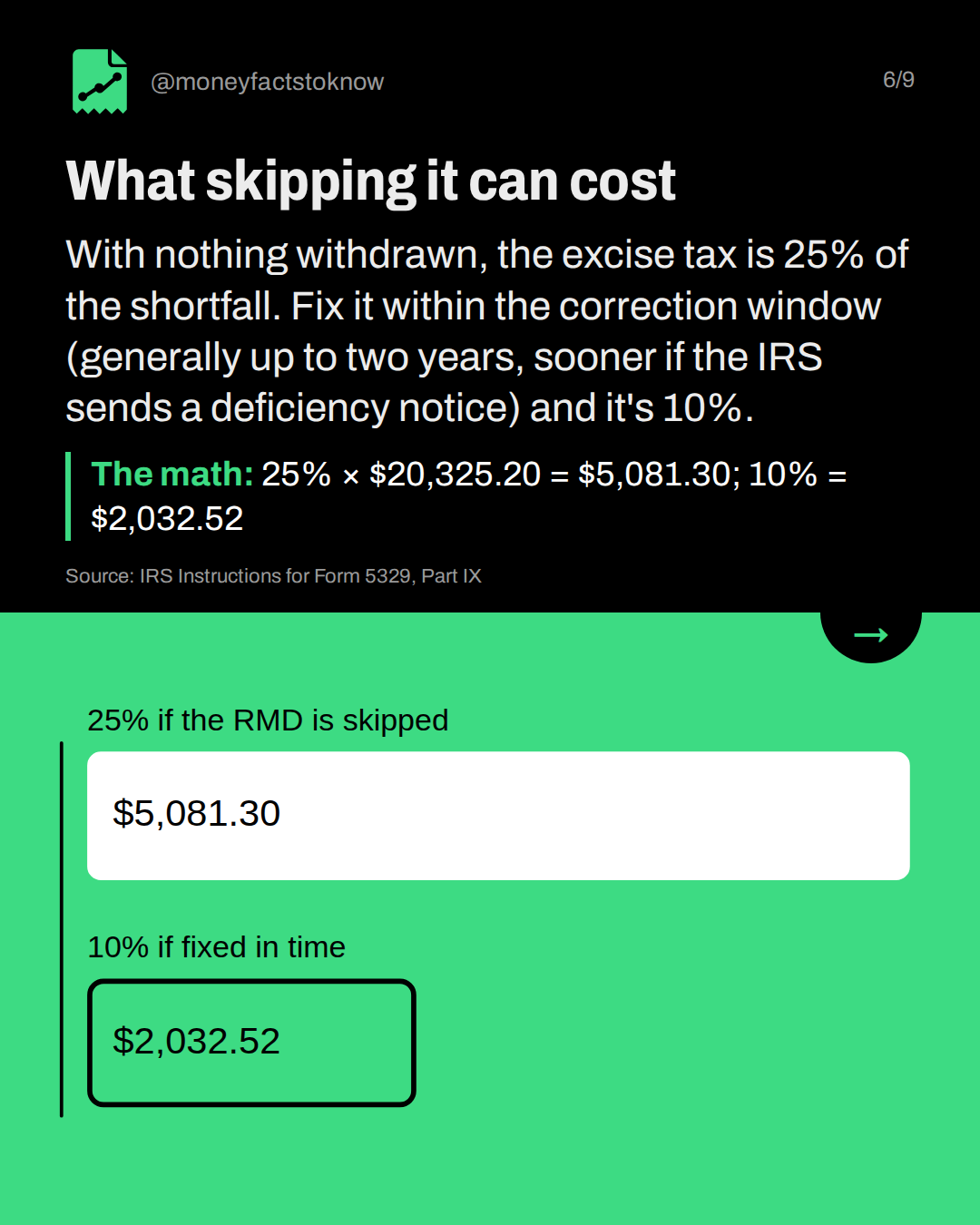
What skipping it can cost
With nothing withdrawn, the excise tax is 25% of the shortfall. Fix it within the correction window (generally up to two years, sooner if the IRS sends a deficiency notice) and it's 10%.
The math: 25% × $20,325.20 = $5,081.30; 10% = $2,032.52
Source: IRS Instructions for Form 5329, Part IX
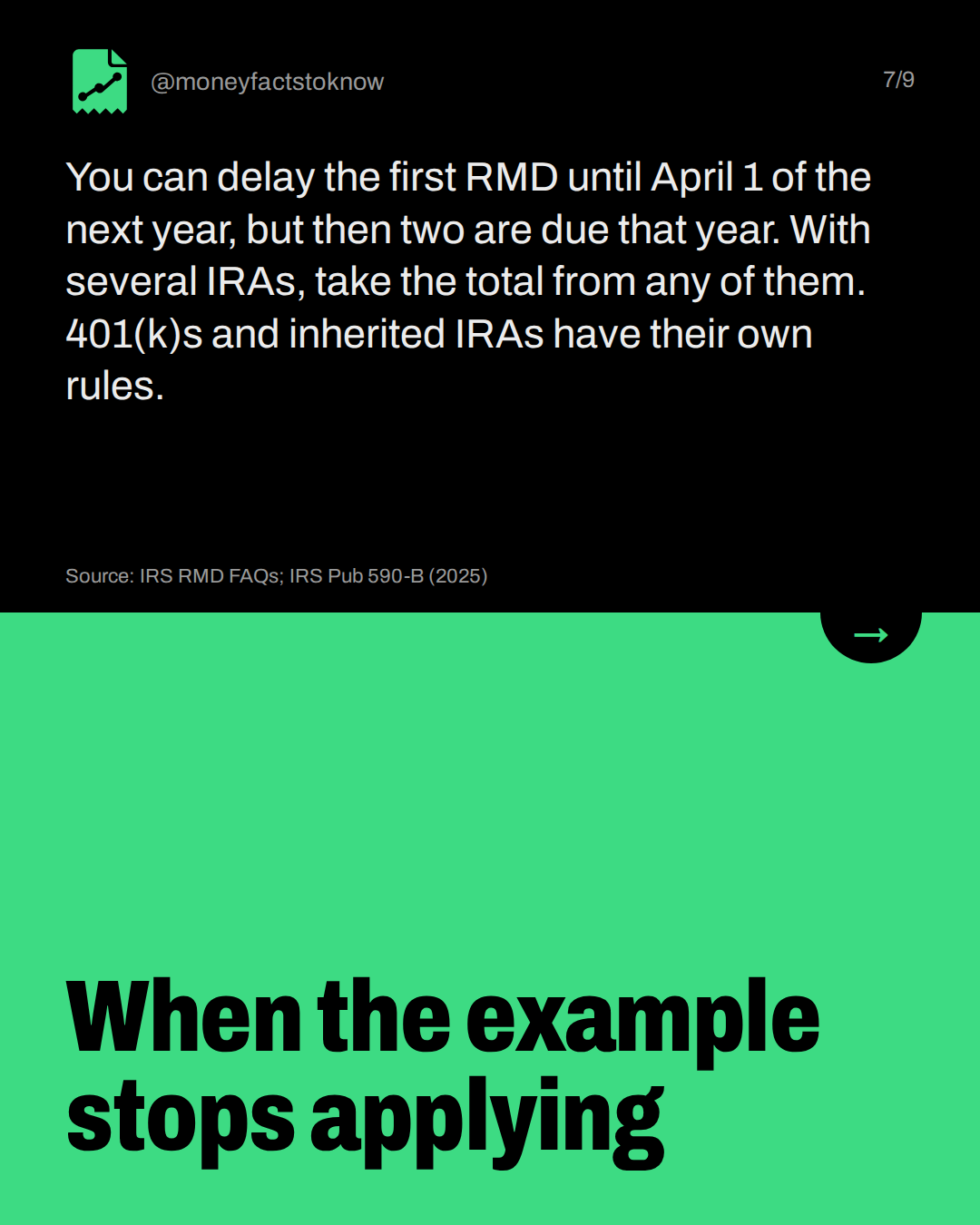
When the example stops applying
You can delay the first RMD until April 1 of the next year, but then two are due that year. With several IRAs, take the total from any of them. 401(k)s and inherited IRAs have their own rules.
Source: IRS RMD FAQs; IRS Pub 590-B (2025)

What to check each year
Check your Dec 31 balance, the age you turn this year, the table factor and the deadline: Dec 31, or April 1 for the first one. Extra withdrawn this year won't count toward future years.
Source: IRS Pub 590-B (2025)
Sources and assumptions
- IRS Publication 590-B (2025), Distributions from IRAs: RMD = IRA balance at close of business Dec 31 of the preceding year ÷ applicable denominator, using the age at your birthday in the distribution year; worked example 'Your applicable denominator is 24.6. Your required minimum distribution for 2026 would be $4,065 ($100,000 ÷ 24.6)'; Table II only when the spouse is sole beneficiary and more than 10 years younger; can total RMDs from multiple traditional IRAs and take them from one or more; no credit in future years for amounts above the RMD; begin by April 1 of the year after reaching 73 (checked 2026-10-27)
- Cornell LII, 26 CFR 1.401(a)(9)-9 (Uniform Lifetime Table): Uniform Lifetime Table distribution periods: age 72 = 27.4, 73 = 26.5, 74 = 25.5, 75 = 24.6, 76 = 23.7 (checked 2026-10-27)
- IRS, Retirement plan and IRA required minimum distributions FAQs: RMD start at 73; RMD = prior Dec 31 balance ÷ IRS life-expectancy factor; excise tax of 25%, 10% if timely corrected within two years; first RMD by April 1 of the following year, later ones by Dec 31 (two in one year if the first is delayed); RMD rules don't apply to Roth IRAs while the owner is alive (checked 2026-10-27)
- IRS, Retirement topics: Required minimum distributions (RMDs): Balance at end of the preceding year ÷ Uniform Lifetime Table distribution period; Uniform Lifetime Table applies to unmarried owners, owners whose spouse isn't more than 10 years younger, and owners whose spouse isn't the sole beneficiary; 25% excise tax (10% if withdrawn within 2 years); IRA deadlines April 1 / Dec 31 (checked 2026-10-27)
- IRS Instructions for Form 5329, Part IX: 25% of the excess accumulation (required minus actually distributed); 10% if the shortfall is distributed and a return reflecting the tax is filed within the correction window; window ends at the earliest of the deficiency-notice mailing date, the assessment date, or the last day of the second taxable year beginning after the year the tax is imposed; IRS can waive for reasonable error (checked 2026-10-27)
- Cornell LII, 26 U.S.C. 401(a)(9)(C)(v) (statute text): Applicable age is 73 for someone who reaches 72 after Dec 31, 2022 and 73 before Jan 1, 2033; 75 for someone who reaches 74 after Dec 31, 2032 (that is, born 1960 or later) (checked 2026-10-27)
- Congressional Research Service IF12750 (Aug 29, 2024): Applicable age 73 for people born 1951–1958, 75 for those born 1960 or later; people born in 1959 fell under both statutory clauses (the proposed regulations treat their age as 73) (checked 2026-10-27)
Assumptions:
- Fictional IRA owner, a US taxpayer, who turns 75 in 2026 (born 1951, so applicable age 73 and RMDs already began)
- Traditional IRA (all pre-tax); balance at close of business Dec 31, 2025 = $500,000 (fictional)
- Uniform Lifetime Table applies: the spouse is not the sole beneficiary, or is not more than 10 years younger
- Owner's own IRA, not inherited; one IRA (with several, each RMD is figured separately and the total can come from any of them)
- Penalty example assumes nothing was withdrawn for 2026; no reasonable-error waiver; RMD dollar amounts before income tax
- Rules as of tax year 2026 (IRS Pub 590-B 2025 edition, final regulations 2024)
The short version
- RMD = last Dec 31 balance ÷ IRS factor
- At 75, the factor is 24.6
- Fictional $500,000 IRA: $20,325.20 for 2026
- Skipping it can cost 25% of the shortfall
- Roth IRAs have no RMDs while the owner is alive


