 Money Facts To Know
A $300,000 gain on a main home: $50,000 taxable if single

Tax-free has a cap
Selling your main home is often tax-free if you pass the tests, but only up to a cap: usually $250,000 of gain for a single filer, or up to $500,000 on a qualifying joint return.
Source: IRS Topic 701
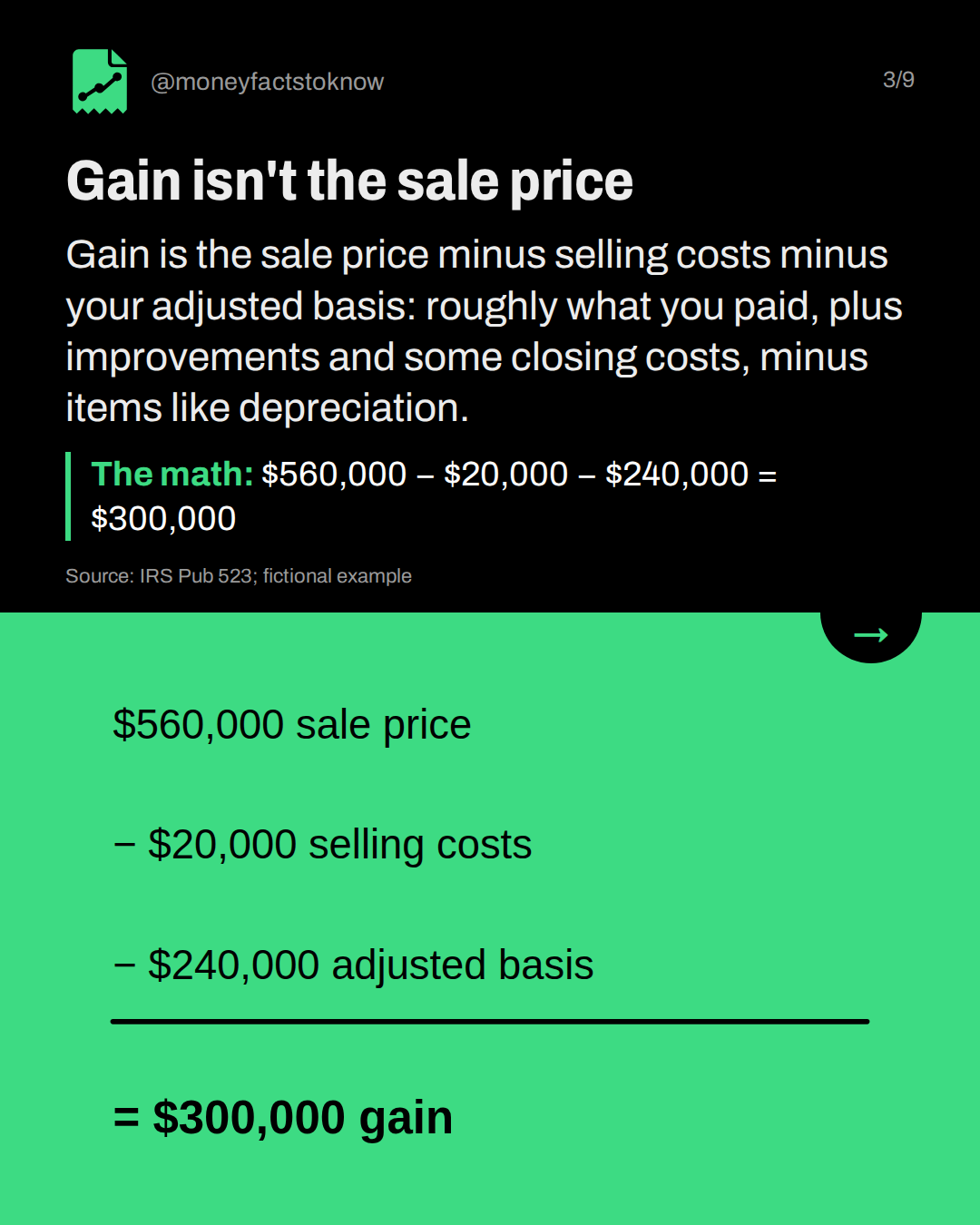
Gain isn't the sale price
Gain is the sale price minus selling costs minus your adjusted basis: roughly what you paid, plus improvements and some closing costs, minus items like depreciation.
The math: $560,000 − $20,000 − $240,000 = $300,000
Source: IRS Pub 523; fictional example
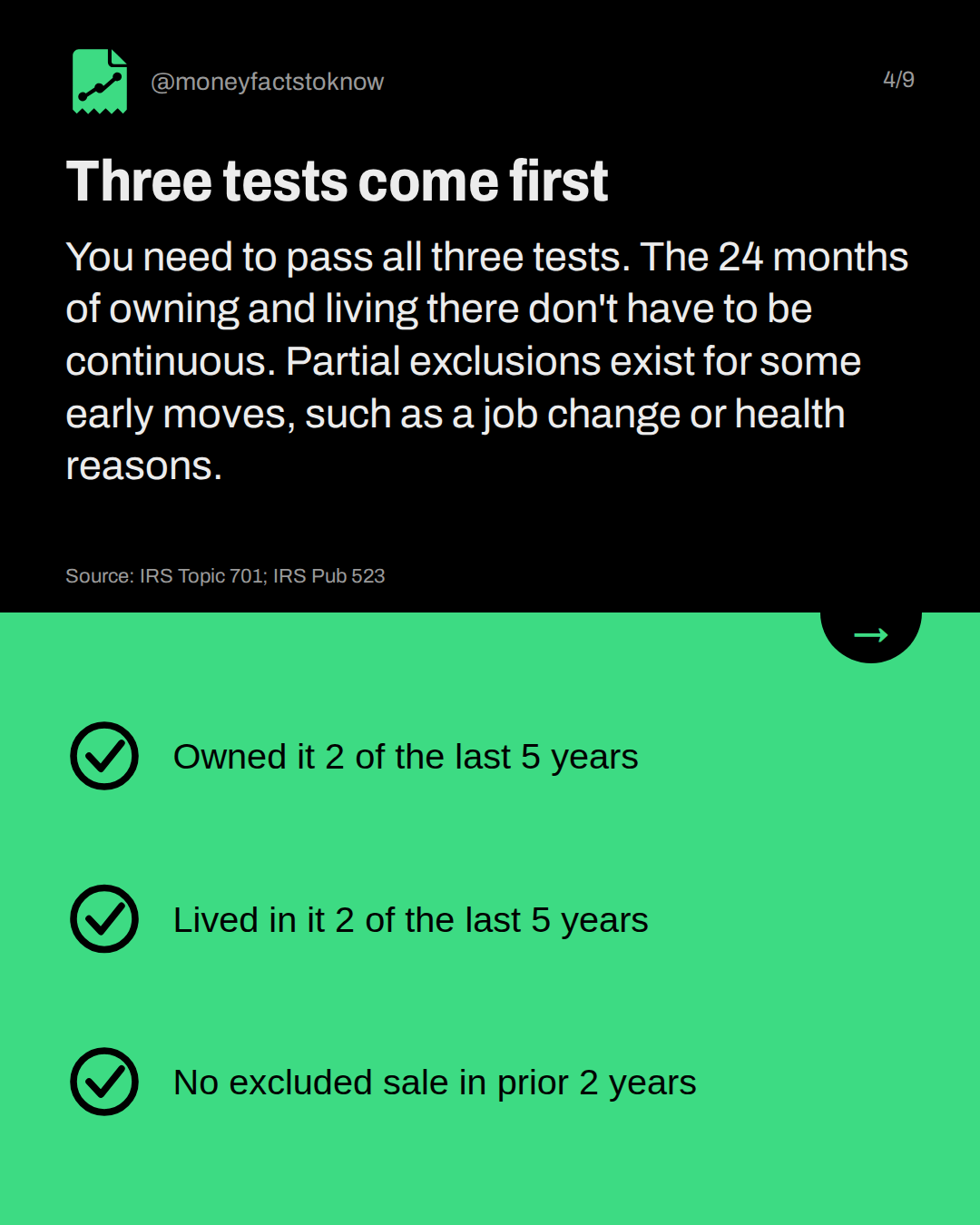
Three tests come first
You need to pass all three tests. The 24 months of owning and living there don't have to be continuous. Partial exclusions exist for some early moves, such as a job change or health reasons.
Source: IRS Topic 701; IRS Pub 523
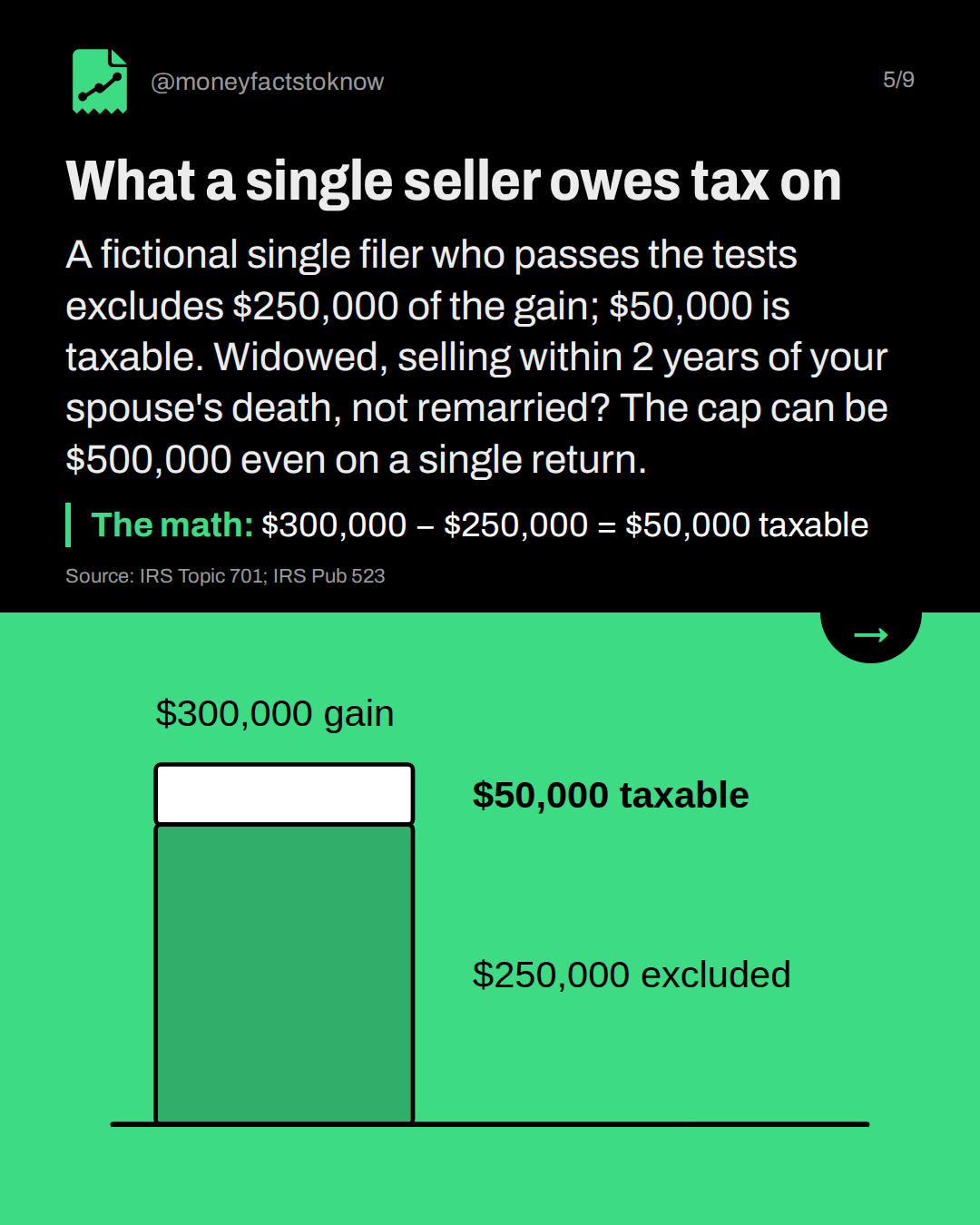
What a single seller owes tax on
A fictional single filer who passes the tests excludes $250,000 of the gain; $50,000 is taxable. Widowed, selling within 2 years of your spouse's death, not remarried? The cap can be $500,000 even on a single return.
The math: $300,000 − $250,000 = $50,000 taxable
Source: IRS Topic 701; IRS Pub 523
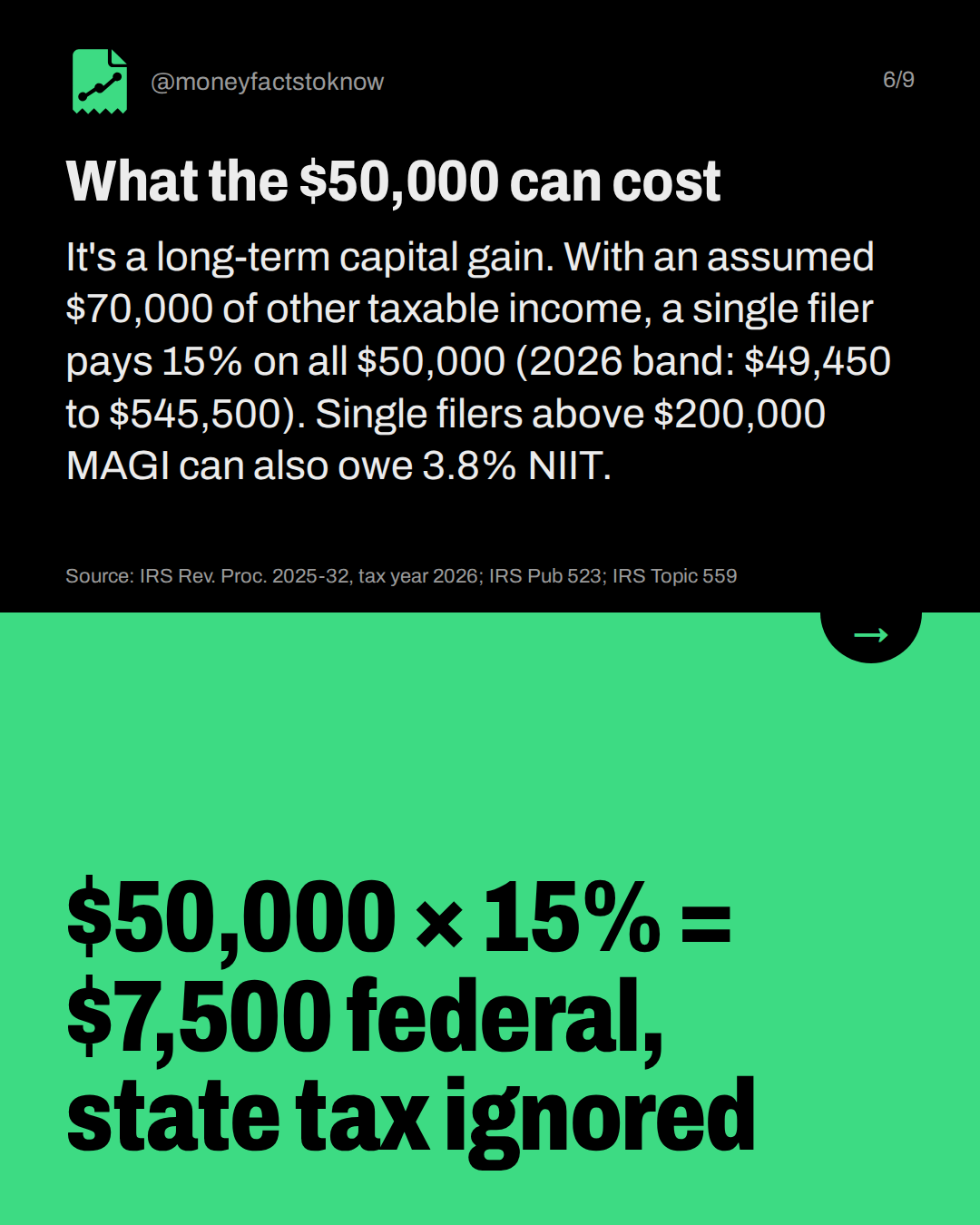
What the $50,000 can cost
It's a long-term capital gain. With an assumed $70,000 of other taxable income, a single filer pays 15% on all $50,000 (2026 band: $49,450 to $545,500). Single filers above $200,000 MAGI can also owe 3.8% NIIT.
The math: $50,000 × 15% = $7,500 federal, state tax ignored
Source: IRS Rev. Proc. 2025-32, tax year 2026; IRS Pub 523; IRS Topic 559
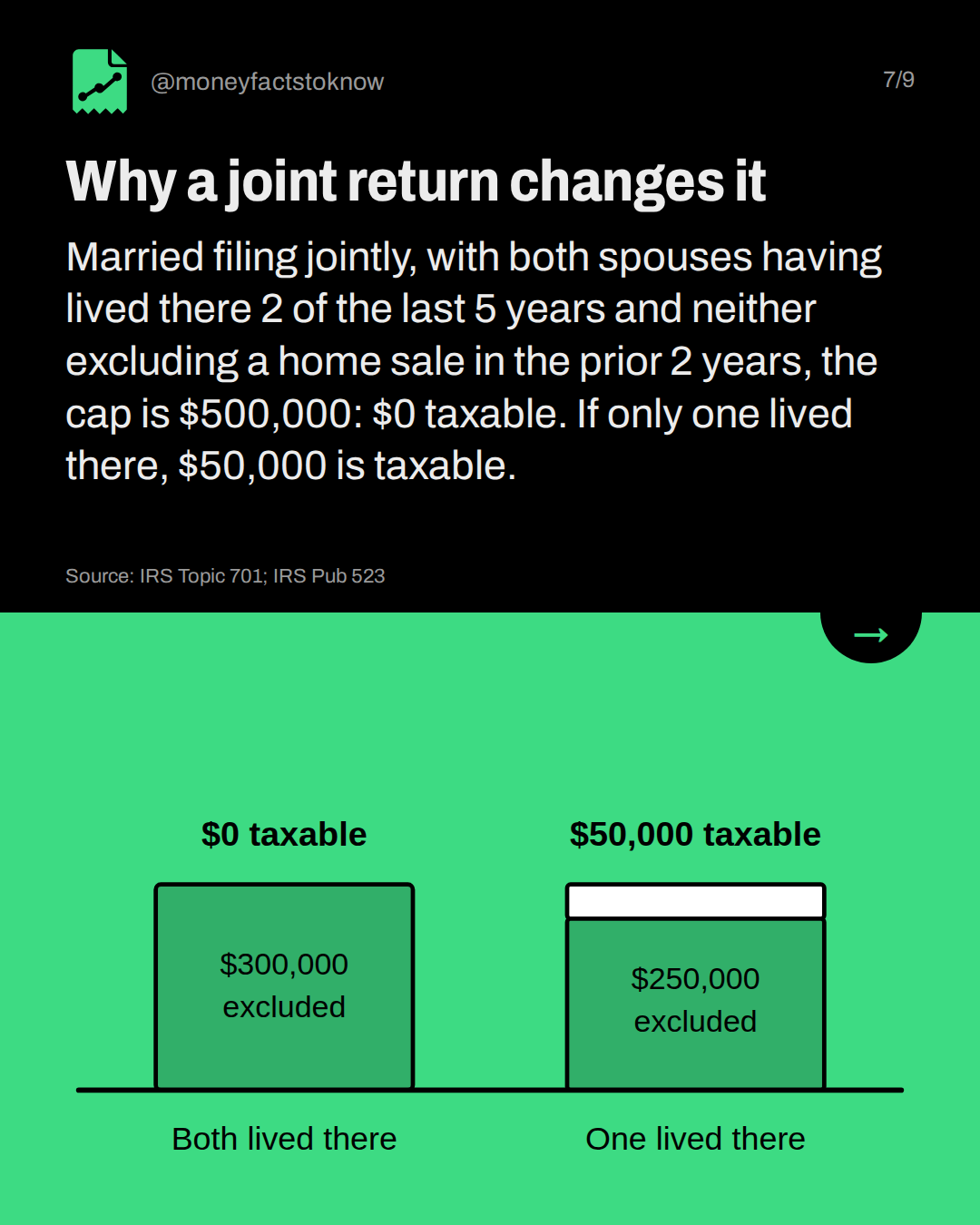
Why a joint return changes it
Married filing jointly, with both spouses having lived there 2 of the last 5 years and neither excluding a home sale in the prior 2 years, the cap is $500,000: $0 taxable. If only one lived there, $50,000 is taxable.
Source: IRS Topic 701; IRS Pub 523
When part of the gain stays taxable
Depreciation (deductions for renting out part of the home or a home office) after May 6, 1997 can't be excluded and can be taxed up to 25%. Got Form 1099-S? Report the sale even if you owe $0.
The math: Check basis records, your 24-month dates and any excluded home sale in the prior 2 years.
Source: IRS Pub 523; IRS Topics 701 and 409
Sources and assumptions
- IRS Topic no. 701, Sale of your home: $250,000 / $500,000 (joint return) exclusion; own ≥24 months and use as residence ≥24 months of last 5 years; not eligible if gain excluded on another home in the 2 years before; joint: either spouse meets ownership, both meet use; must report the sale if Form 1099-S received even if gain is excludable (page reviewed 12-Oct-2026) (checked 2026-10-27)
- IRS Publication 523 (2025), Selling Your Home: Amount realized = sale price minus selling expenses; gain = amount realized minus adjusted basis; improvements add to basis; $500,000 requires both spouses meet residence and look-back requirements and one or both meet ownership; only $250,000 if only one spouse meets residence; once in 2 years; depreciation after May 6, 1997 not excludable; nonqualified use after 2008; taxable gain reported on Form 8949 and Schedule D as a capital gain, long-term if held more than one year (checked 2026-10-27)
- IRS Rev. Proc. 2025-32, Internal Revenue Bulletin 2025-45, section 4.03: Tax year 2026 long-term capital gains: unmarried Maximum Zero Rate Amount $49,450, Maximum 15% Rate Amount $545,500; married filing jointly $98,900 / $613,700 (checked 2026-10-27)
- IRS IR-2025-103, tax inflation adjustments for tax year 2026: 2026 single standard deduction $16,100 (used only for the MAGI assumption) (checked 2026-10-27)
- IRS Topic no. 559, Net investment income tax: 3.8% NIIT above $200,000 MAGI (single) / $250,000 (MFJ); NIIT doesn't apply to gain from sale of a principal residence on the portion excluded for income tax purposes (checked 2026-10-27)
- IRS Topic no. 409, Capital gains and losses: 'The portion of any unrecaptured section 1250 gain from selling section 1250 real property is taxed at a maximum 25% rate.' (page last reviewed or updated 24-Sep-2026) (checked 2026-10-27)
Assumptions:
- All people are fictional.
- Fictional home: sale price $560,000, selling costs $20,000, adjusted basis $240,000 (purchase price plus improvements), so gain $300,000.
- The home is the seller's main home, owned and lived in at least 24 of the 60 months before the sale, with no excluded home sale in the prior 2 years; no depreciation (no home office or rental use) and no nonqualified use.
- Home owned more than one year, so the taxable gain is long-term.
- For the 15% example: tax year 2026, single filer, $70,000 of other taxable income after deductions (about $86,100 of wages with the $16,100 standard deduction and no other items), so MAGI about $136,100, below the $200,000 NIIT threshold.
- Federal tax only; state tax ignored; no credits, other gains or losses.
- Joint comparison: married filing jointly, both spouses meet the use test and look-back, at least one meets the ownership test.
The short version
- Gain is sale price minus costs minus basis
- Cap: $250,000 single; $500,000 joint if both lived there
- Own it and live in it 2 of 5 years; no excluded sale in the prior 2 years
- Gain above the cap is a capital gain


