 Money Facts To Know
In the 22% bracket, $100 into a pre-tax 401(k) cost only $78

What most people assume
Many people assume every $100 they defer means $100 less take-home pay. For pre-tax (traditional) deferrals, the paycheck usually drops by less than that.
Why the paycheck drops less
Pre-tax deferrals aren't subject to federal income tax withholding (and are left out of W-2 Box 1), so federal withholding falls. FICA (Social Security and Medicare tax) still applies to the full $100.
Source: IRS retirement plan FAQs; IRS Topic 424
The fictional paycheck we're testing
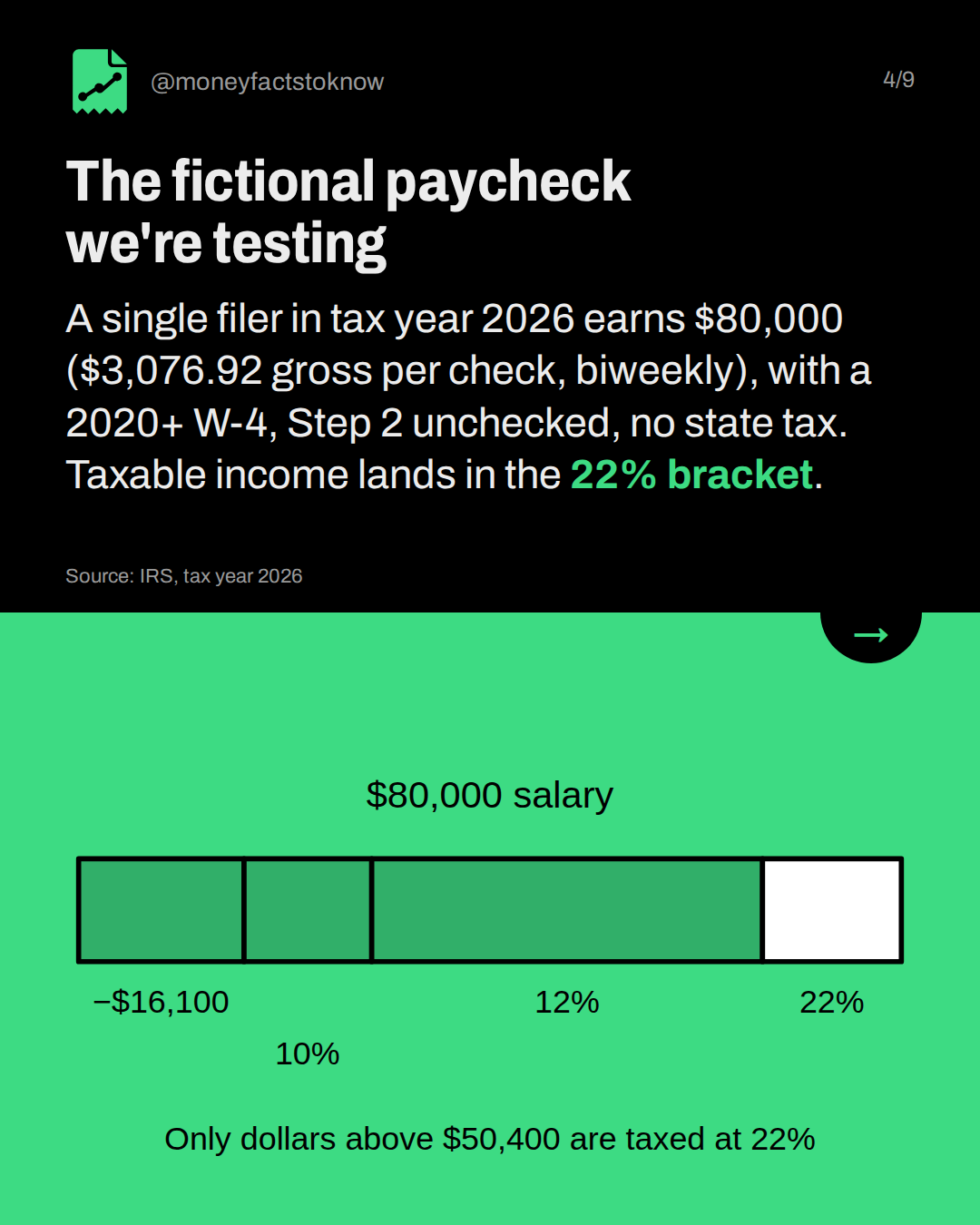
A single filer in tax year 2026 earns $80,000 ($3,076.92 gross per check, biweekly), with a 2020+ W-4, Step 2 unchecked, no state tax. Taxable income lands in the 22% bracket.
Source: IRS, tax year 2026
Where the other $22 went
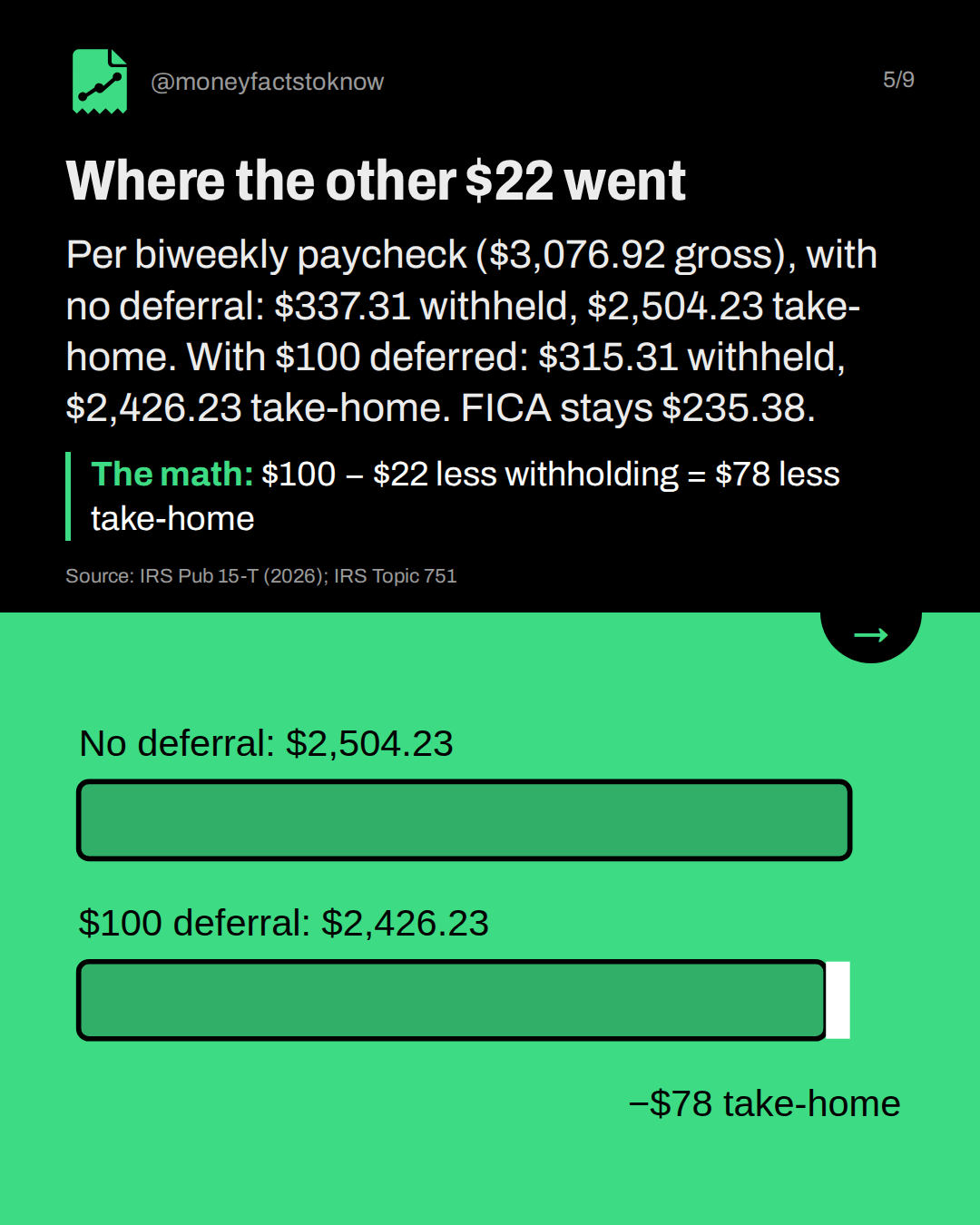
Per biweekly paycheck ($3,076.92 gross), with no deferral: $337.31 withheld, $2,504.23 take-home. With $100 deferred: $315.31 withheld, $2,426.23 take-home. FICA stays $235.38.
The math: $100 − $22 less withholding = $78 less take-home
Source: IRS Pub 15-T (2026); IRS Topic 751
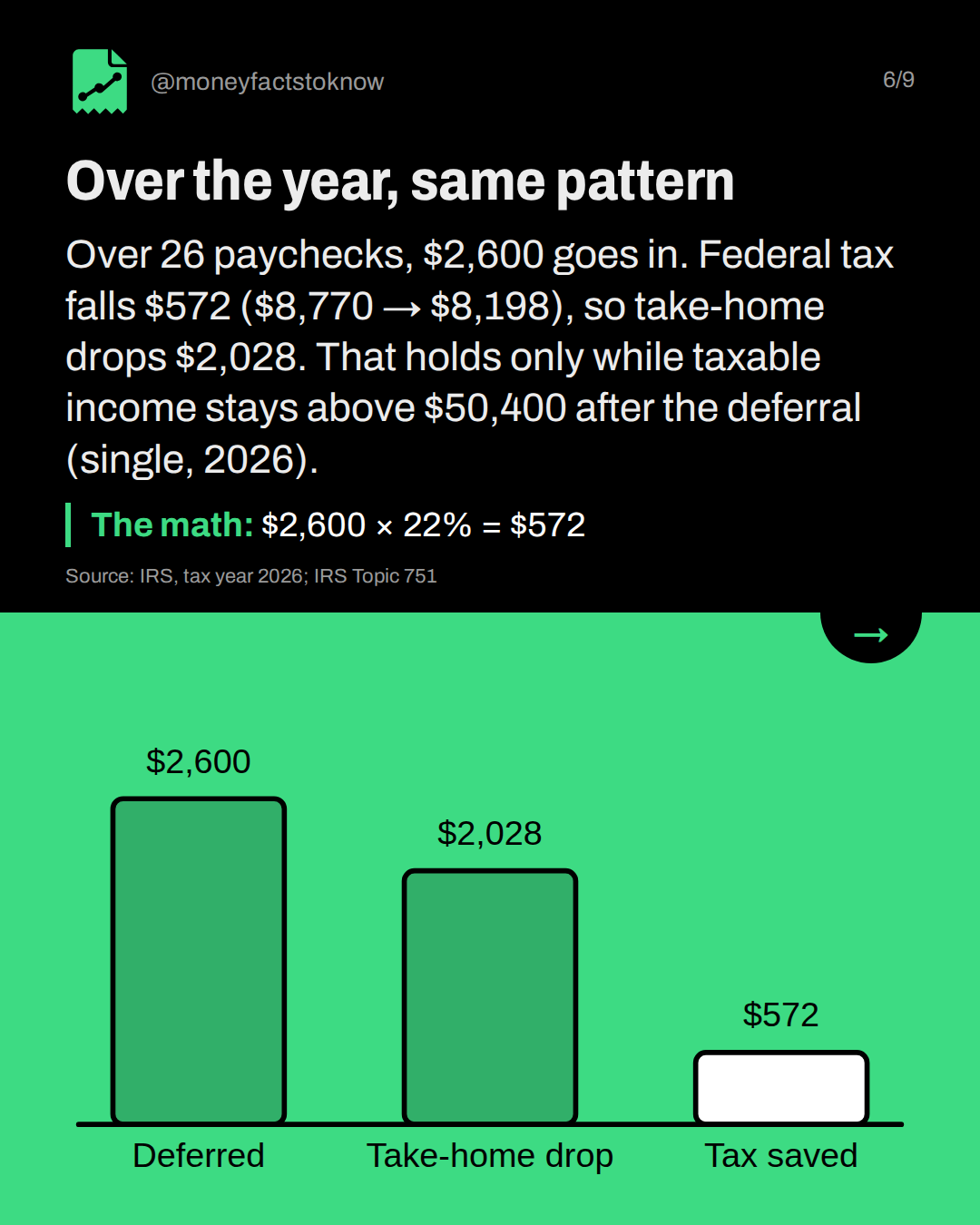
Over the year, same pattern
Over 26 paychecks, $2,600 goes in. Federal tax falls $572 ($8,770 → $8,198), so take-home drops $2,028. That holds only while taxable income stays above $50,400 after the deferral (single, 2026).
The math: $2,600 × 22% = $572
Source: IRS, tax year 2026; IRS Topic 751
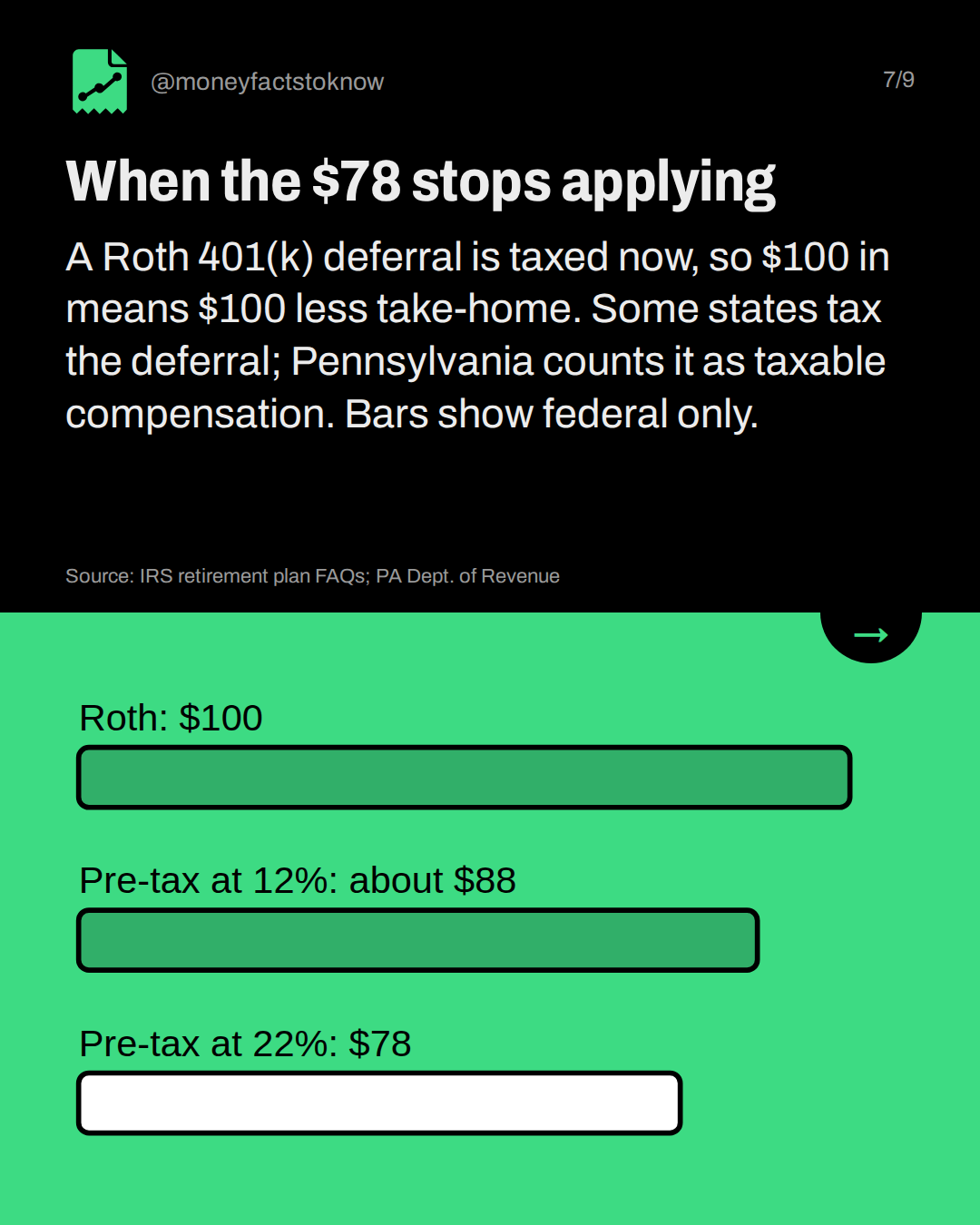
When the $78 stops applying
A Roth 401(k) deferral is taxed now, so $100 in means $100 less take-home. Some states tax the deferral; Pennsylvania counts it as taxable compensation. Bars show federal only.
Source: IRS retirement plan FAQs; PA Dept. of Revenue
How to estimate your own
Estimate it with $100 × (1 − your federal bracket rate) if the deferral stays in one bracket. On your W-2, Box 5 (Medicare wages) is usually higher than Box 1 (income tax wages) by your deferrals.
The math: Compare your next pay stub after any change.
Source: IRS retirement plan FAQs
Sources and assumptions
- IRS – Retirement plan FAQs regarding contributions: are retirement plan contributions subject to withholding for FICA, Medicare or federal income tax?: Pre-tax elective deferrals: FICA and Medicare yes, federal income tax no. Roth deferrals: all three yes. Pre-tax deferrals are left out of W-2 Box 1 but included in Boxes 3 and 5. (checked 2026-10-26)
- IRS – Topic no. 424, 401(k) plans: Elective deferrals aren't subject to income tax withholding when deferred but remain subject to Social Security and Medicare taxes; plans may offer designated Roth contributions on an after-tax basis. (checked 2026-10-26)
- IRS – IRS releases tax inflation adjustments for tax year 2026, including amendments from the One, Big, Beautiful Bill: 2026 single standard deduction $16,100. Single brackets: 10% to $12,400, 12% over $12,400, 22% over $50,400, 24% over $105,700. (checked 2026-10-26)
- IRS – Publication 15-T (2026), Federal Income Tax Withholding Methods: 2026 Annual Percentage Method table, Single, standard withholding: $57,900–$113,200 is $5,800 plus 22% over $57,900. Lower rows: $0–$7,500 0%, $7,500–$19,900 10%, $19,900–$57,900 $1,240 plus 12%. (checked 2026-10-26)
- IRS – Topic no. 751, Social Security and Medicare withholding rates: Employee Social Security 6.2%, Medicare 1.45%; 2026 Social Security wage base $184,500. (checked 2026-10-26)
- Pennsylvania Department of Revenue – PA Personal Income Tax Guide, Gross Compensation: PA lists 'contributions to a qualified deferred compensation plan' among income items always taxable as Pennsylvania compensation, so pre-tax 401(k) deferrals don't lower PA taxable wages. (checked 2026-10-26)
Assumptions:
- Fictional single filer, tax year 2026, $80,000 salary, no other income, $16,100 standard deduction, no credits.
- Paid biweekly: 26 paychecks of $3,076.92; $100 traditional (pre-tax) 401(k) deferral per paycheck.
- Form W-4 from 2020 or later, standard withholding, Step 2 not checked, no Step 3/4 entries; withholding computed with the 2026 Pub 15-T Worksheet 1A annual percentage method (annualize wages, subtract the $8,600 line 1g amount, apply the Single standard table, divide by 26).
- No state or local income tax (state treatment varies; Pennsylvania taxes the deferral).
- FICA = 6.2% Social Security + 1.45% Medicare on the full $3,076.92 gross; salary is below the $184,500 wage base, so no Additional Medicare Tax applies.
- Taxable income stays inside the 22% bracket (above $50,400) after deferring; annualized withholding wages stay above $57,900.
- No other pre-tax deductions (health premiums, HSA) that would change the starting wages.
- Figures are federal, nominal dollars; the post doesn't model investment growth or later taxes on withdrawals.
The short version
- Pre-tax deferrals skip income tax withholding
- Social Security and Medicare still apply
- In our 22% example, $100 in cost $78
- Roth deferrals and some states differ


