 Money Facts To Know
Paying $3,000 for a lower mortgage rate? Count the months first
A lower rate isn't free
Points are usually paid in cash at closing (this example assumes you pay them yourself), and one point equals 1% of the loan amount. On $300,000, that's $3,000.
Source: CFPB
The $3,000 trade
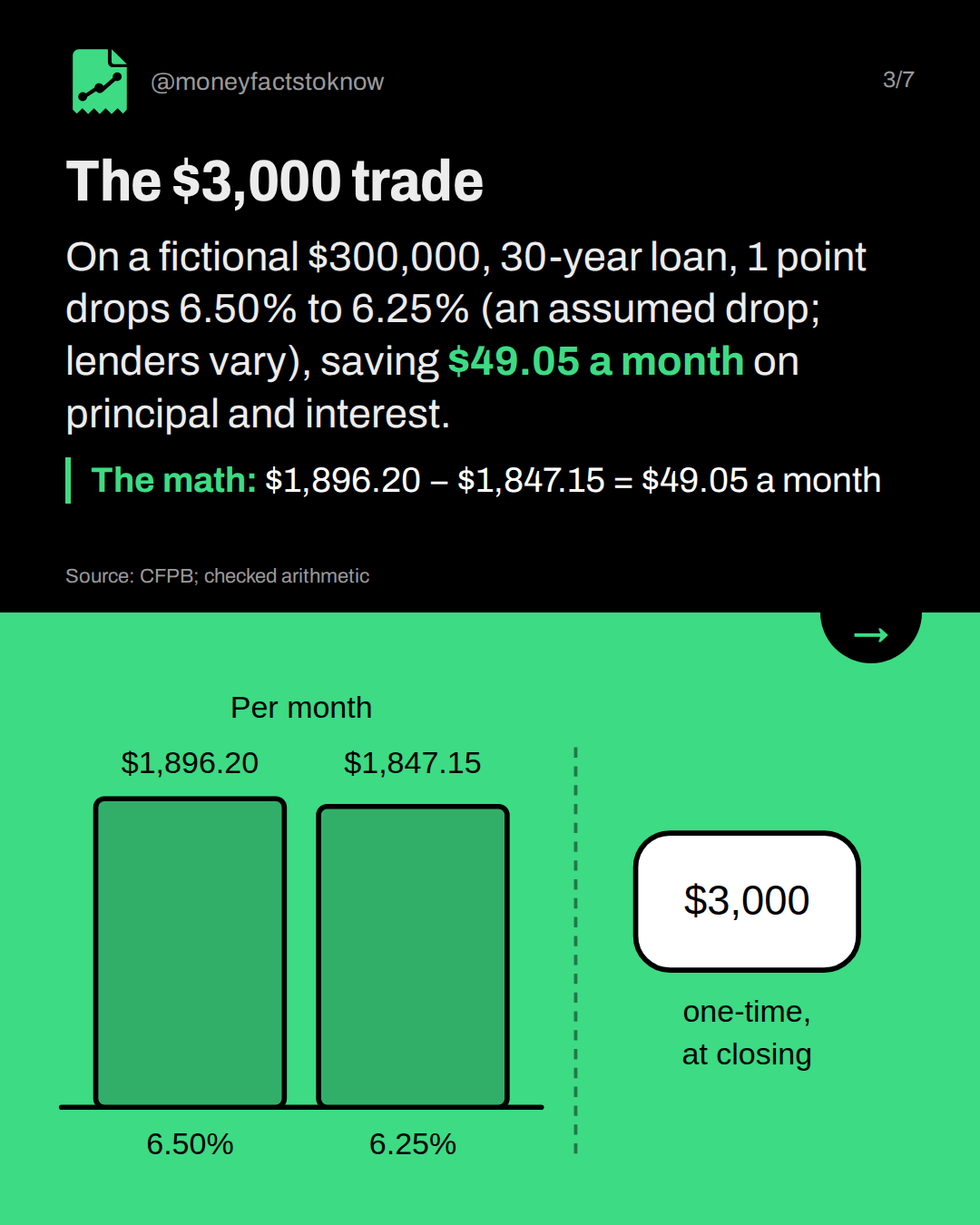
On a fictional $300,000, 30-year loan, 1 point drops 6.50% to 6.25% (an assumed drop; lenders vary), saving $49.05 a month on principal and interest.
The math: $1,896.20 − $1,847.15 = $49.05 a month
Source: CFPB; checked arithmetic
When the $3,000 comes back
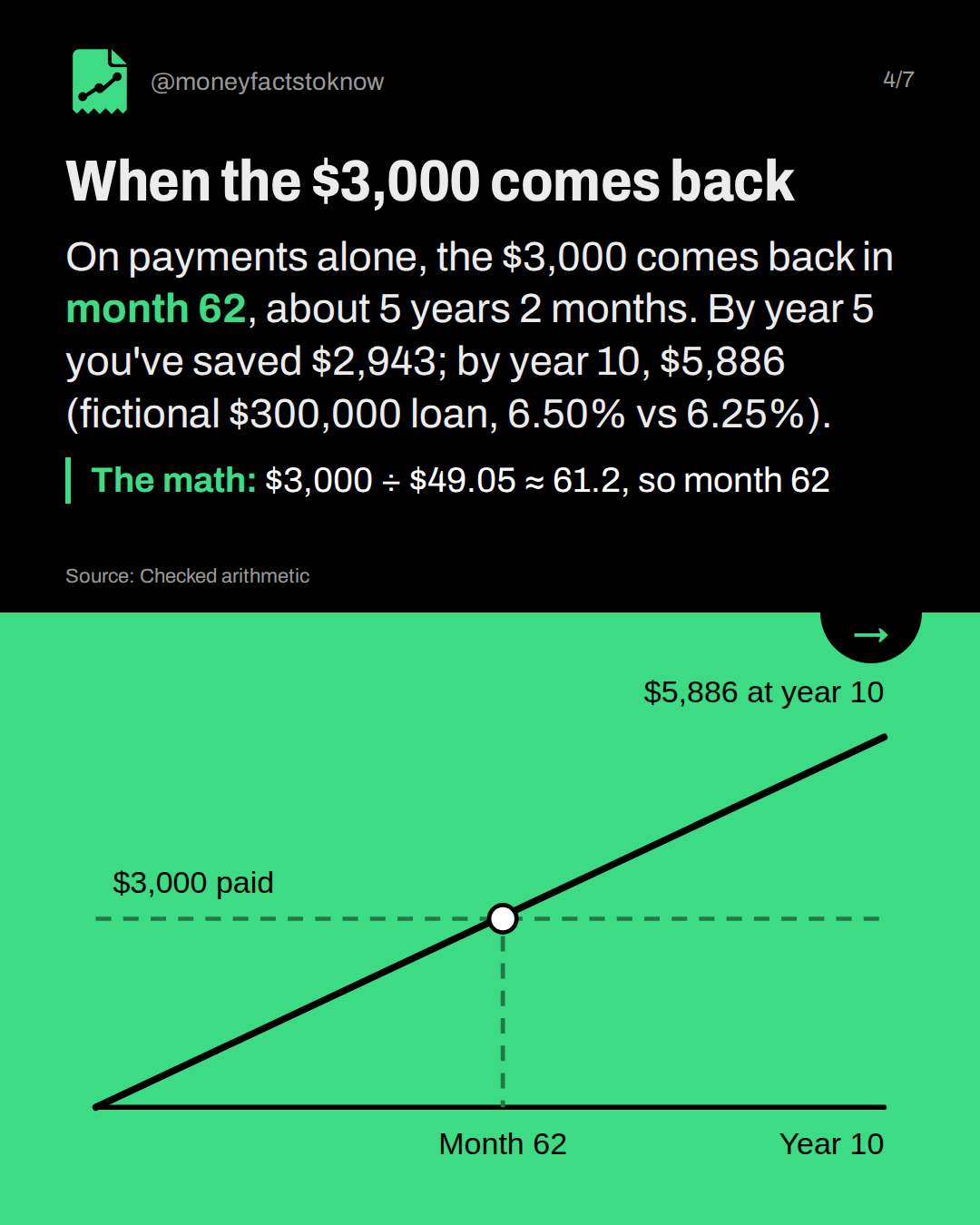
On payments alone, the $3,000 comes back in month 62, about 5 years 2 months. By year 5 you've saved $2,943; by year 10, $5,886 (fictional $300,000 loan, 6.50% vs 6.25%).
The math: $3,000 ÷ $49.05 ≈ 61.2, so month 62
Source: Checked arithmetic
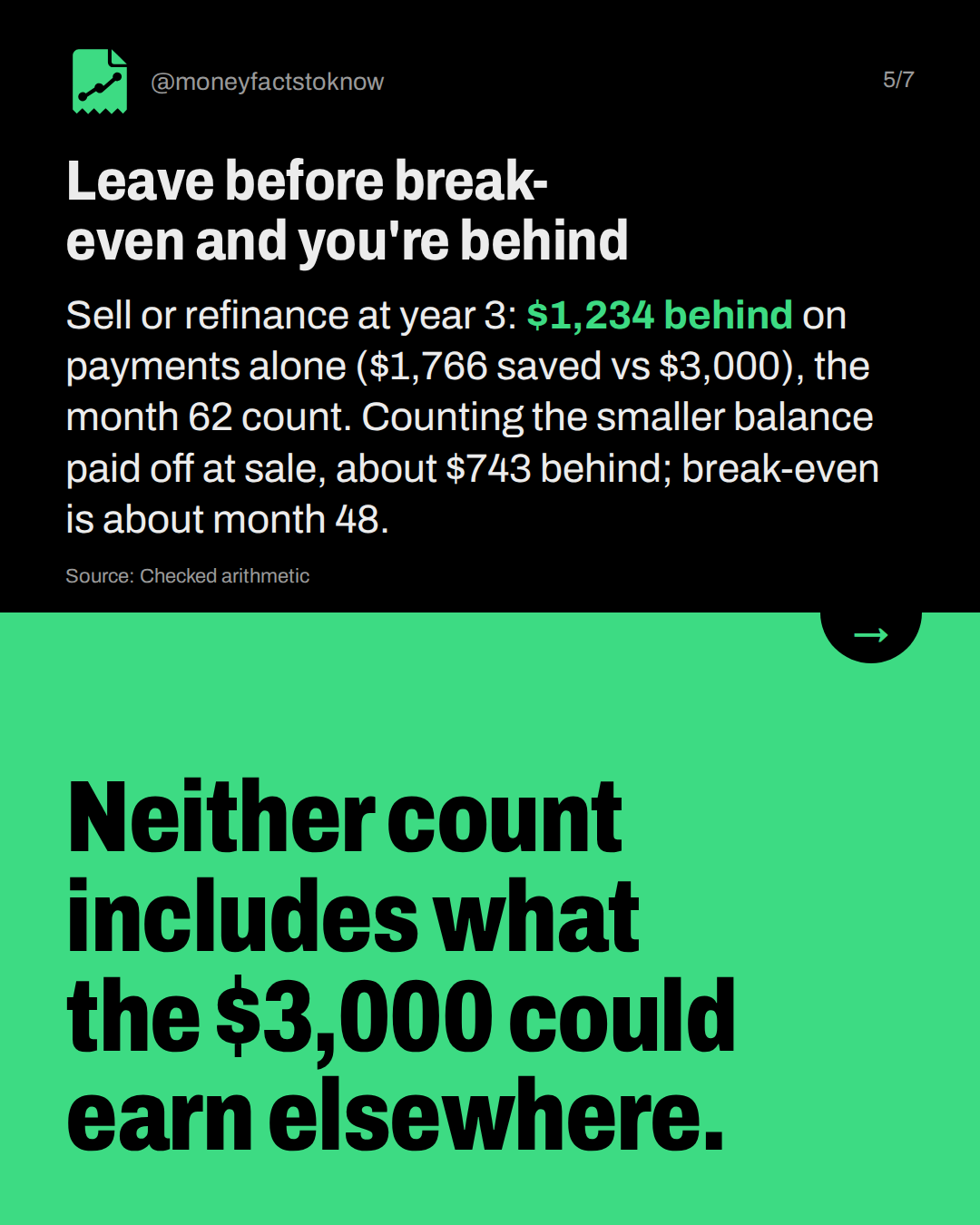
Leave before break-even and you're behind
Sell or refinance at year 3: $1,234 behind on payments alone ($1,766 saved vs $3,000), the month 62 count. Counting the smaller balance paid off at sale, about $743 behind; break-even is about month 48.
The math: Neither count includes what the $3,000 could earn elsewhere.
Source: Checked arithmetic
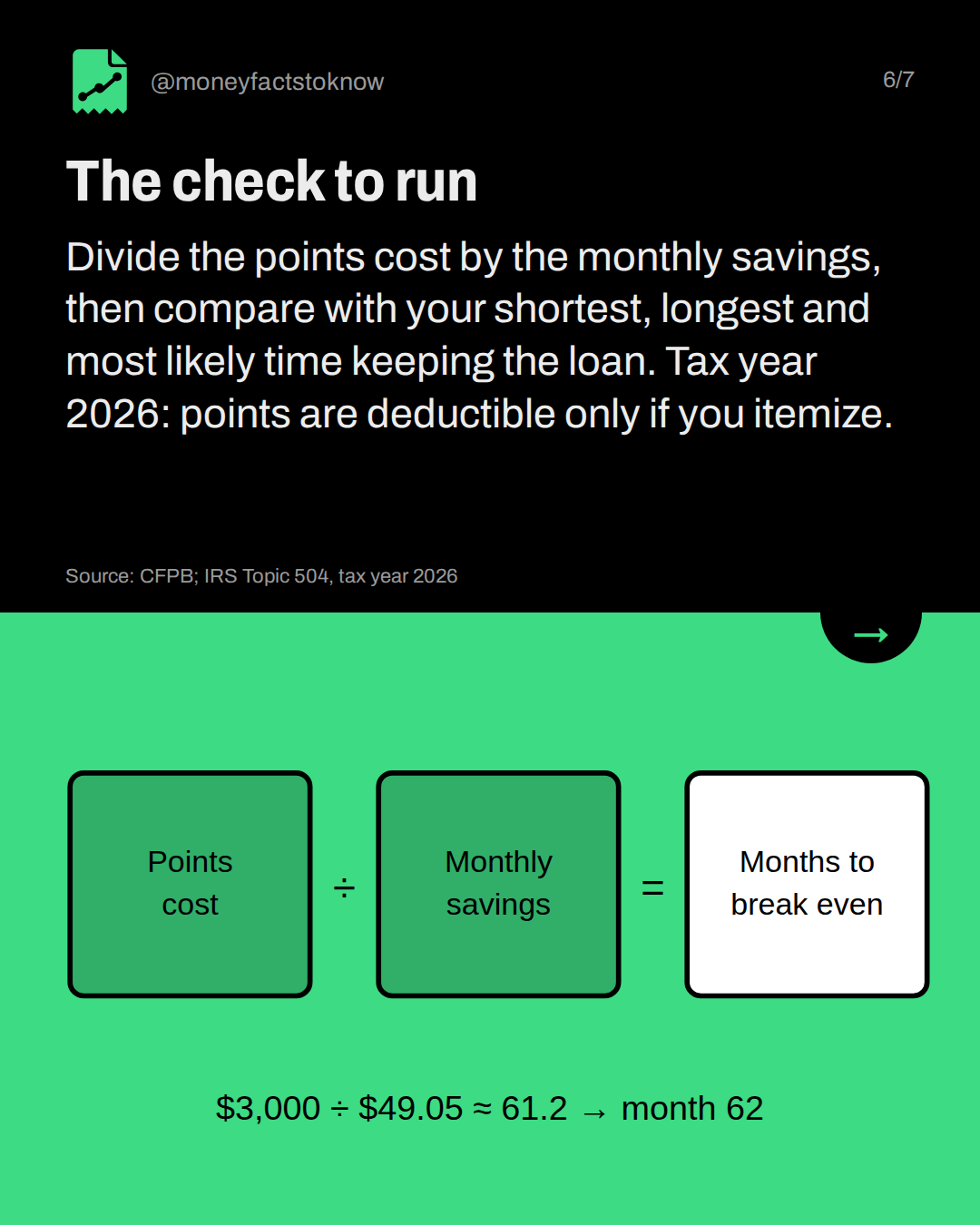
The check to run
Divide the points cost by the monthly savings, then compare with your shortest, longest and most likely time keeping the loan. Tax year 2026: points are deductible only if you itemize.
Source: CFPB; IRS Topic 504, tax year 2026
Sources and assumptions
- CFPB: What are (discount) points and lender credits and how do they work?: One point equals 1% of the loan amount. Points lower the rate compared with the same lender's zero-point loan. The size of the drop depends on the lender, the loan type and the market. Points can be a good choice if you keep the loan a long time. Compare the shortest, longest and most likely times you'll keep the loan. Lender credits work the other way (higher rate, less up front). Page updated Oct 1, 2024. (checked 2026-10-25)
- CFPB newsroom: CFPB finds Americans are paying upfront fees seeking to lower interest rates on mortgages: Points are a one-time fee paid at closing. Most borrowers benefit only if they keep the mortgage long enough for the monthly savings to outweigh the up-front cost. 61% of home purchase loans carried discount points in September 2023. (checked 2026-10-25)
- IRS Topic no. 504, Home mortgage points: Points are deductible only if you itemize on Schedule A. Points on a principal-residence purchase loan can be deducted in full in the year paid if the criteria are met. Refinance points are deducted ratably over the loan's term. (checked 2026-10-25)
Assumptions:
- Fictional borrower. Loan amount $300,000, 30-year fixed, monthly payments, principal and interest only (no taxes, insurance or PMI).
- Option A: 6.50% with 0 points. Option B: 6.25% with 1 point. The 0.25-point drop per point is an assumption; CFPB says the drop varies by lender, loan type and market.
- 1 point = 1% of the loan amount = $3,000, paid in cash at closing (not financed into the loan).
- Payments use the standard amortization formula P·i/(1−(1+i)^−360), i = rate/12, rounded to cents.
- The payment-only break-even ignores the lower remaining balance on the 6.25% loan and what the $3,000 could earn elsewhere. Any tax deduction for points is excluded.
- The 'about month 48' break-even counts payment savings plus the difference in remaining balance at sale, before any return on the $3,000.
The short version
- 1 point equals 1% of the loan
- Fictional example: $49.05 saved a month
- $3,000 ÷ $49.05 puts payment-only break-even at month 62
- Leaving earlier can cost more than it saved
- Compare it with how long you'll keep the loan


