 Money Facts To Know
You sold nothing. A taxable-account fund can hand you a taxable gain


No sale doesn't always mean no tax
For a stock you hold, a rise in its price generally isn't taxed until you sell. A mutual fund, though, buys and sells holdings inside the fund all year, and gains from those sales can reach you.
Source: IRS Topic 409; IRS Topic 404; IRS FAQ, Mutual Funds
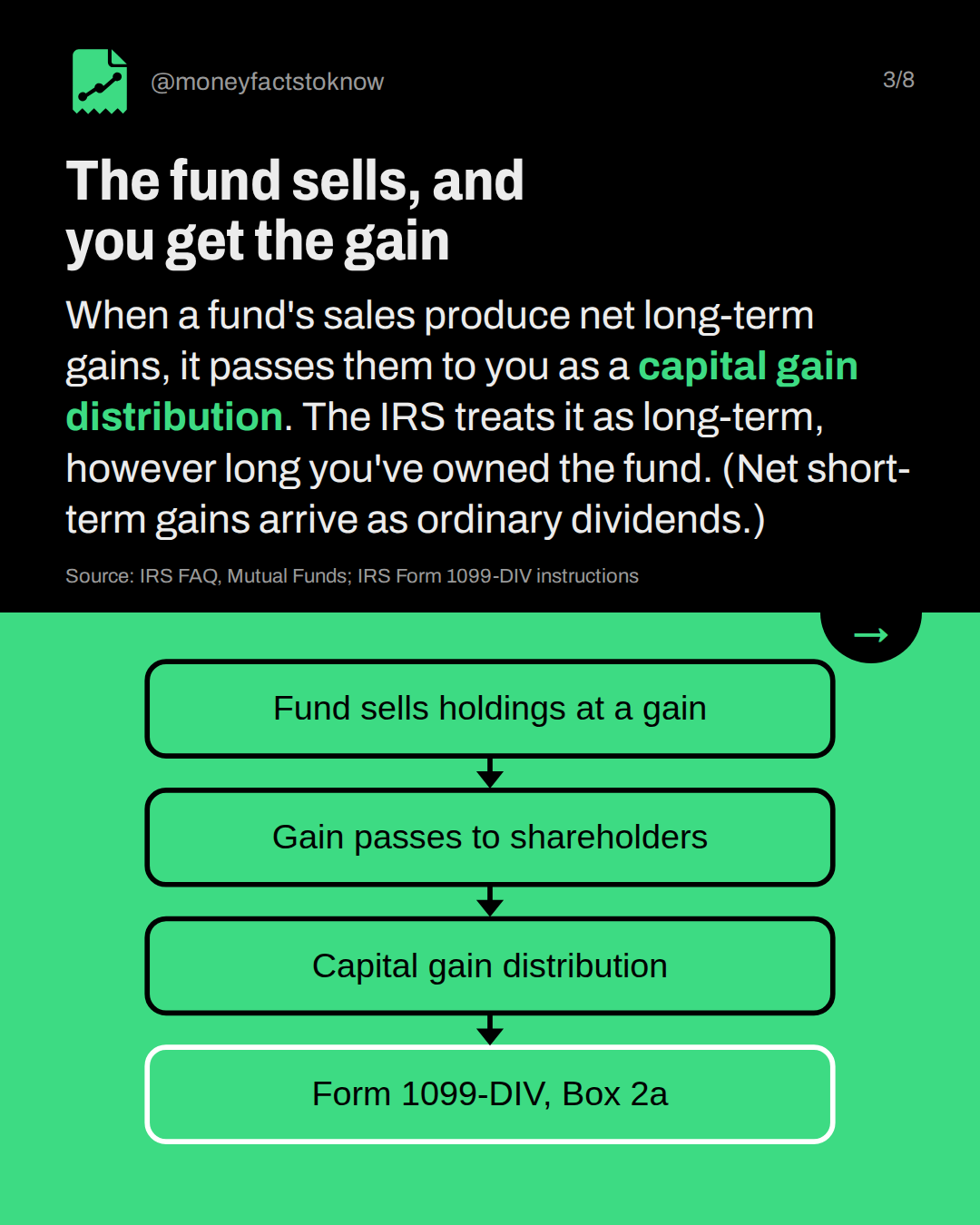
The fund sells, and you get the gain
When a fund's sales produce net long-term gains, it passes them to you as a capital gain distribution. The IRS treats it as long-term, however long you've owned the fund. (Net short-term gains arrive as ordinary dividends.)
Source: IRS FAQ, Mutual Funds; IRS Form 1099-DIV instructions
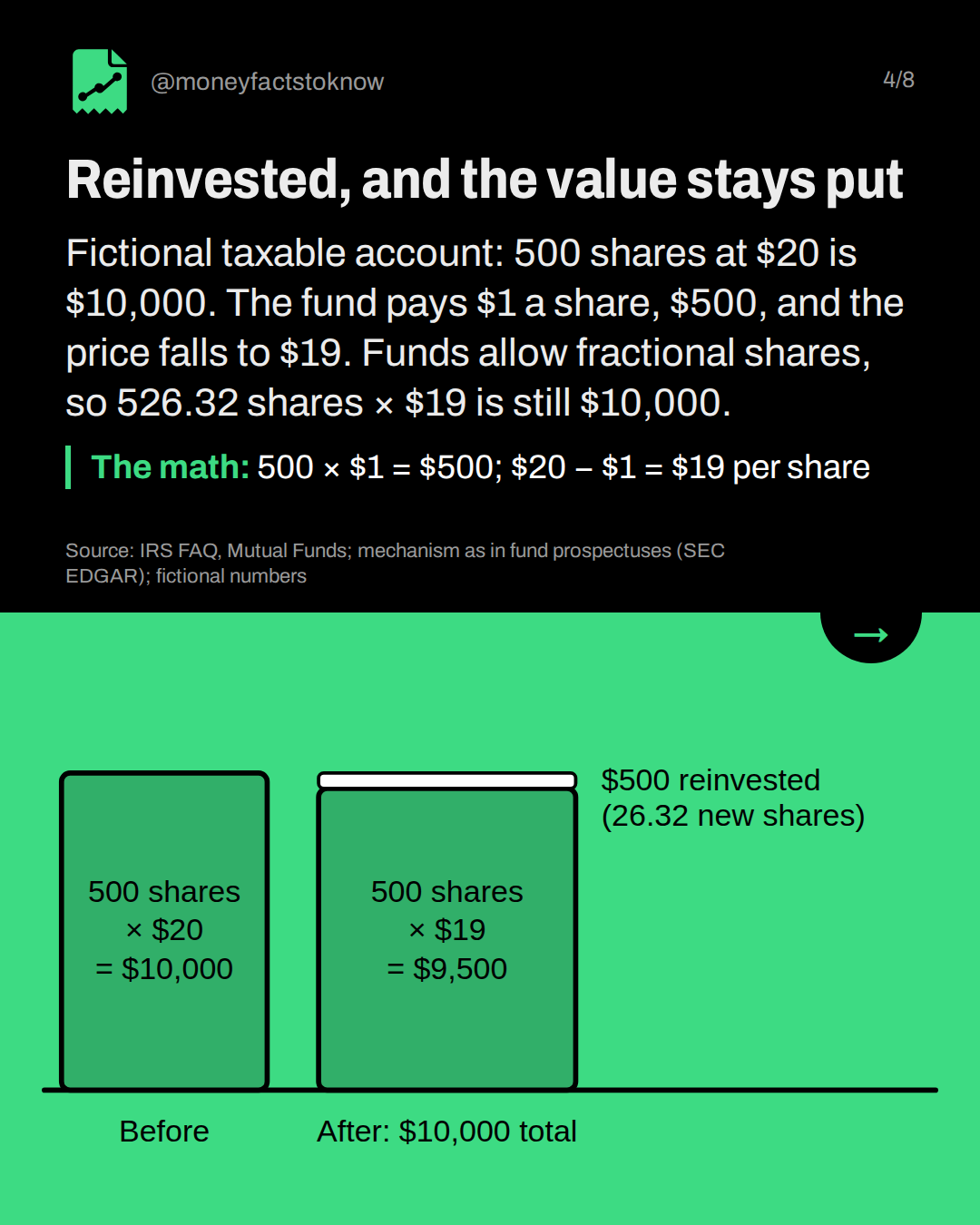
Reinvested, and the value stays put
Fictional taxable account: 500 shares at $20 is $10,000. The fund pays $1 a share, $500, and the price falls to $19. Funds allow fractional shares, so 526.32 shares × $19 is still $10,000.
The math: 500 × $1 = $500; $20 − $1 = $19 per share
Source: IRS FAQ, Mutual Funds; mechanism as in fund prospectuses (SEC EDGAR); fictional numbers
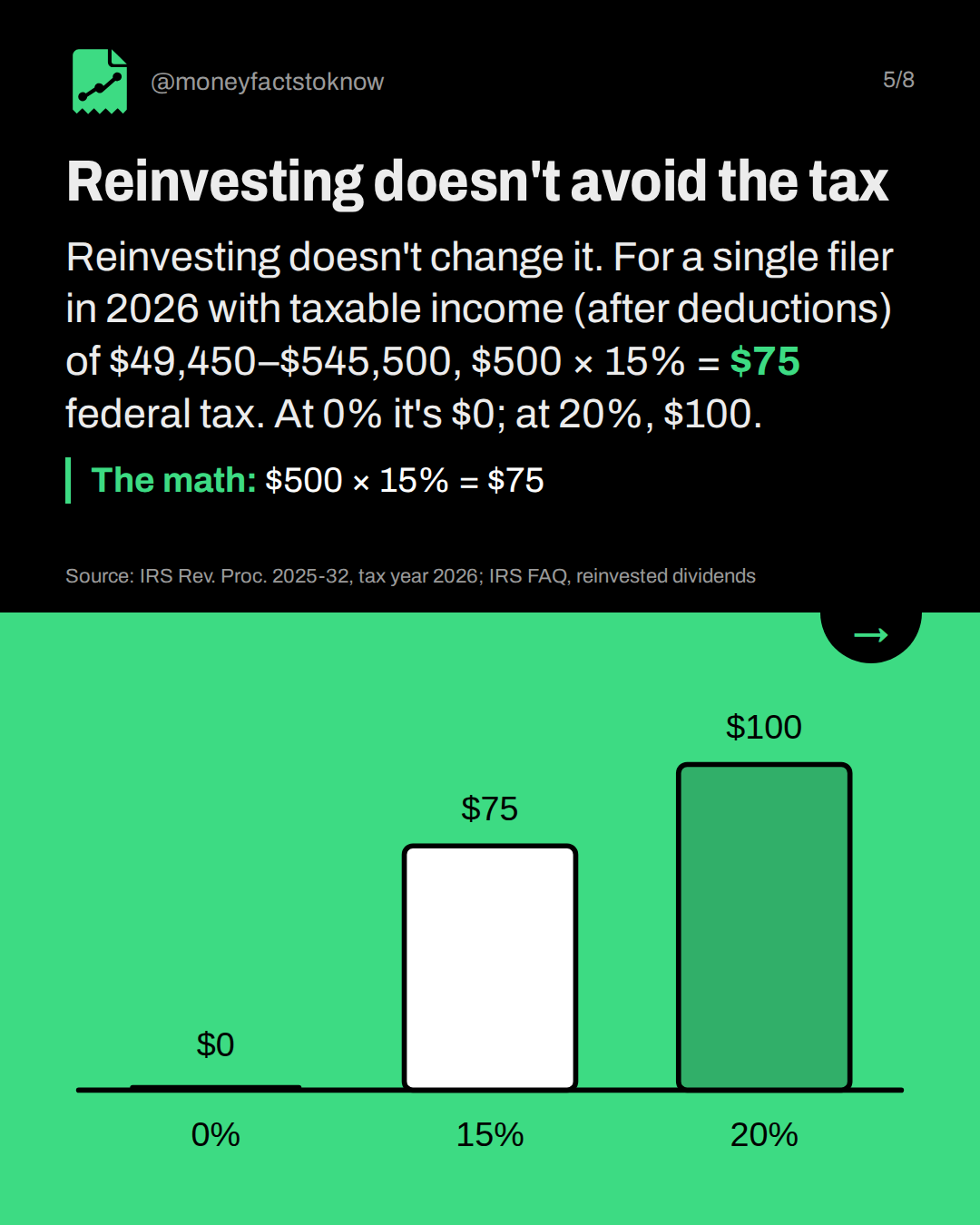
Reinvesting doesn't avoid the tax
Reinvesting doesn't change it. For a single filer in 2026 with taxable income (after deductions) of $49,450–$545,500, $500 × 15% = $75 federal tax. At 0% it's $0; at 20%, $100.
The math: $500 × 15% = $75
Source: IRS Rev. Proc. 2025-32, tax year 2026; IRS FAQ, reinvested dividends
When this doesn't apply
Inside an IRA or 401(k), the distribution isn't taxed when it's paid; withdrawals follow the account's rules. The example leaves out state tax and the 3.8% net investment income tax (single filers above $200,000 MAGI).
Source: IRS Pub. 590-B (2025); IRS, 401(k) Plans; IRS Topic 559
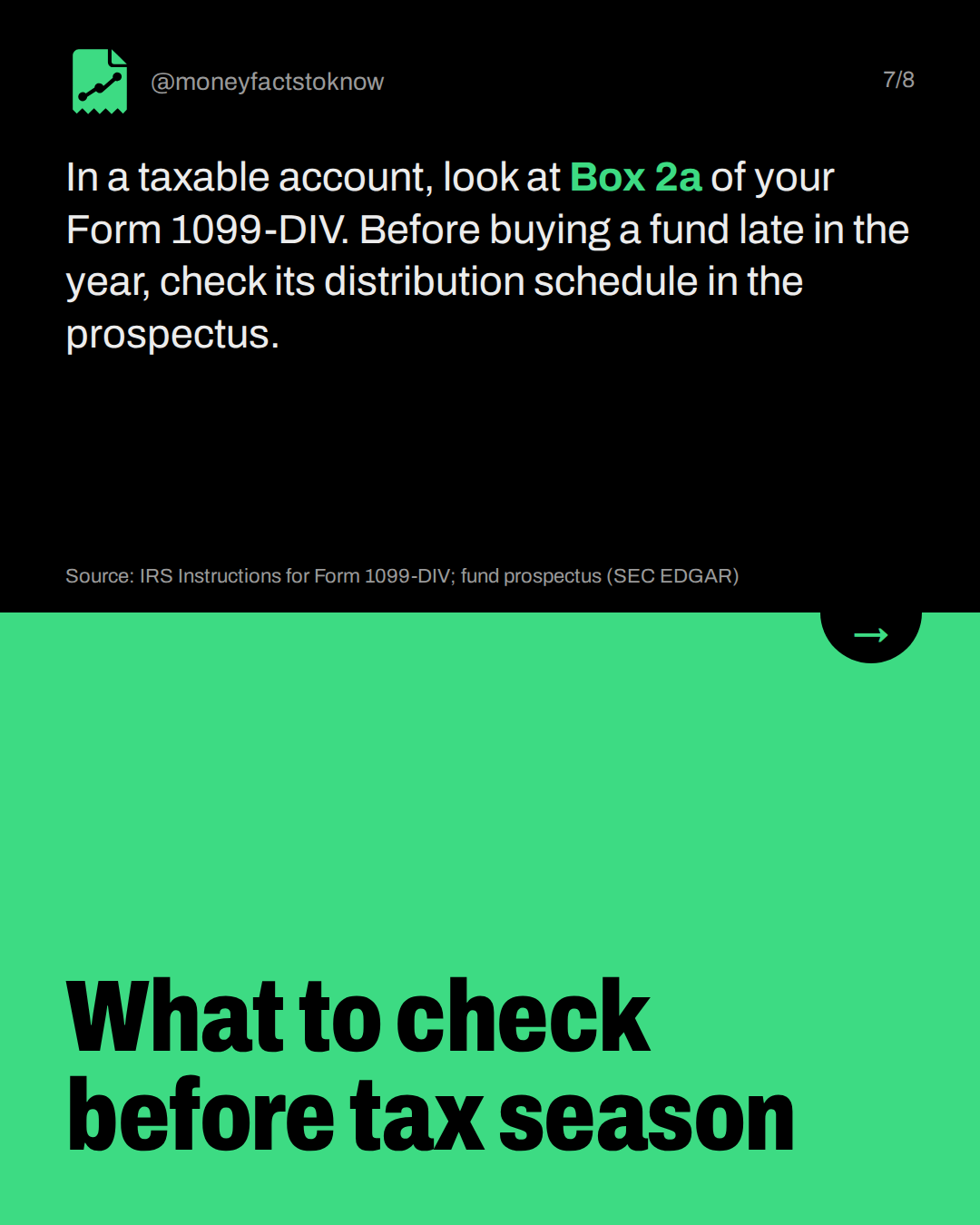
What to check before tax season
In a taxable account, look at Box 2a of your Form 1099-DIV. Before buying a fund late in the year, check its distribution schedule in the prospectus.
Source: IRS Instructions for Form 1099-DIV; fund prospectus (SEC EDGAR)
Sources and assumptions
- IRS FAQ: Capital Gains, Losses, and Sale of Home — Mutual Funds (Costs, Distributions, etc.): Q: why report capital gains from mutual funds if I never sold shares? The fund passes gains from its own sales on as capital gain distributions; 'Consider capital gain distributions as long-term capital gains no matter how long you've owned shares in the mutual fund'; Form 1099-DIV box 2a goes on Schedule D line 13 (checked 2026-10-25)
- IRS Topic no. 404, Dividends: Capital gain distributions from investment companies 'are always reported as long-term capital gains' and are reported on Form 1099-DIV; Form 1099-DIV is required for $10 or more in distributions (checked 2026-10-25)
- IRS Instructions for Form 1099-DIV (Rev. 01/2024): Box 2a: 'Enter total capital gain distributions (long-term).' Box 1a: 'Include reinvested dividends' (checked 2026-10-25)
- IRS: Stocks (options, splits, traders) 2 FAQ: Dividends reinvested on your behalf to buy more shares must still be reported as income (checked 2026-10-25)
- Vanguard Growth and Income Fund prospectus (Form 485BPOS, filed 2017-01-26, SEC EDGAR): 'Distributions are taxable to you whether or not you reinvest these amounts in additional Fund shares'; buying-a-dividend example: a $1/share distribution drops the price from $20 to $19 and total value stays the same, but tax is owed on the distribution even if it's reinvested; after-tax returns aren't relevant in an IRA or 401(k) (checked 2026-10-25)
- IRS Rev. Proc. 2025-32 (Internal Revenue Bulletin 2025-45): Tax year 2026, all other (single) individuals: maximum zero rate amount $49,450; maximum 15% rate amount $545,500 (MFJ $98,900 / $613,700) (checked 2026-10-25)
- IRS Publication 590-B (2025): 'Generally, amounts in your IRA (including earnings and gains) aren't taxed until distributed.' (checked 2026-10-25)
- IRS: 401(k) Plans: 'Distributions, including earnings, are includible in taxable income at retirement (except for qualified distributions of designated Roth accounts)' (checked 2026-10-25)
- IRS Topic no. 559, Net investment income tax: 3.8% NIIT applies above $200,000 MAGI for single filers (checked in the 2026-10-10-b research; cited here only as a qualifier) (checked 2026-10-10)
- IRS Topic no. 409, Capital gains and losses: 'When you sell a capital asset, the difference between the adjusted basis in the asset and the amount you realized from the sale is a capital gain or a capital loss.' (Page last reviewed 2026-09-24; its rate table shows tax year 2025 thresholds, so the 2026 thresholds still come from Rev. Proc. 2025-32) (checked 2026-10-25)
Assumptions:
- Fictional single filer, tax year 2026, shares held in a regular taxable brokerage account
- 500 shares bought at $20 = $10,000; the fund pays a $1.00-per-share capital gain distribution (all long-term, Box 2a), so $500 in total, fully reinvested
- The share price drops by exactly the distribution, $20 to $19, with no other market movement that day
- The filer's 2026 taxable income, including the $500, is above $49,450 and below $545,500, so the whole $500 is taxed at 15%
- Federal income tax only: no state tax, and no 3.8% NIIT (MAGI under $200,000)
- Fund prospectus wording comes from one Vanguard prospectus (2017) as an example of actual fund terms; each fund's prospectus has its own distribution schedule
The short version
- A fund's sales can create your taxable gain
- Reinvesting doesn't cancel the tax
- Look in Box 2a of Form 1099-DIV
- IRAs and 401(k)s follow withdrawal rules


