 Money Facts To Know
No opt-in, no overdraft fee on your debit card swipe
The rule: no opt-in, no fee
For ATM and one-time debit card transactions, Regulation E says a bank can't charge an overdraft fee unless you opted in. You can change that any time; the bank must apply it as soon as reasonably practicable.
Source: CFPB, Regulation E § 1005.17, as of Oct 2026
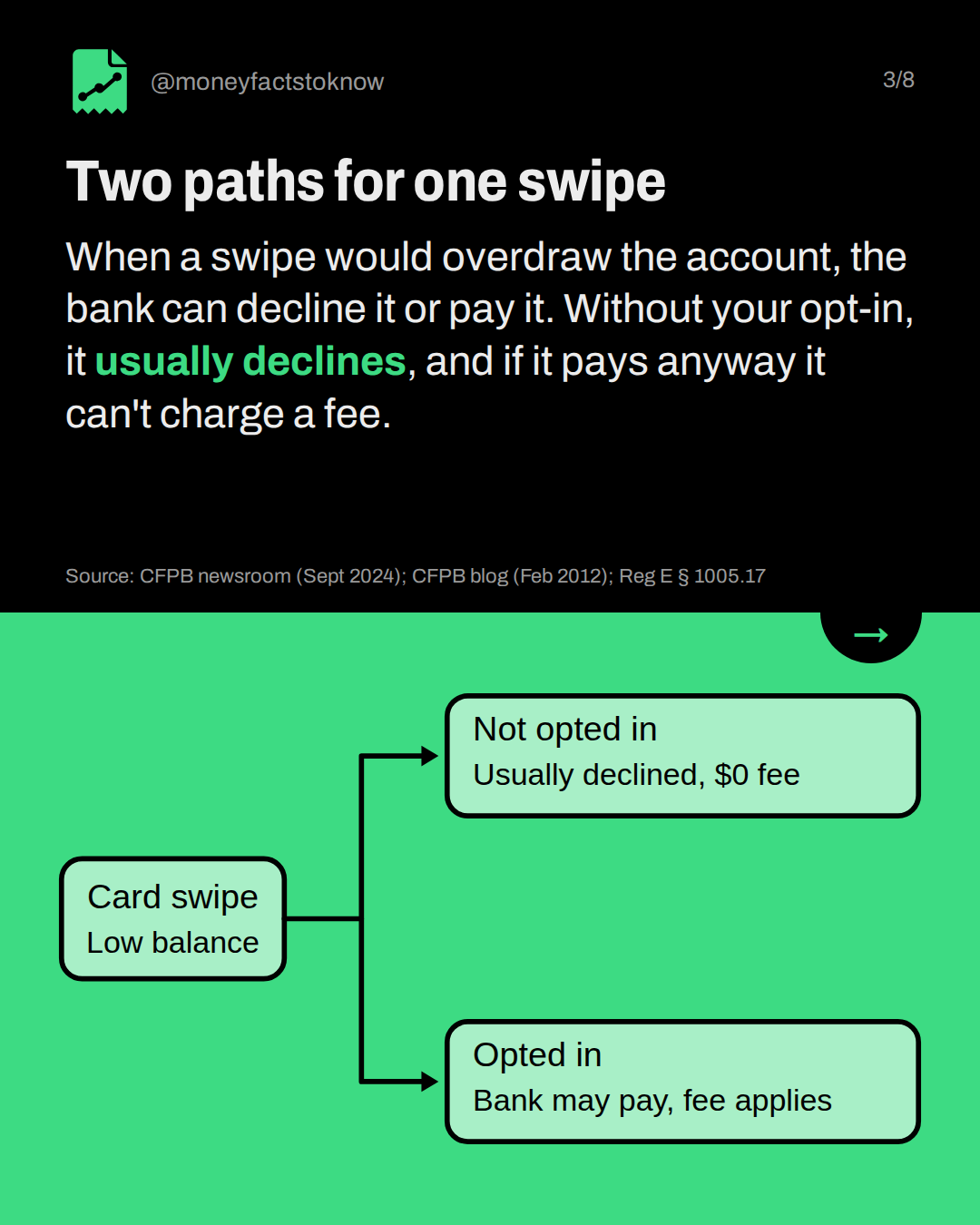
Two paths for one swipe
When a swipe would overdraw the account, the bank can decline it or pay it. Without your opt-in, it usually declines, and if it pays anyway it can't charge a fee.
Source: CFPB newsroom (Sept 2024); CFPB blog (Feb 2012); Reg E § 1005.17
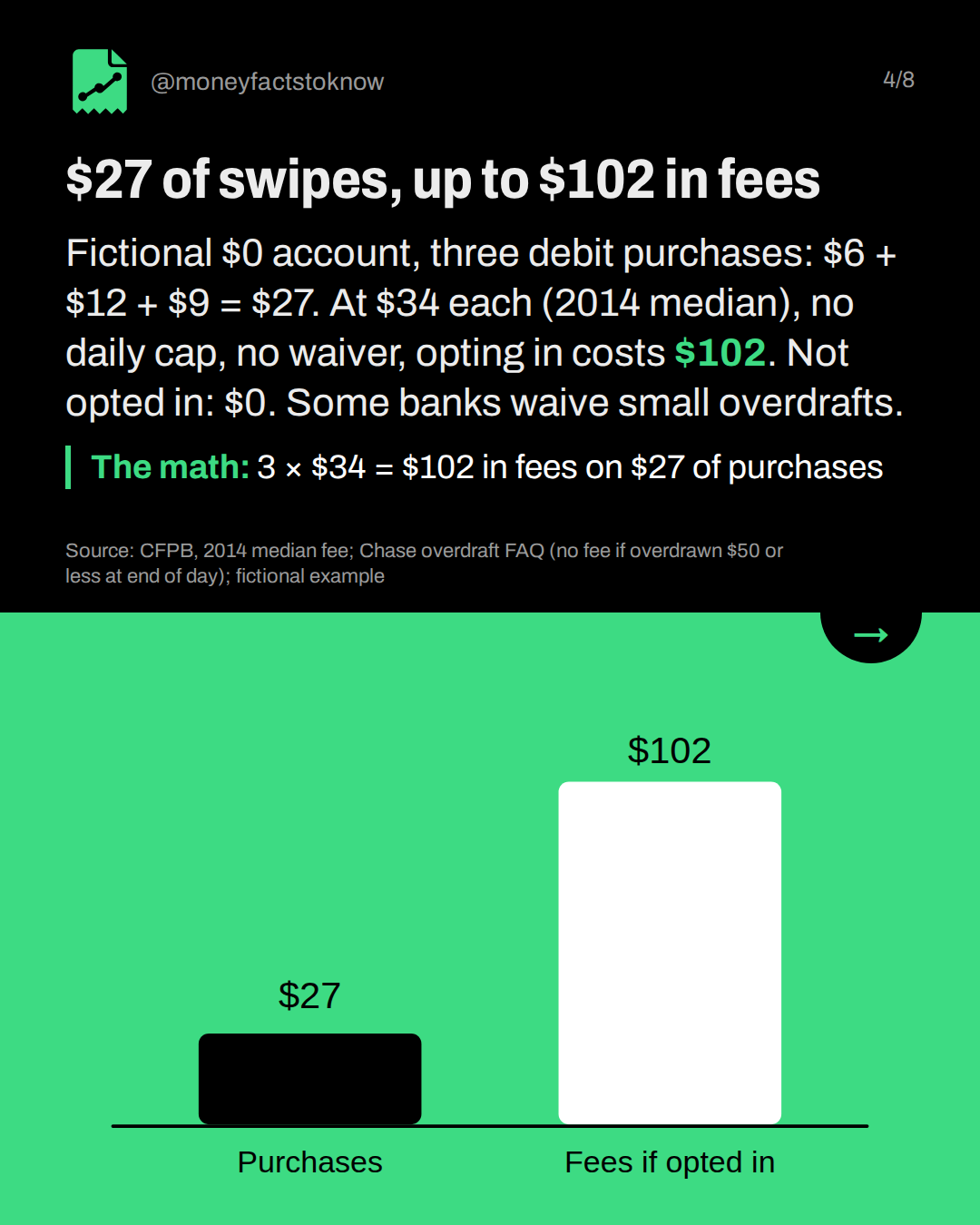
$27 of swipes, up to $102 in fees
Fictional $0 account, three debit purchases: $6 + $12 + $9 = $27. At $34 each (2014 median), no daily cap, no waiver, opting in costs $102. Not opted in: $0. Some banks waive small overdrafts.
The math: 3 × $34 = $102 in fees on $27 of purchases
Source: CFPB, 2014 median fee; Chase overdraft FAQ (no fee if overdrawn $50 or less at end of day); fictional example
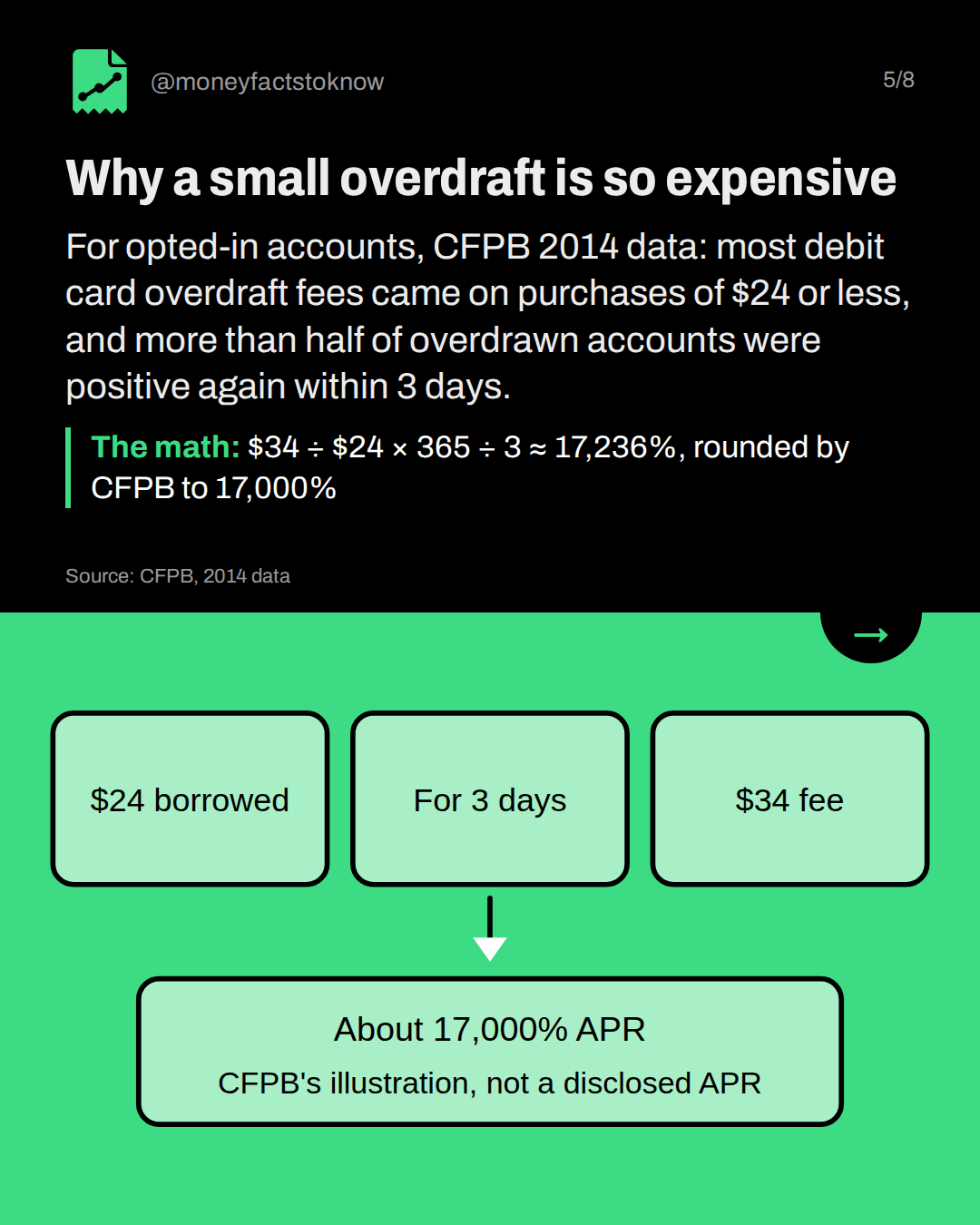
Why a small overdraft is so expensive
For opted-in accounts, CFPB 2014 data: most debit card overdraft fees came on purchases of $24 or less, and more than half of overdrawn accounts were positive again within 3 days.
The math: $34 ÷ $24 × 365 ÷ 3 ≈ 17,236%, rounded by CFPB to 17,000%
Source: CFPB, 2014 data
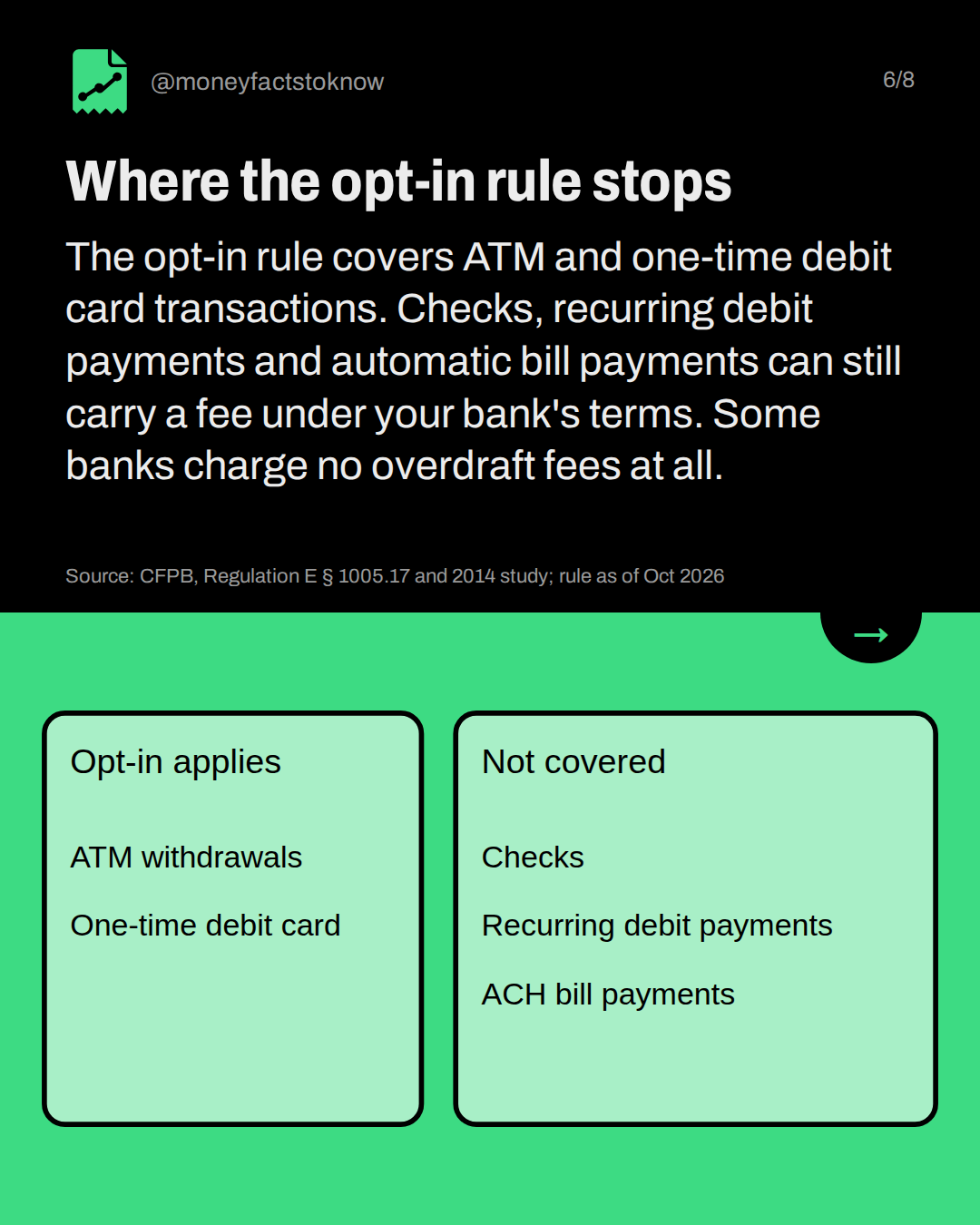
Where the opt-in rule stops
The opt-in rule covers ATM and one-time debit card transactions. Checks, recurring debit payments and automatic bill payments can still carry a fee under your bank's terms. Some banks charge no overdraft fees at all.
Source: CFPB, Regulation E § 1005.17 and 2014 study; rule as of Oct 2026
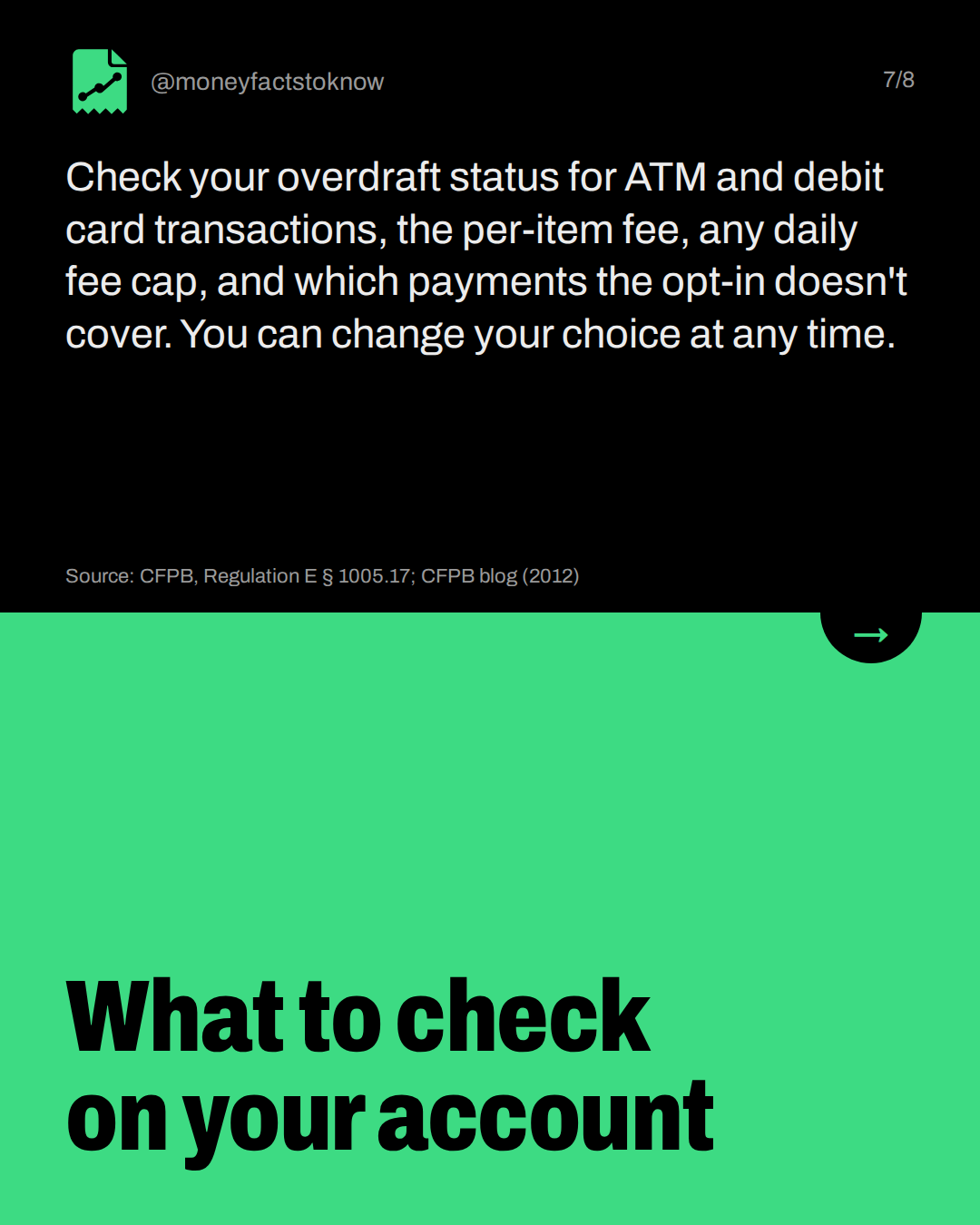
What to check on your account
Check your overdraft status for ATM and debit card transactions, the per-item fee, any daily fee cap, and which payments the opt-in doesn't cover. You can change your choice at any time.
Source: CFPB, Regulation E § 1005.17; CFPB blog (2012)
Sources and assumptions
- CFPB, Regulation E § 1005.17 Requirements for overdraft services: Institution 'shall not assess a fee or charge on a consumer's account for paying an ATM or one-time debit card transaction' under an overdraft service without notice, a reasonable opportunity to consent, affirmative consent and written confirmation; consumer may revoke at any time, implemented 'as soon as reasonably practicable'; same account terms for consumers who don't opt in (1005.17(b)(3)) (checked 2026-10-24)
- CFPB newsroom: CFPB Finds Small Debit Purchases Lead to Expensive Overdraft Charges (July 31, 2014): Majority of debit card overdraft fees incurred on transactions of $24 or less; more than half of accounts positive within three days, more than 75% within a week; median overdraft fee at studied banks $34; $24 for three days with a $34 charge ≈ 17,000% APR; the 2010 opt-in rule covers most ATM and debit card transactions but not checks or automated (ACH) bill payments (checked 2026-10-24)
- CFPB newsroom: CFPB takes action to stop banks from harvesting overdraft fees without consumers' consent (Sept 17, 2024): When a transaction would overdraw the account, banks can decline it or let it go through by extending an overdraft loan; 'Banks can only charge a fee if the consumer opted into overdraft services.' (checked 2026-10-24)
- CFPB blog: What's your status when it comes to overdraft coverage? (Feb 22, 2012): 'Institutions can't charge you for overdrafts on ATM or point-of-sale debit card transactions unless you have opted in'; if you opt out the card will be declined but you won't incur fees on these transactions; banks offer separate overdraft coverage for checks and online bill payments; 'You can change your overdraft decision at any time.' (checked 2026-10-24)
- Congressional Research Service IN12513: Congress Repeals CFPB's Overdraft Rule (secondary, used for context only): Context only, not on slides: the December 2024 CFPB rule capping large-bank overdraft fees was nullified by S.J.Res. 18 (P.L. 119-10) in May 2025, so no federal fee cap applies and the Regulation E opt-in rule is the operative protection (checked 2026-10-24)
- Chase Overdraft Services FAQ (Chase Overdraft Assist): 'we won't charge an Overdraft Fee if you're overdrawn by $50 or less at the end of the business day'; Overdraft Assist needs no enrollment and excludes 'Chase First Checking, Chase High School Checking or Chase Secure Checking'; Debit Card Coverage is a separate, optional enrollment; examples use a $34 Overdraft Fee (checked 2026-10-24)
Assumptions:
- Fictional account with a $0 available balance before the three purchases
- Fictional purchases: $6 coffee, $12 lunch, $9 gas, all one-time debit card transactions on one day
- $34 per-item fee = median overdraft fee at the banks the CFPB studied (2014 data), used as an illustrative fee; real fees vary by bank and some banks charge none
- Assumes the bank charges per item with no daily cap and no small-overdraft exemption; many banks cap the number of fees per day or skip fees under a threshold
- 'Not opted in' path assumes the bank declines the transactions (it may instead pay them, but then can't charge a fee)
- The APR illustration annualizes a one-time fee using a 365-day year: $34 / $24 × 365 / 3
The short version
- ATM and one-time debit card fees need your opt-in
- Not opted in: usually declined, $0 fee
- Checks and bill payments aren't covered by opt-in
- Your bank's fee schedule is what counts


