 Money Facts To Know
A fictional $240,000 salary in 2026: Social Security tax stops in October
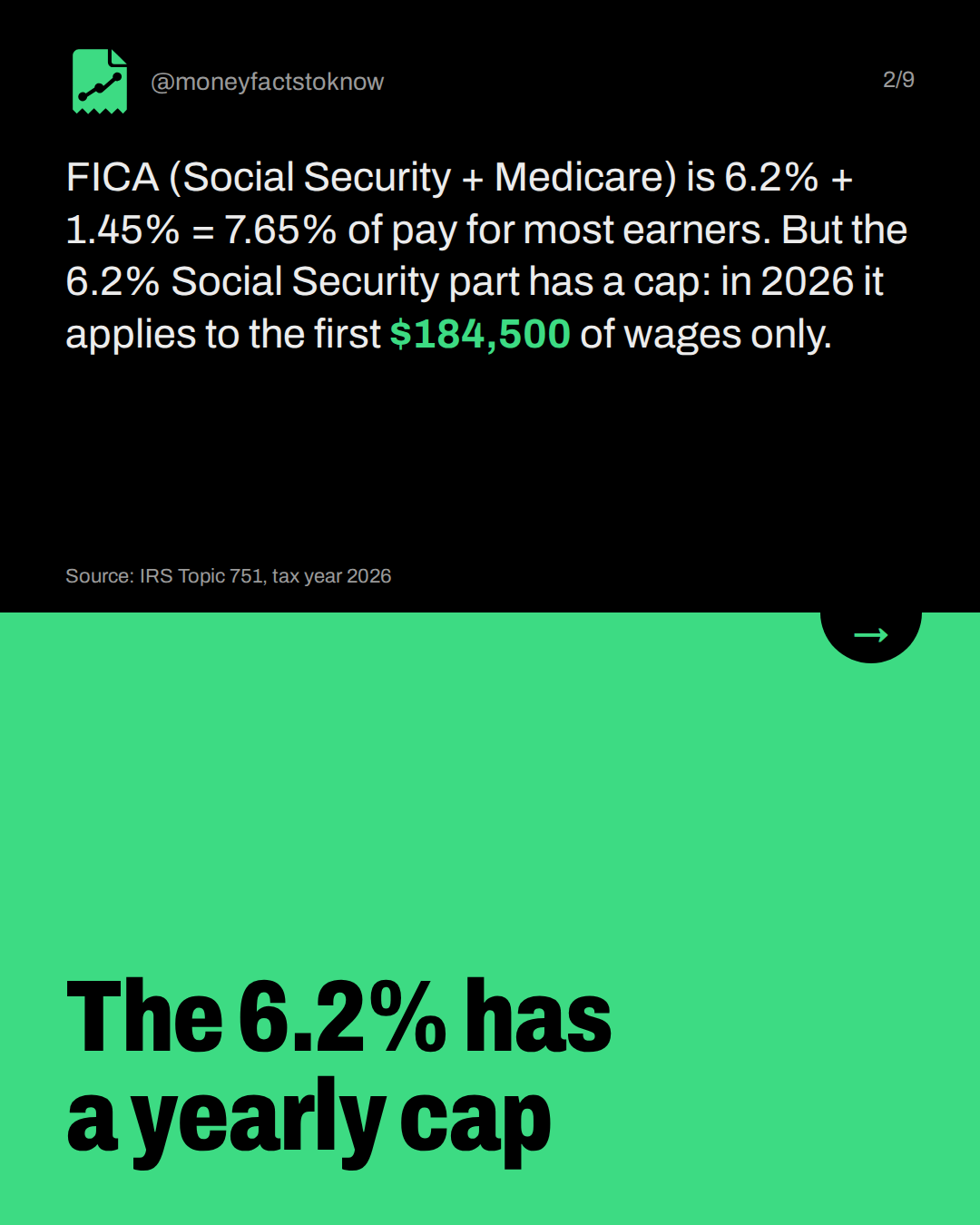
The 6.2% has a yearly cap
FICA (Social Security + Medicare) is 6.2% + 1.45% = 7.65% of pay for most earners. But the 6.2% Social Security part has a cap: in 2026 it applies to the first $184,500 of wages only.
Source: IRS Topic 751, tax year 2026
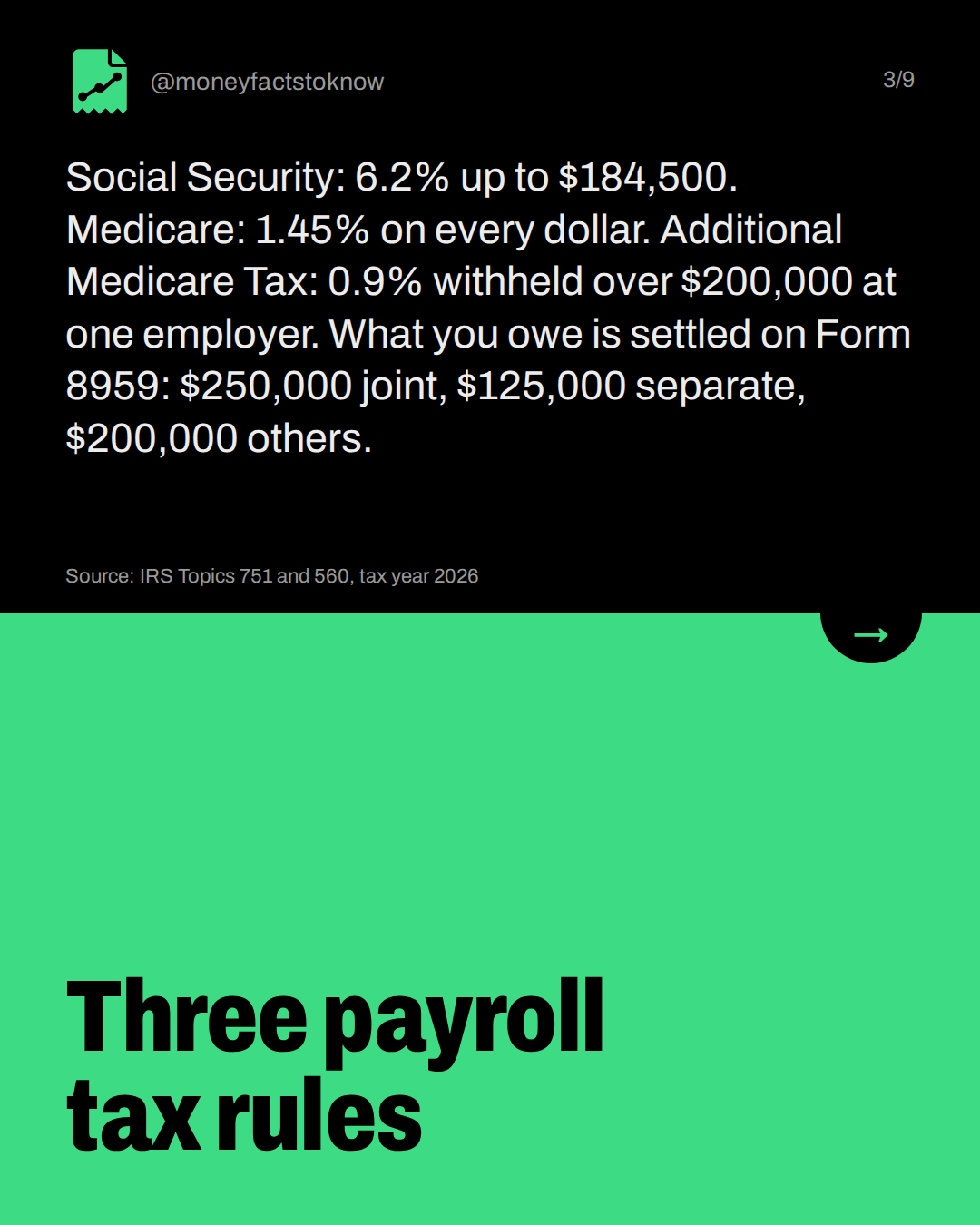
Three payroll tax rules
Social Security: 6.2% up to $184,500. Medicare: 1.45% on every dollar. Additional Medicare Tax: 0.9% withheld over $200,000 at one employer. What you owe is settled on Form 8959: $250,000 joint, $125,000 separate, $200,000 others.
Source: IRS Topics 751 and 560, tax year 2026
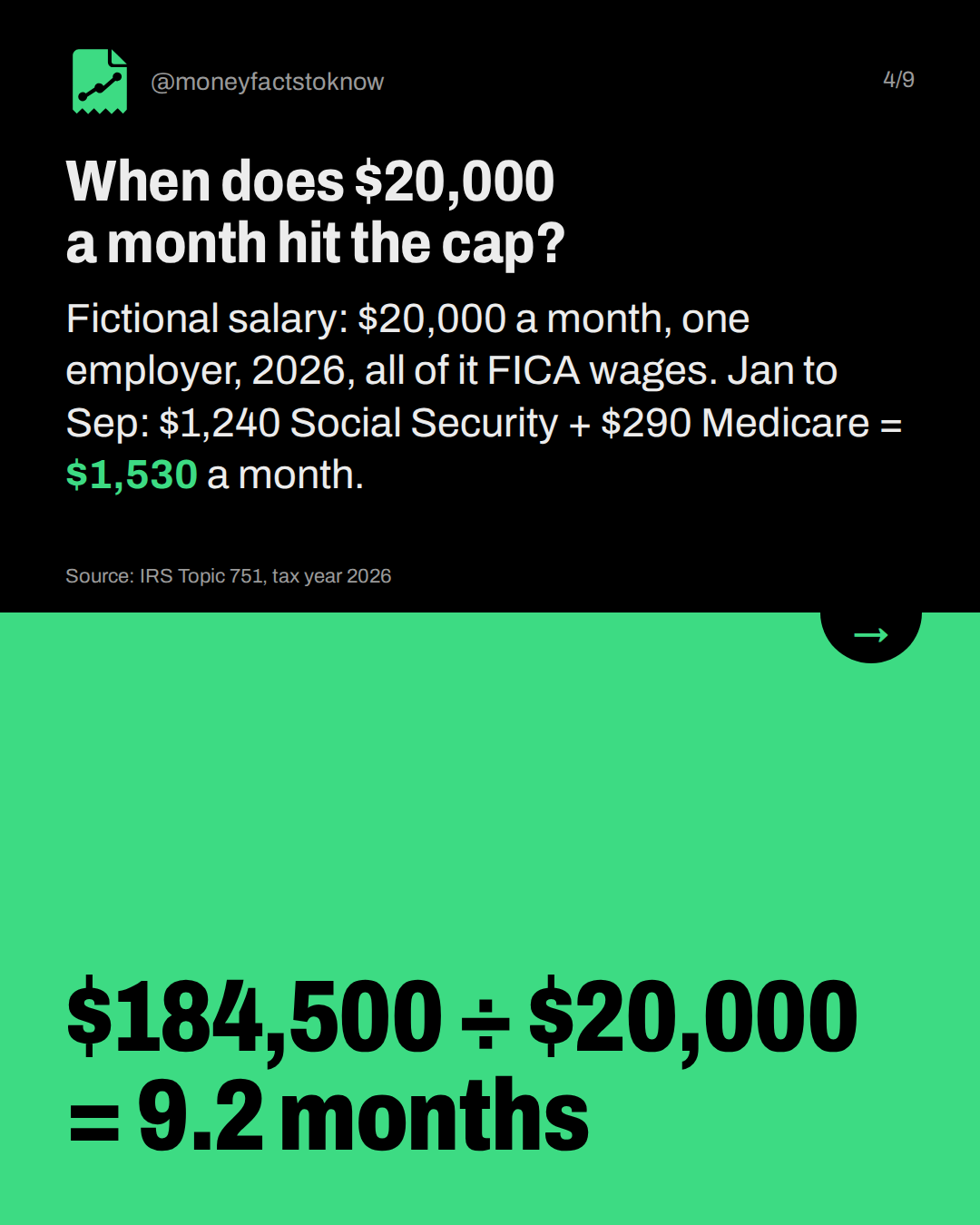
When does $20,000 a month hit the cap?
Fictional salary: $20,000 a month, one employer, 2026, all of it FICA wages. Jan to Sep: $1,240 Social Security + $290 Medicare = $1,530 a month.
The math: $184,500 ÷ $20,000 = 9.2 months
Source: IRS Topic 751, tax year 2026
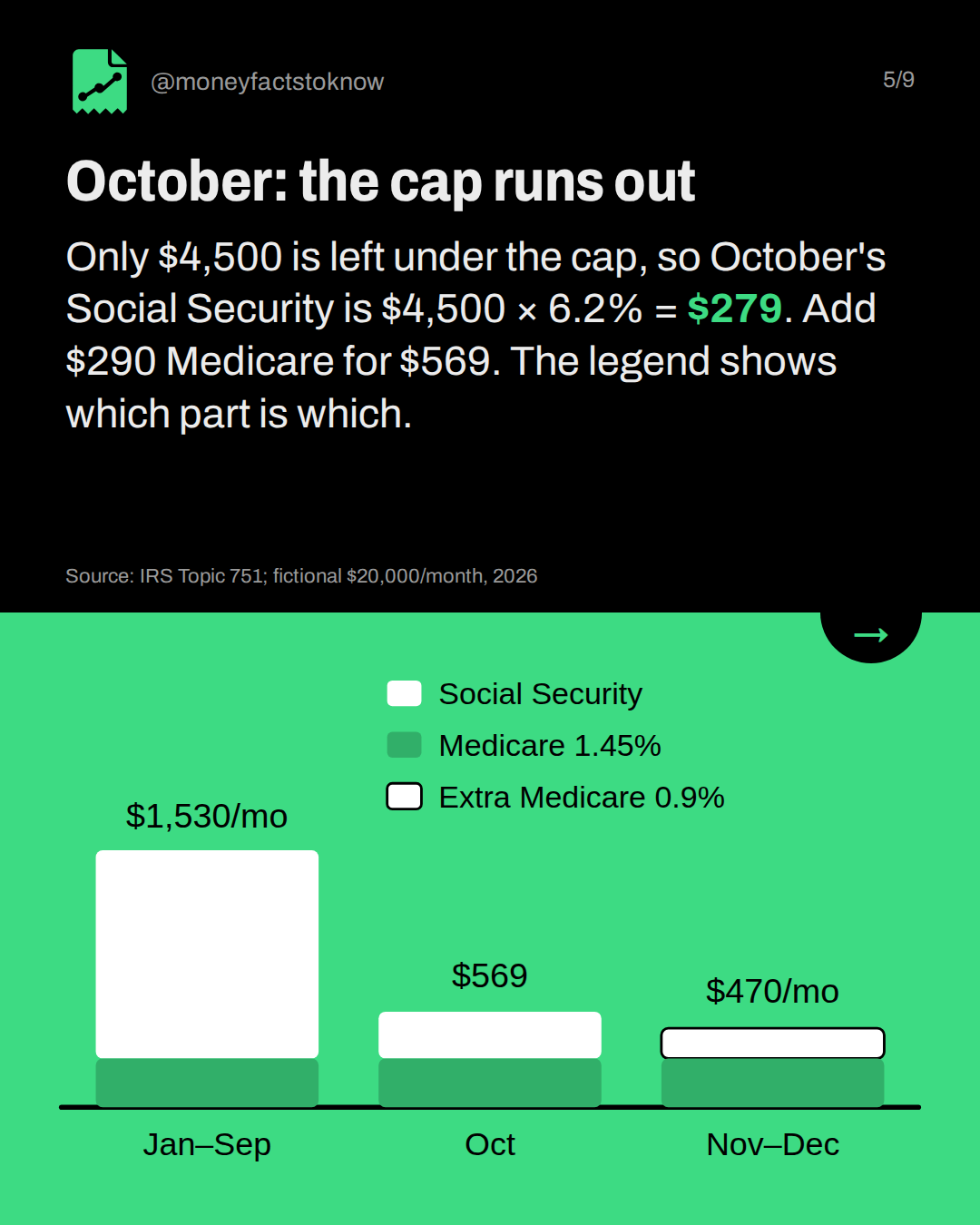
October: the cap runs out
Only $4,500 is left under the cap, so October's Social Security is $4,500 × 6.2% = $279. Add $290 Medicare for $569. The legend shows which part is which.
Source: IRS Topic 751; fictional $20,000/month, 2026
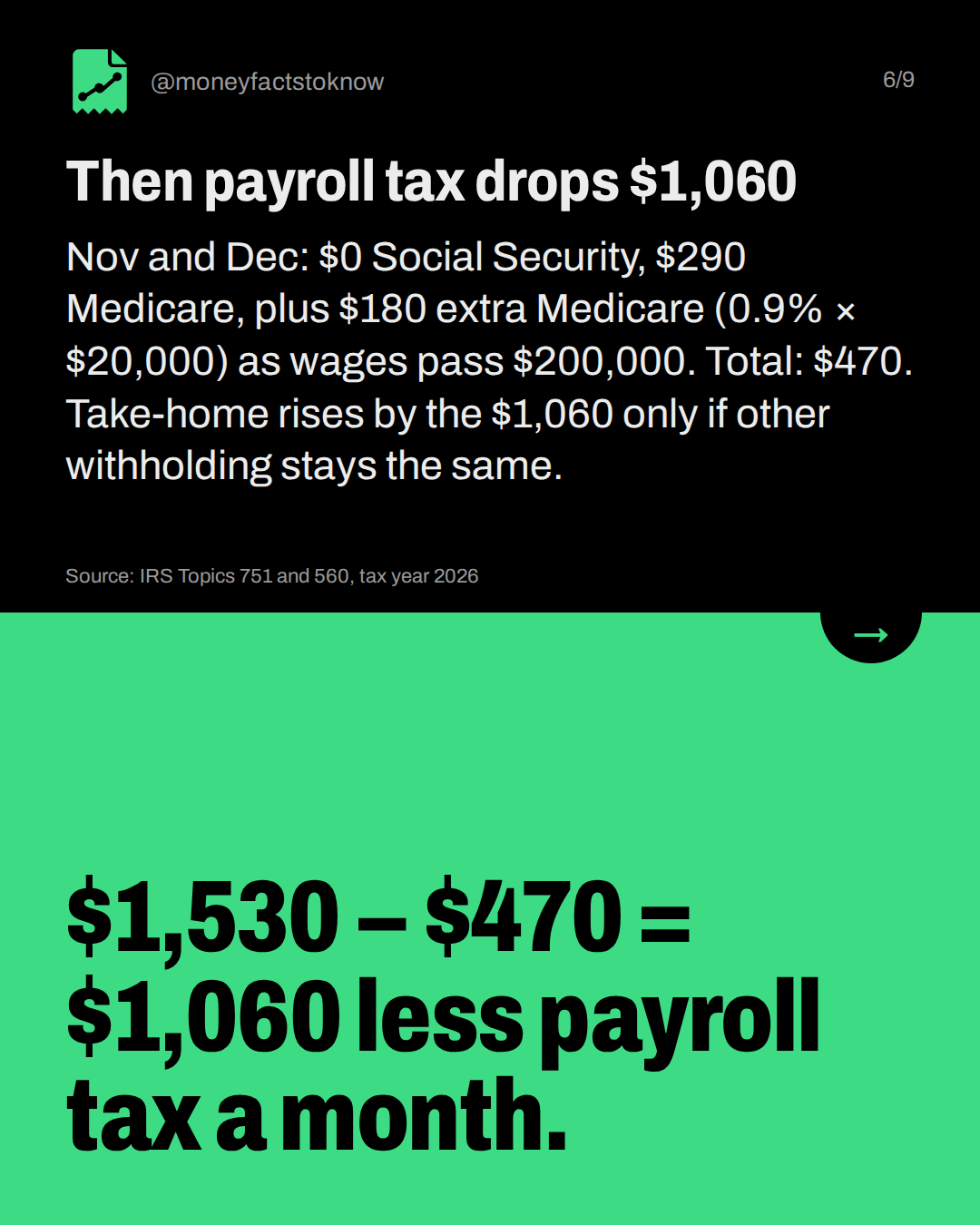
Then payroll tax drops $1,060
Nov and Dec: $0 Social Security, $290 Medicare, plus $180 extra Medicare (0.9% × $20,000) as wages pass $200,000. Total: $470. Take-home rises by the $1,060 only if other withholding stays the same.
The math: $1,530 − $470 = $1,060 less payroll tax a month.
Source: IRS Topics 751 and 560, tax year 2026
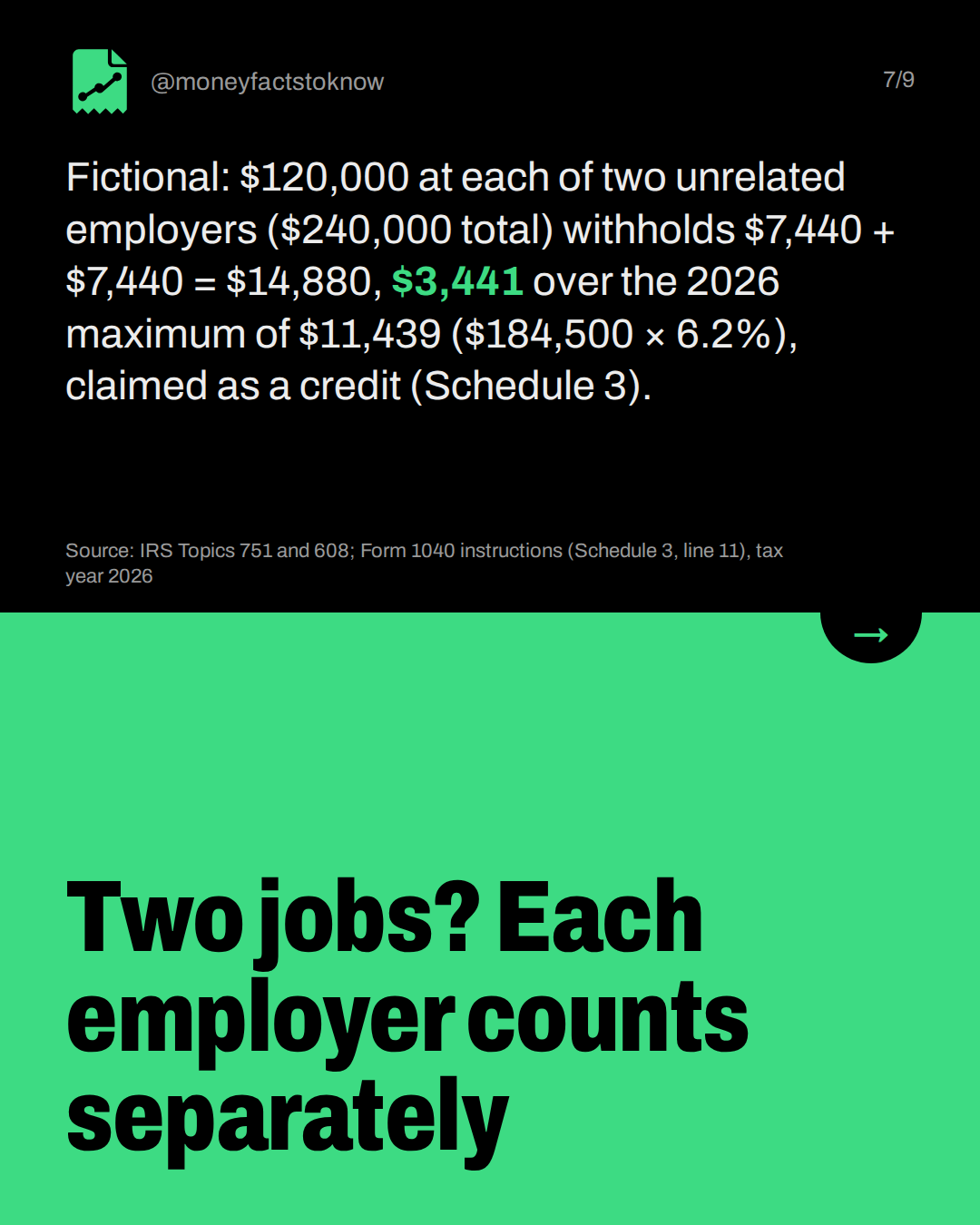
Two jobs? Each employer counts separately
Fictional: $120,000 at each of two unrelated employers ($240,000 total) withholds $7,440 + $7,440 = $14,880, $3,441 over the 2026 maximum of $11,439 ($184,500 × 6.2%), claimed as a credit (Schedule 3).
Source: IRS Topics 751 and 608; Form 1040 instructions (Schedule 3, line 11), tax year 2026
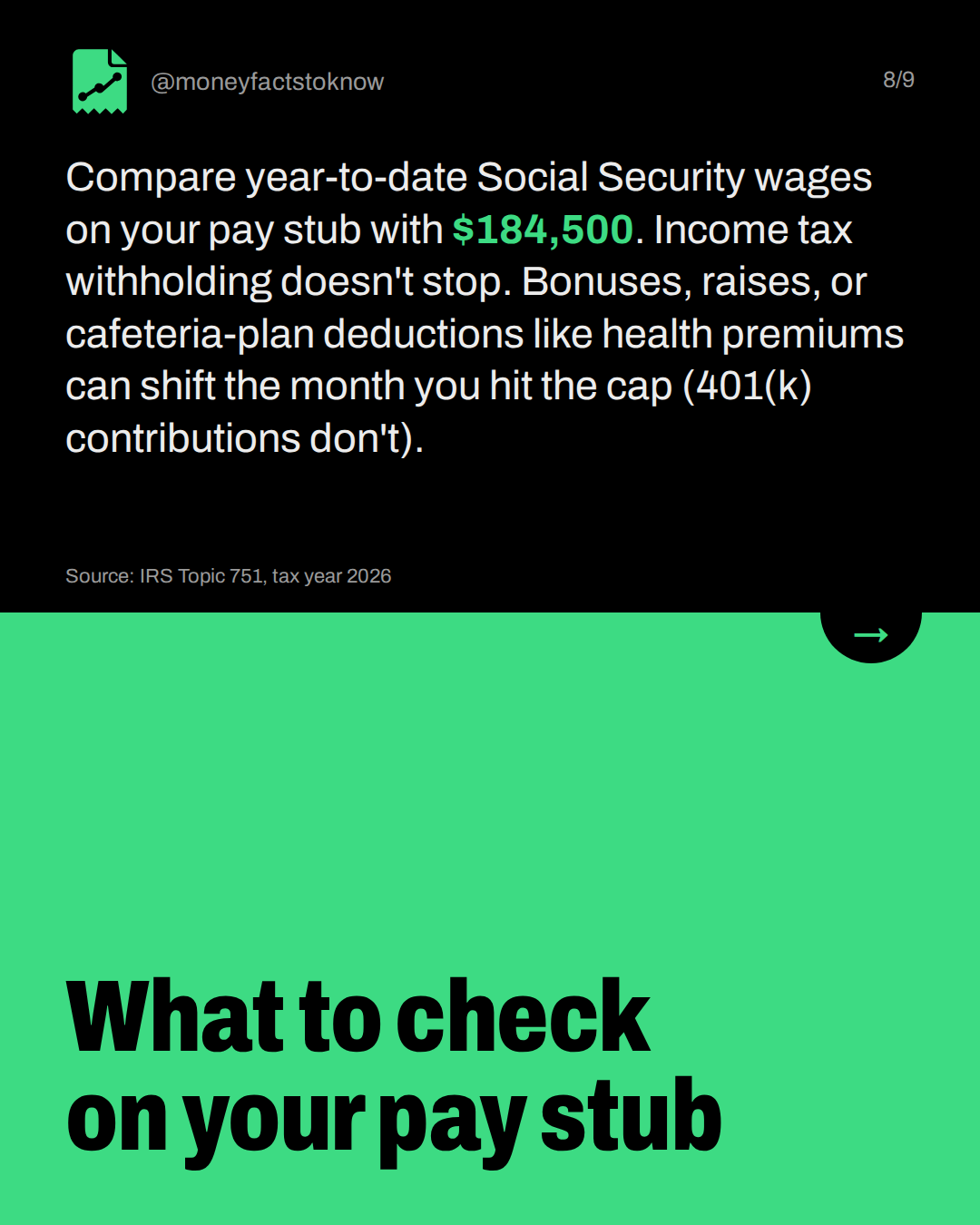
What to check on your pay stub
Compare year-to-date Social Security wages on your pay stub with $184,500. Income tax withholding doesn't stop. Bonuses, raises, or cafeteria-plan deductions like health premiums can shift the month you hit the cap (401(k) contributions don't).
Source: IRS Topic 751, tax year 2026
Sources and assumptions
- IRS Topic no. 751, Social Security and Medicare withholding rates: 6.2% employee Social Security rate; 1.45% employee Medicare rate; 2026 wage base limit $184,500; no wage base limit for Medicare; employers withhold 0.9% Additional Medicare tax on wages over $200,000 in a calendar year regardless of filing status (checked 2026-10-24)
- IRS Topic no. 560, Additional Medicare Tax: 0.9% rate; thresholds $250,000 MFJ, $125,000 MFS, $200,000 all others; employer withholding over $200,000 regardless of filing status; final liability figured on Form 8959 and can differ from withholding (checked 2026-10-24)
- IRS Topic no. 608, Excess Social Security and RRTA tax withheld: With more than one employer, excess Social Security tax withheld may be claimed as a credit against income tax on the return; if one employer withheld too much, it generally can't be claimed as a credit, so the employer should correct it or you file Form 843 (checked 2026-10-24)
- IRS Instructions for Form 1040 (Schedule 3, line 11): Excess Social Security and tier 1 RRTA tax withheld is reported on Schedule 3, line 11 (checked 2026-10-24)
Assumptions:
- Fictional employee, tax year 2026, one employer (except the two-job example), paid monthly, $20,000 gross every month ($240,000 a year)
- All $20,000 counts as Social Security and Medicare wages: no Section 125 (cafeteria plan) deductions that lower FICA wages; 401(k) deferrals don't lower FICA wages
- No bonuses or uneven pay; pay dates fall in the calendar month
- Only employee-side payroll taxes are shown; federal and state income tax withholding are not included and keep going
- The Additional Medicare withholding shown is the employer's $200,000 rule; final Additional Medicare tax depends on filing status and total income (Form 8959)
- Two-job example: fictional $120,000 at each of two employers, each withholding 6.2% on its own wages
The short version
- In 2026, Social Security tax covers the first $184,500
- Medicare has no cap
- An extra 0.9% is withheld above $200,000 per employer
- What you owe depends on filing status
- Two employers can withhold over the max


