 Money Facts To Know
Spousal Social Security: $1,200 at full retirement age, $780 at 62 (fictional)

A spouse isn't always left out
Many people assume a spouse with little or no work history gets nothing from Social Security, or that a spouse simply gets half of whatever the worker receives.
The rule starts with the worker's PIA
A spouse can get up to 50% of the worker's full-retirement-age benefit (Primary Insurance Amount, PIA), not of what they actually receive. The worker must have filed; the spouse must be 62+ or caring for a qualifying child.
Source: 20 CFR 404.330, 404.333; rules as of Oct 2026
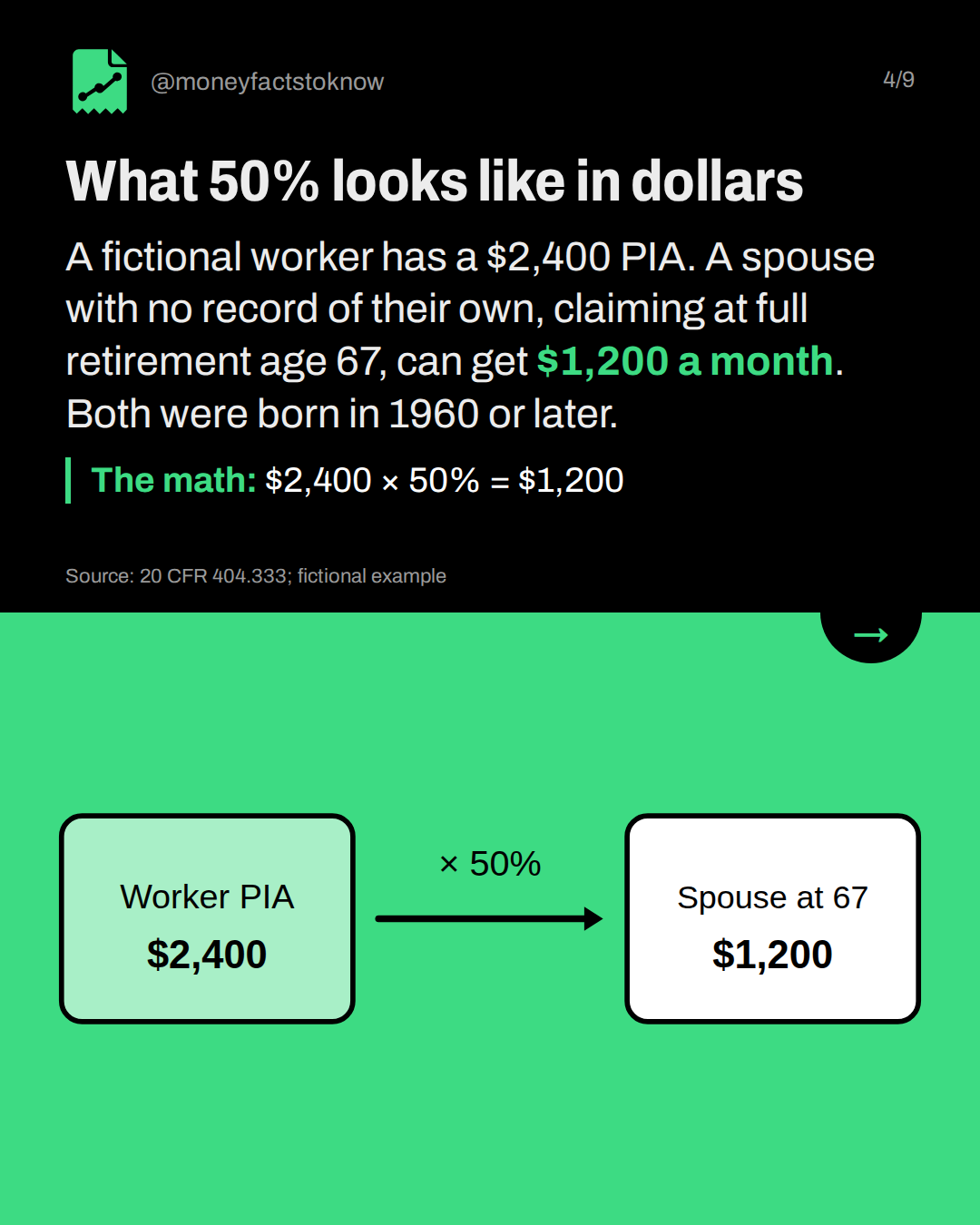
What 50% looks like in dollars
A fictional worker has a $2,400 PIA. A spouse with no record of their own, claiming at full retirement age 67, can get $1,200 a month. Both were born in 1960 or later.
The math: $2,400 × 50% = $1,200
Source: 20 CFR 404.333; fictional example
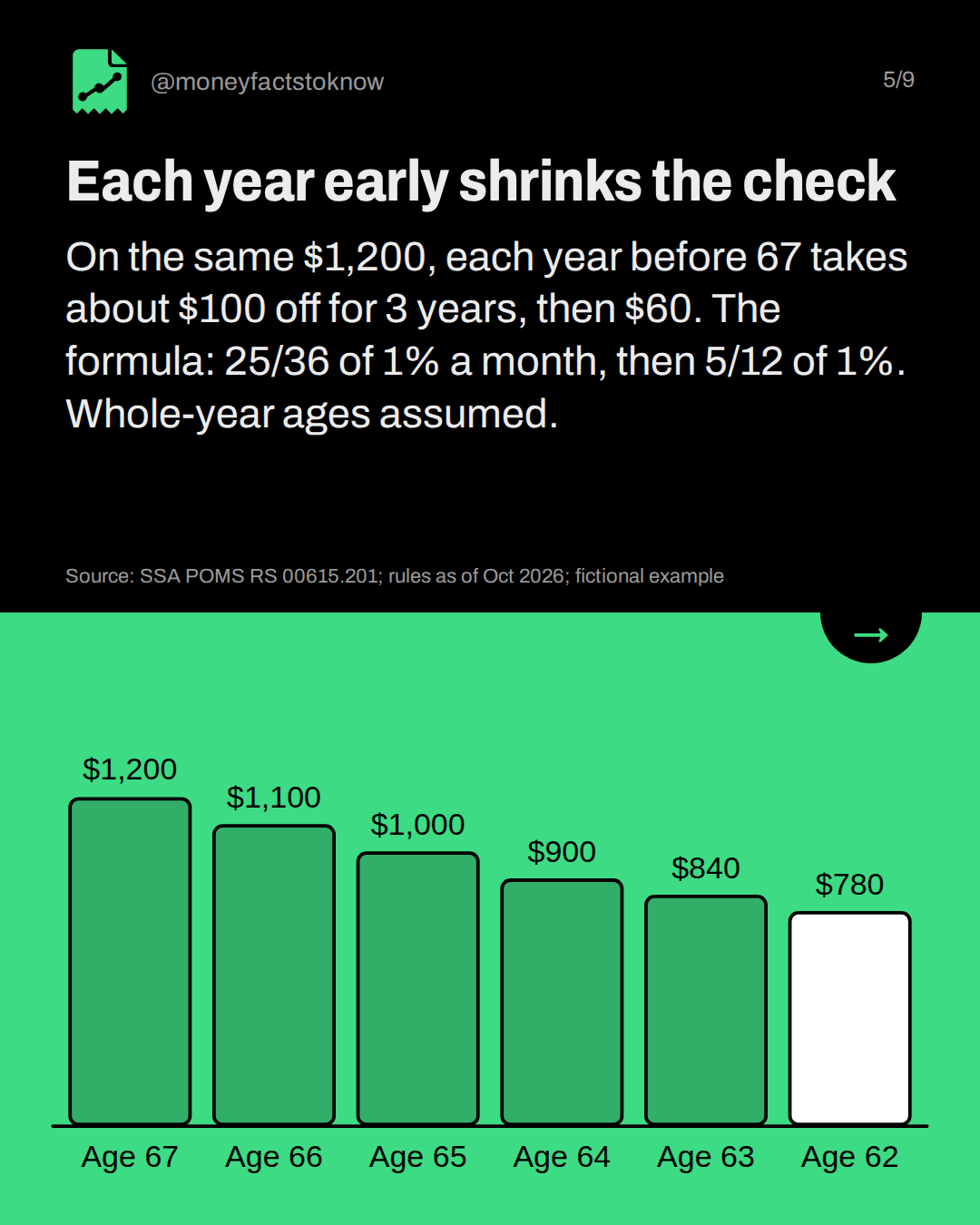
Each year early shrinks the check
On the same $1,200, each year before 67 takes about $100 off for 3 years, then $60. The formula: 25/36 of 1% a month, then 5/12 of 1%. Whole-year ages assumed.
Source: SSA POMS RS 00615.201; rules as of Oct 2026; fictional example
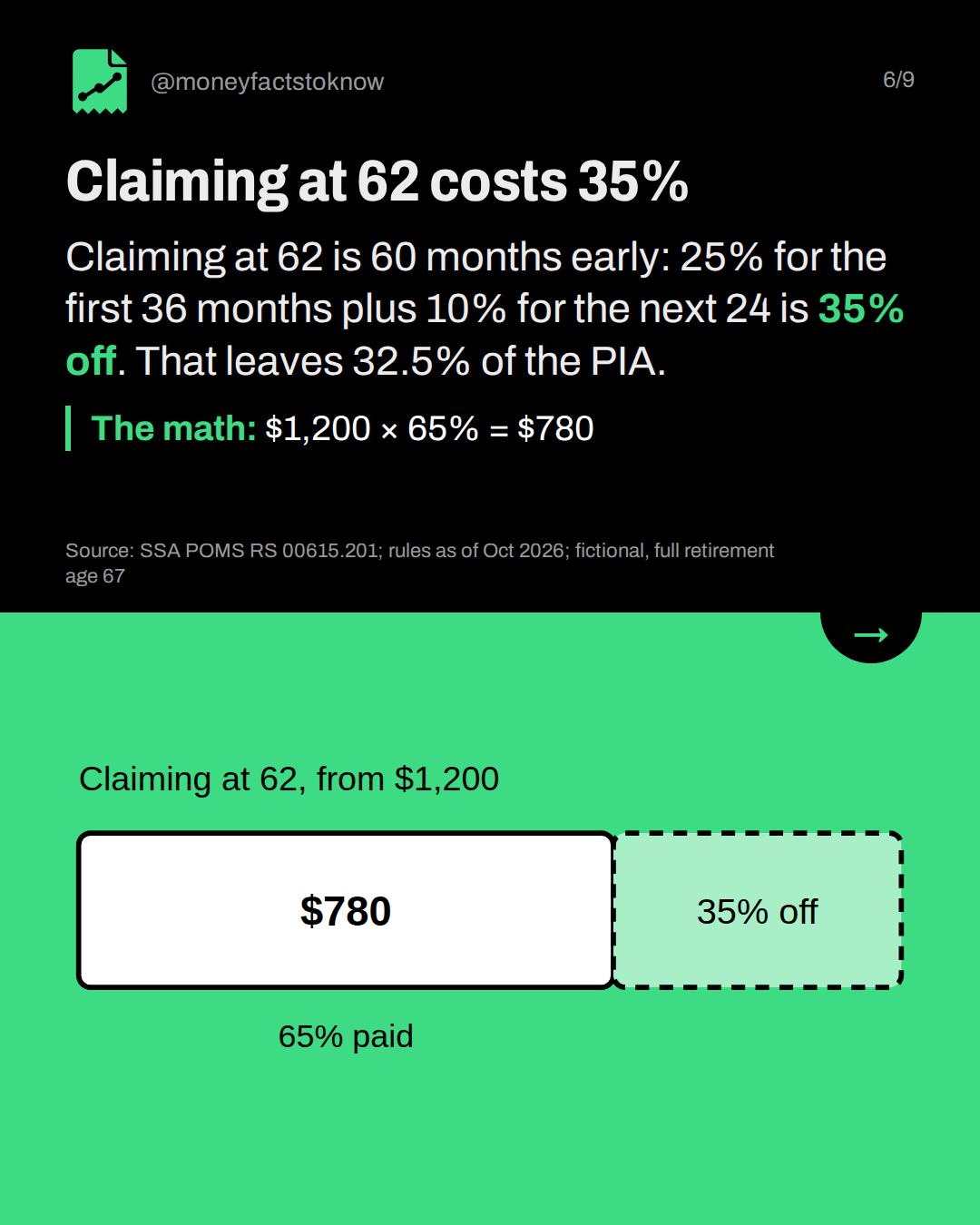
Claiming at 62 costs 35%
Claiming at 62 is 60 months early: 25% for the first 36 months plus 10% for the next 24 is 35% off. That leaves 32.5% of the PIA.
The math: $1,200 × 65% = $780
Source: SSA POMS RS 00615.201; rules as of Oct 2026; fictional, full retirement age 67
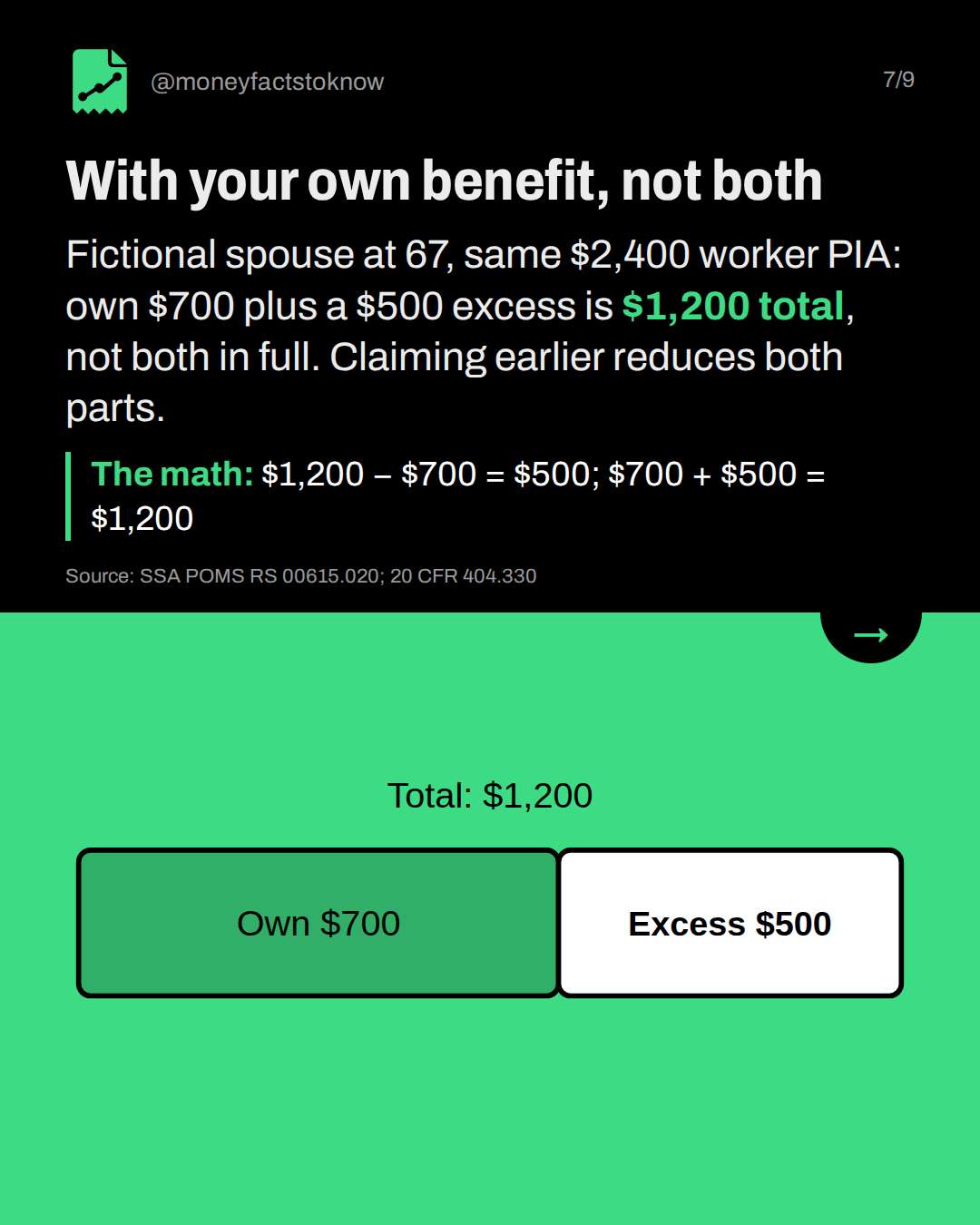
With your own benefit, not both
Fictional spouse at 67, same $2,400 worker PIA: own $700 plus a $500 excess is $1,200 total, not both in full. Claiming earlier reduces both parts.
The math: $1,200 − $700 = $500; $700 + $500 = $1,200
Source: SSA POMS RS 00615.020; 20 CFR 404.330
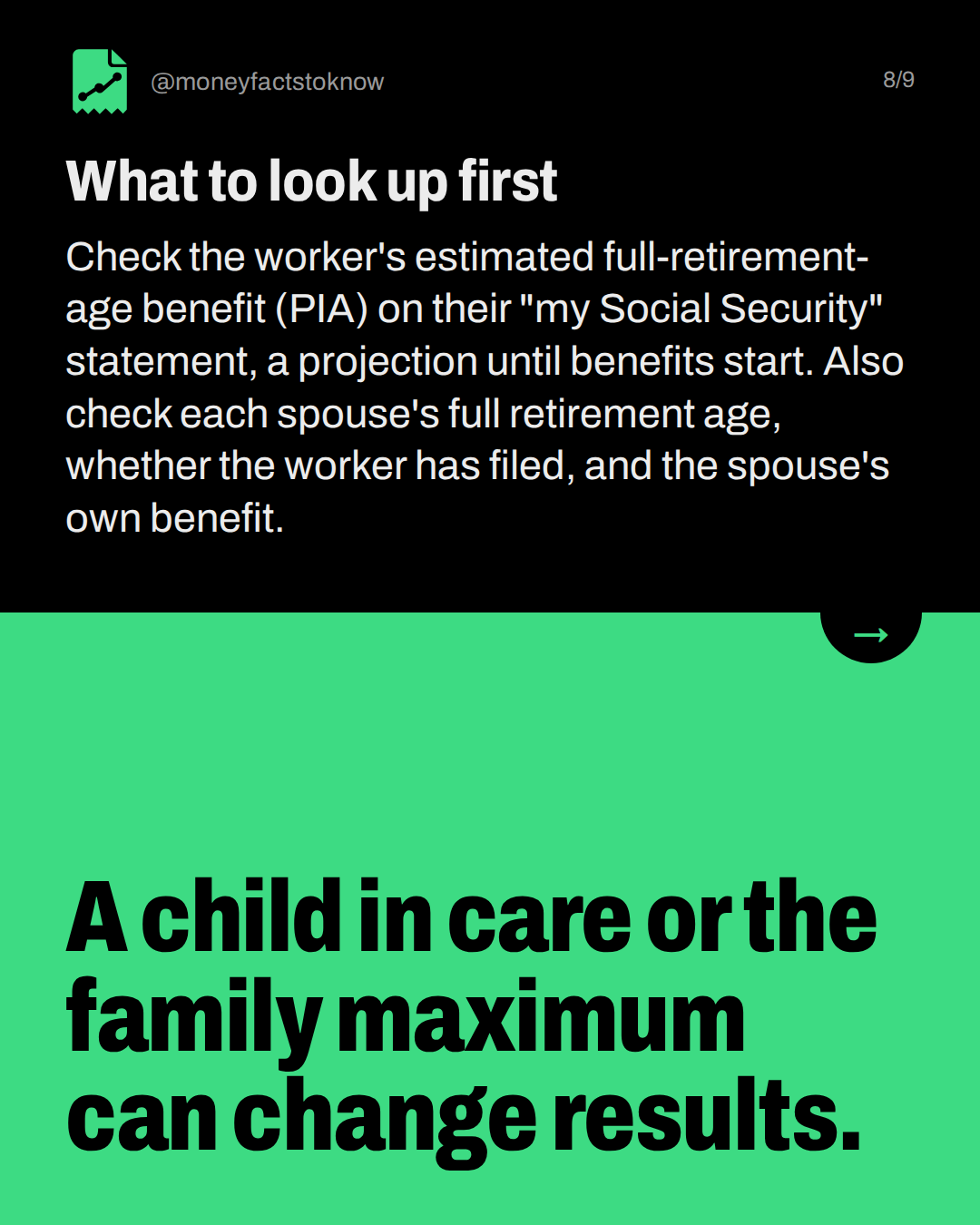
What to look up first
Check the worker's estimated full-retirement-age benefit (PIA) on their "my Social Security" statement, a projection until benefits start. Also check each spouse's full retirement age, whether the worker has filed, and the spouse's own benefit.
The math: A child in care or the family maximum can change results.
Sources and assumptions
- 20 CFR § 404.333, Wife's and husband's benefit amounts (eCFR text via Cornell LII): The full wife's or husband's monthly benefit equals one-half of the insured person's primary insurance amount (checked 2026-10-23)
- 20 CFR § 404.330, Who is entitled to wife's or husband's benefits (eCFR text via Cornell LII): The worker must be entitled to old-age or disability benefits. The spouse must be age 62 or older, or caring for a qualifying child, must meet a marriage condition (e.g. 1 year), and must apply. A spouse whose own PIA is equal to or larger than the full spouse's benefit isn't entitled (checked 2026-10-23)
- 20 CFR § 404.410, How does the Social Security Administration reduce my benefits when my entitlement begins before full retirement age (eCFR text via Cornell LII): Spouse's benefits are reduced 25/36 of 1 percent for each of the first 36 months and 5/12 of 1 percent for each month beyond 36, except months with a qualifying child in care (checked 2026-10-23)
- SSA POMS RS 00615.201, Reduced Spouse's Benefits (TN 53, 12-23): Same monthly reduction rates; the reduction factor at 60 reduction months (FRA 67) is 156/240 = 65% of the unreduced spouse benefit (checked 2026-10-23)
- SSA POMS RS 00615.020, Dual Entitlement Overview (TN 41, 12-23): A dually entitled person gets their own (smaller) benefit plus the excess of the larger one. 'A person's benefit amount can never exceed the highest single benefit to which that person is entitled.' (checked 2026-10-23)
Assumptions:
- Fictional couple; the worker's primary insurance amount (benefit at full retirement age) is $2,400 a month
- Both spouses born 1960 or later, so full retirement age is 67 and claiming at exactly 62 is 60 months early
- The worker has filed for retirement benefits (required before a spouse's benefit can be paid)
- Main example: the spouse has no Social Security benefit of their own. The own-benefit example uses a fictional $700 PIA with the spouse claiming at full retirement age
- No qualifying child in the spouse's care (a child in care removes the age reduction for those months)
- The family maximum isn't reached; amounts are before Medicare premiums and any earnings-test withholding, and ignore future cost-of-living adjustments
- Ages in the timeline are whole years before 67 (12, 24, 36, 48, 60 months early)
The short version
- A spouse can get up to 50% of the worker's PIA.
- Full retirement age 67: claiming at 62 cuts it 35%.
- Fictional example: $1,200 becomes $780.
- With their own benefit, a spouse gets the higher amount, not both.


