 Money Facts To Know
Closing an unused $5,000 card: 20% to 30% utilization (fictional example)
Closing it feels harmless
The thinking goes, "I never use it, so closing it can't hurt." But myFICO's short answer to "will closing a card help my FICO Score?" is no.
Source: myFICO
One division decides utilization
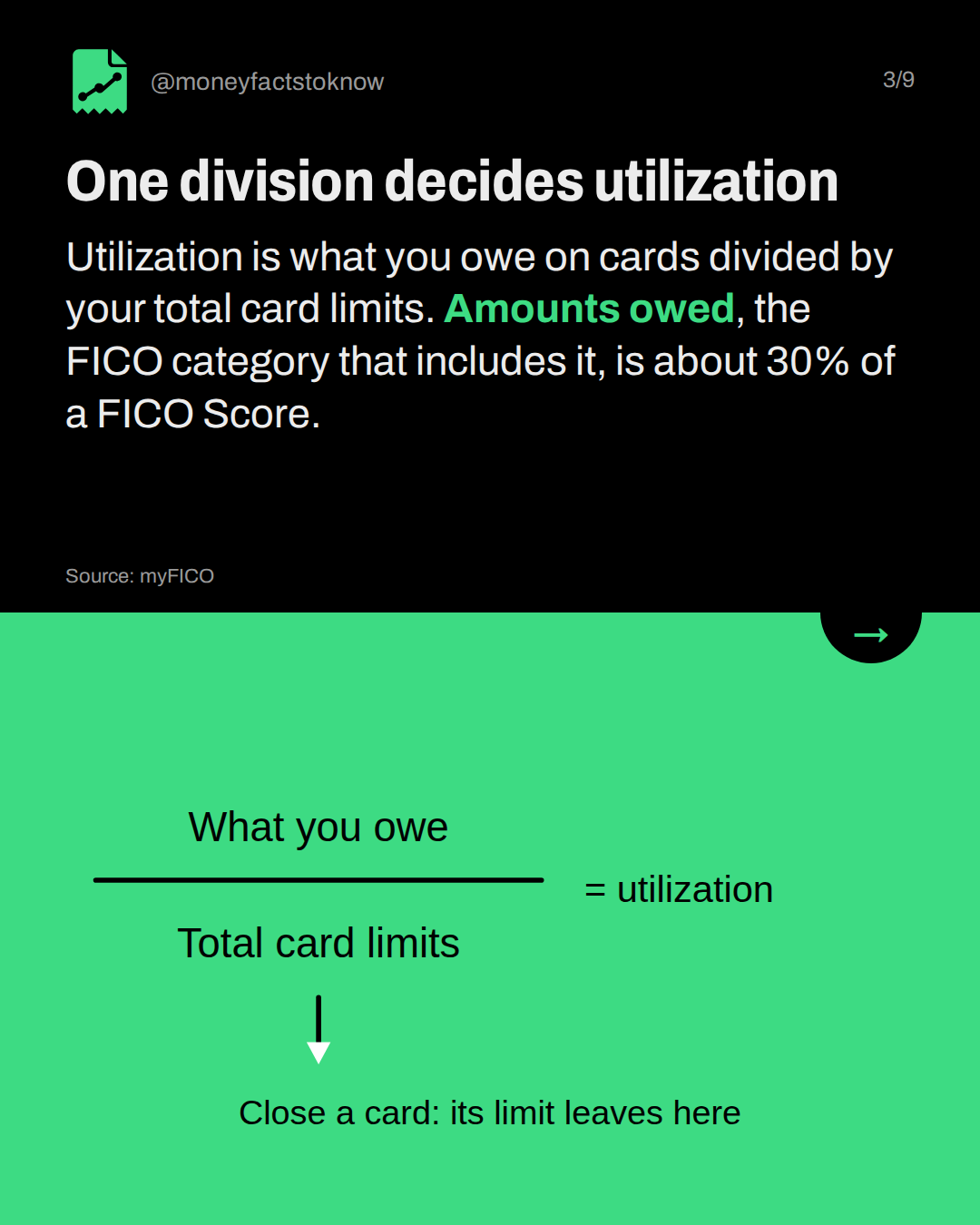
Utilization is what you owe on cards divided by your total card limits. Amounts owed, the FICO category that includes it, is about 30% of a FICO Score.
Source: myFICO
Before: 20% of your credit
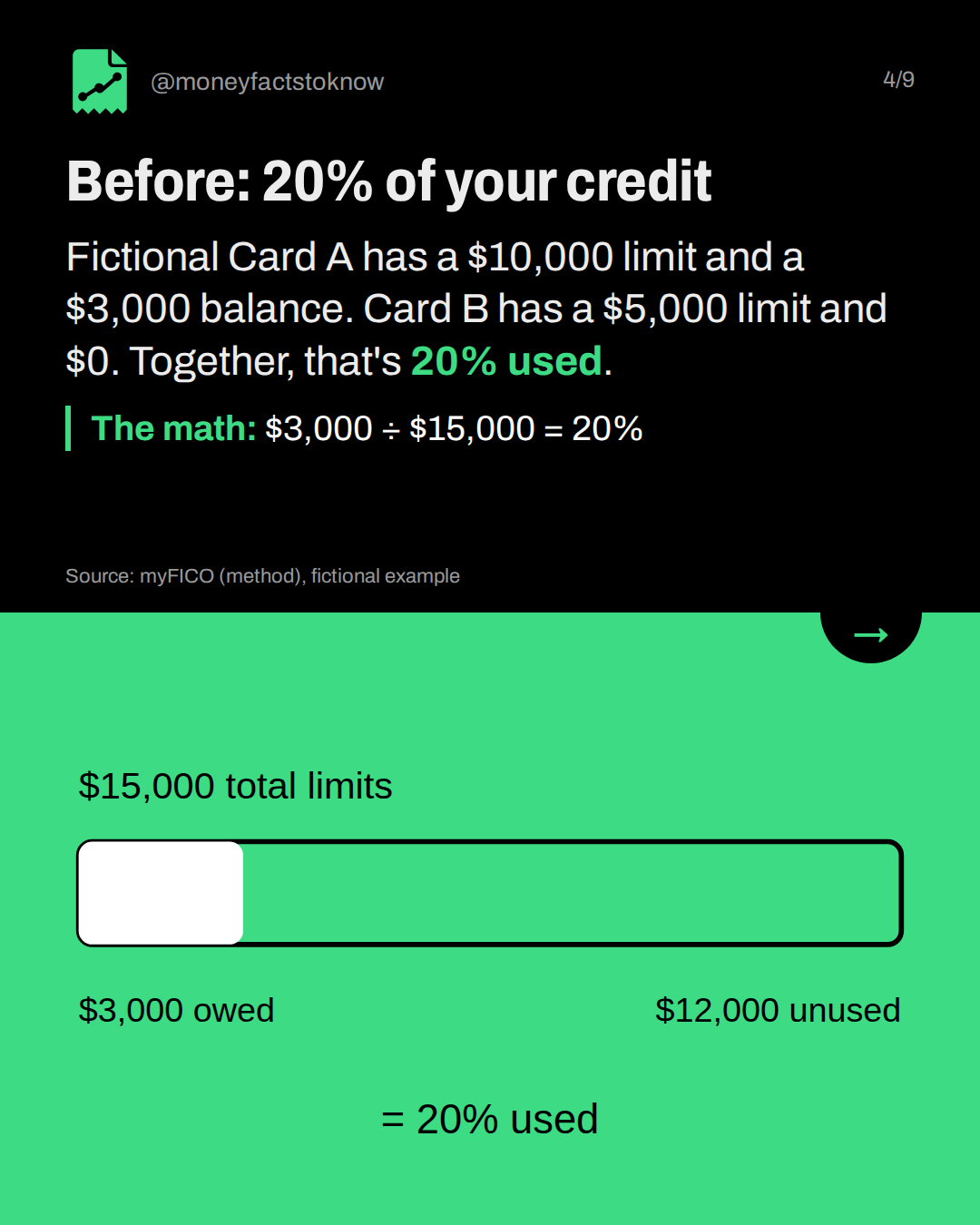
Fictional Card A has a $10,000 limit and a $3,000 balance. Card B has a $5,000 limit and $0. Together, that's 20% used.
The math: $3,000 ÷ $15,000 = 20%
Source: myFICO (method), fictional example
After: the same balance is 30%
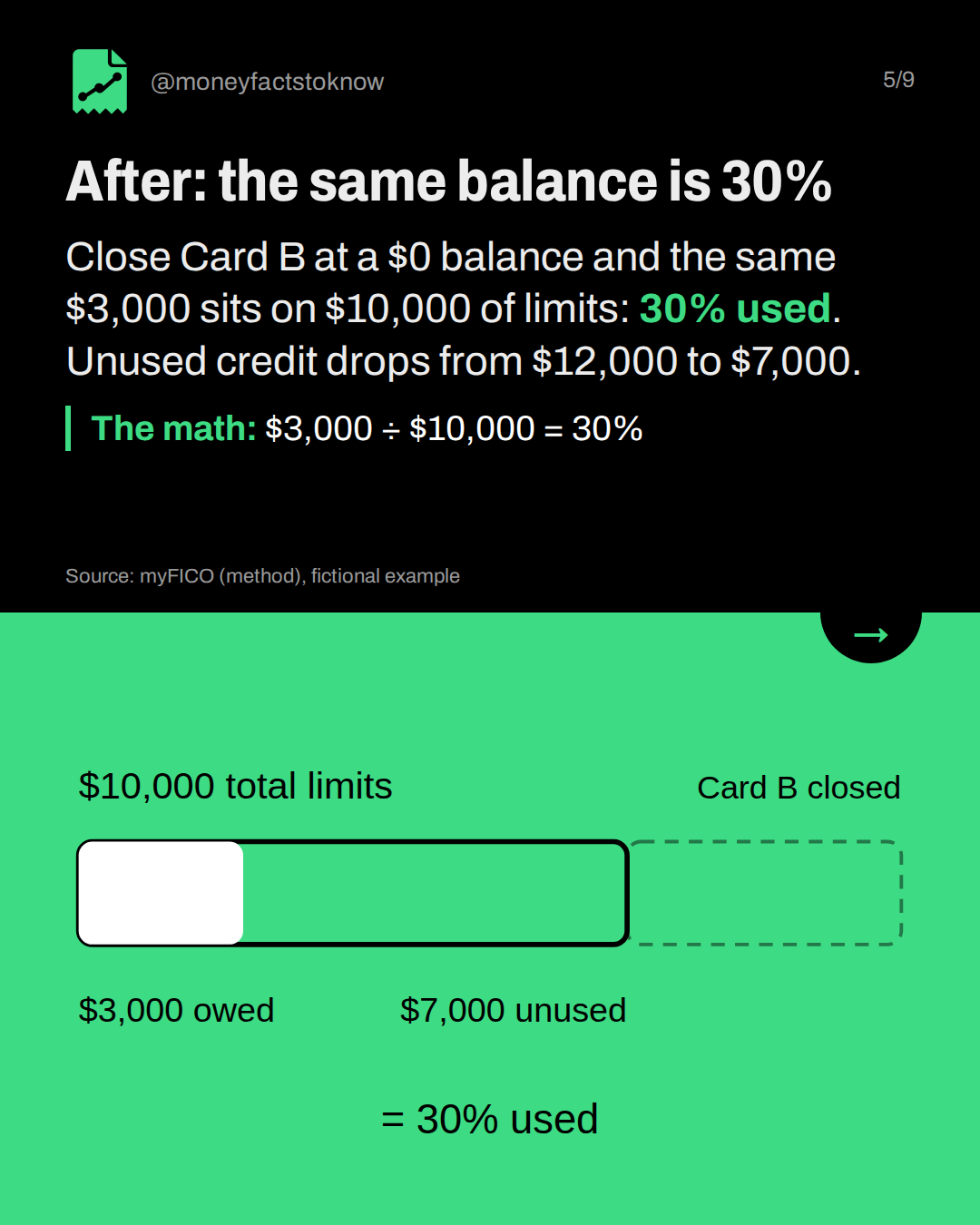
Close Card B at a $0 balance and the same $3,000 sits on $10,000 of limits: 30% used. Unused credit drops from $12,000 to $7,000.
The math: $3,000 ÷ $10,000 = 30%
Source: myFICO (method), fictional example
myFICO's own example
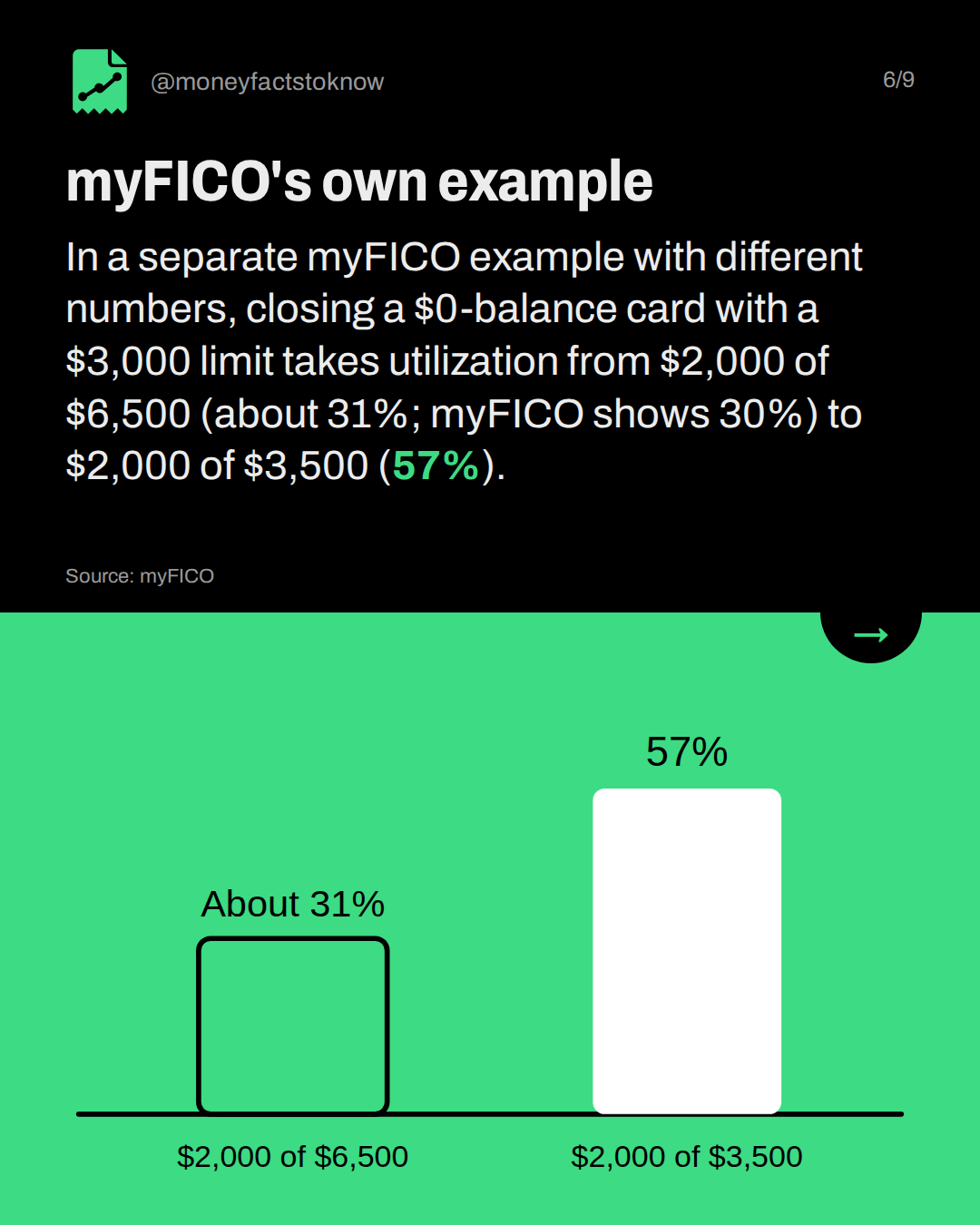
In a separate myFICO example with different numbers, closing a $0-balance card with a $3,000 limit takes utilization from $2,000 of $6,500 (about 31%; myFICO shows 30%) to $2,000 of $3,500 (57%).
Source: myFICO
Where this stops applying
This post predicts no point change, because scoring models and your wider profile matter. A closed card with a balance still counts, and FICO still considers a closed account's payment history.
Source: myFICO
Divide both ways first
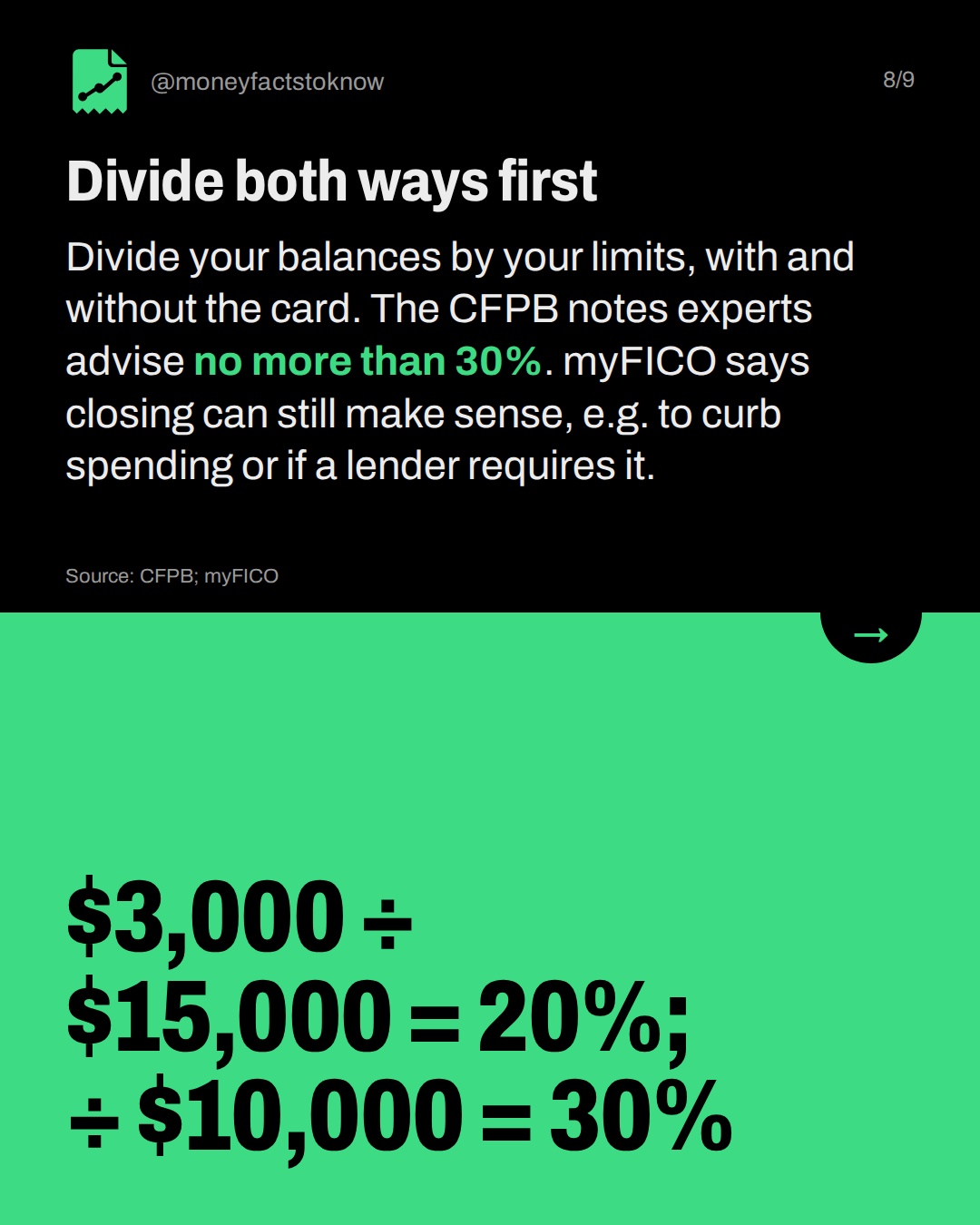
Divide your balances by your limits, with and without the card. The CFPB notes experts advise no more than 30%. myFICO says closing can still make sense, e.g. to curb spending or if a lender requires it.
The math: $3,000 ÷ $15,000 = 20%; ÷ $10,000 = 30%
Source: CFPB; myFICO
Sources and assumptions
- myFICO: Will Closing a Credit Card Help My FICO® Score?: Closing a card won't help a FICO Score ('We never recommend closing a credit card for the sole purpose of raising your FICO Score'). Closing an old or unused card wipes away available credit and raises the utilization ratio. Example: closing a $0-balance, $3,000-limit card takes utilization from 2000/6500 (30%) to 2000/3500 (57%). FICO Scores still consider payment history and balances on closed accounts. Closing may make sense as a spending control. (checked 2026-10-23)
- myFICO: How Owing Money Impacts Your Credit Score (Amounts Owed): Amounts owed determines 30% of a FICO Score. Utilization is the percentage of your available credit you're using, and a high percentage can have a negative impact. (checked 2026-10-23)
- CFPB: How do I get and keep a good credit score? (updated Dec 18, 2024): Keep balances low compared to your total credit limit, at no more than 30 percent. Closing some card accounts may hurt your score if it means you're using a high percentage of your total credit limit. (checked 2026-10-23)
Assumptions:
- Fictional cardholder with two cards: Card A has a $10,000 limit and a $3,000 reported balance. Card B has a $5,000 limit and a $0 balance.
- Utilization means overall revolving utilization (total card balances ÷ total card limits). The cardholder has no other revolving accounts.
- Card B carries no balance when it's closed. A closed card with a balance can still be counted by FICO.
- The balance on Card A stays at $3,000 before and after.
- No point change is predicted. The score effect depends on the scoring model and the person's whole credit profile.
- 30% is the CFPB's general guideline. It isn't a FICO cutoff.
The short version
- Closing a card removes its limit
- Same $3,000 balance: 20% becomes 30%
- A closed card with a balance still counts
- Divide both ways before closing


