 Money Facts To Know
Leftover 529 money can move to a Roth IRA: $35,000 lifetime max


Leftover 529 money isn't automatically stuck
Many assume unused 529 money can only come out with income tax plus a 10% additional tax on the earnings part. Since 2024, federal law allows another route: a rollover into the beneficiary's own Roth IRA.
Source: IRS Pub 970; 26 U.S.C. 529(c)(3)(E), 529(c)(6); IRS Pub 590-A
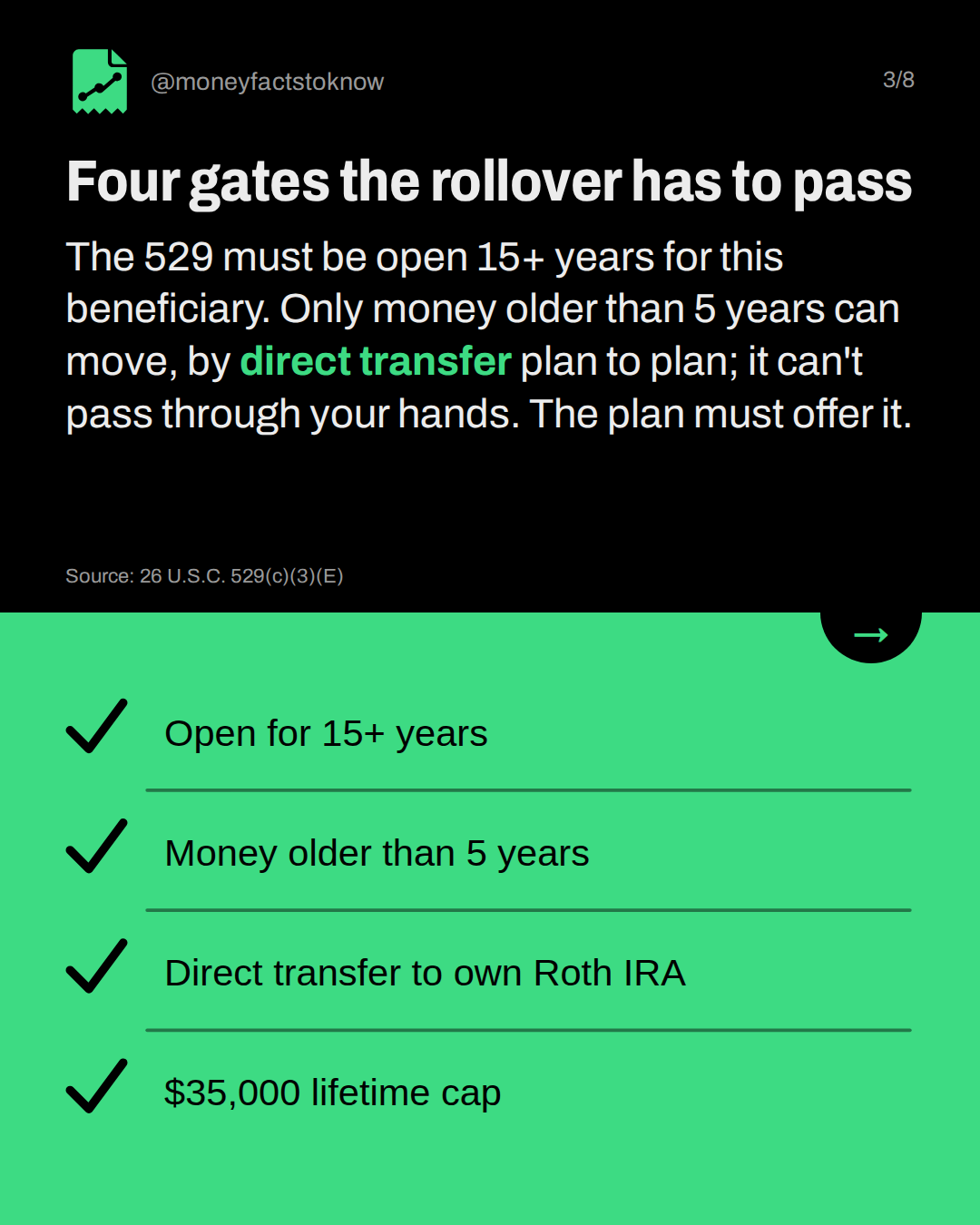
Four gates the rollover has to pass
The 529 must be open 15+ years for this beneficiary. Only money older than 5 years can move, by direct transfer plan to plan; it can't pass through your hands. The plan must offer it.
Source: 26 U.S.C. 529(c)(3)(E)
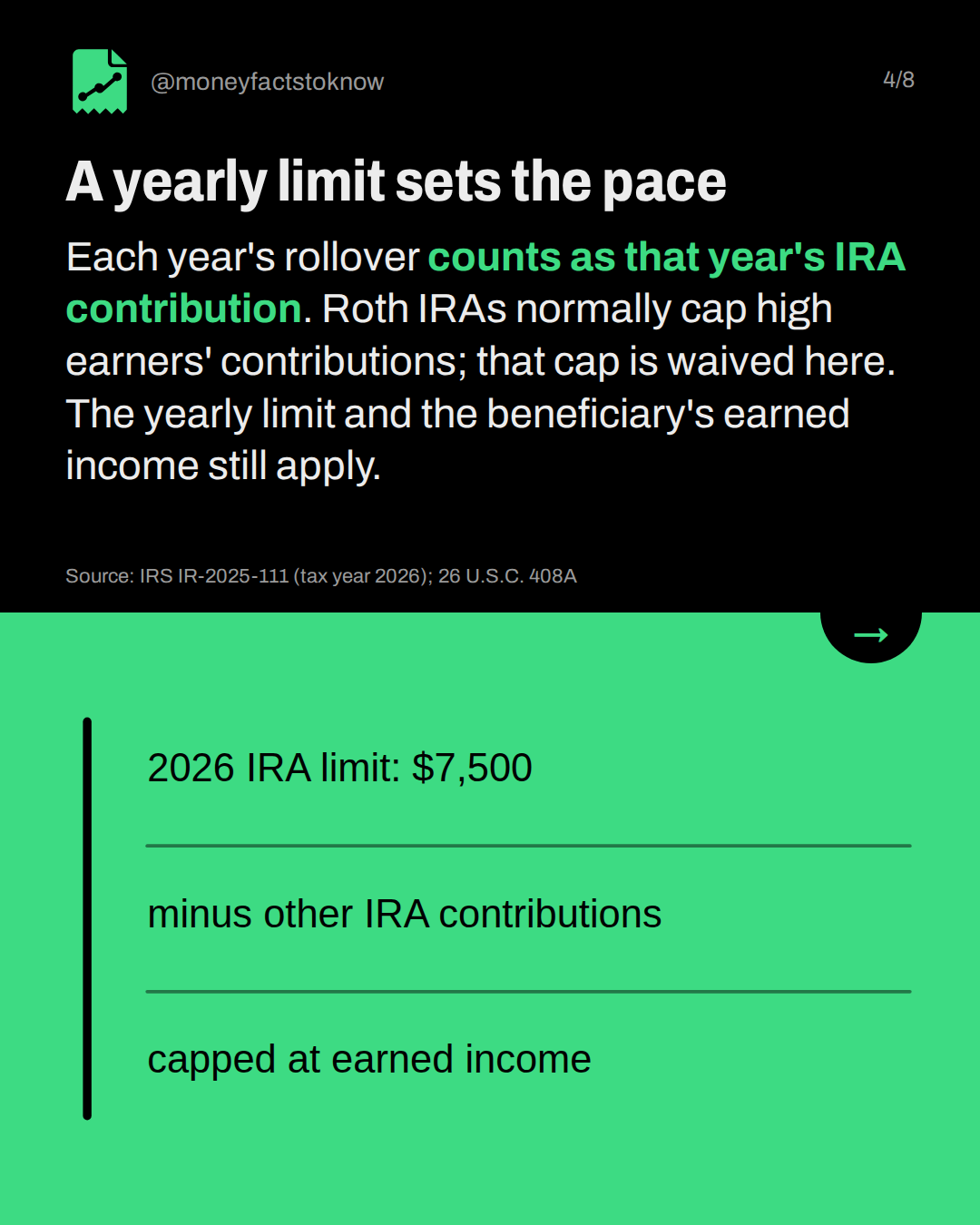
A yearly limit sets the pace
Each year's rollover counts as that year's IRA contribution. Roth IRAs normally cap high earners' contributions; that cap is waived here. The yearly limit and the beneficiary's earned income still apply.
Source: IRS IR-2025-111 (tax year 2026); 26 U.S.C. 408A
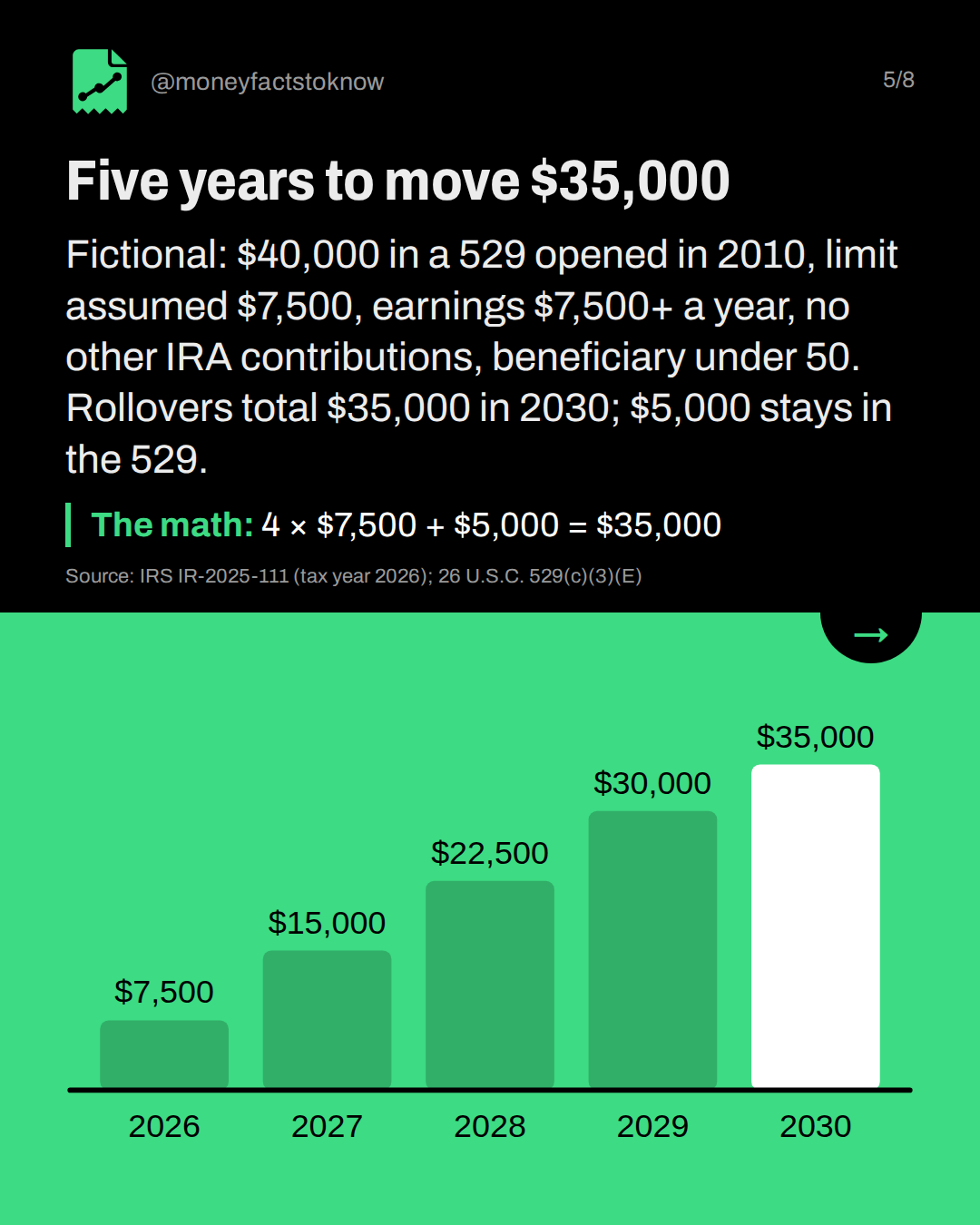
Five years to move $35,000
Fictional: $40,000 in a 529 opened in 2010, limit assumed $7,500, earnings $7,500+ a year, no other IRA contributions, beneficiary under 50. Rollovers total $35,000 in 2030; $5,000 stays in the 529.
The math: 4 × $7,500 + $5,000 = $35,000
Source: IRS IR-2025-111 (tax year 2026); 26 U.S.C. 529(c)(3)(E)
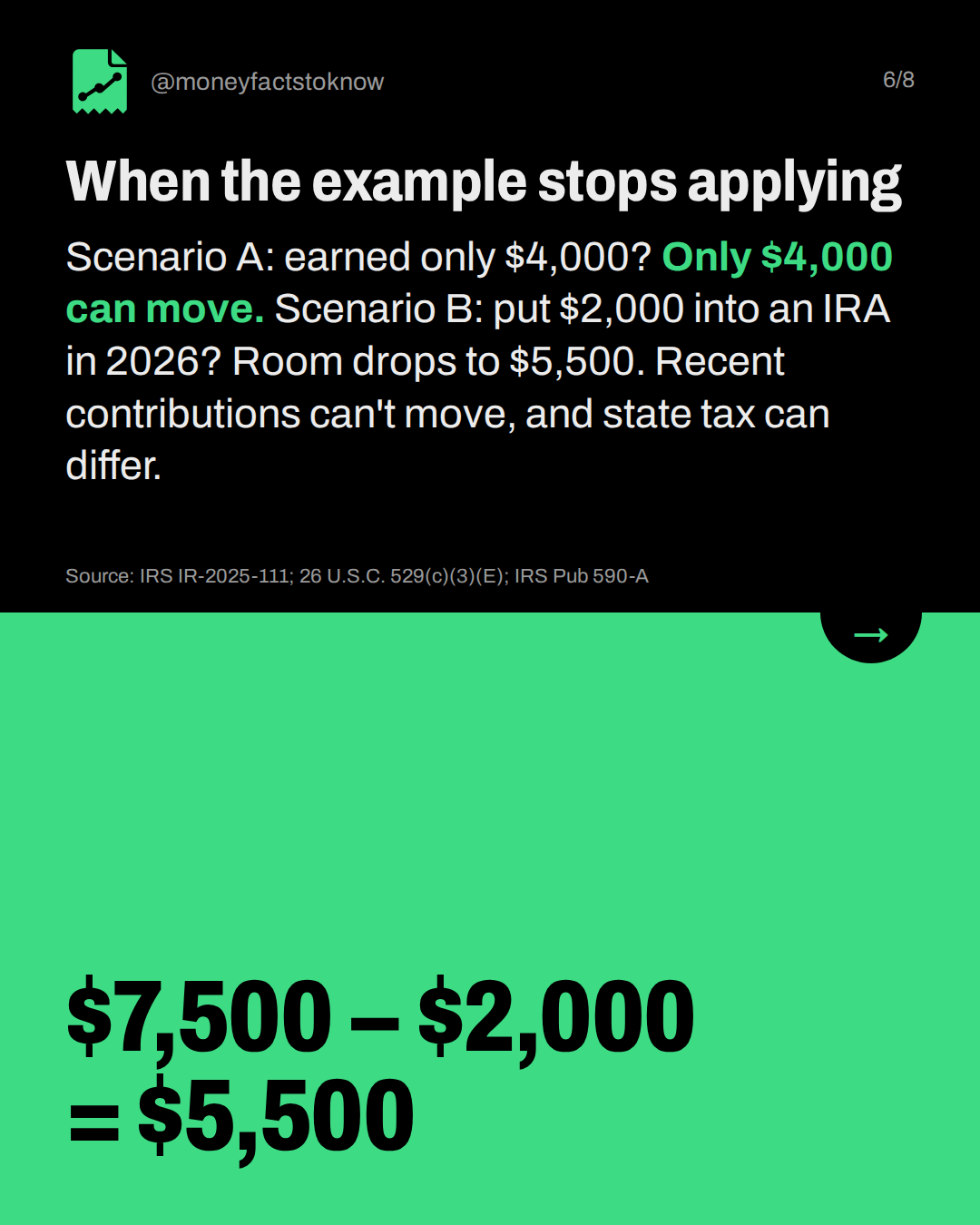
When the example stops applying
Scenario A: earned only $4,000? Only $4,000 can move. Scenario B: put $2,000 into an IRA in 2026? Room drops to $5,500. Recent contributions can't move, and state tax can differ.
The math: $7,500 − $2,000 = $5,500
Source: IRS IR-2025-111; 26 U.S.C. 529(c)(3)(E); IRS Pub 590-A
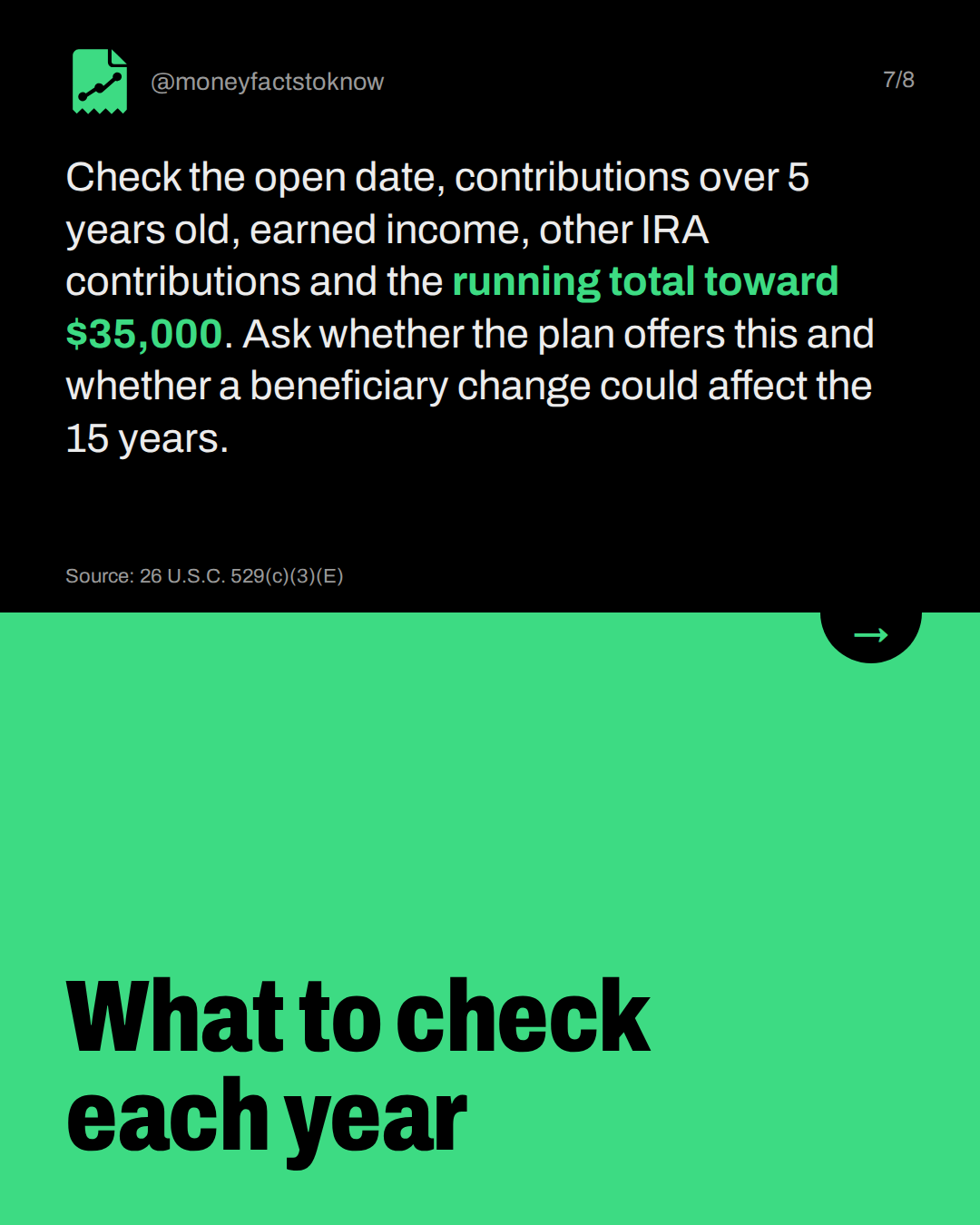
What to check each year
Check the open date, contributions over 5 years old, earned income, other IRA contributions and the running total toward $35,000. Ask whether the plan offers this and whether a beneficiary change could affect the 15 years.
Source: 26 U.S.C. 529(c)(3)(E)
Sources and assumptions
- 26 U.S.C. § 529(c)(3)(E), Special rollover to Roth IRAs from long-term qualified tuition programs (Cornell LII): The 529 must have been maintained for the designated beneficiary for the 15-year period ending on the distribution date; the amount rolled over can't exceed contributions (and their earnings) made before the 5-year period ending on the distribution date; it must be a direct trustee-to-trustee transfer to a Roth IRA maintained for that beneficiary; the annual limit is the 408A(c)(2) amount reduced by other IRA contributions that year; the lifetime aggregate is $35,000 (checked 2026-10-22)
- 26 U.S.C. § 408A (Cornell LII): 408A(c)(3)(E): the income-based limit is increased by 529(c)(3)(E) contributions, so the Roth MAGI phase-out doesn't block the rollover; 408A(c)(2): the contribution limit ties to the IRA deductible amount (checked 2026-10-22)
- IRS IR-2025-111 (Nov. 13, 2025): 401(k) limit increases to $24,500 for 2026, IRA limit increases to $7,500: 2026 IRA contribution limit is $7,500 (up from $7,000); the catch-up for age 50+ is $1,100 (checked 2026-10-22)
- IRS Publication 590-A (2025): Beginning with distributions after Dec. 31, 2023, a 529 beneficiary may roll over a 529 distribution into a Roth IRA for the beneficiary if requirements are met; the IRA contribution limit is the smaller of the dollar limit or your taxable compensation for the year (checked 2026-10-22)
- 26 U.S.C. § 530(d)(4), Additional tax on Coverdell distributions includible in gross income, applied to 529 plans by § 529(c)(6) (Cornell LII): 530(d)(4)(A): the tax 'shall be increased by 10 percent of the amount which is so includible'. 530(d)(4)(B) exceptions: the beneficiary's death, disability (72(m)(7)), scholarship (up to that amount), US military academy attendance. 529(c)(6) (https://www.law.cornell.edu/uscode/text/26/529): 'The tax imposed by section 530(d)(4) shall apply to any payment or distribution from a qualified tuition program in the same manner as such tax applies to a Coverdell education savings account.' 529(c)(3)(A): distributions are 'includible in the gross income of the distributee in the manner as provided under section 72'. (checked 2026-10-22)
- IRS Publication 970 (2025), Tax Benefits for Education, Qualified Tuition Program chapter: Section 'Figuring the Taxable Portion of a Distribution': earnings in distributions that exceed adjusted qualified education expenses are taxable. Section 'Additional Tax on Taxable Distributions' applies the 10% additional tax to the taxable part. It lists exceptions for scholarships, US military academy attendance, and the beneficiary's death or disability. (checked 2026-10-22)
Assumptions:
- Fictional beneficiary and account; not a real person
- The 529 was opened for this same beneficiary in 2010, so it is more than 15 years old in 2026
- Fictional $40,000 left in the 529, all from contributions made more than 5 years before each rollover (plus their earnings)
- The beneficiary has at least $7,500 of earned income (taxable compensation) every year 2026–2030 and makes no other IRA contributions
- The IRA limit is assumed to stay $7,500 in 2027–2030 (it is inflation-adjusted and may rise, which could shorten the timeline); the beneficiary is under 50, so no $1,100 catch-up
- One rollover per tax year, done as a direct trustee-to-trustee transfer
- Federal rules only; state tax treatment of 529-to-Roth rollovers can differ
The short version
- Leftover 529 money can roll into the beneficiary's Roth IRA
- The 529 must be 15+ years old
- Only money older than 5 years can move
- Capped by the yearly IRA limit and $35,000 for life
- Fictional example: about 5 years


