 Money Facts To Know
Working while on early Social Security? Withheld isn't the same as gone

Withheld is not the same as lost
People often assume working while claiming early costs benefits for good. That's half right: SSA (Social Security Administration) withholds the benefit, then credits the withheld months later with a slightly larger check at full retirement age.
The 2026 earnings limit
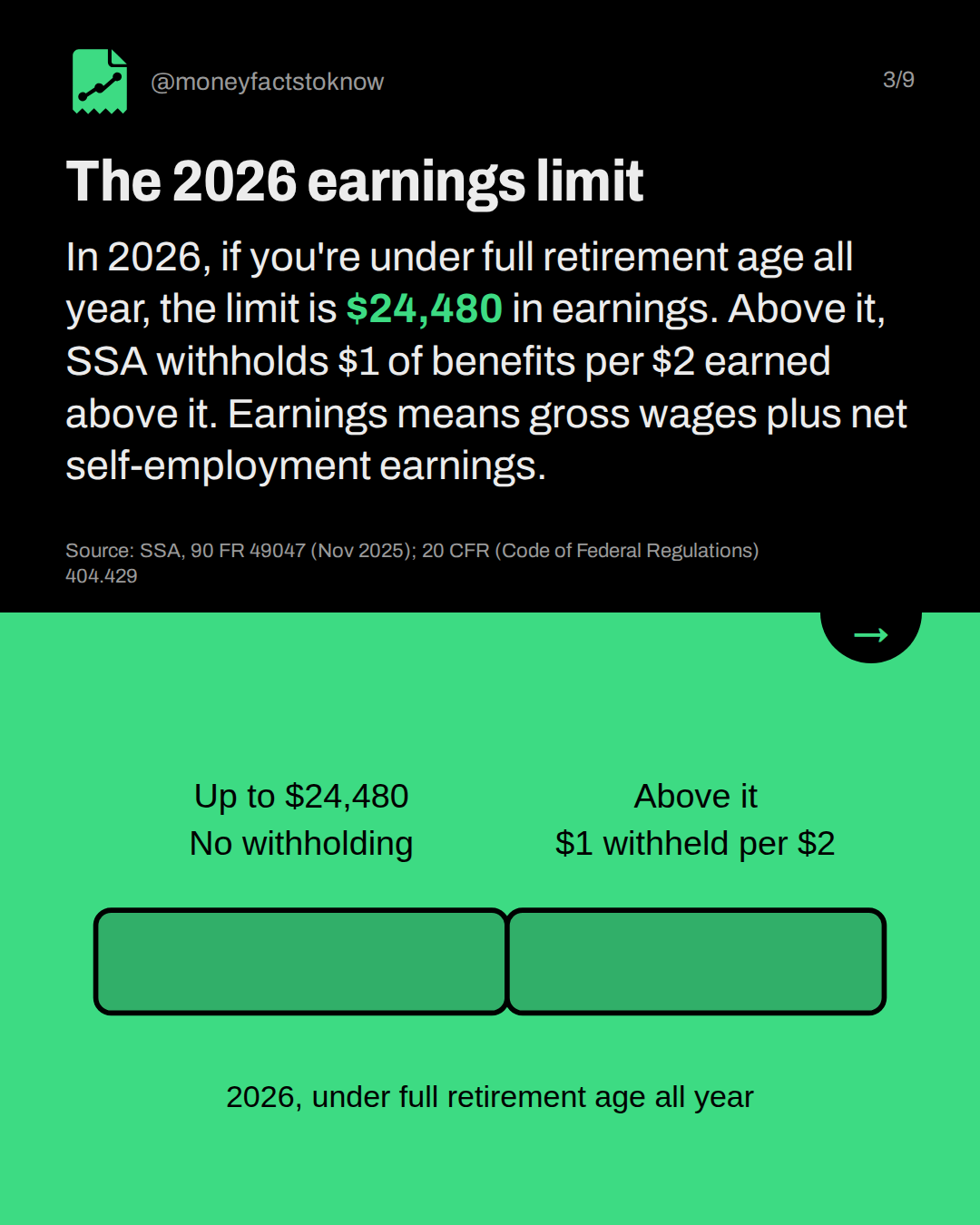
In 2026, if you're under full retirement age all year, the limit is $24,480 in earnings. Above it, SSA withholds $1 of benefits per $2 earned above it. Earnings means gross wages plus net self-employment earnings.
Source: SSA, 90 FR 49047 (Nov 2025); 20 CFR (Code of Federal Regulations) 404.429
What $30,000 of wages costs
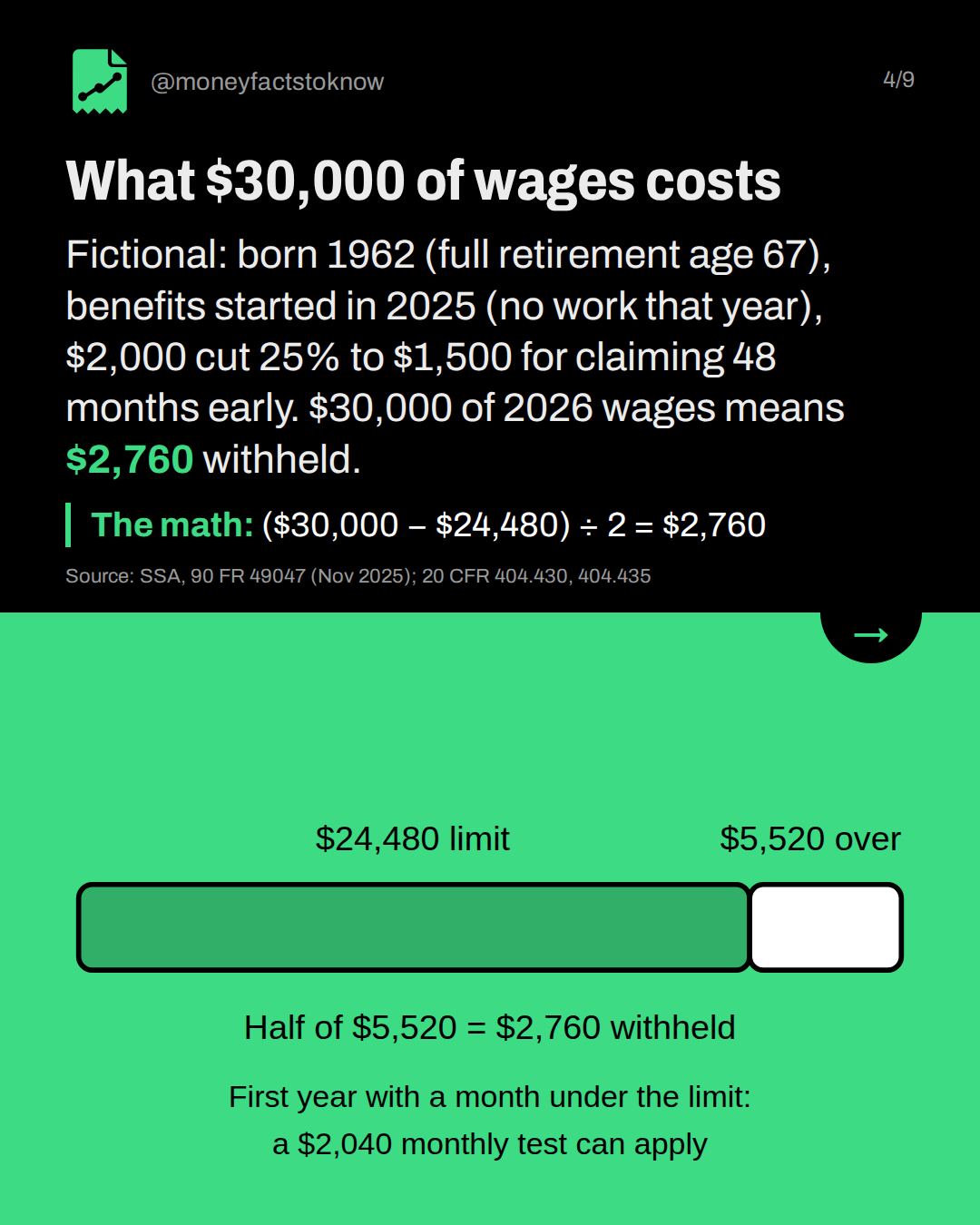
Fictional: born 1962 (full retirement age 67), benefits started in 2025 (no work that year), $2,000 cut 25% to $1,500 for claiming 48 months early. $30,000 of 2026 wages means $2,760 withheld.
The math: ($30,000 − $24,480) ÷ 2 = $2,760
Source: SSA, 90 FR 49047 (Nov 2025); 20 CFR 404.430, 404.435
Which checks get held back
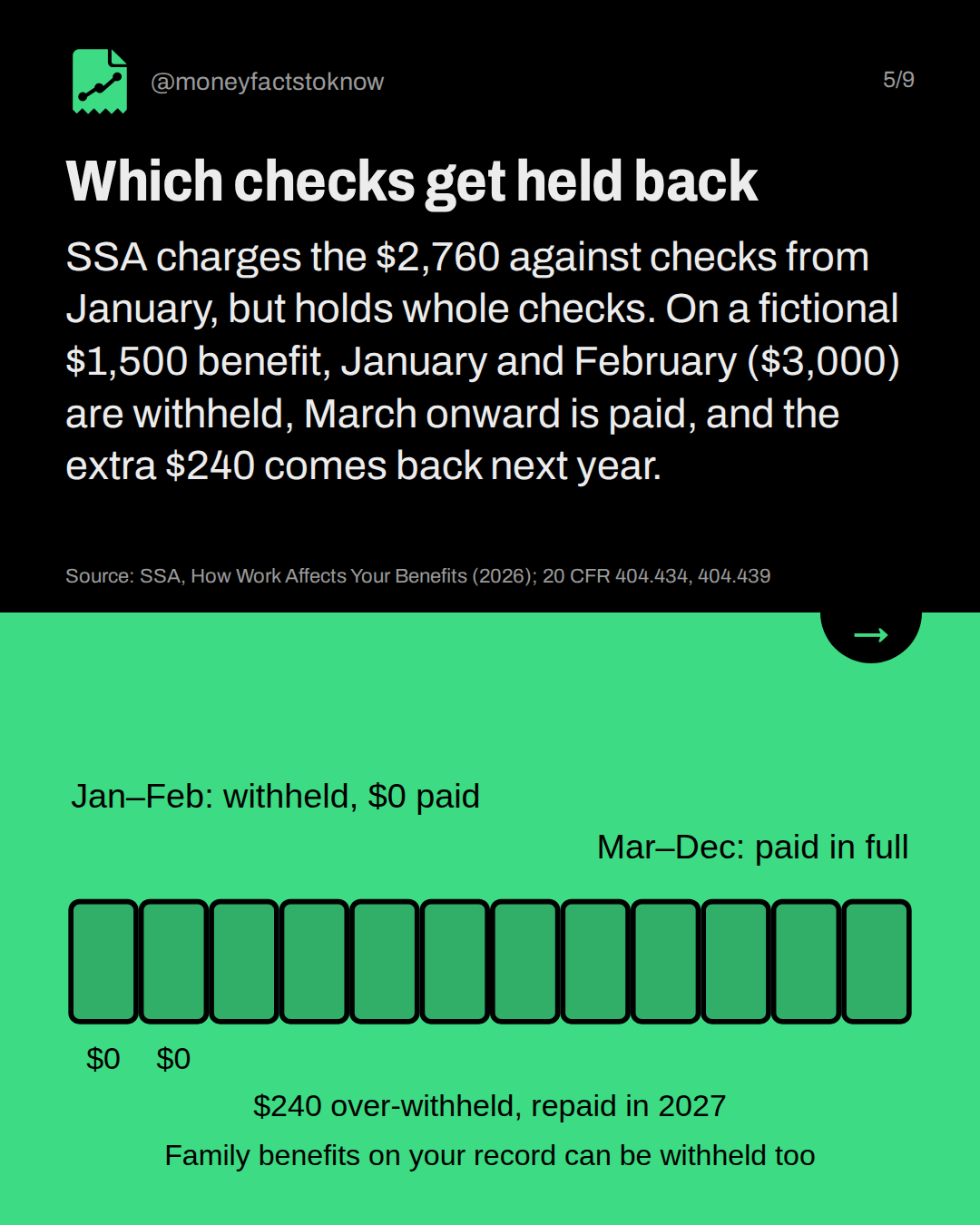
SSA charges the $2,760 against checks from January, but holds whole checks. On a fictional $1,500 benefit, January and February ($3,000) are withheld, March onward is paid, and the extra $240 comes back next year.
Source: SSA, How Work Affects Your Benefits (2026); 20 CFR 404.434, 404.439
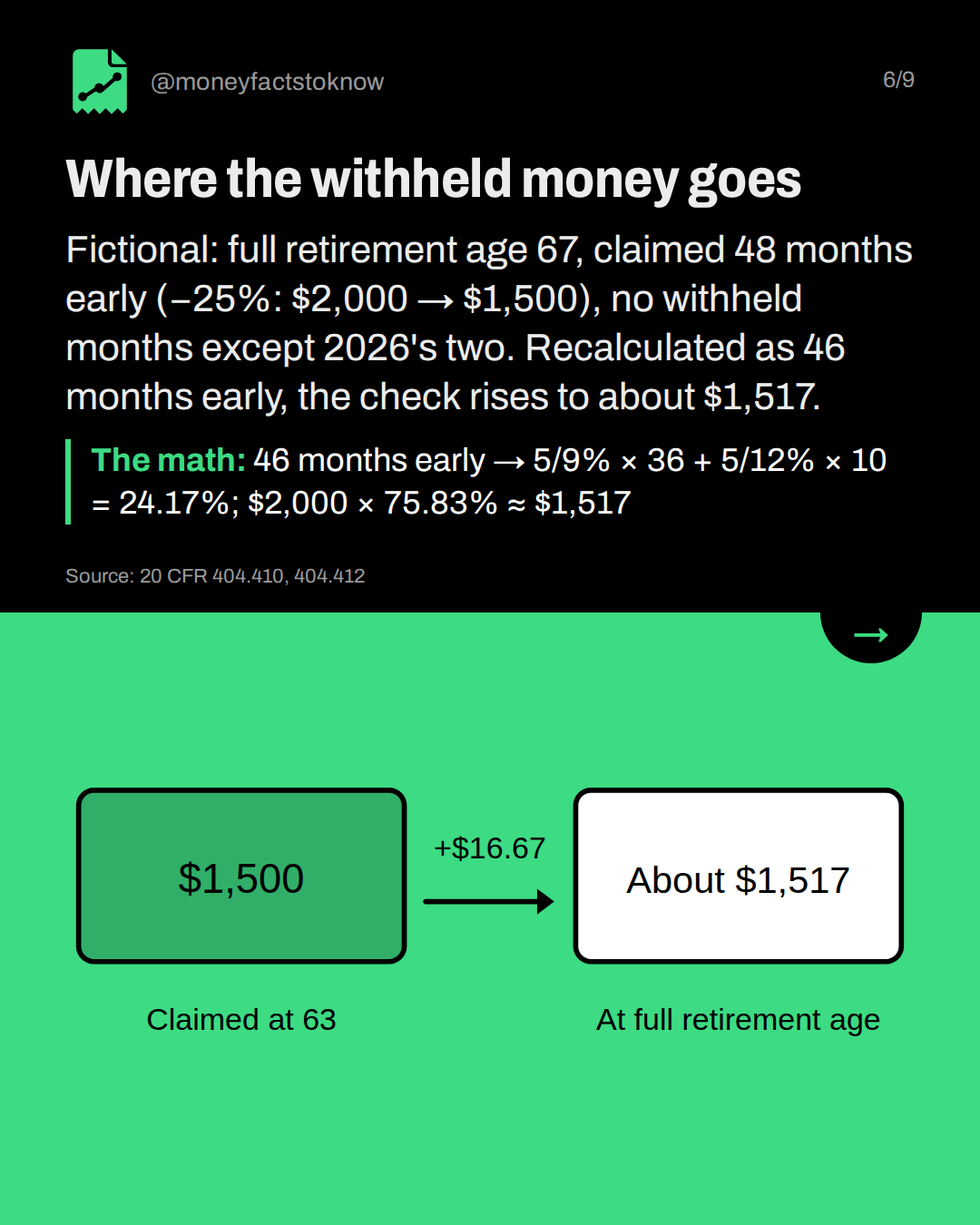
Where the withheld money goes
Fictional: full retirement age 67, claimed 48 months early (−25%: $2,000 → $1,500), no withheld months except 2026's two. Recalculated as 46 months early, the check rises to about $1,517.
The math: 46 months early → 5/9% × 36 + 5/12% × 10 = 24.17%; $2,000 × 75.83% ≈ $1,517
Source: 20 CFR 404.410, 404.412
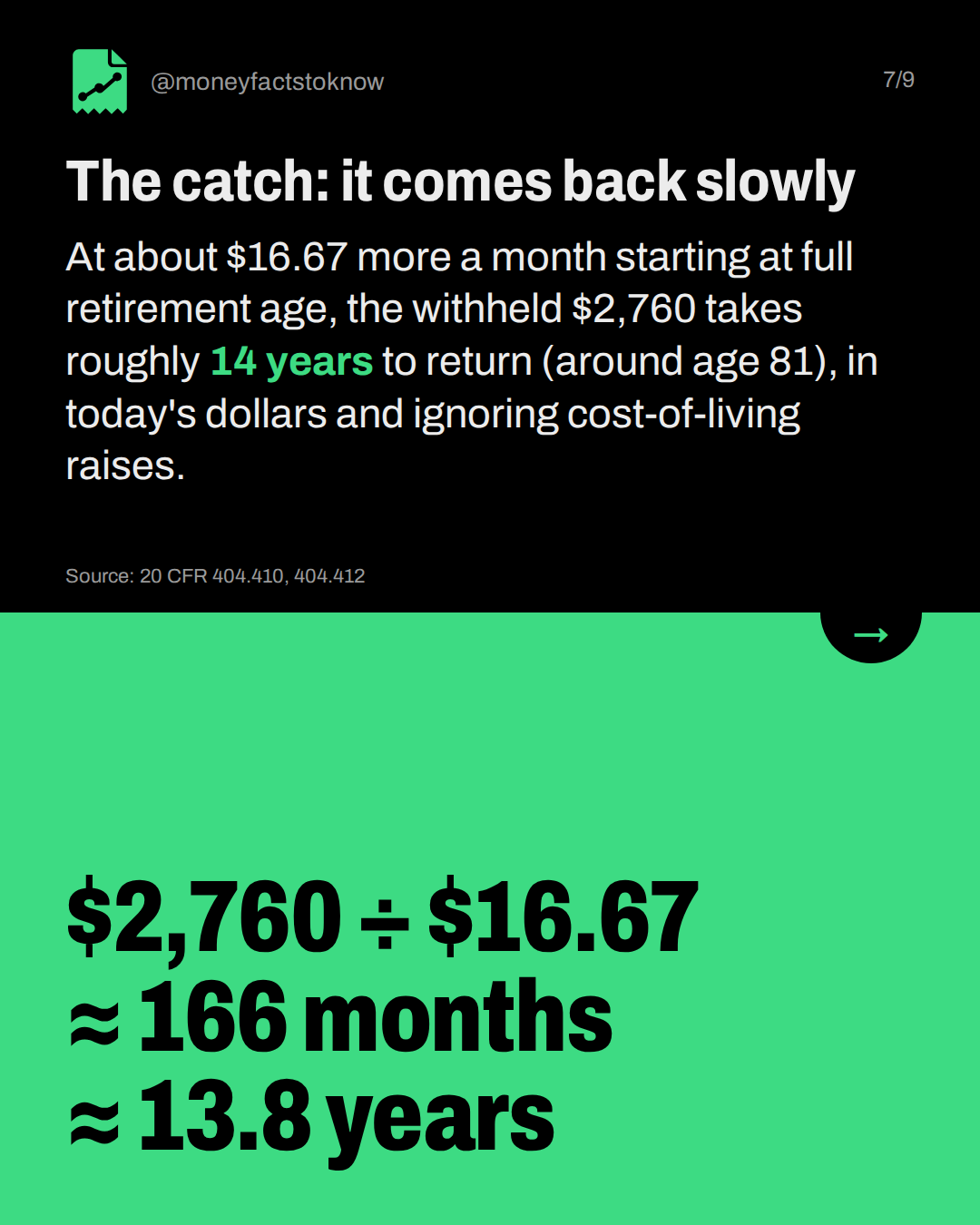
The catch: it comes back slowly
At about $16.67 more a month starting at full retirement age, the withheld $2,760 takes roughly 14 years to return (around age 81), in today's dollars and ignoring cost-of-living raises.
The math: $2,760 ÷ $16.67 ≈ 166 months ≈ 13.8 years
Source: 20 CFR 404.410, 404.412
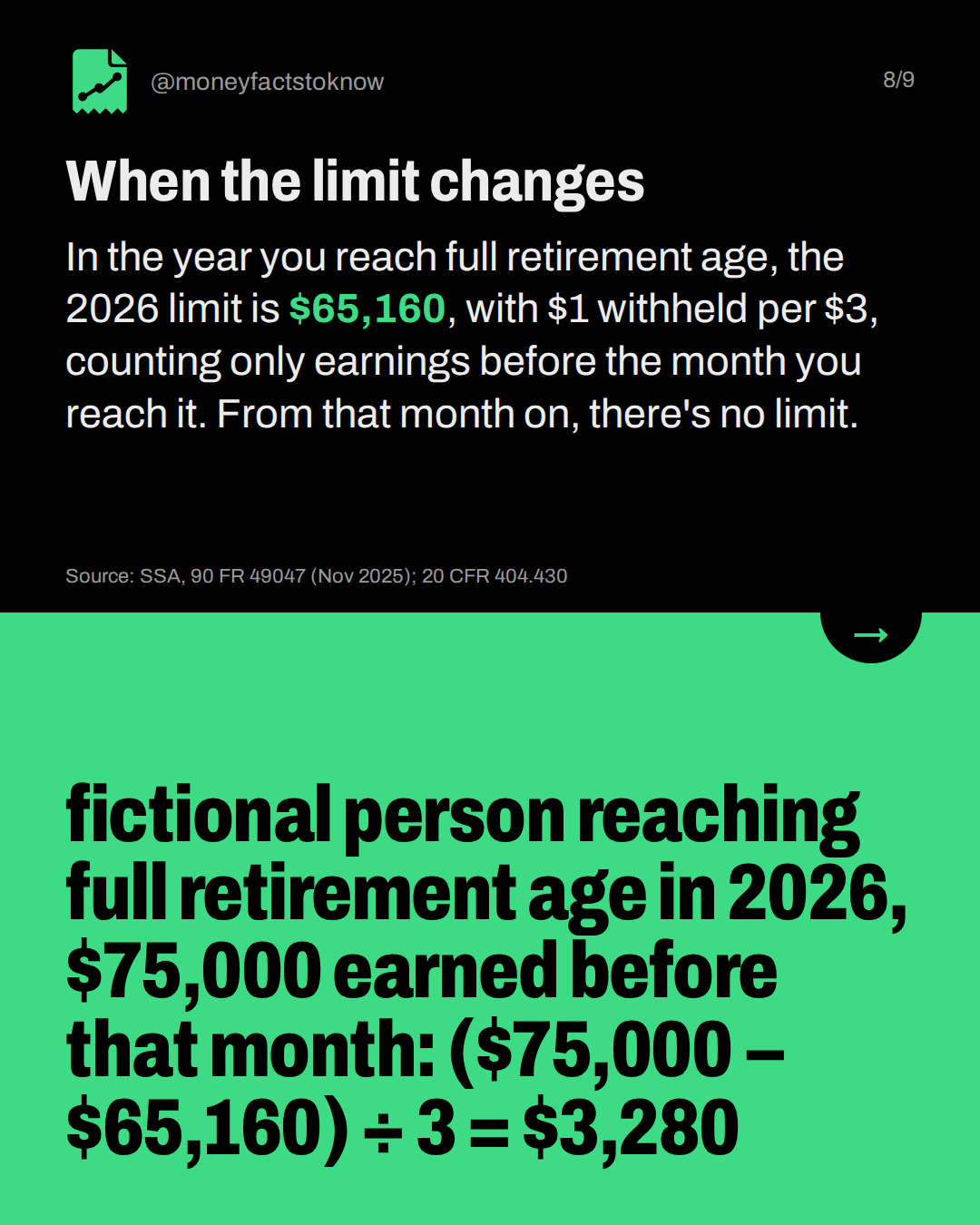
When the limit changes
In the year you reach full retirement age, the 2026 limit is $65,160, with $1 withheld per $3, counting only earnings before the month you reach it. From that month on, there's no limit.
The math: fictional person reaching full retirement age in 2026, $75,000 earned before that month: ($75,000 − $65,160) ÷ 3 = $3,280
Source: SSA, 90 FR 49047 (Nov 2025); 20 CFR 404.430
Sources and assumptions
- Social Security Administration, 'Cost-of-Living Increase and Other Determinations for 2026', Federal Register 90 FR 49047 (Nov 3, 2025): 2026 retirement earnings test exempt amounts: $24,480/yr ($2,040/mo) for beneficiaries under NRA not reaching it in 2026; $65,160/yr ($5,430/mo) in the year NRA is reached; $1 withheld per $2 over the lower amount, $1 per $3 over the higher amount for months before NRA; NRA 67 for those born 1960 or later (checked 2026-10-22)
- 20 CFR 404.430 (eCFR), Monthly and annual exempt amounts defined; excess earnings defined: Excess earnings are 50% of earnings over the exempt amount, or 33 1/3% in the year of reaching full retirement age, counting only earnings of months before that month; earnings after reaching full retirement age are not subject to the earnings test (checked 2026-10-22)
- 20 CFR 404.429 (eCFR), Earnings; defined: Earnings for the test are gross wages plus net earnings from self-employment (checked 2026-10-22)
- 20 CFR 404.434 (eCFR), Excess earnings; method of charging: Excess earnings are charged against the full benefit each month from the beginning of the year until used up, $1 of benefits per $1 of excess earnings (checked 2026-10-22)
- 20 CFR 404.439 (eCFR), Partial monthly benefits; excess earnings less than the total benefit: When the excess charged to a month is less than that month's benefit, the difference is paid (checked 2026-10-22)
- 20 CFR 404.410 (eCFR), How does SSA reduce my benefits when my entitlement begins before full retirement age?: Early retirement reduction: 5/9 of 1% for each of the first 36 months before full retirement age and 5/12 of 1% for each additional month (checked 2026-10-22)
- 20 CFR 404.412 (eCFR), After full retirement age, adjustment of the reduction: Months subject to deduction under 404.415 are not counted for the reduction; SSA makes automatic adjustments effective with the month full retirement age is reached (checked 2026-10-22)
- 20 CFR 404.435 (eCFR), Excess earnings; months to which excess earnings can or cannot be charged; grace year defined: In the grace year (the first year with a non-service month after entitlement) a monthly test applies: benefits are paid for months without earnings over the monthly exempt amount, even if annual earnings exceed the annual exempt amount (checked 2026-10-22)
- Social Security Administration, 'How Work Affects Your Benefits' (2026), Publication No. EN-05-10069: SSA's 2026 example: 'we would withhold all benefit payments from January 2026 through February 2026. Beginning in March 2026, you would receive your $600 benefit… In 2027, we would pay you the additional $400 we withheld in February 2026.' (ssa.gov returned 403 to direct fetch; the 2026 edition at this URL and the 'In 2027, we would pay you the additional' text were confirmed through search indexing, and the full-month rule was confirmed in POMS RS 02501.100) (checked 2026-10-22)
- SSA Program Operations Manual System (POMS) RS 02501.100, Imposing Work Suspensions: 'When the excess earnings charged to a month are less than a full monthly benefit, impose a work suspension for the entire month.' Exception: 'If a beneficiary protests the withholding of a full month's benefit when only part of that month's benefit is not payable based on an estimate of earnings, pay the partial benefit.' Example: $562 benefit, $2,880 excess, partial benefit possible for June, 'However, apply full-month suspensions through June.' (checked 2026-10-22)
Assumptions:
- Fictional claimant born in 1962, so full retirement age is 67
- Claimed retirement benefits exactly 48 months before full retirement age (at 63), in 2025, and did not work in 2025, so 2025 was the grace year and the annual test (not the first-year monthly test) applies in 2026
- Fictional primary insurance amount (full-retirement-age benefit) of $2,000, reduced 25% to $1,500 a month
- $30,000 of gross wages in 2026, no self-employment income, does not reach full retirement age in 2026; no benefits withheld in 2027, 2028 or 2029 before reaching full retirement age, so January–February 2026 are the only withheld months
- Only the worker's own benefit; no spouse or child benefits on the record
- Recalculated benefit and payback time ignore cost-of-living adjustments and SSA's rounding of benefit amounts down to the dime/dollar
- Payback time compares the withheld dollars with the monthly increase in today's dollars and ignores any interest or time value
- Full-retirement-age-year example: fictional $75,000 earned in the months before the month of reaching full retirement age
- 2026 figures; SSA sets new exempt amounts each year
The short version
- Under full retirement age, 2026 limit: $24,480
- Over it, $1 withheld per $2 earned
- Withheld months return as a bigger check
- It's a slow credit, not a refund
- Born 1960 or later: full retirement age is 67


