 Money Facts To Know
$50,000 HELOC at 8%: $333 a month can become $607 (10-year repayment)
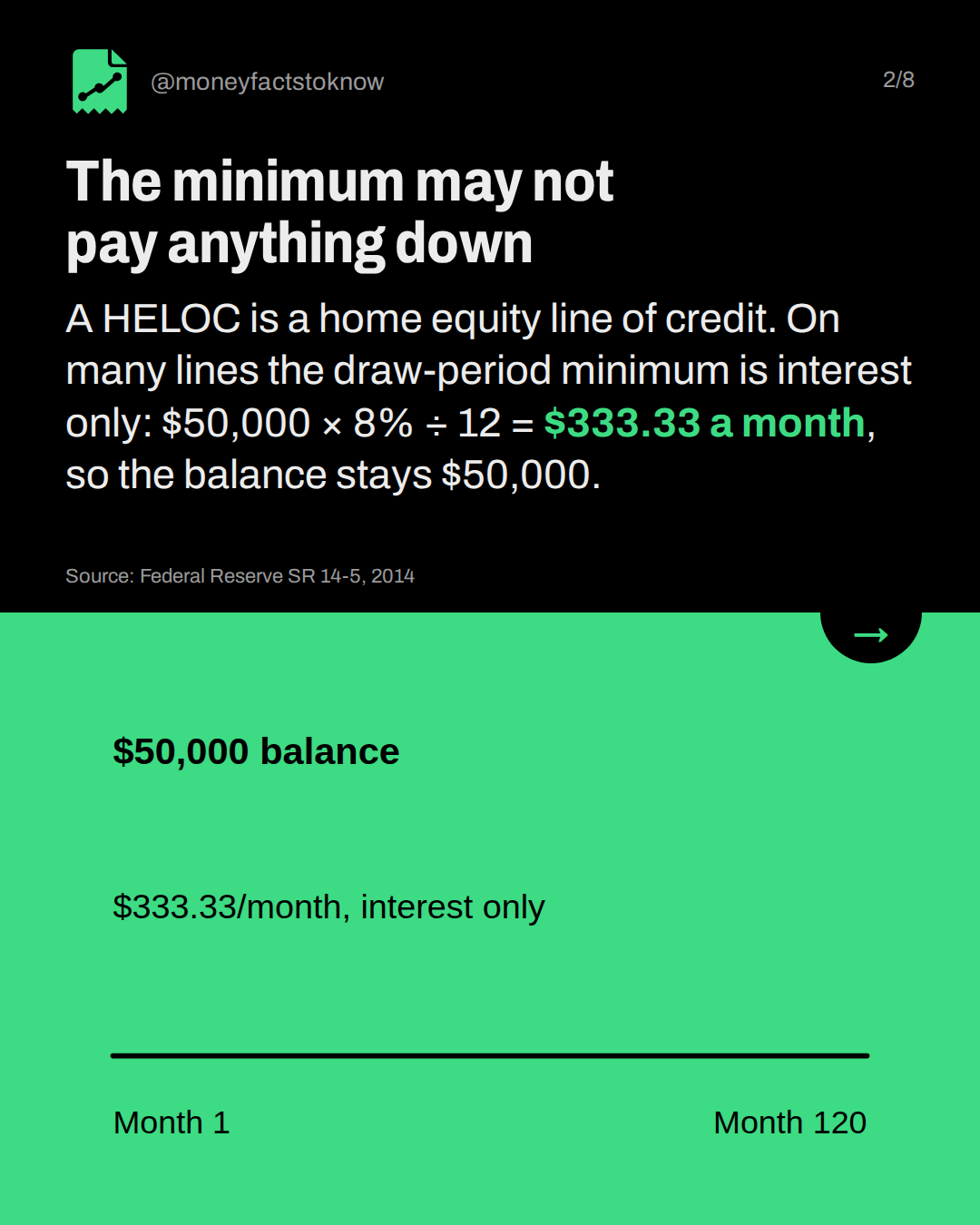
The minimum may not pay anything down
A HELOC is a home equity line of credit. On many lines the draw-period minimum is interest only: $50,000 × 8% ÷ 12 = $333.33 a month, so the balance stays $50,000.
Source: Federal Reserve SR 14-5, 2014
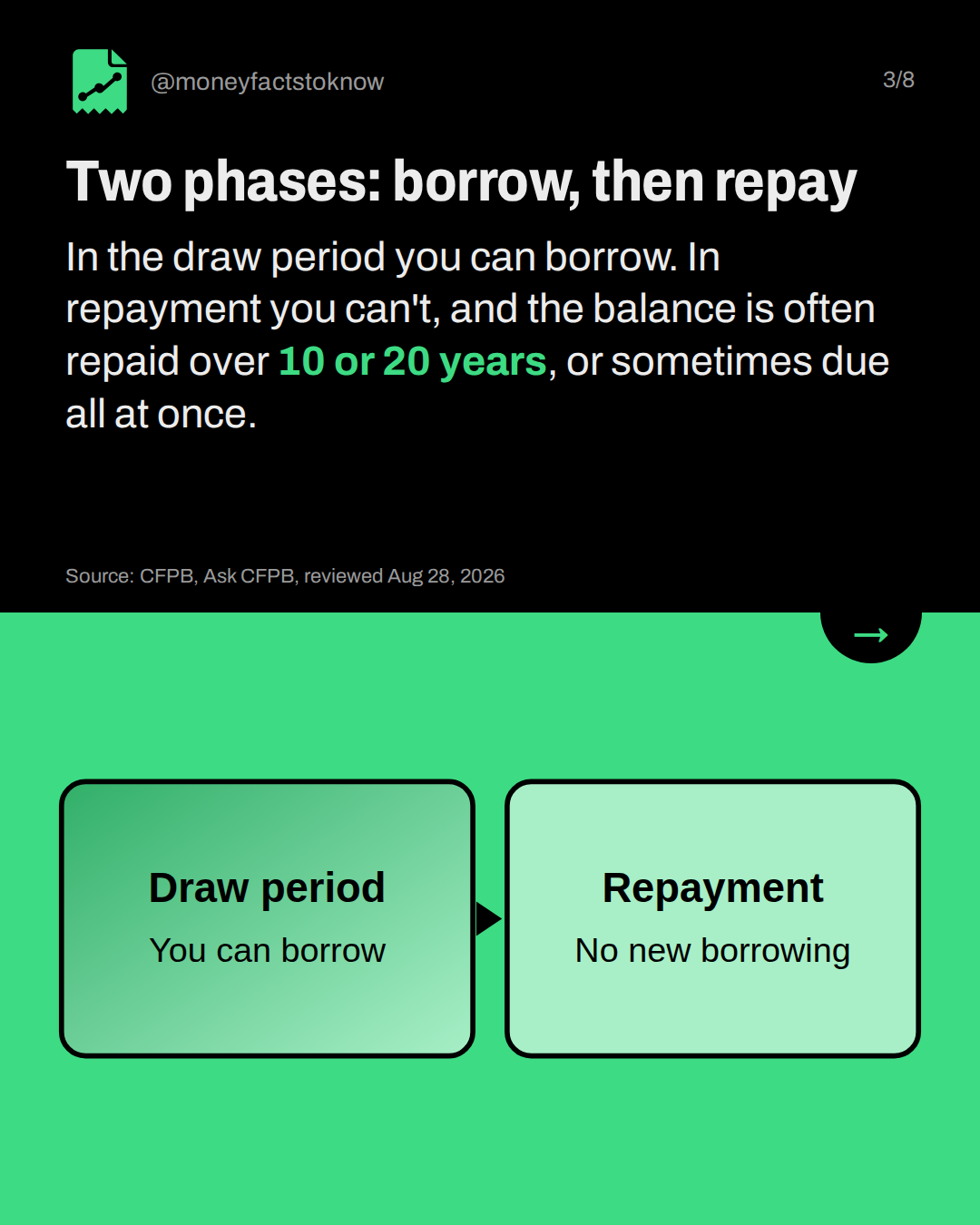
Two phases: borrow, then repay
In the draw period you can borrow. In repayment you can't, and the balance is often repaid over 10 or 20 years, or sometimes due all at once.
Source: CFPB, Ask CFPB, reviewed Aug 28, 2026
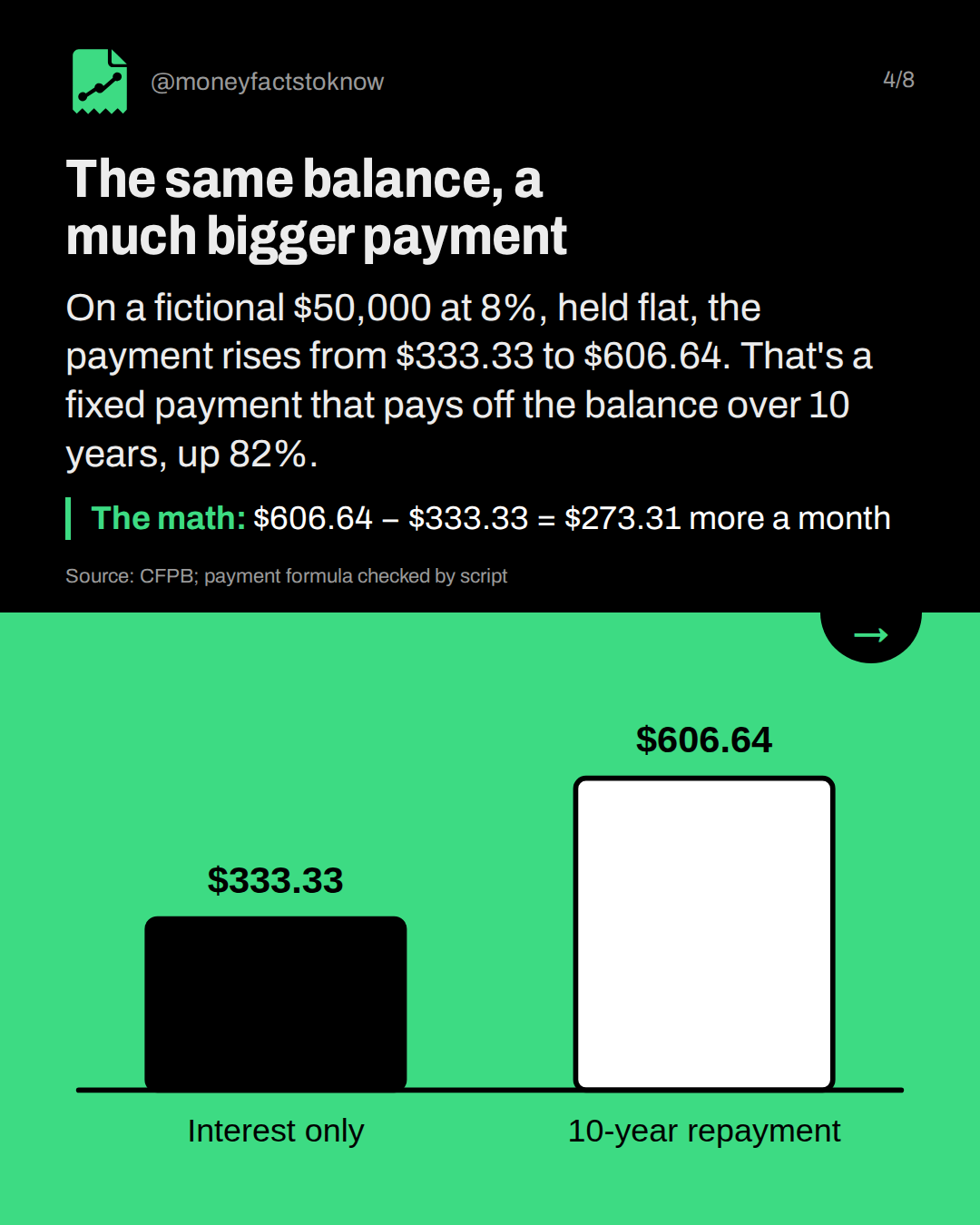
The same balance, a much bigger payment
On a fictional $50,000 at 8%, held flat, the payment rises from $333.33 to $606.64. That's a fixed payment that pays off the balance over 10 years, up 82%.
The math: $606.64 − $333.33 = $273.31 more a month
Source: CFPB; payment formula checked by script
Interest-only draw years pay no principal
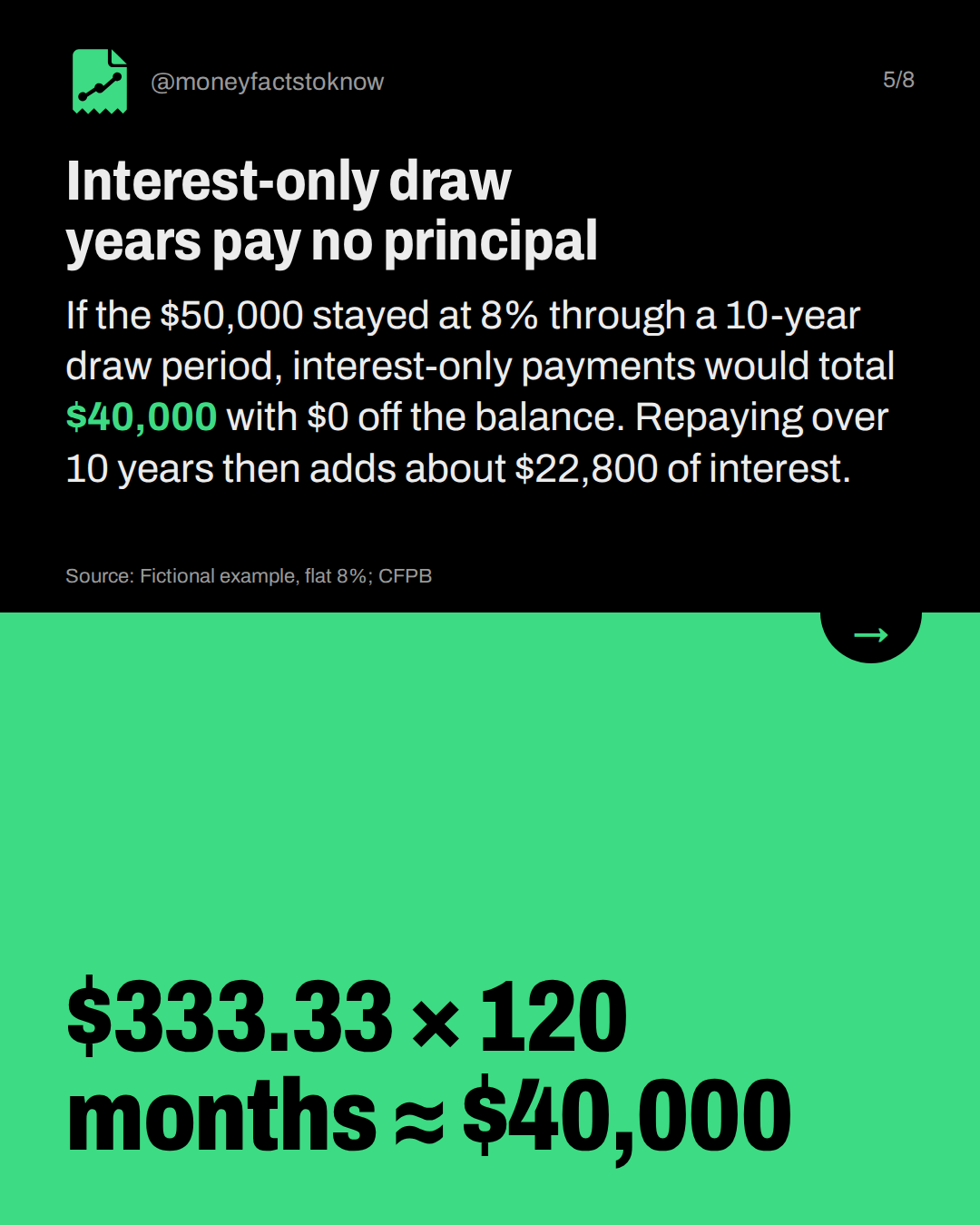
If the $50,000 stayed at 8% through a 10-year draw period, interest-only payments would total $40,000 with $0 off the balance. Repaying over 10 years then adds about $22,800 of interest.
The math: $333.33 × 120 months ≈ $40,000
Source: Fictional example, flat 8%; CFPB
What changes the size of the jump
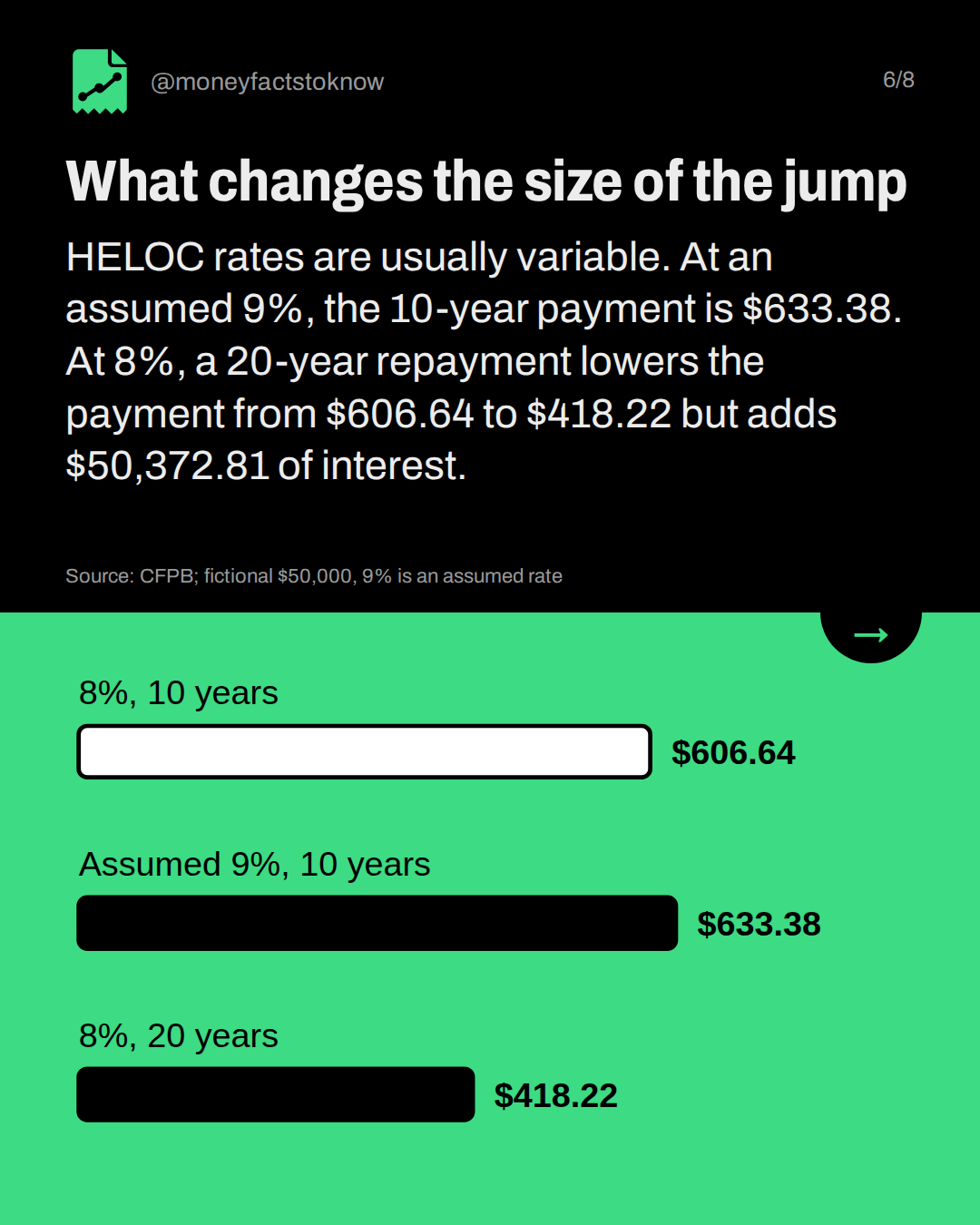
HELOC rates are usually variable. At an assumed 9%, the 10-year payment is $633.38. At 8%, a 20-year repayment lowers the payment from $606.64 to $418.22 but adds $50,372.81 of interest.
Source: CFPB; fictional $50,000, 9% is an assumed rate
Four things to find in your agreement
Look up when your draw period ends, the repayment term or whether the balance is due all at once, whether your minimum is interest only, and your current rate (and whether it's variable).
Sources and assumptions
- CFPB, Ask CFPB: What is a home equity line of credit (HELOC)? (last reviewed Aug 28, 2026): Borrowing happens during the 'draw period' (example: 10 years); afterward you enter the 'repayment period' and can't borrow; 'Monthly payments are often significantly higher once you enter repayment'; the lender may require repayment over 10 or 20 years or the whole balance at once; many HELOCs have minimum monthly payments based on the current balance; 'HELOCs usually have a variable interest rate, so your payments may change from month to month.' (checked 2026-10-21)
- Federal Reserve, Interagency Guidance on Home Equity Lines of Credit Nearing Their End-of-Draw Periods (SR 14-5, July 1, 2014): 'This line of credit often requires interest-only payments' during the draw period; in repayment the principal is 'either due immediately in a balloon payment or is repaid over the remaining loan term through higher monthly payments, resulting in payment shock.' (checked 2026-10-21)
Assumptions:
- Fictional borrower; $50,000 outstanding balance, fully drawn at the start of repayment
- 8% APR held constant throughout (real HELOC rates are usually variable)
- Draw-period minimum payment is interest-only (common, but not true of every plan; check the agreement)
- Monthly interest = balance × APR ÷ 12; no fees, no rate caps, no extra principal payments
- Repayment is a standard fixed-payment amortization over 120 months (10 years); 240 months (20 years) shown as a comparison
- Draw-period total interest assumes the $50,000 balance and 8% rate stay flat for a 10-year draw period (120 months)
- 9% figures are an assumed rate rise for sensitivity, not a forecast
The short version
- An interest-only minimum doesn't reduce the balance
- Fictional $50,000 at 8%: $333.33 became $606.64 (10-year repayment)
- Rate and repayment term change the jump
- Find your draw-period end date


