 Money Facts To Know
A $10,000 net investment loss can cut other income by only $3,000 a year
A loss doesn't come off all at once
Many people assume a $10,000 loss means a $10,000 deduction. But a net capital loss can reduce wages and other income by only $3,000 a year ($1,500 if married filing separately).
Source: IRS Topic no. 409; 26 U.S.C. 1211(b), tax year 2026
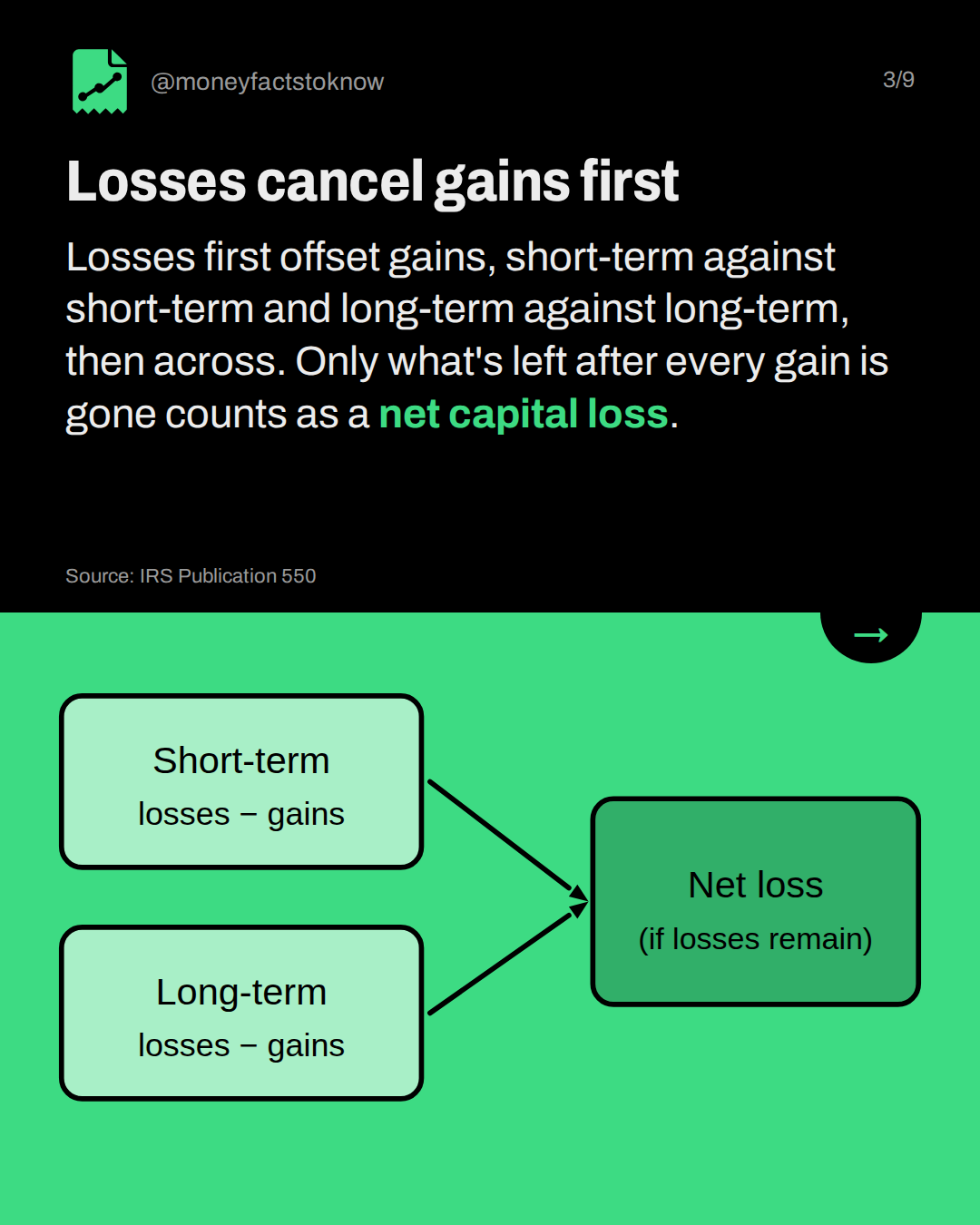
Losses cancel gains first
Losses first offset gains, short-term against short-term and long-term against long-term, then across. Only what's left after every gain is gone counts as a net capital loss.
Source: IRS Publication 550
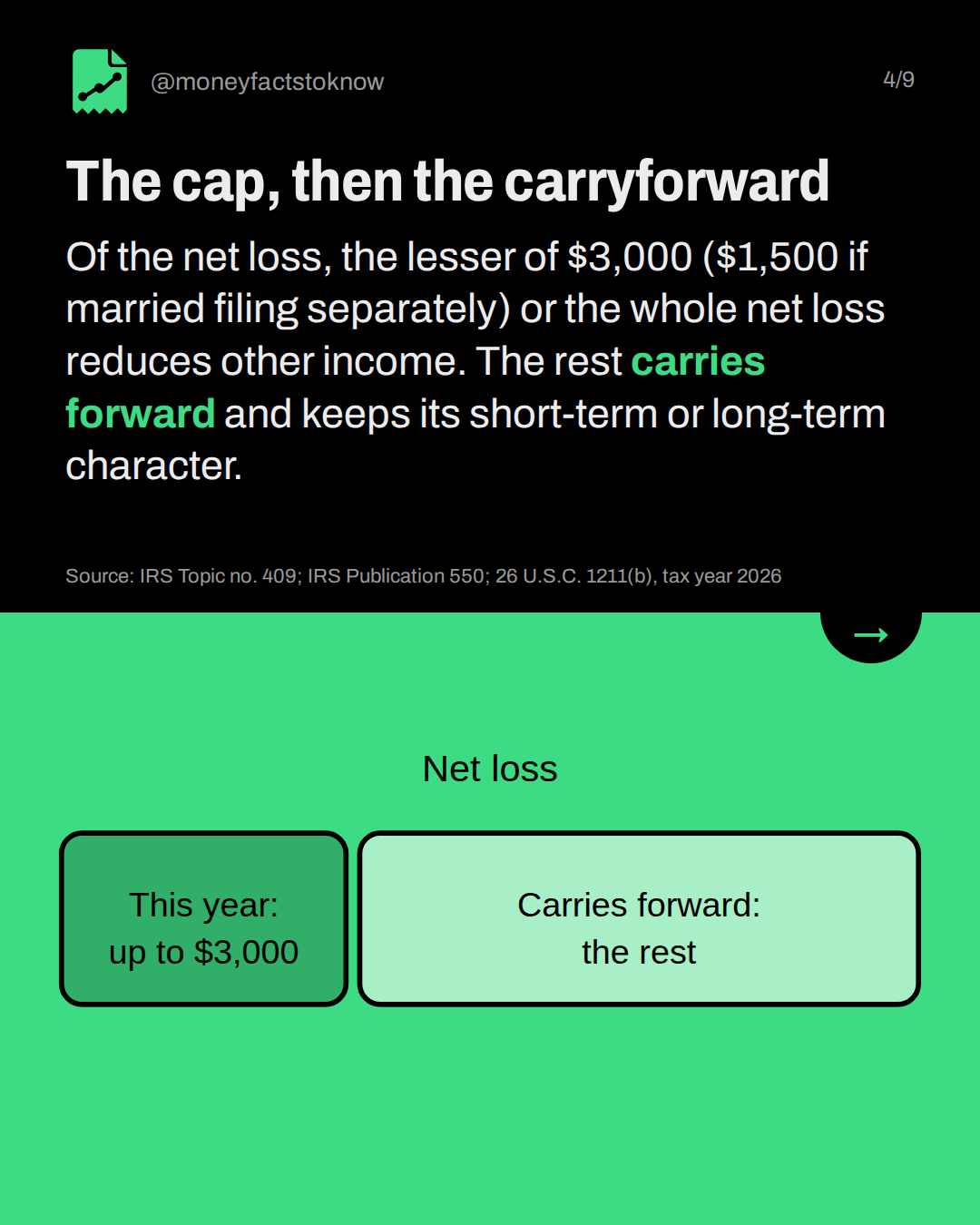
The cap, then the carryforward
Of the net loss, the lesser of $3,000 ($1,500 if married filing separately) or the whole net loss reduces other income. The rest carries forward and keeps its short-term or long-term character.
Source: IRS Topic no. 409; IRS Publication 550; 26 U.S.C. 1211(b), tax year 2026
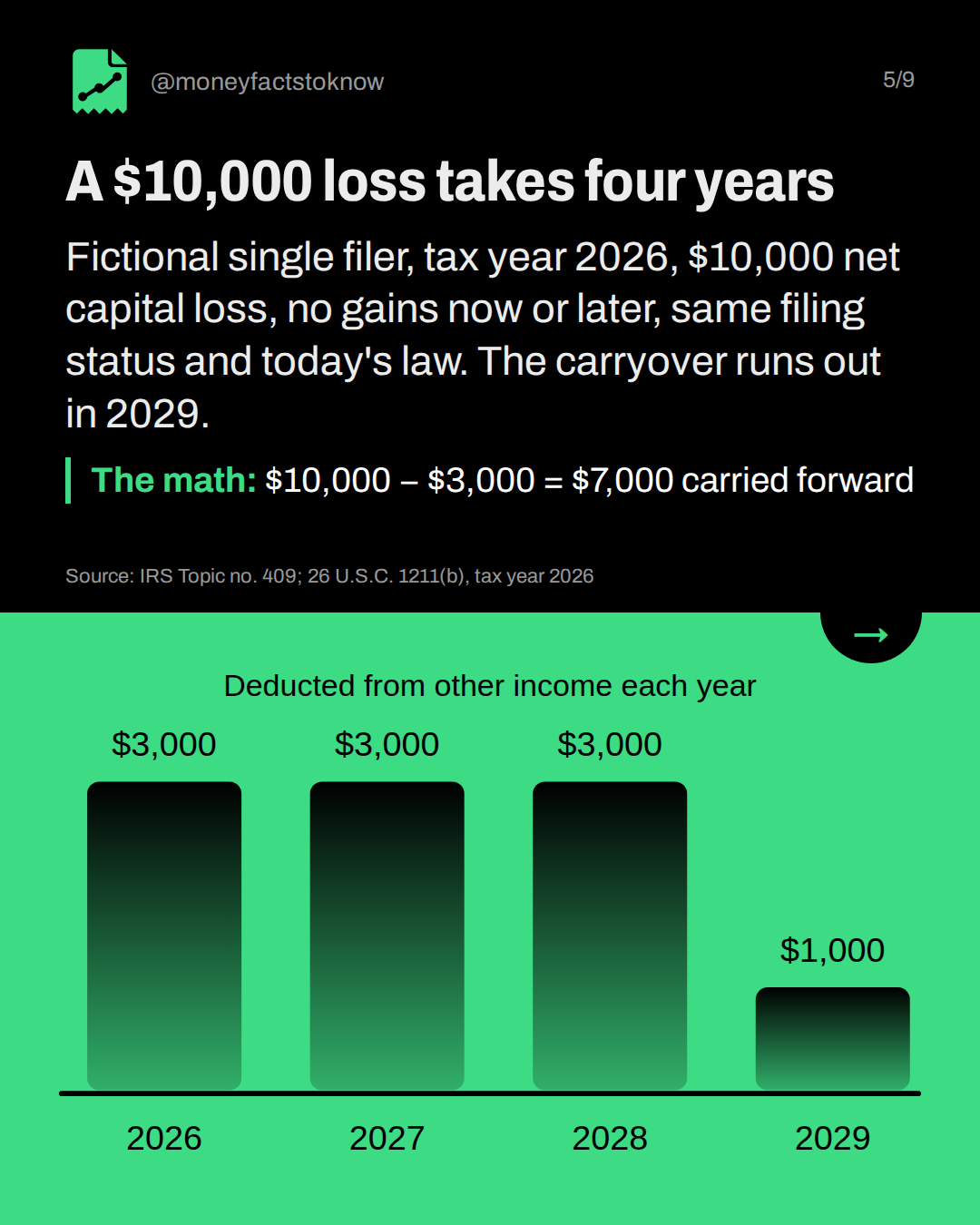
A $10,000 loss takes four years
Fictional single filer, tax year 2026, $10,000 net capital loss, no gains now or later, same filing status and today's law. The carryover runs out in 2029.
The math: $10,000 − $3,000 = $7,000 carried forward
Source: IRS Topic no. 409; 26 U.S.C. 1211(b), tax year 2026
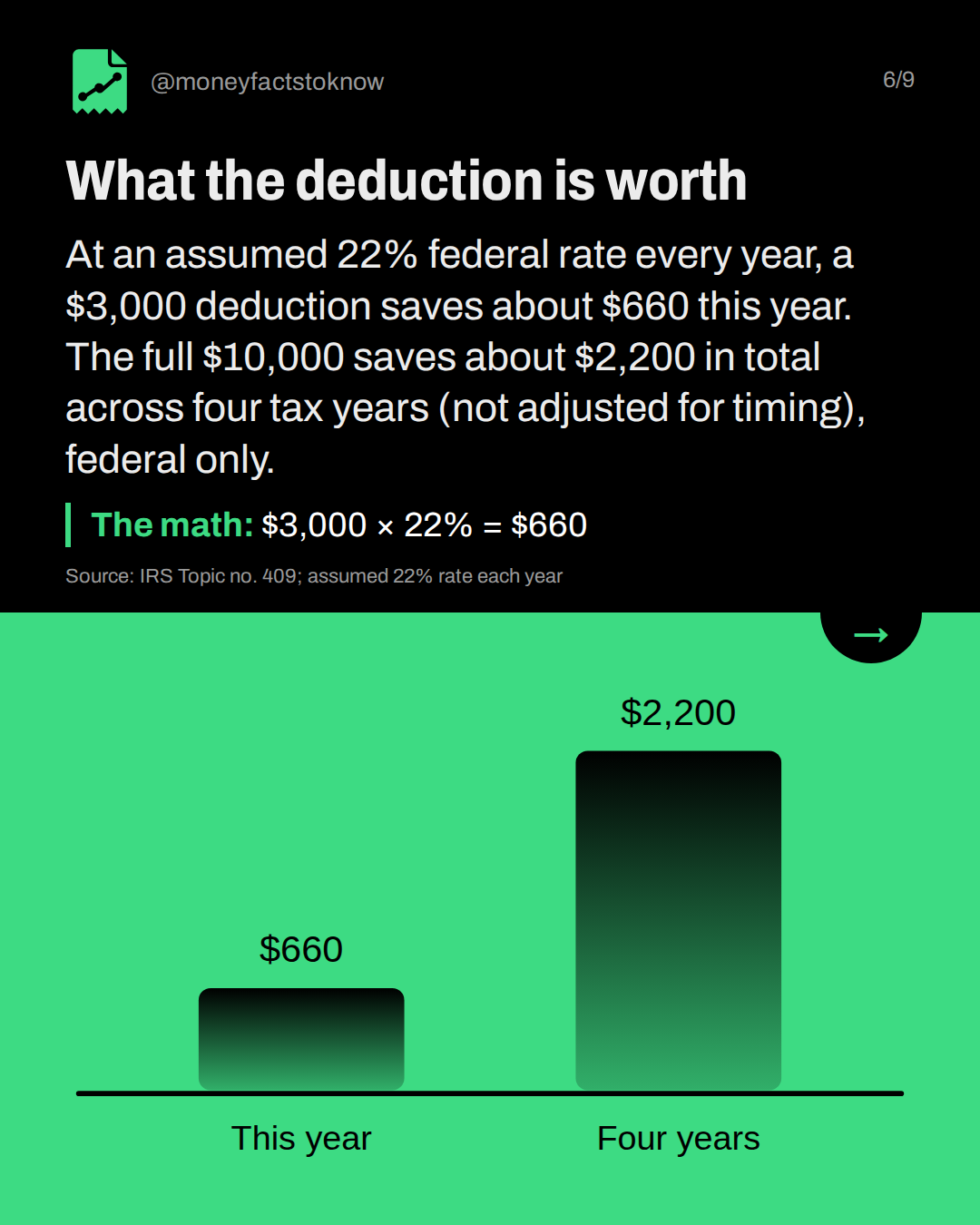
What the deduction is worth
At an assumed 22% federal rate every year, a $3,000 deduction saves about $660 this year. The full $10,000 saves about $2,200 in total across four tax years (not adjusted for timing), federal only.
The math: $3,000 × 22% = $660
Source: IRS Topic no. 409; assumed 22% rate each year
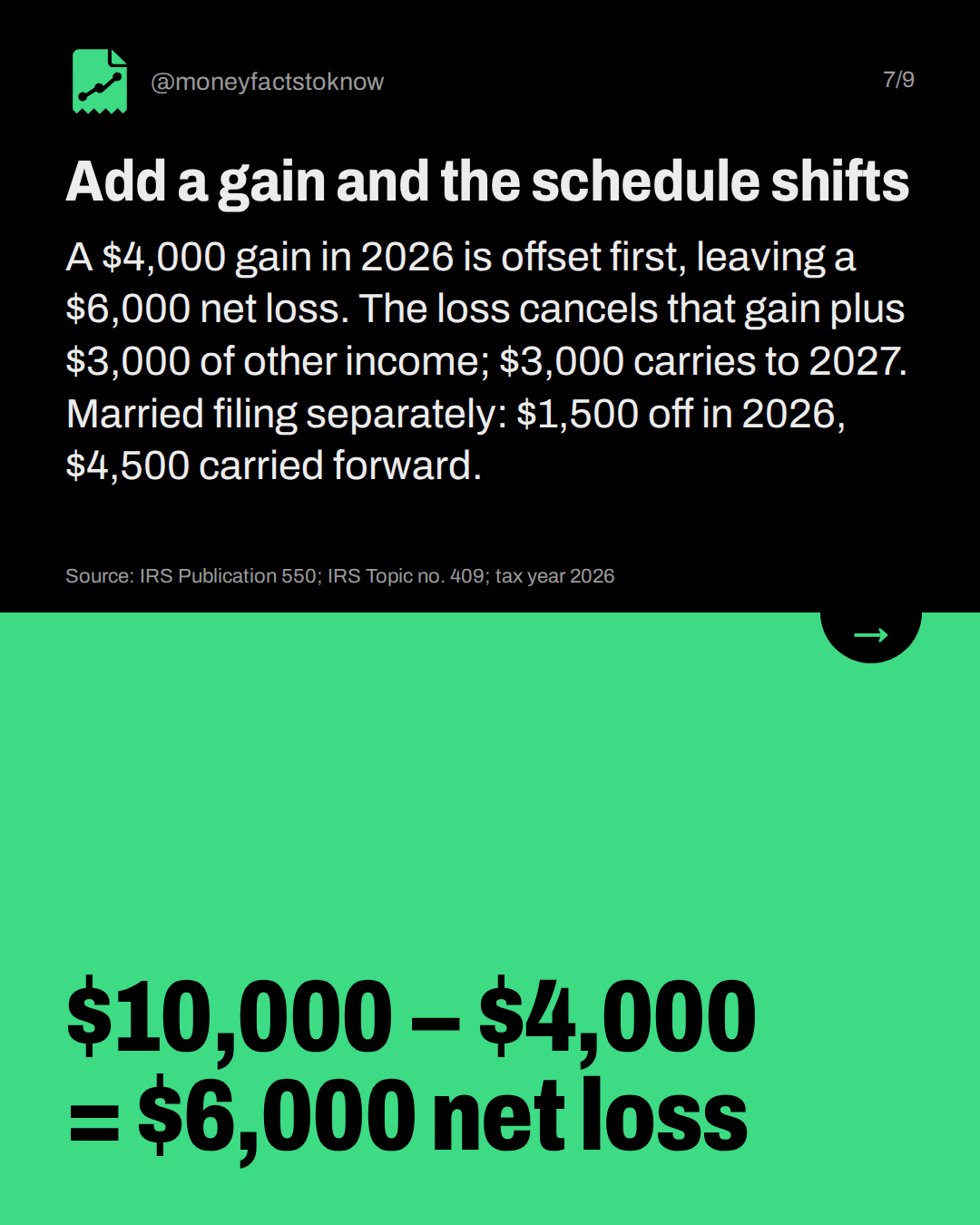
Add a gain and the schedule shifts
A $4,000 gain in 2026 is offset first, leaving a $6,000 net loss. The loss cancels that gain plus $3,000 of other income; $3,000 carries to 2027. Married filing separately: $1,500 off in 2026, $4,500 carried forward.
The math: $10,000 − $4,000 = $6,000 net loss
Source: IRS Publication 550; IRS Topic no. 409; tax year 2026
What to check on your return
Check your net capital loss after gains on Schedule D (the capital gains form in your return or tax software), the $3,000 or $1,500 line, and the carryover worksheet, so next year's return picks up the rest.
Source: IRS Publication 550; Schedule D (Form 1040) instructions, tax year 2026
Sources and assumptions
- IRS Topic no. 409, Capital gains and losses (last reviewed Sept 24, 2026): If capital losses exceed capital gains, the excess you can claim to lower income is the lesser of $3,000 ($1,500 if married filing separately) or your total net loss. A net capital loss above this limit can be carried forward to later years. Capital losses first reduce capital gains. (checked 2026-10-21)
- IRS Publication 550 (2025), Investment Income and Expenses: 'A net capital loss is limited to $3,000 per year ($1,500 if you are married filing separately).' 'You can carry over the excess to future years until the loss is completely used up.' Carryovers keep their long-term or short-term character. The netting order: short-term against short-term, long-term against long-term, then across. Worksheet 4-1 is the Capital Loss Carryover Worksheet. (checked 2026-10-21)
- 26 U.S.C. § 1211(b) (Cornell LII): Statutory text: losses are allowed to the extent of gains plus the lower of $3,000 ($1,500 for a married individual filing a separate return). The amount is a fixed dollar figure with no inflation-indexing provision. (checked 2026-10-21)
- IRS Publication 559, Survivors, Executors, and Administrators: A decedent's capital losses, including carryovers, can be deducted only on the decedent's final income tax return. Any unused capital loss can't be deducted on the estate's income tax return. (checked 2026-10-21)
Assumptions:
- Fictional single filer in tax year 2026 (federal only; state tax not included)
- The $10,000 is a net capital loss with no capital gains in 2026 or in later years for the main example
- Assumed 22% marginal federal income tax rate for the dollar savings, with the whole $3,000 deduction falling inside that bracket
- The loss is an allowed loss (not disallowed by the wash-sale rule) on investments held in a taxable account
- Gain-offset example: the same $10,000 loss plus a $4,000 capital gain in 2026
- Tax law as of October 2026. The $3,000 limit is statutory, so it would change only if Congress amends 26 U.S.C. 1211(b)
The short version
- Losses cancel gains first.
- Only $3,000 a year reaches other income.
- That's $1,500 if married filing separately.
- The rest carries forward until it's used up.


