 Money Facts To Know
Your rate is fixed. Why did the mortgage payment rise $100?
A fixed rate isn't a fixed payment
A fixed rate locks the principal and interest part of your payment. If your payment also includes escrow, that part follows your property tax and homeowners insurance bills.
Source: CFPB
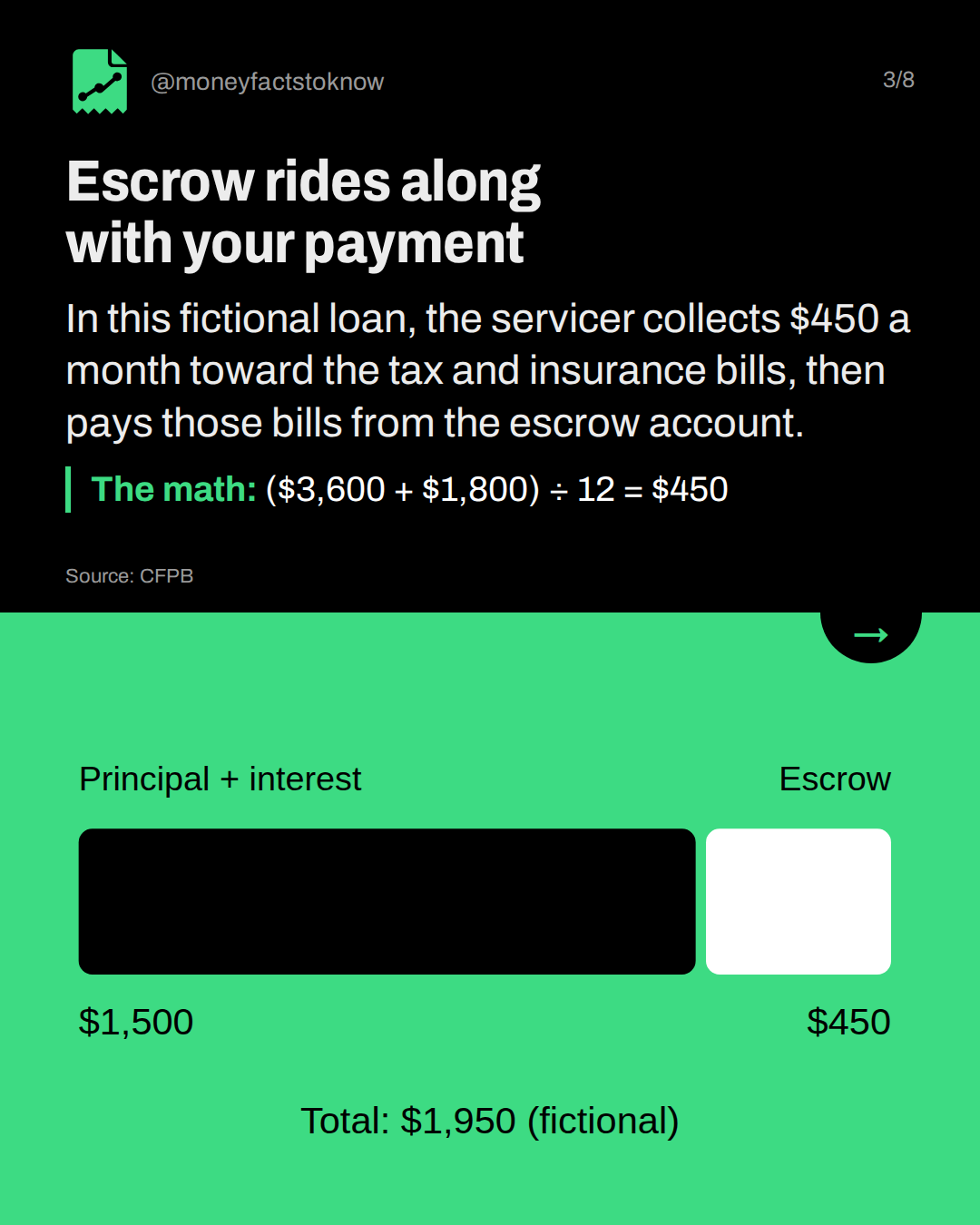
Escrow rides along with your payment
In this fictional loan, the servicer collects $450 a month toward the tax and insurance bills, then pays those bills from the escrow account.
The math: ($3,600 + $1,800) ÷ 12 = $450
Source: CFPB
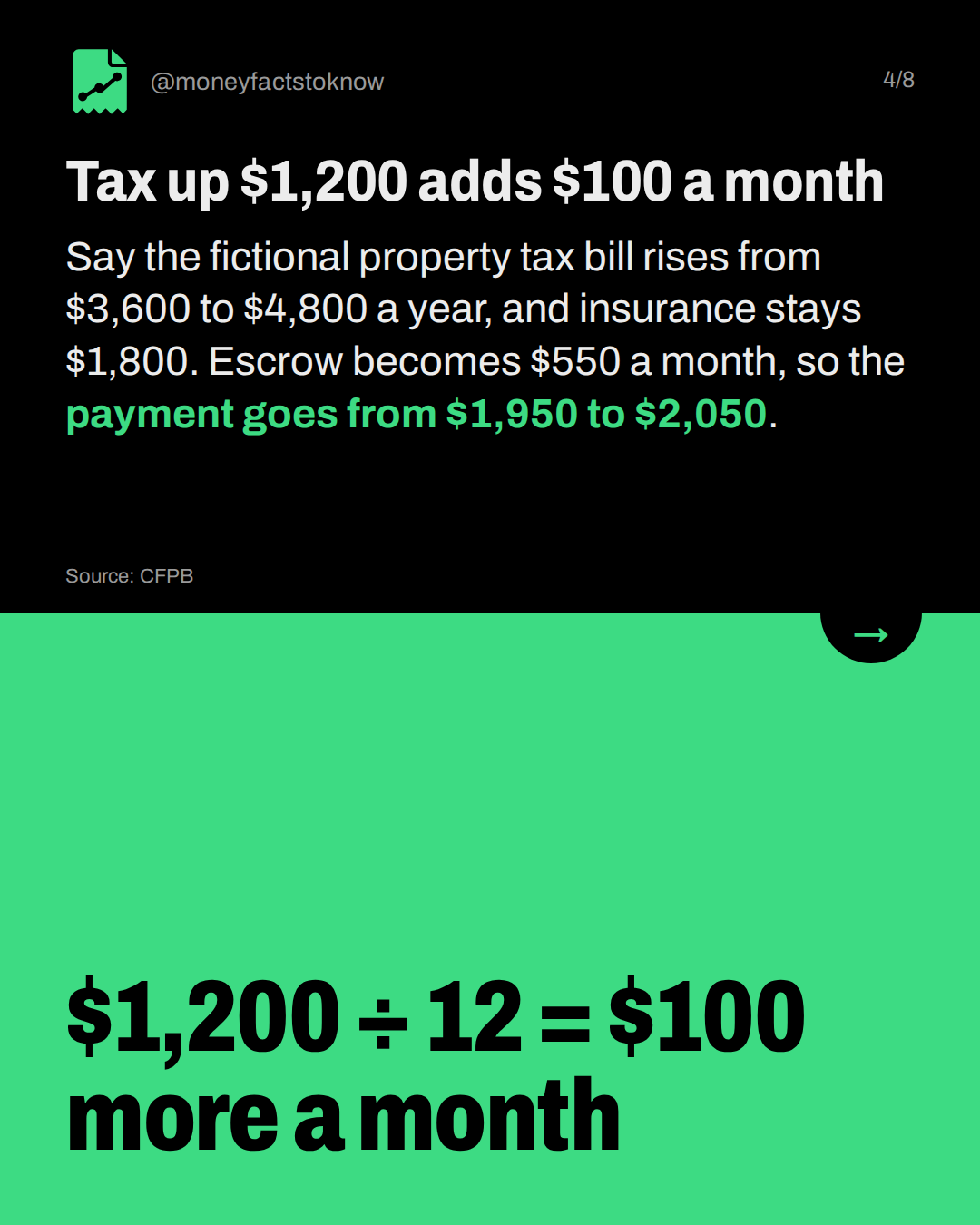
Tax up $1,200 adds $100 a month
Say the fictional property tax bill rises from $3,600 to $4,800 a year, and insurance stays $1,800. Escrow becomes $550 a month, so the payment goes from $1,950 to $2,050.
The math: $1,200 ÷ 12 = $100 more a month
Source: CFPB
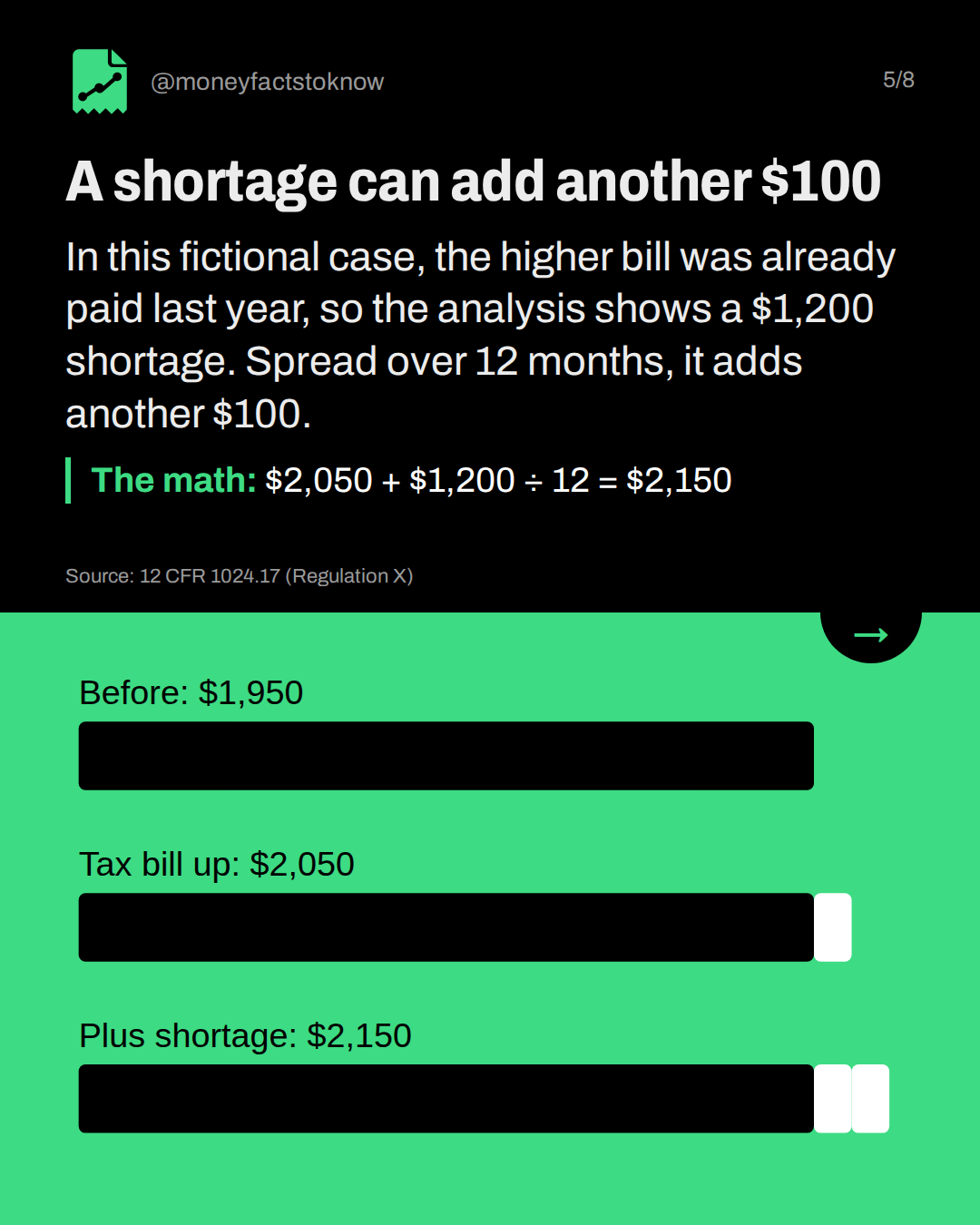
A shortage can add another $100
In this fictional case, the higher bill was already paid last year, so the analysis shows a $1,200 shortage. Spread over 12 months, it adds another $100.
The math: $2,050 + $1,200 ÷ 12 = $2,150
Source: 12 CFR 1024.17 (Regulation X)
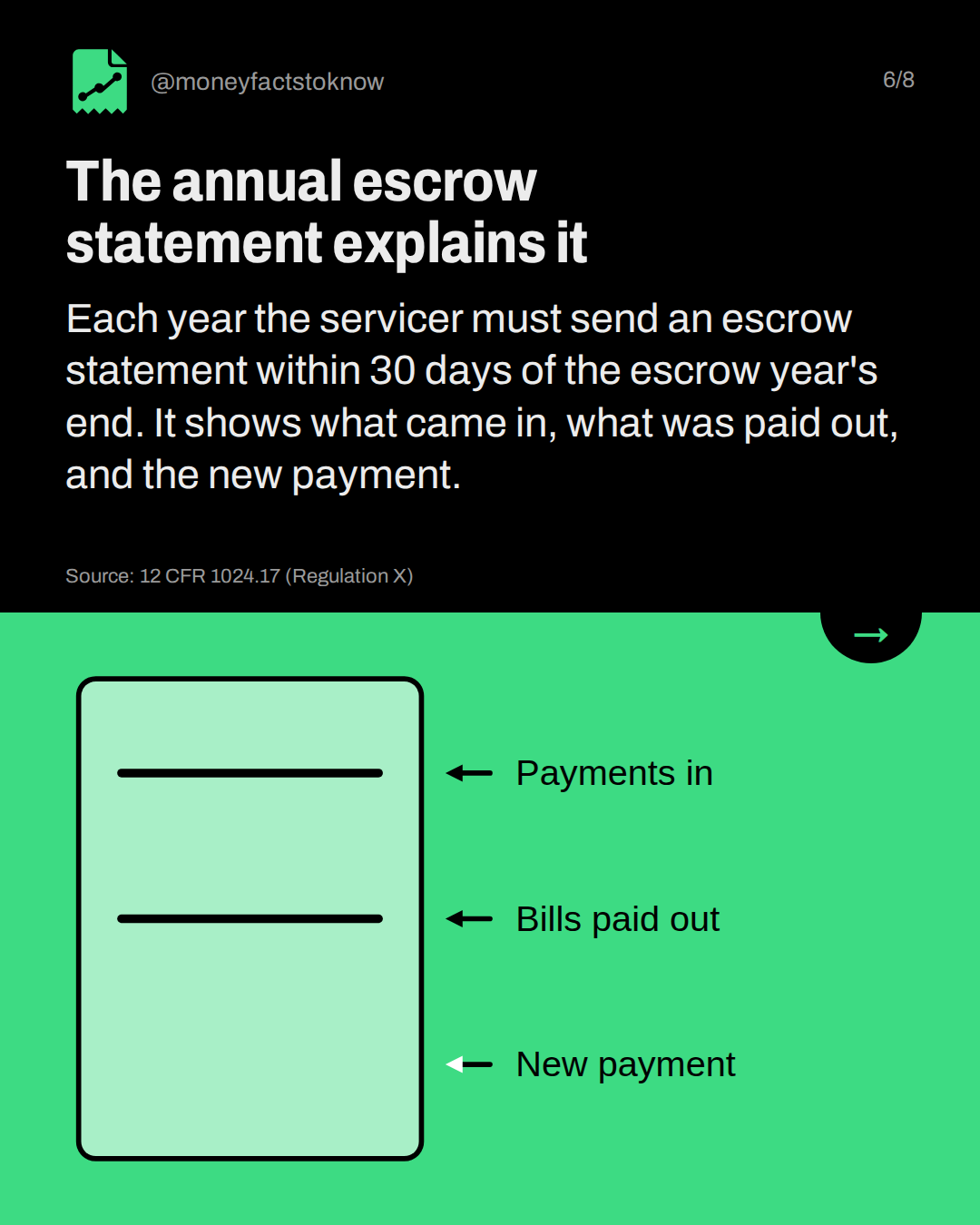
The annual escrow statement explains it
Each year the servicer must send an escrow statement within 30 days of the escrow year's end. It shows what came in, what was paid out, and the new payment.
Source: 12 CFR 1024.17 (Regulation X)
When this example stops applying
The numbers are fictional. A cushion of up to 1/6 of yearly bills ($1,100 here) can add more, and ARMs or buydowns change payments for other reasons.
Source: CFPB; 12 CFR 1024.17 (Regulation X)
Sources and assumptions
- CFPB: Why did my monthly mortgage payment go up or change?: If the monthly payment includes the escrow amount, the payment goes up or down when taxes or premiums go up or down. Other causes: ARMs, temporary buydowns, interest-only loans. Check the mortgage statement's itemized charges. (checked 2026-10-20)
- CFPB: What is an escrow or impound account?: An escrow account is set up by the lender to pay property taxes and homeowners insurance. Those bills can change each year, and the escrow payment and total monthly payment change with them. (checked 2026-10-20)
- CFPB: Regulation X, 12 CFR 1024.17 Escrow accounts: Cushion no greater than 1/6 of estimated annual disbursements ((c)(1)(i)). Escrow analysis required at the end of each computation year ((c)(3)). A shortage under one month's payment can be left in place, collected within 30 days, or spread over 12+ months ((f)(3)(i)). A shortage of one month's payment or more can be left in place or repaid in equal monthly payments over at least 12 months ((f)(3)(ii)). A surplus of $50 or more is refunded ((f)(2)(i)). The annual statement is due within 30 days of the end of the computation year and shows payments, disbursements, the ending balance, and how a surplus or shortage is handled ((i)). (checked 2026-10-20)
Assumptions:
- Fictional loan: fixed-rate mortgage with $1,500 a month of principal and interest
- Fictional escrow before: $3,600 a year property tax + $1,800 a year homeowners insurance = $5,400, or $450 a month
- Property tax rises $1,200 a year to $4,800; insurance unchanged
- Shortage example: the higher $1,200 bill was already paid from the account, leaving a $1,200 shortage at the annual analysis that the servicer spreads over 12 months (the minimum Reg X allows for a shortage of one month's payment or more)
- Ignores the cushion: the maximum cushion (1/6 of yearly bills) rises from $900 to $1,100, which can add to a real shortage
- Loan is a federally related mortgage covered by RESPA/Regulation X (most US residential mortgages)
- All numbers recomputed with python3 on 2026-10-20
Check these lines
- A fixed rate locks principal and interest
- Escrow follows your tax and insurance bills
- Fictional $1,200 more tax adds $100 a month
- A shortage can add more on top
- Compare old and new escrow, each bill, the shortage


