 Money Facts To Know
A lease money factor of 0.0025 is about 6%, not 0.25%
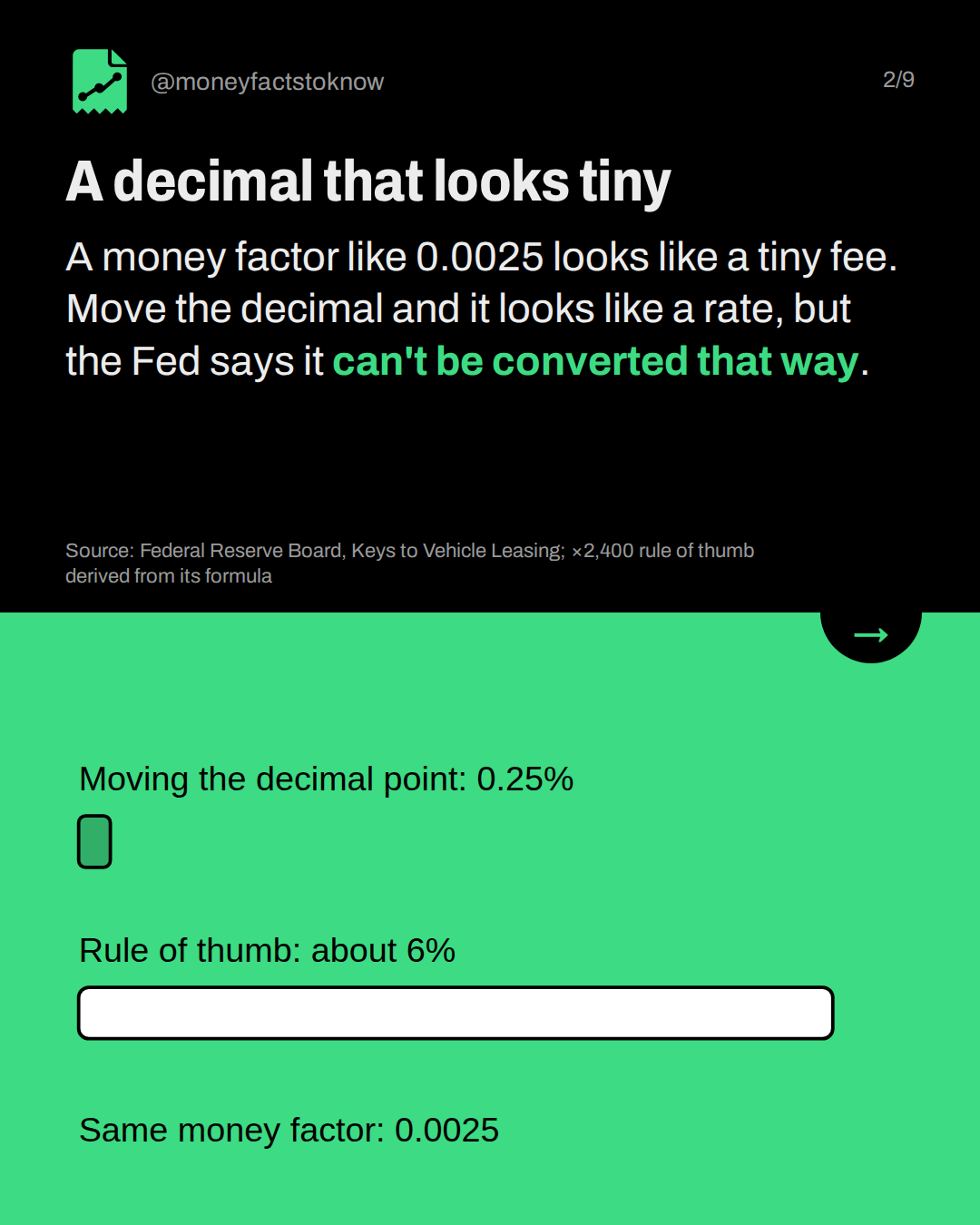
A decimal that looks tiny
A money factor like 0.0025 looks like a tiny fee. Move the decimal and it looks like a rate, but the Fed says it can't be converted that way.
Source: Federal Reserve Board, Keys to Vehicle Leasing; ×2,400 rule of thumb derived from its formula
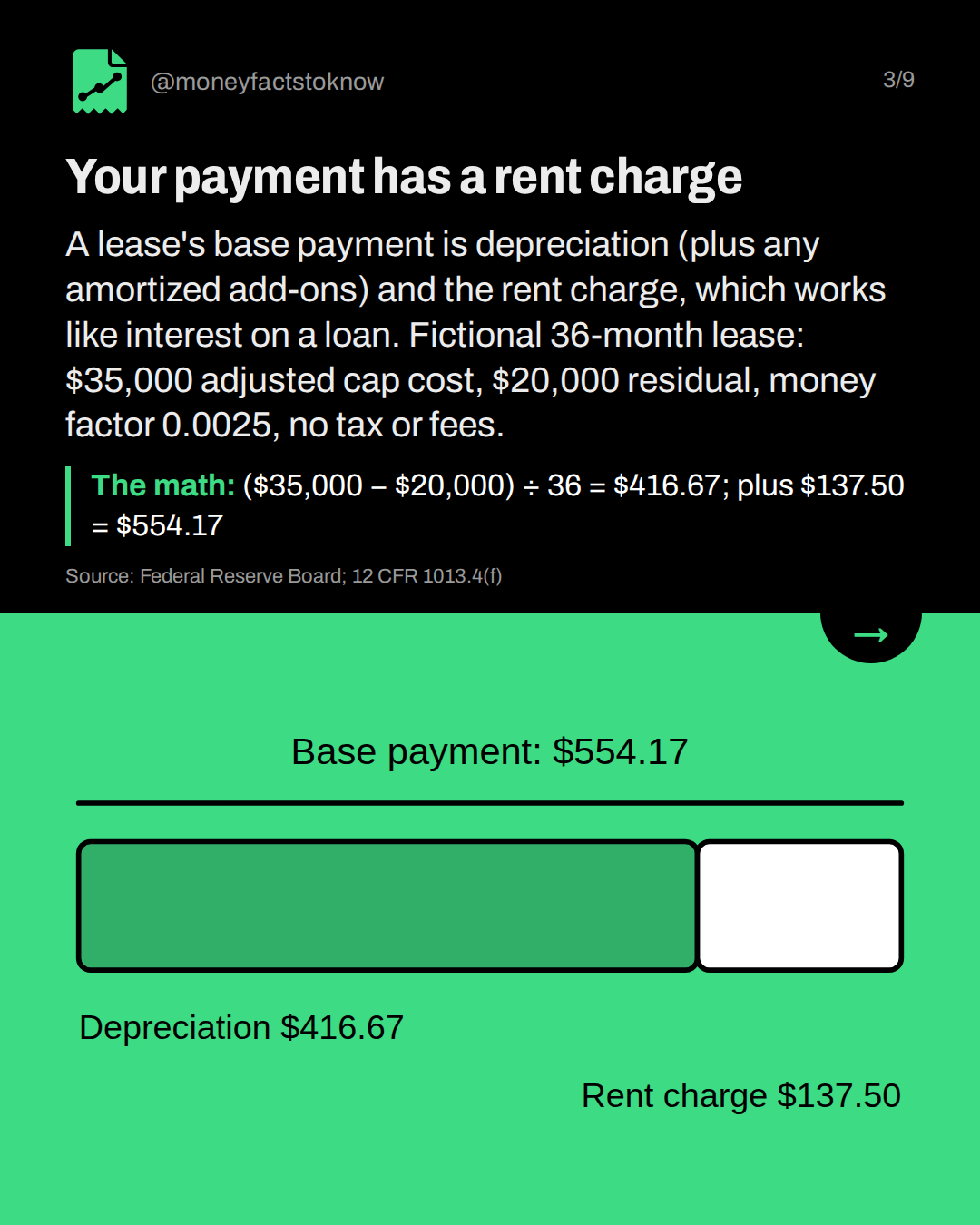
Your payment has a rent charge
A lease's base payment is depreciation (plus any amortized add-ons) and the rent charge, which works like interest on a loan. Fictional 36-month lease: $35,000 adjusted cap cost, $20,000 residual, money factor 0.0025, no tax or fees.
The math: ($35,000 − $20,000) ÷ 36 = $416.67; plus $137.50 = $554.17
Source: Federal Reserve Board; 12 CFR 1013.4(f)
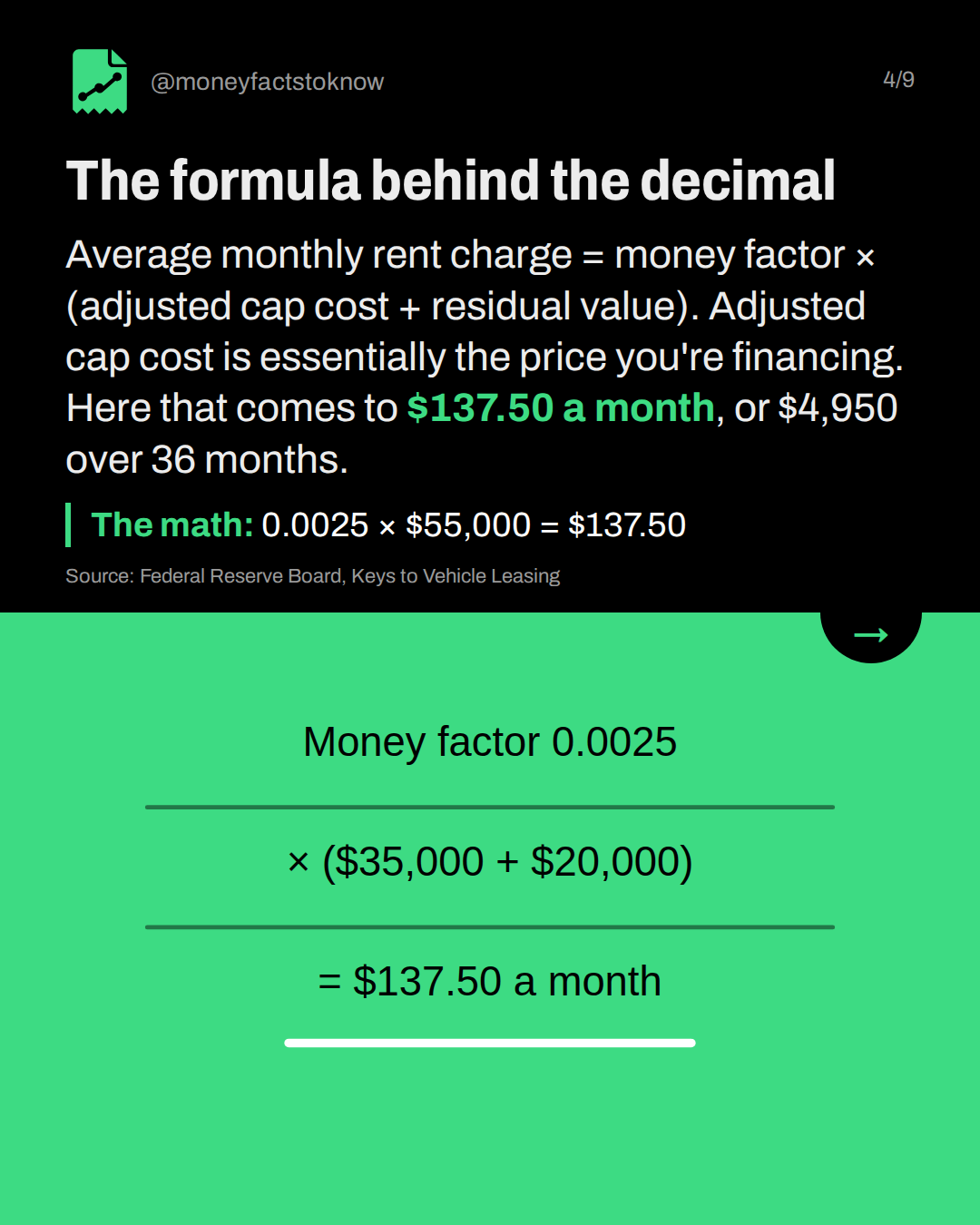
The formula behind the decimal
Average monthly rent charge = money factor × (adjusted cap cost + residual value). Adjusted cap cost is essentially the price you're financing. Here that comes to $137.50 a month, or $4,950 over 36 months.
The math: 0.0025 × $55,000 = $137.50
Source: Federal Reserve Board, Keys to Vehicle Leasing
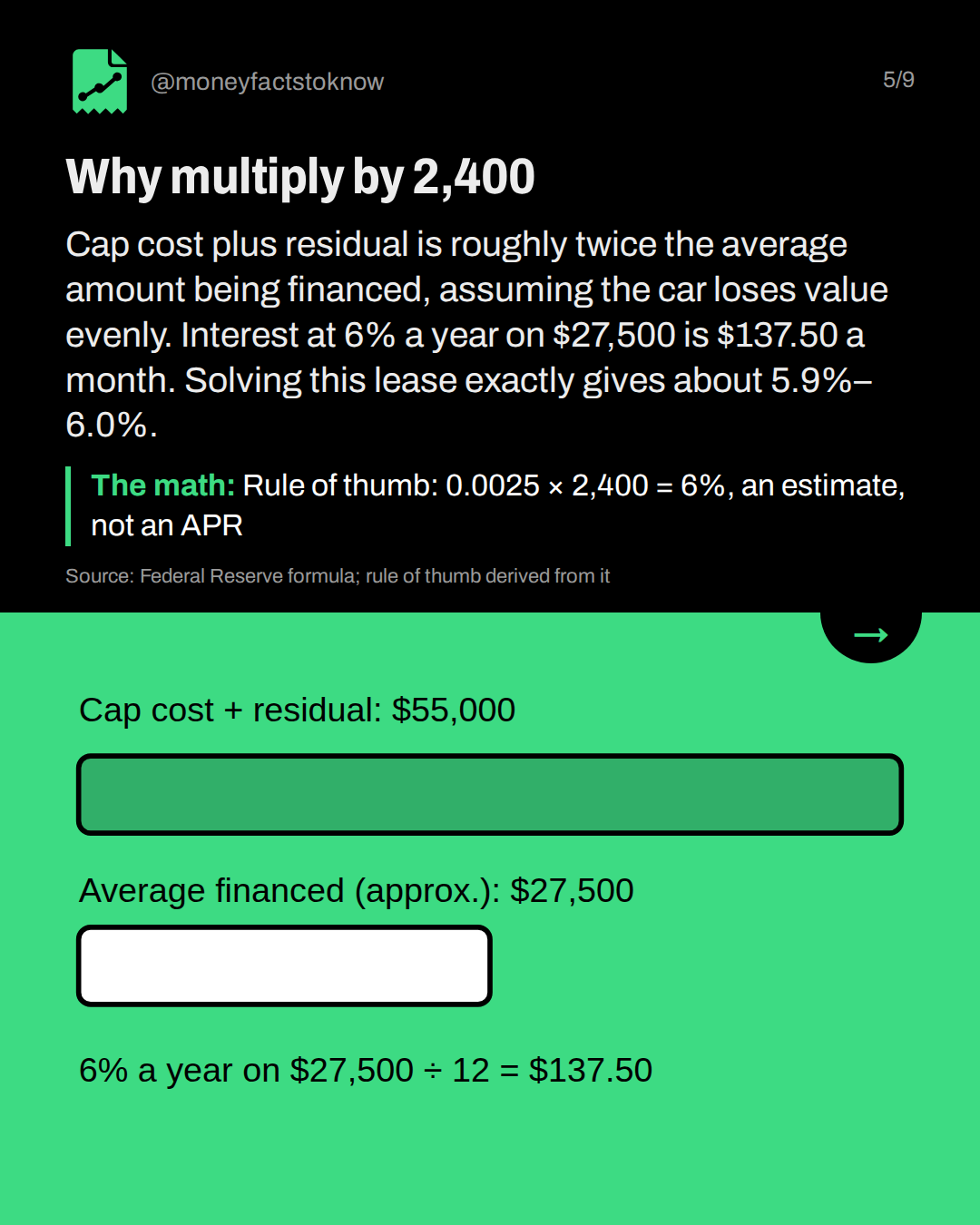
Why multiply by 2,400
Cap cost plus residual is roughly twice the average amount being financed, assuming the car loses value evenly. Interest at 6% a year on $27,500 is $137.50 a month. Solving this lease exactly gives about 5.9%–6.0%.
The math: Rule of thumb: 0.0025 × 2,400 = 6%, an estimate, not an APR
Source: Federal Reserve formula; rule of thumb derived from it
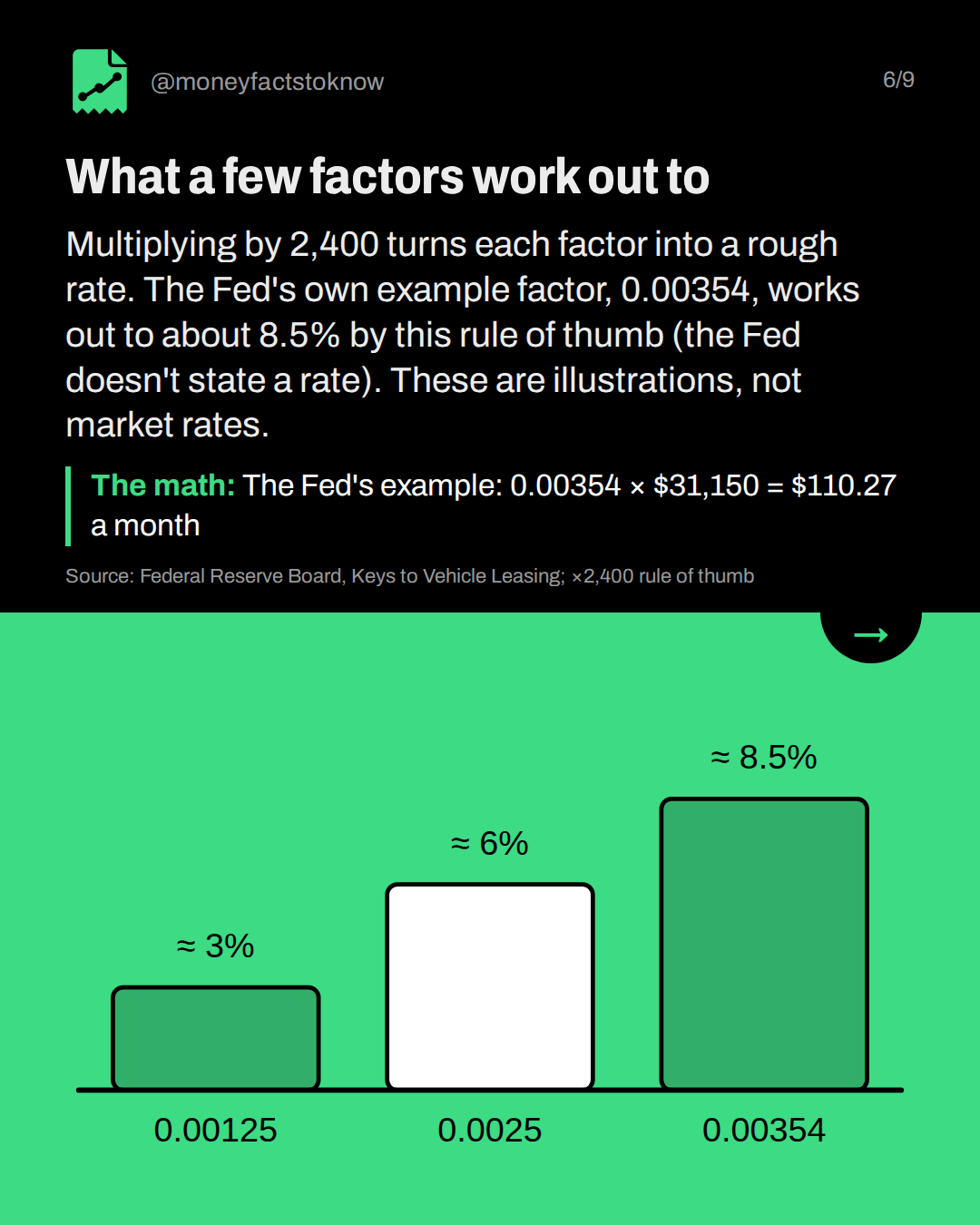
What a few factors work out to
Multiplying by 2,400 turns each factor into a rough rate. The Fed's own example factor, 0.00354, works out to about 8.5% by this rule of thumb (the Fed doesn't state a rate). These are illustrations, not market rates.
The math: The Fed's example: 0.00354 × $31,150 = $110.27 a month
Source: Federal Reserve Board, Keys to Vehicle Leasing; ×2,400 rule of thumb
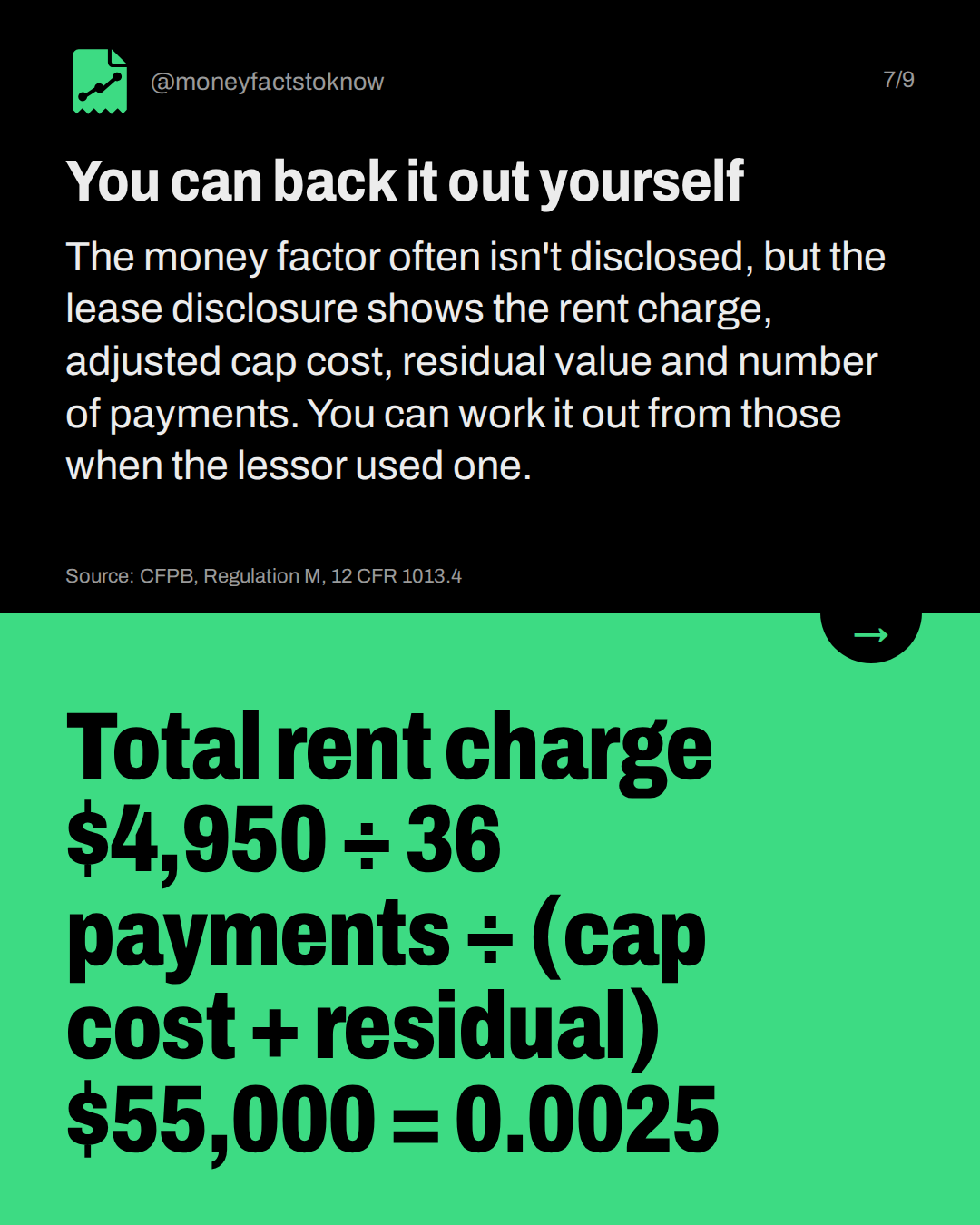
You can back it out yourself
The money factor often isn't disclosed, but the lease disclosure shows the rent charge, adjusted cap cost, residual value and number of payments. You can work it out from those when the lessor used one.
The math: Total rent charge $4,950 ÷ 36 payments ÷ (cap cost + residual) $55,000 = 0.0025
Source: CFPB, Regulation M, 12 CFR 1013.4
Where the estimate stops applying
Taxes, fees, add-ons and payment timing change the real cost, so ×2,400 is an estimate, not an APR. A lessor quoting a lease percentage must add: "this percentage may not measure the overall cost of financing this lease."
Source: CFPB, Regulation M, 12 CFR 1013.4(s)
Sources and assumptions
- Federal Reserve Board, Keys to Vehicle Leasing: More Information about the Rent Charge: The rent charge is the part of the base monthly payment that is not depreciation or amortized amounts and is similar to interest. It is usually set with a money factor, which is not a lease rate and can't be converted to one by moving the decimal point, and which typically isn't disclosed. Average monthly rent charge = money factor × (adjusted capitalized cost + residual value). Fed example: 0.00354 × ($18,800 + $12,350) = $110.27 (checked 2026-10-19)
- Federal Reserve Board, Keys to Vehicle Leasing: Lease payments: A monthly lease payment is made of depreciation, amortized amounts, the rent charge (similar to interest on a loan), sales/use tax and other fees (checked 2026-10-19)
- CFPB, Regulation M, 12 CFR 1013.4 Content of disclosures: A motor vehicle lease disclosure must show gross capitalized cost, capitalized cost reduction, adjusted capitalized cost, residual value, depreciation and amortized amounts, rent charge, total of base periodic payments, number of payments and base periodic payment (§1013.4(f)). A lessor that quotes a percentage rate must add 'this percentage may not measure the overall cost of financing this lease' and may not call it an 'annual percentage rate' (§1013.4(s)) (checked 2026-10-19)
Assumptions:
- Fictional lease: adjusted capitalized cost $35,000, residual value $20,000, 36 monthly payments, money factor 0.0025
- No sales tax, fees or amortized add-ons are included in the payment shown
- The ×2,400 conversion is a rule-of-thumb approximation derived here from the Fed's formula (cap cost + residual = 2 × average balance). It is not a Federal Reserve method and not an APR
- The exact implied rate comes from a script that solves the rate at which the payments plus the residual are worth $35,000 with monthly compounding: about 6.03% with payments at the start of each month and 5.91% at the end
- The 3% and 8.5% scale points are arithmetic illustrations, not market rates
The short version
- Rent charge = factor × (cap cost + residual)
- Money factor × 2,400 ≈ rate (estimate, not APR)
- 0.0025 is about 6%, not 0.25%
- Check the rent charge line on the disclosure


