 Money Facts To Know
The 2026 $24,500 401(k) limit doesn't count your employer's match
What many people assume
Many people read $24,500 as the most that can go into a 401(k) in 2026. They worry that maxing out their own contributions would leave no room for the match.
Source: IRS, tax year 2026
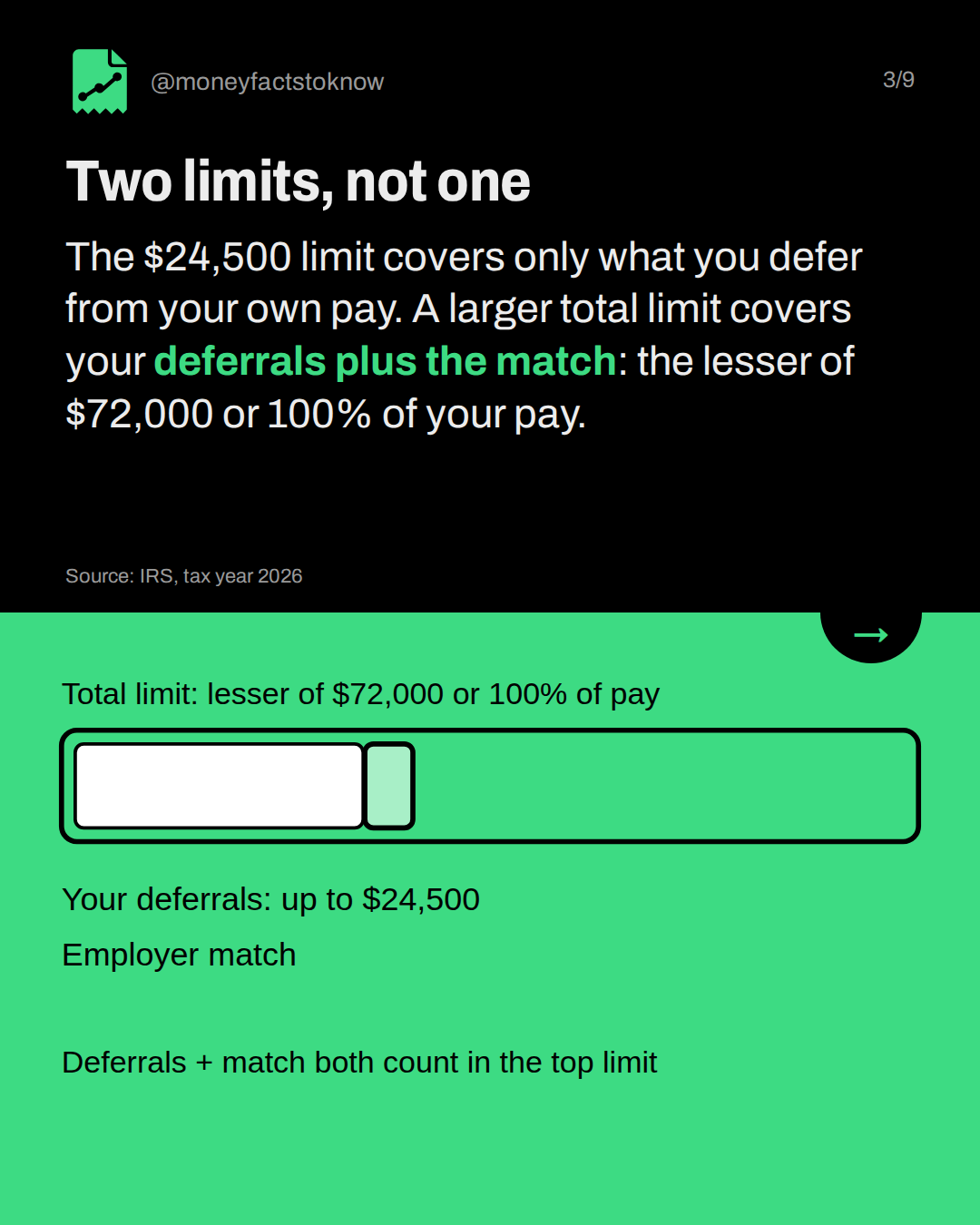
Two limits, not one
The $24,500 limit covers only what you defer from your own pay. A larger total limit covers your deferrals plus the match: the lesser of $72,000 or 100% of your pay.
Source: IRS, tax year 2026
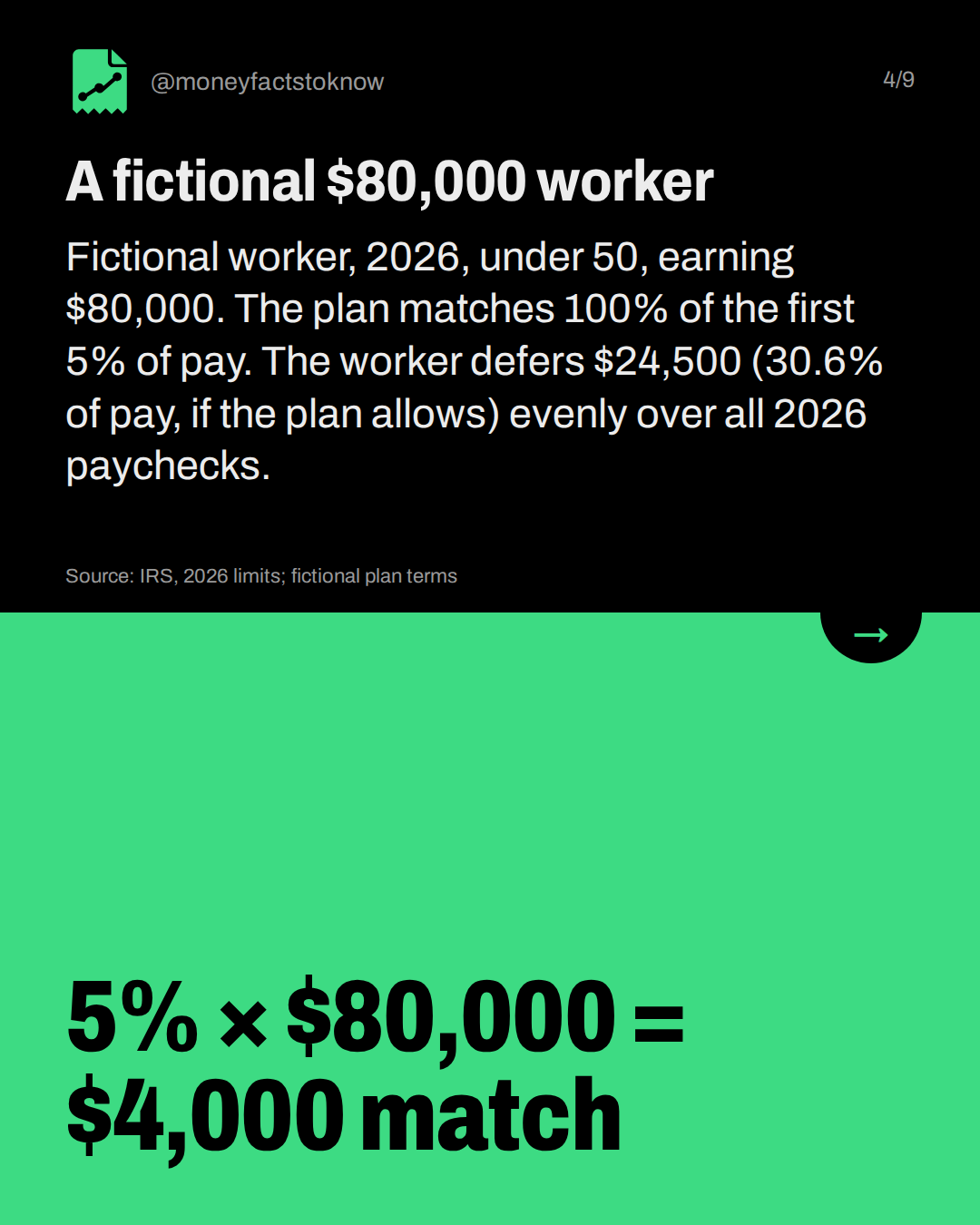
A fictional $80,000 worker
Fictional worker, 2026, under 50, earning $80,000. The plan matches 100% of the first 5% of pay. The worker defers $24,500 (30.6% of pay, if the plan allows) evenly over all 2026 paychecks.
The math: 5% × $80,000 = $4,000 match
Source: IRS, 2026 limits; fictional plan terms
The sum leaves plenty of room
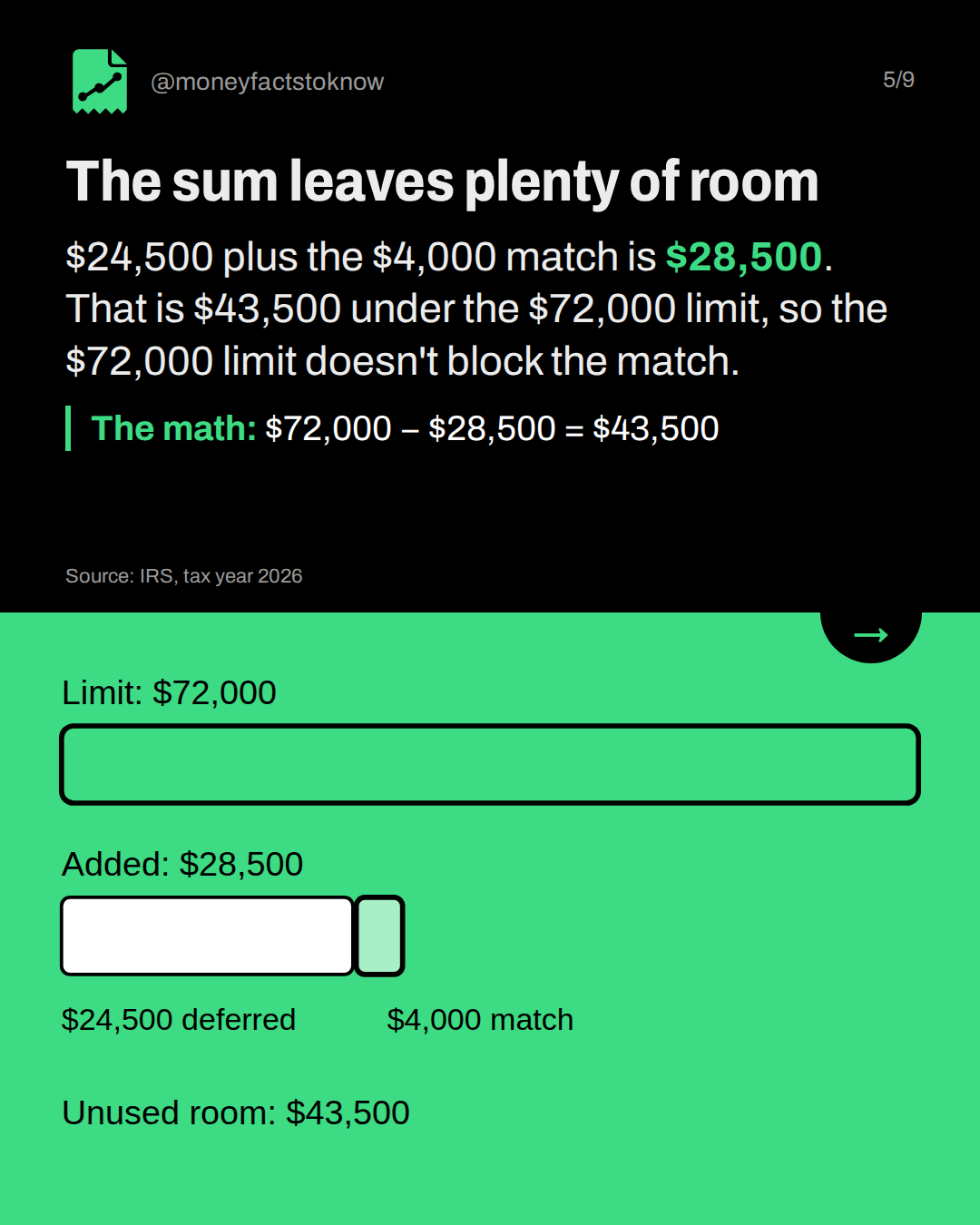
$24,500 plus the $4,000 match is $28,500. That is $43,500 under the $72,000 limit, so the $72,000 limit doesn't block the match.
The math: $72,000 − $28,500 = $43,500
Source: IRS, tax year 2026
When the total limit is lower
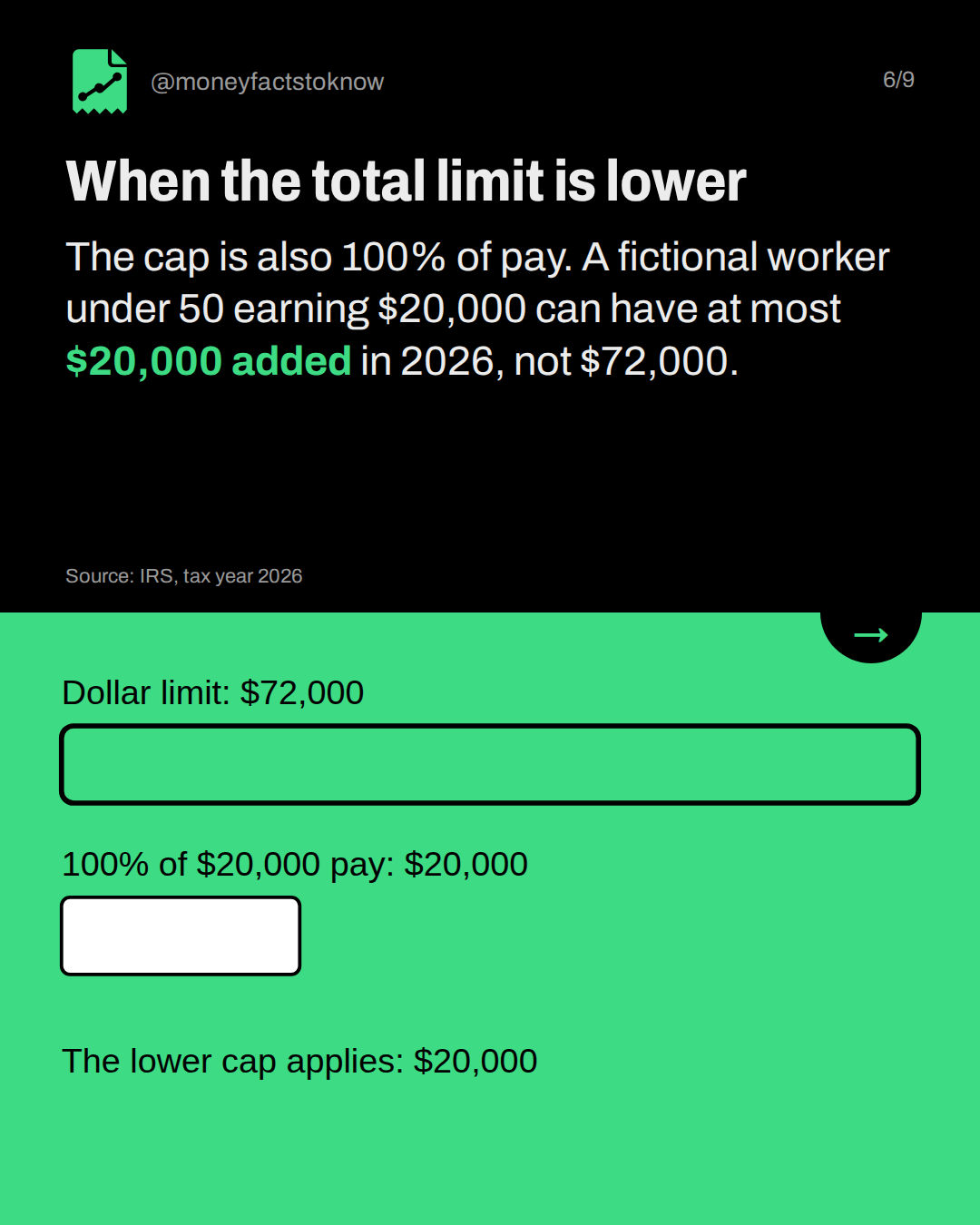
The cap is also 100% of pay. A fictional worker under 50 earning $20,000 can have at most $20,000 added in 2026, not $72,000.
Source: IRS, tax year 2026
Catch-ups sit on top
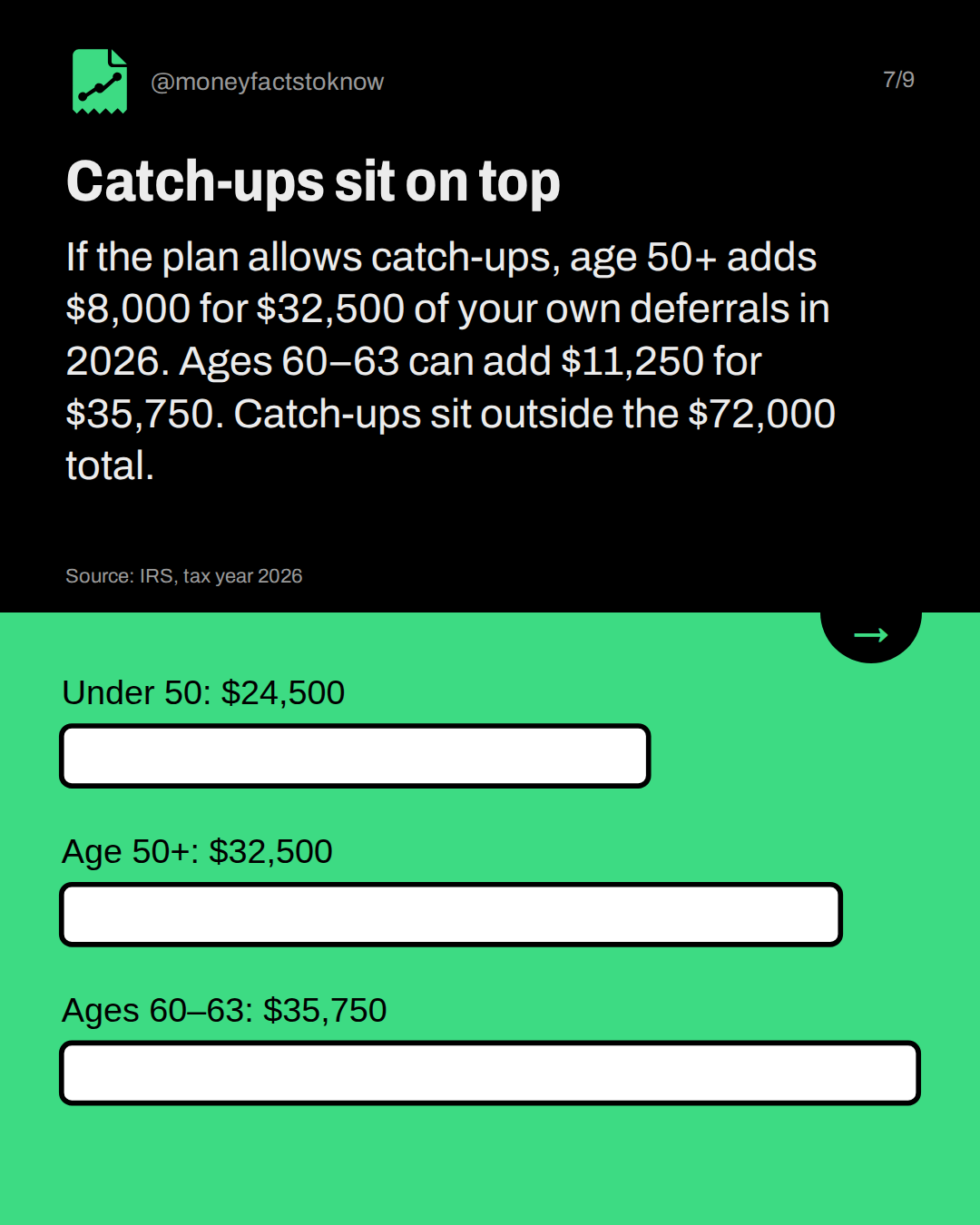
If the plan allows catch-ups, age 50+ adds $8,000 for $32,500 of your own deferrals in 2026. Ages 60–63 can add $11,250 for $35,750. Catch-ups sit outside the $72,000 total.
Source: IRS, tax year 2026
What to check on your plan site
Check deferrals against $24,500 (per person; add every employer's plan if you changed jobs), employer contributions listed separately, and whether the plan has a year-end true-up. Without one, reaching it early can stop a per-paycheck match.
Source: IRS, tax year 2026; IRS Retirement topics – 401(k) contribution limits
Sources and assumptions
- IRS newsroom IR-2025-111: 401(k) limit increases to $24,500 for 2026, IRA limit increases to $7,500 (Nov 13, 2025; Notice 2025-67): 2026 elective deferral limit $24,500; age 50+ catch-up $8,000 (total $32,500); ages 60-63 higher catch-up $11,250; figures come from Notice 2025-67 (checked 2026-10-19)
- IRS: Retirement topics - 401(k) and profit-sharing plan contribution limits: Annual additions (elective deferrals, employer matching, nonelective contributions, forfeitures) limited to the lesser of 100% of compensation or $72,000 in 2026 ($83,250 with ages 60-63 catch-ups); employer contributions don't count toward the $24,500 elective deferral limit; catch-up contributions are excluded from annual additions (checked 2026-10-19)
- IRS: 401(k) plan fix-it guide - Employer matching contributions weren't made to all appropriate employees: The plan document decides how often the match is figured: "If the plan document states the match is a percentage of the deferrals made on a yearly basis and you make matches on a weekly basis, you may have a mistake." The guide also says that when matches are figured each payroll period, "at the end of the year, the sum of these amounts may not comply with the terms of the plan." (checked 2026-10-19)
Assumptions:
- Tax year 2026 IRS limits
- Fictional worker: $80,000 salary, under age 50, one employer, one 401(k) plan
- Fictional plan match: 100% of the first 5% of pay. The worker's deferrals are spread evenly over all 2026 paychecks, so every paycheck gets the full match ($4,000 for the year). If deferrals reach $24,500 early in the year and the plan matches per paycheck with no year-end true-up, the match can stop for the rest of the year
- Deferring $24,500 is 30.6% of $80,000 pay; assumes the plan allows that deferral percentage
- No after-tax contributions, nonelective employer contributions or forfeitures in the example
- Part-time example: fictional $20,000 compensation for the year
The short version
- $24,500 (2026) covers only your own deferrals
- Match counts toward the $72,000 2026 total
- The total is capped at 100% of pay
- Catch-ups sit outside the total limit


