 Money Facts To Know
Fictional $300,000 of shares, sold: inherited, $0 gain. Gifted, $250,000 gain


It feels like the same shares
Whether shares are given now or left in a will, it seems like the tax when they're sold should be the same. The rules treat the two differently.

Your gain starts with your basis
A taxable gain is the sale price minus your basis. Basis is generally what was paid for the asset, and how you receive it can change it.
Source: IRS Topic No. 703
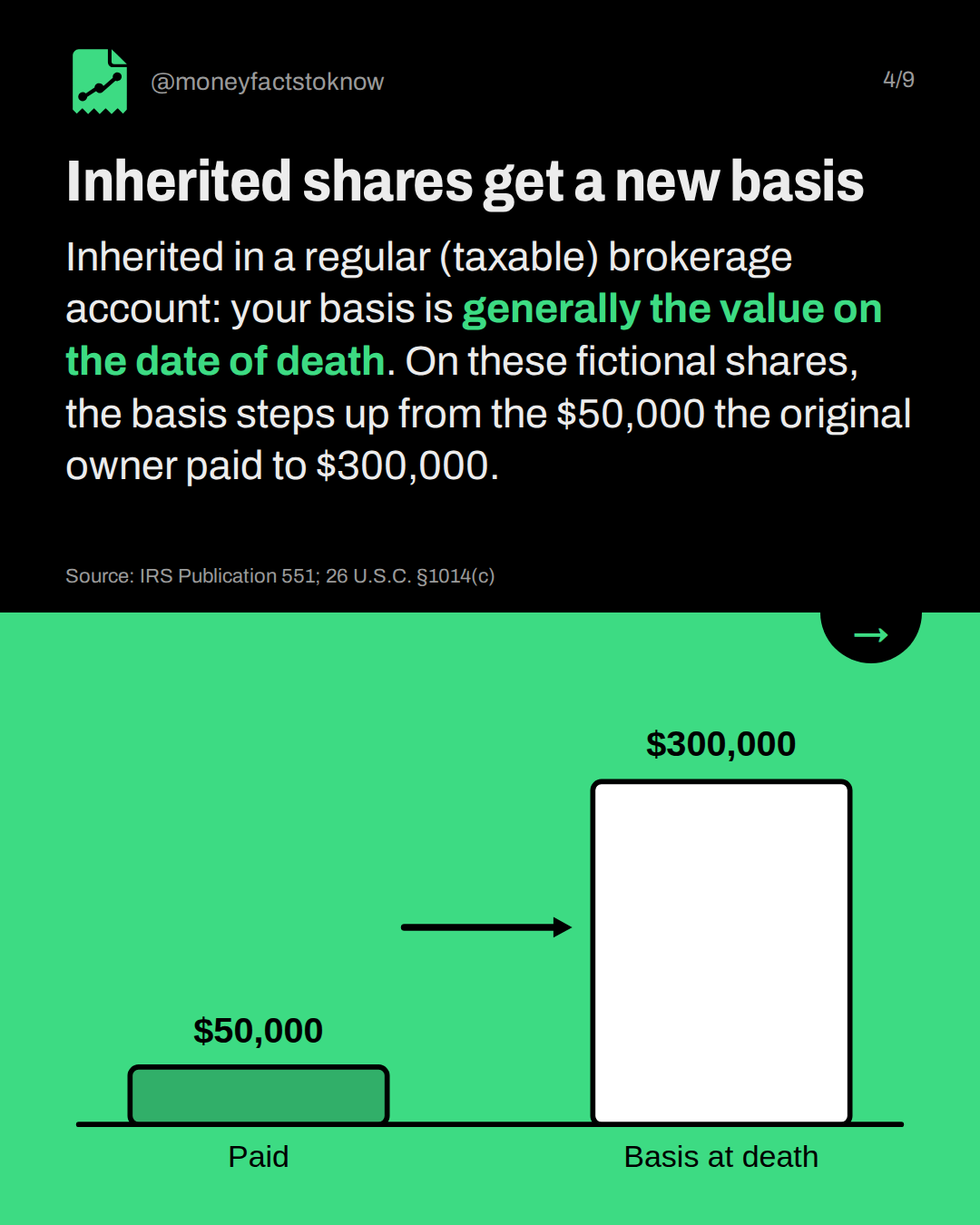
Inherited shares get a new basis
Inherited in a regular (taxable) brokerage account: your basis is generally the value on the date of death. On these fictional shares, the basis steps up from the $50,000 the original owner paid to $300,000.
Source: IRS Publication 551; 26 U.S.C. §1014(c)
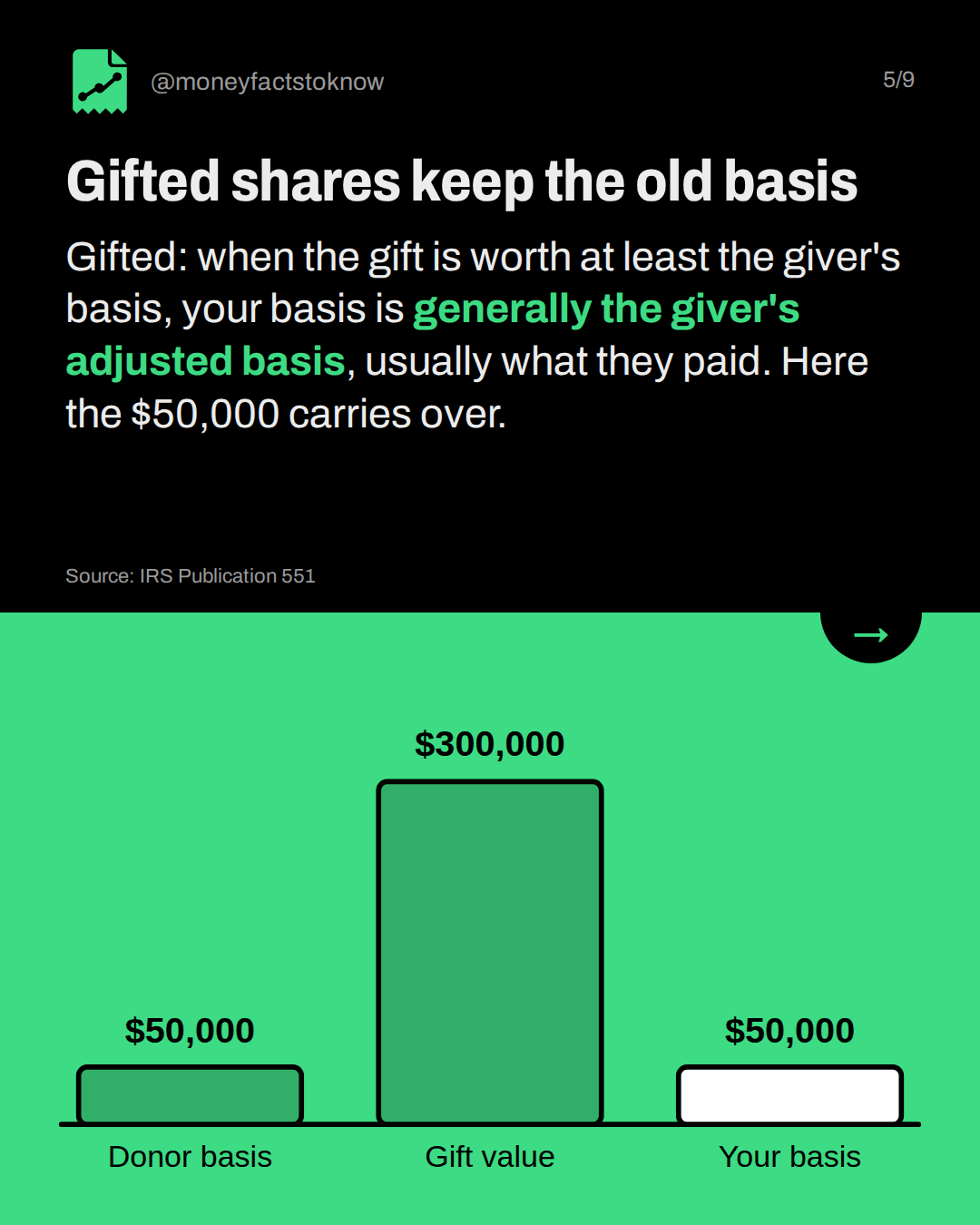
Gifted shares keep the old basis
Gifted: when the gift is worth at least the giver's basis, your basis is generally the giver's adjusted basis, usually what they paid. Here the $50,000 carries over.
Source: IRS Publication 551
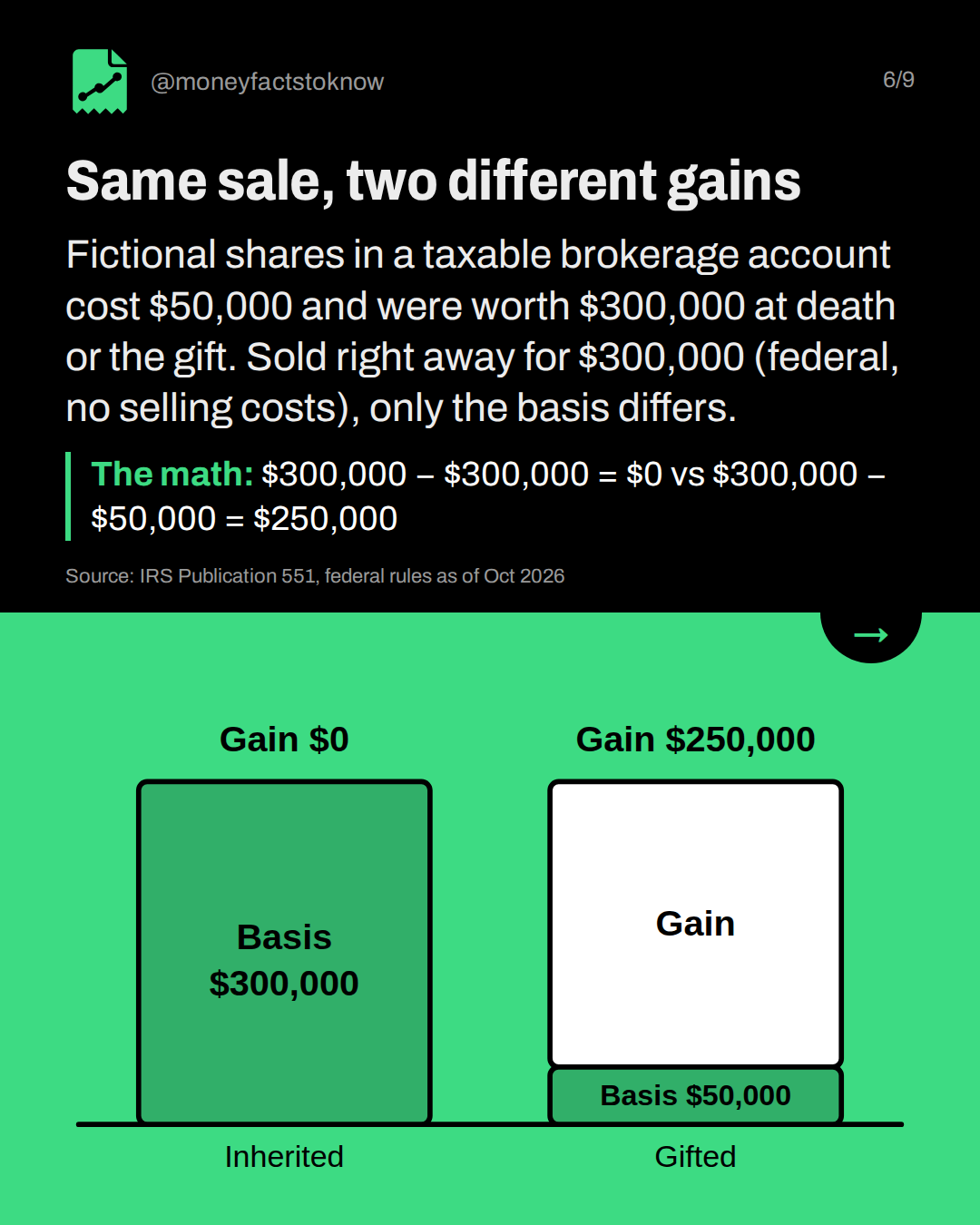
Same sale, two different gains
Fictional shares in a taxable brokerage account cost $50,000 and were worth $300,000 at death or the gift. Sold right away for $300,000 (federal, no selling costs), only the basis differs.
The math: $300,000 − $300,000 = $0 vs $300,000 − $50,000 = $250,000
Source: IRS Publication 551, federal rules as of Oct 2026
When the example stops applying
Inherited shares inside a traditional IRA or 401(k) get no step-up; withdrawals are generally taxed as income. Gift tax actually paid can raise a gift's basis. Other cases: alternate valuation date, community property, Form 8971.
Source: IRS Publication 551; 26 U.S.C. §1014(c); IRS Publication 559

What to check before shares move
Before shares change hands, look up the giver's adjusted cost basis and the value on the transfer date, and keep records of both. This post shows the gain, not the tax owed.
Sources and assumptions
- IRS Publication 551, Basis of Assets — Inherited Property: Basis of inherited property is generally the FMV at the date of death, or the FMV on the alternate valuation date if the personal representative elects it; community-property rule; beneficiaries who receive Schedule A (Form 8971) use that value (checked 2026-10-18)
- IRS Publication 551, Basis of Assets — Property Received as a Gift: If FMV at the gift ≥ the donor's adjusted basis, your basis is the donor's adjusted basis; if FMV < donor's basis, basis for gain = donor's basis and basis for loss = FMV at the gift; for gifts after 1976, gift tax paid on the net increase in value adds to basis (checked 2026-10-18)
- IRS Topic No. 703, Basis of Assets: Basis is generally the amount you paid for the asset and is used to figure gain or loss on a sale; gifts and inheritances are covered in Pub 551 (checked 2026-10-18)
- IRS FAQ: Gifts & Inheritances: Inherited property basis is generally FMV on the date of death, or alternate valuation only if the executor files Form 706 and elects it (checked 2026-10-18)
- 26 U.S.C. §1014(c) (Cornell LII): "This section shall not apply to property which constitutes a right to receive an item of income in respect of a decedent under section 691." (checked 2026-10-18)
- IRS Publication 559 (2025), Survivors, Executors, and Administrators — Income in Respect of a Decedent: Lists "Inherited individual retirement arrangements (IRAs)" and Roth IRAs under Specific Types of Income in Respect of a Decedent (checked 2026-10-18)
- IRS Publication 590-B (2025), Distributions from IRAs: "Beneficiaries of a traditional IRA must include in their gross income any taxable distributions they receive." "If you inherit a traditional IRA from a person who had basis in the IRA because of nondeductible contributions, that basis remains with the IRA." (checked 2026-10-18)
Assumptions:
- Fictional example: shares originally bought for $50,000 (the donor's adjusted basis, no other adjustments)
- Fair market value is $300,000 both on the date of death and on the date of the gift
- The recipient sells right away for exactly $300,000
- No alternate valuation election, no community-property rule, no Form 8971 value that differs
- No gift tax was paid on the gift (so no basis increase)
- Federal rules only; shares held in a regular taxable brokerage account, not an IRA or 401(k) (inherited retirement-account balances get no step-up under IRC §1014(c)); state tax not covered
- The post shows the taxable gain, not the tax owed, which depends on the holding period, rates and income
The short version
- A gain is the sale price minus basis
- Inherited basis is generally the value at death
- Gifted basis is generally the giver's basis
- Fictional example: $0 gain vs $250,000 gain


