 Money Facts To Know
A $15 fee on a two-week $100 loan is a 391% APR
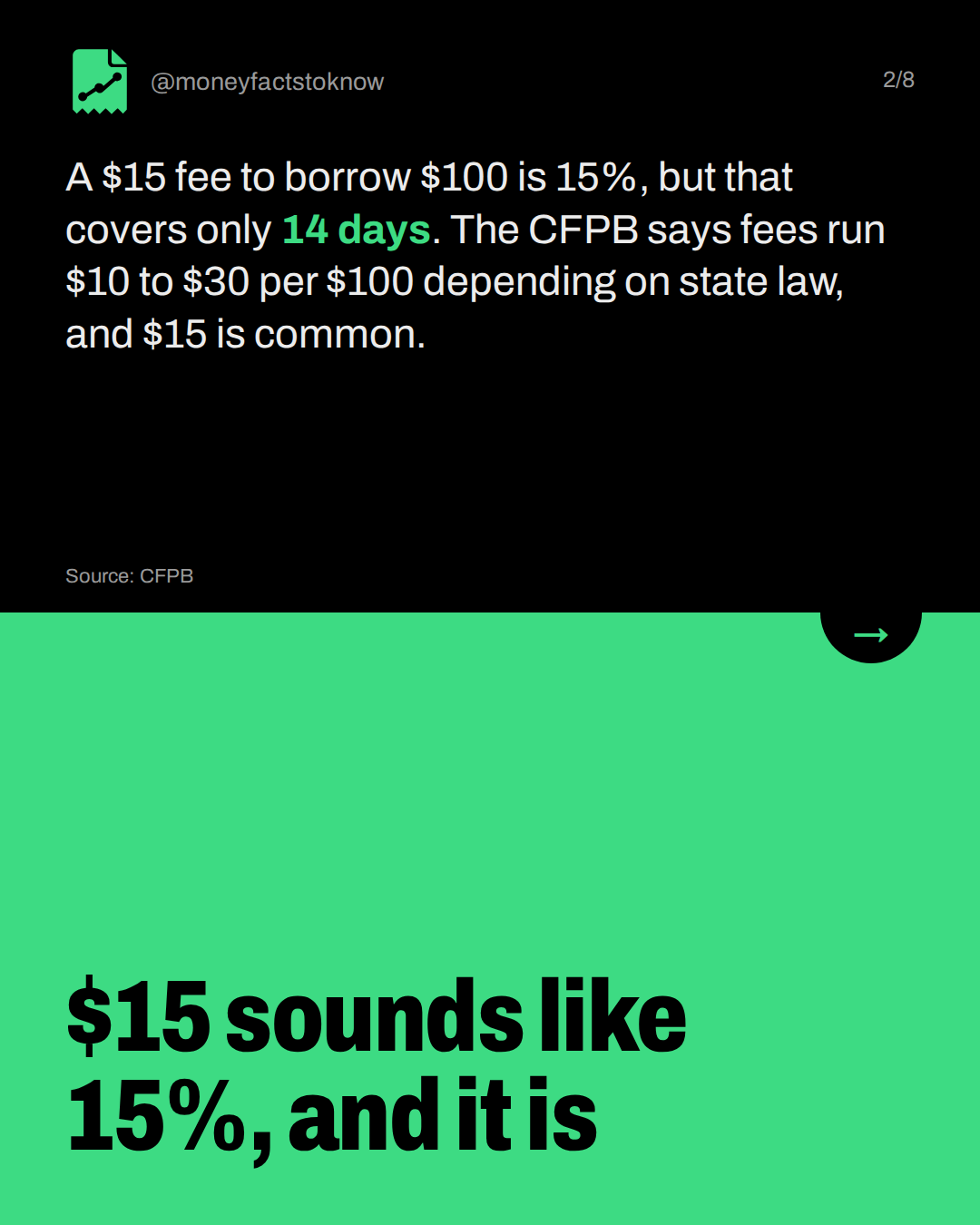
$15 sounds like 15%, and it is
A $15 fee to borrow $100 is 15%, but that covers only 14 days. The CFPB says fees run $10 to $30 per $100 depending on state law, and $15 is common.
Source: CFPB
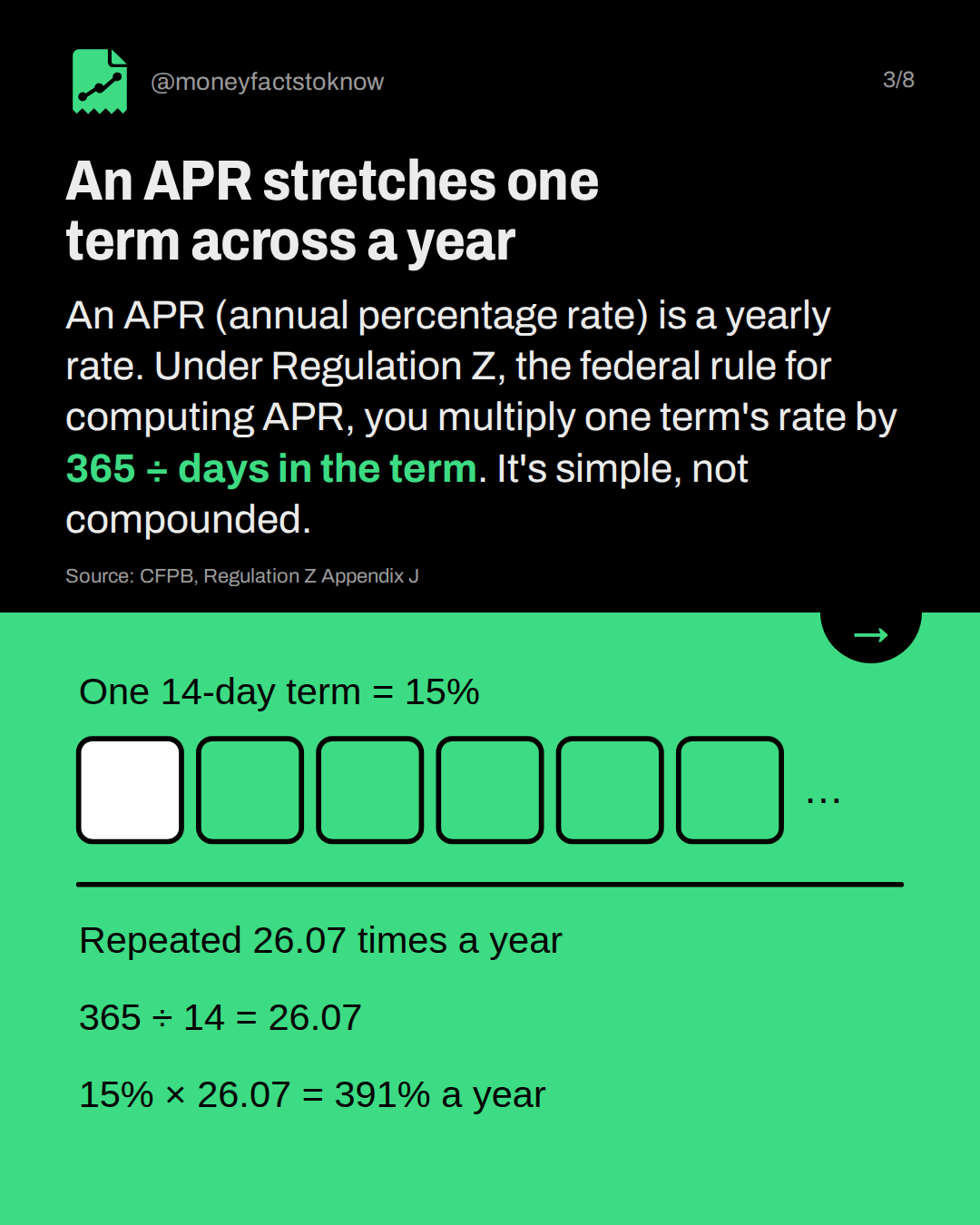
An APR stretches one term across a year
An APR (annual percentage rate) is a yearly rate. Under Regulation Z, the federal rule for computing APR, you multiply one term's rate by 365 ÷ days in the term. It's simple, not compounded.
Source: CFPB, Regulation Z Appendix J
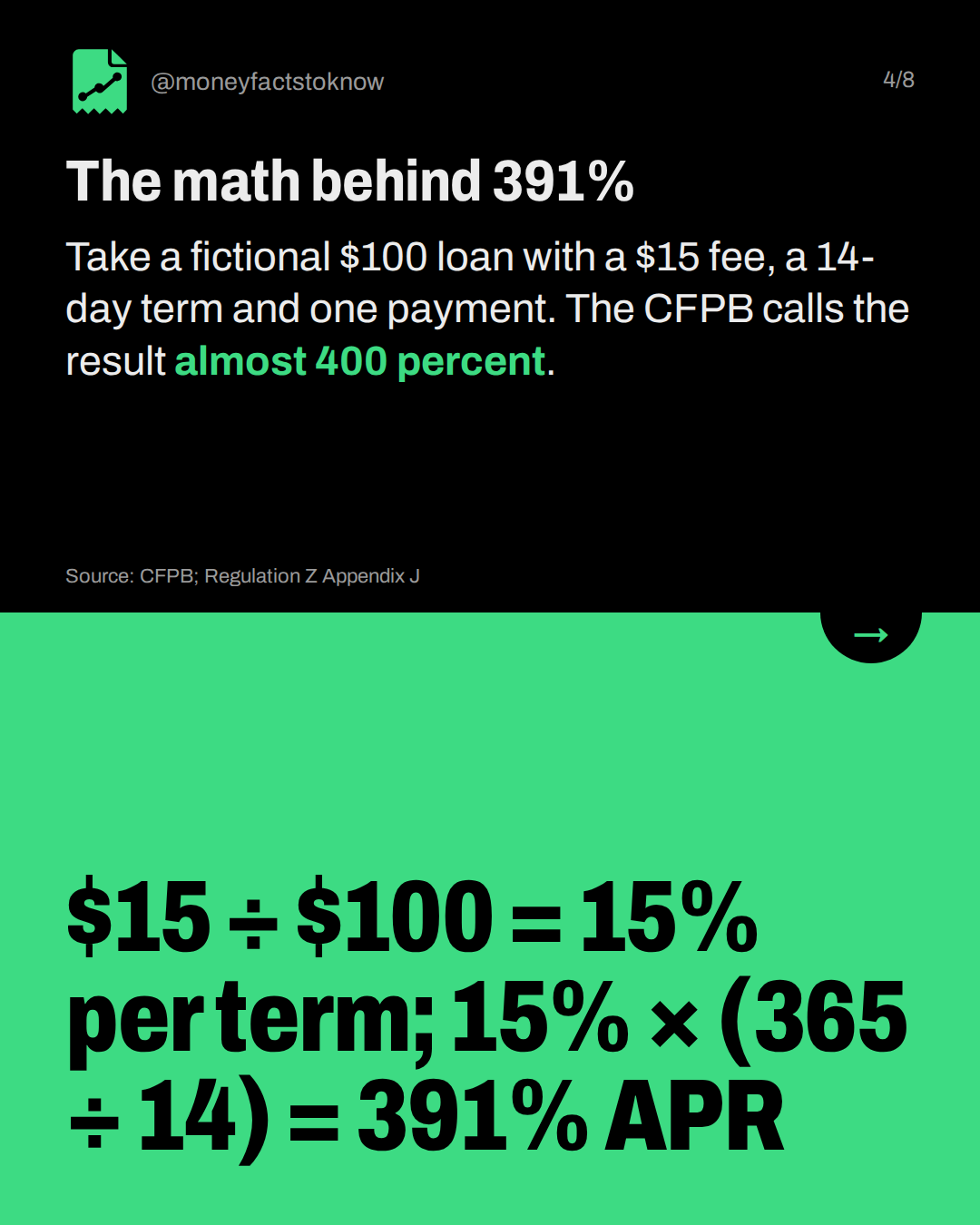
The math behind 391%
Take a fictional $100 loan with a $15 fee, a 14-day term and one payment. The CFPB calls the result almost 400 percent.
The math: $15 ÷ $100 = 15% per term; 15% × (365 ÷ 14) = 391% APR
Source: CFPB; Regulation Z Appendix J
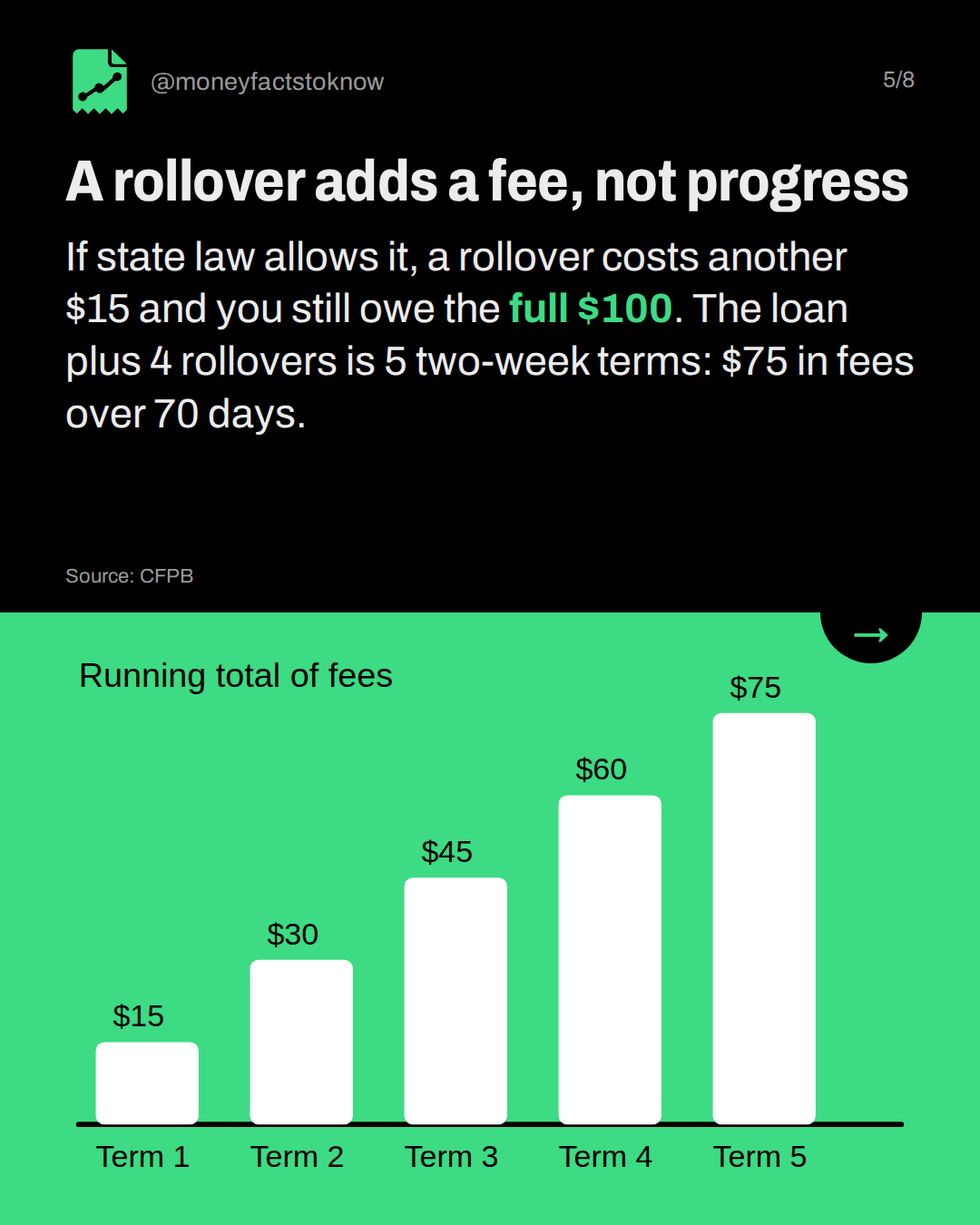
A rollover adds a fee, not progress
If state law allows it, a rollover costs another $15 and you still owe the full $100. The loan plus 4 rollovers is 5 two-week terms: $75 in fees over 70 days.
Source: CFPB
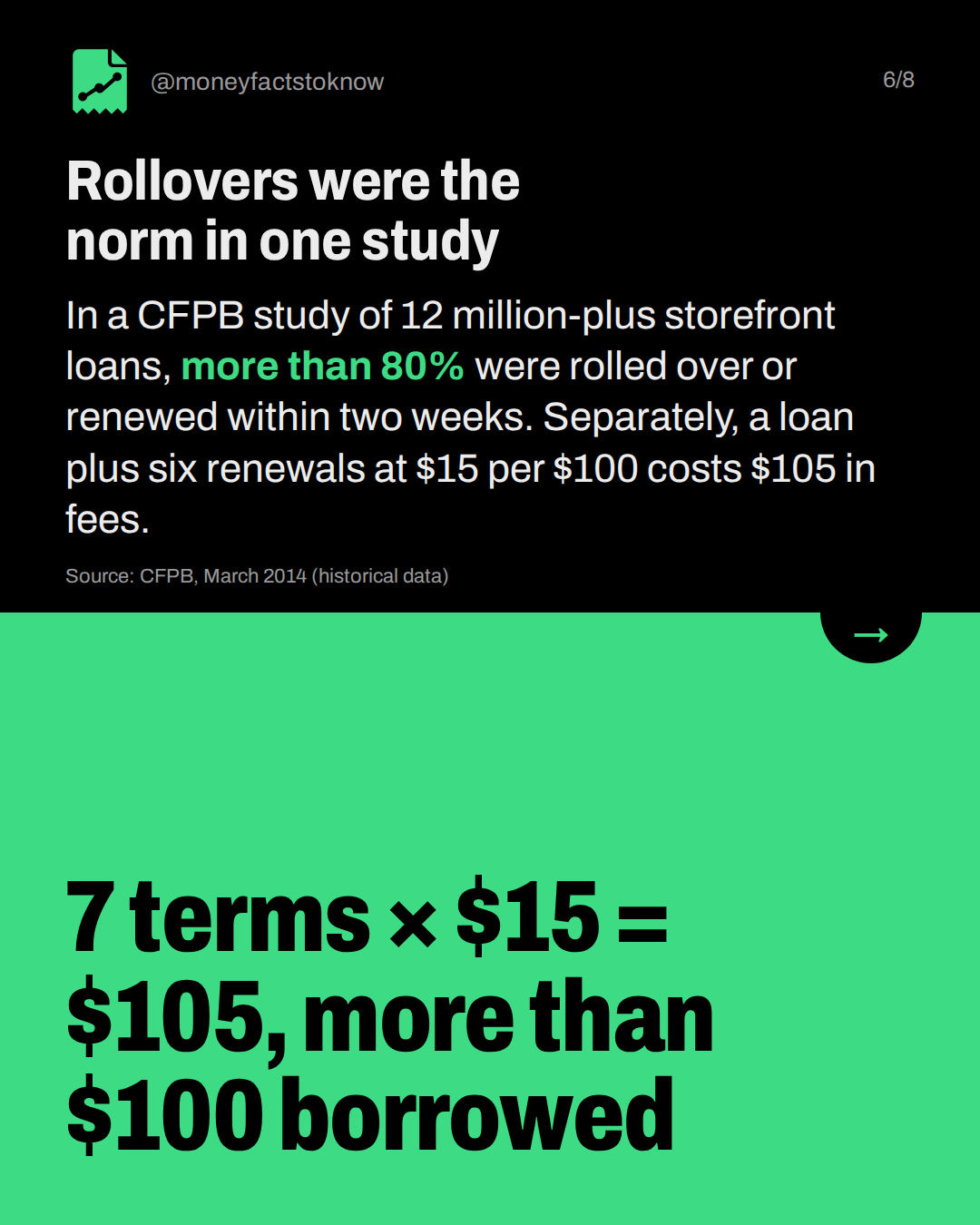
Rollovers were the norm in one study
In a CFPB study of 12 million-plus storefront loans, more than 80% were rolled over or renewed within two weeks. Separately, a loan plus six renewals at $15 per $100 costs $105 in fees.
The math: 7 terms × $15 = $105, more than $100 borrowed
Source: CFPB, March 2014 (historical data)
Two lines to check on the disclosure
Payday loans count as credit under Regulation Z. Look for the finance charge, the dollar amount the credit will cost you, and the annual percentage rate, the cost of your credit as a yearly rate. Also check whether your state allows rollovers.
Source: CFPB, Regulation Z §1026.18
Sources and assumptions
- CFPB: What is the difference between a credit card cash advance and a payday loan?: 'A typical two-week payday loan with a $15 per $100 fee equates to an annual percentage rate (APR) of almost 400 percent.' (checked 2026-10-18)
- CFPB: What are the costs and fees for a payday loan?: The finance charge ranges from $10 to $30 per $100 depending on state law, and $15 per $100 is common (almost 400% APR for two weeks). A rollover means paying another fee while still owing the original balance, if state law permits it (the CFPB's example is a $300 loan with a $45 fee, or $90 for four weeks). (checked 2026-10-18)
- CFPB Regulation Z, 12 CFR 1026.18 (closed-end content of disclosures): The disclosure must use the terms 'finance charge' ('the dollar amount the credit will cost you') and 'annual percentage rate' ('the cost of your credit as a yearly rate'), shown more conspicuously than other disclosures (per 1026.17(a)). (checked 2026-10-18)
- CFPB Regulation Z, Official Interpretation of 1026.2, comment 2(a)(14)-2: Payday loans (a cash advance in exchange for a personal check or a debit authorization) are credit under Regulation Z, and their fees may be finance charges. (checked 2026-10-18)
- CFPB Regulation Z, Appendix J (annual percentage rate computations for closed-end credit): For a single-advance, single-payment loan whose term isn't whole months, the term is 1 unit period, unit periods per year = 365 ÷ days in the term, and APR = unit-period rate × unit periods per year. (checked 2026-10-18)
- CFPB newsroom: CFPB finds four out of five payday loans are rolled over or renewed (March 25, 2014): Across more than 12 million storefront payday loans over 12 months, more than 80% were rolled over or renewed within two weeks, and borrowers who take an initial loan plus six renewals pay more in fees than the original loan amount. (checked 2026-10-18)
Assumptions:
- Fictional loan: $100 borrowed, flat $15 finance charge, 14-day term, single payment, no other fees.
- APR uses Regulation Z Appendix J's single-payment method: (fee ÷ amount) × (365 ÷ days in term). This is a simple annualized rate, not compounded.
- Each rollover is assumed to cost the same $15 and extend the loan by 14 days, with the full $100 still owed. Whether rollovers are allowed, and what they cost, depends on state law.
- '4 rollovers' means 5 two-week terms (the original term plus 4 extensions) = 70 days, $75 in fees.
- Late fees, returned-payment fees, bank NSF charges and repayment-plan fees are excluded.
- The 80% rollover figure is historical: the CFPB's 12-month sample of storefront loans, published March 2014.
The short version
- $15 per $100 is 15% for 14 days
- Over a year, that's a 391% APR
- A rollover adds $15; you still owe $100
- Check the finance charge and APR lines


