 Money Facts To Know
A fictional $10,000 freelance profit (2026) can owe $1,413 before income tax
Income tax is only part of the bill
On a W-2 paycheck, Social Security and Medicare come out automatically, and your employer pays a matching share you never see. Freelance profit has no employer to pay that share.
Source: IRS Topic 751, tax year 2026
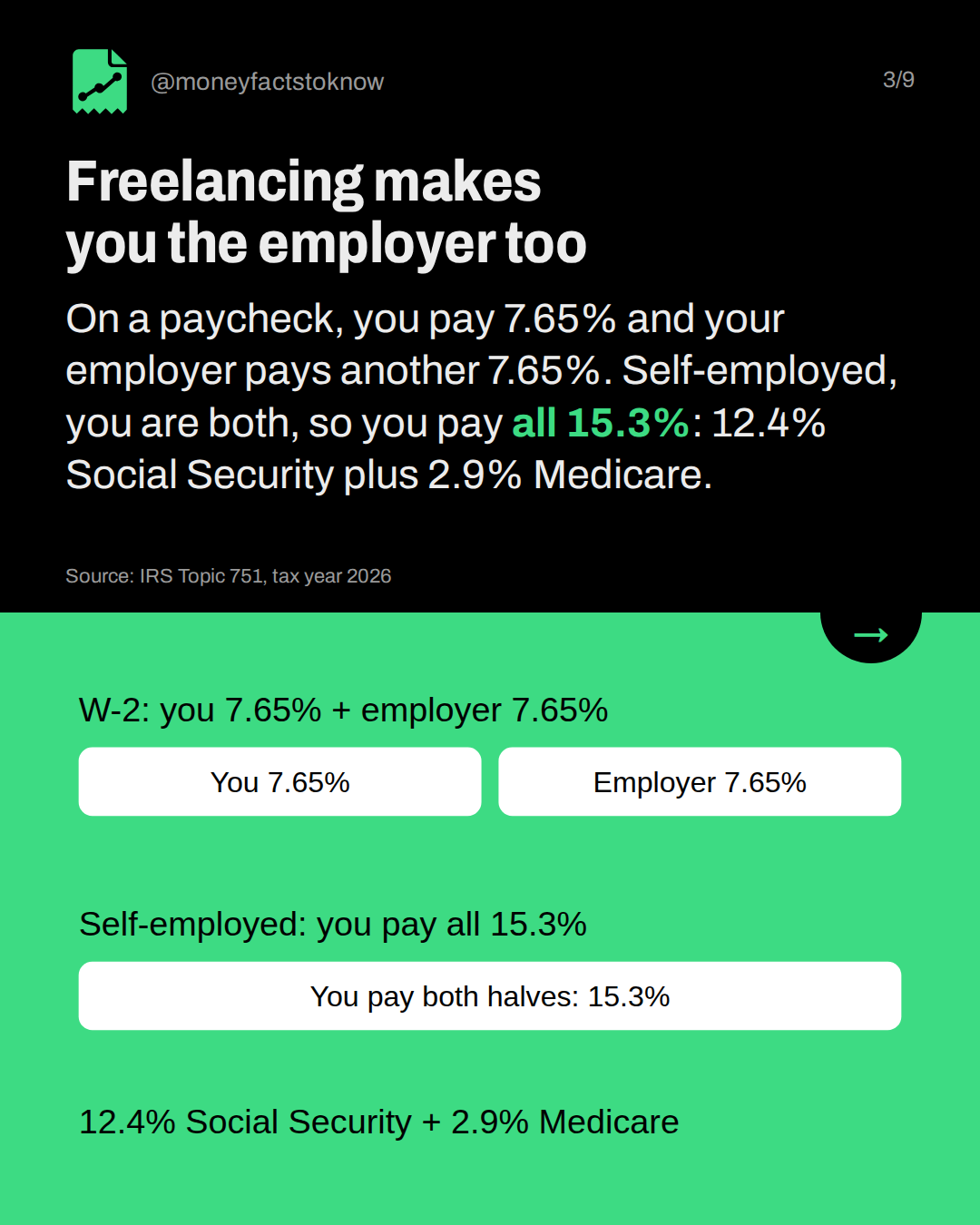
Freelancing makes you the employer too
On a paycheck, you pay 7.65% and your employer pays another 7.65%. Self-employed, you are both, so you pay all 15.3%: 12.4% Social Security plus 2.9% Medicare.
Source: IRS Topic 751, tax year 2026
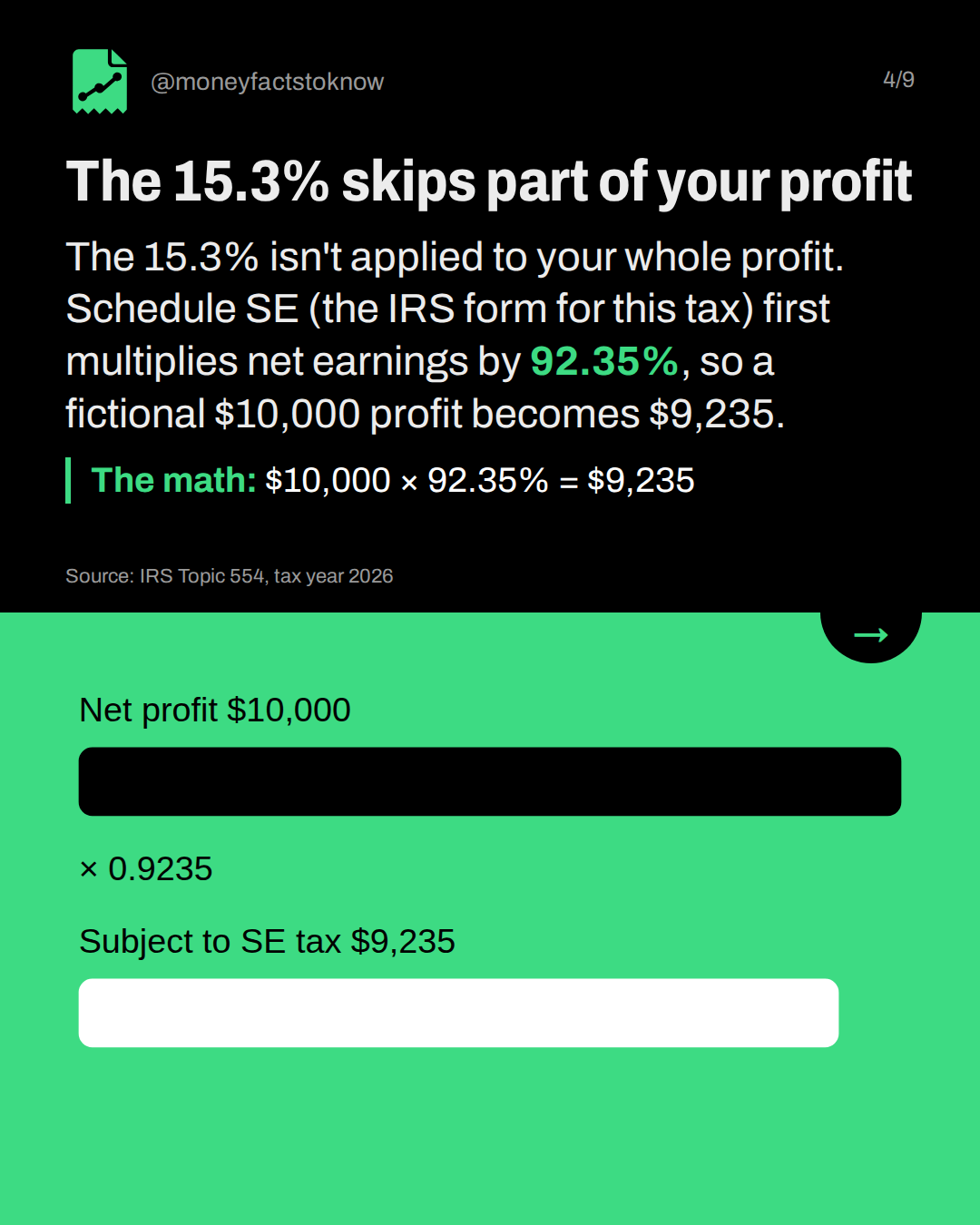
The 15.3% skips part of your profit
The 15.3% isn't applied to your whole profit. Schedule SE (the IRS form for this tax) first multiplies net earnings by 92.35%, so a fictional $10,000 profit becomes $9,235.
The math: $10,000 × 92.35% = $9,235
Source: IRS Topic 554, tax year 2026
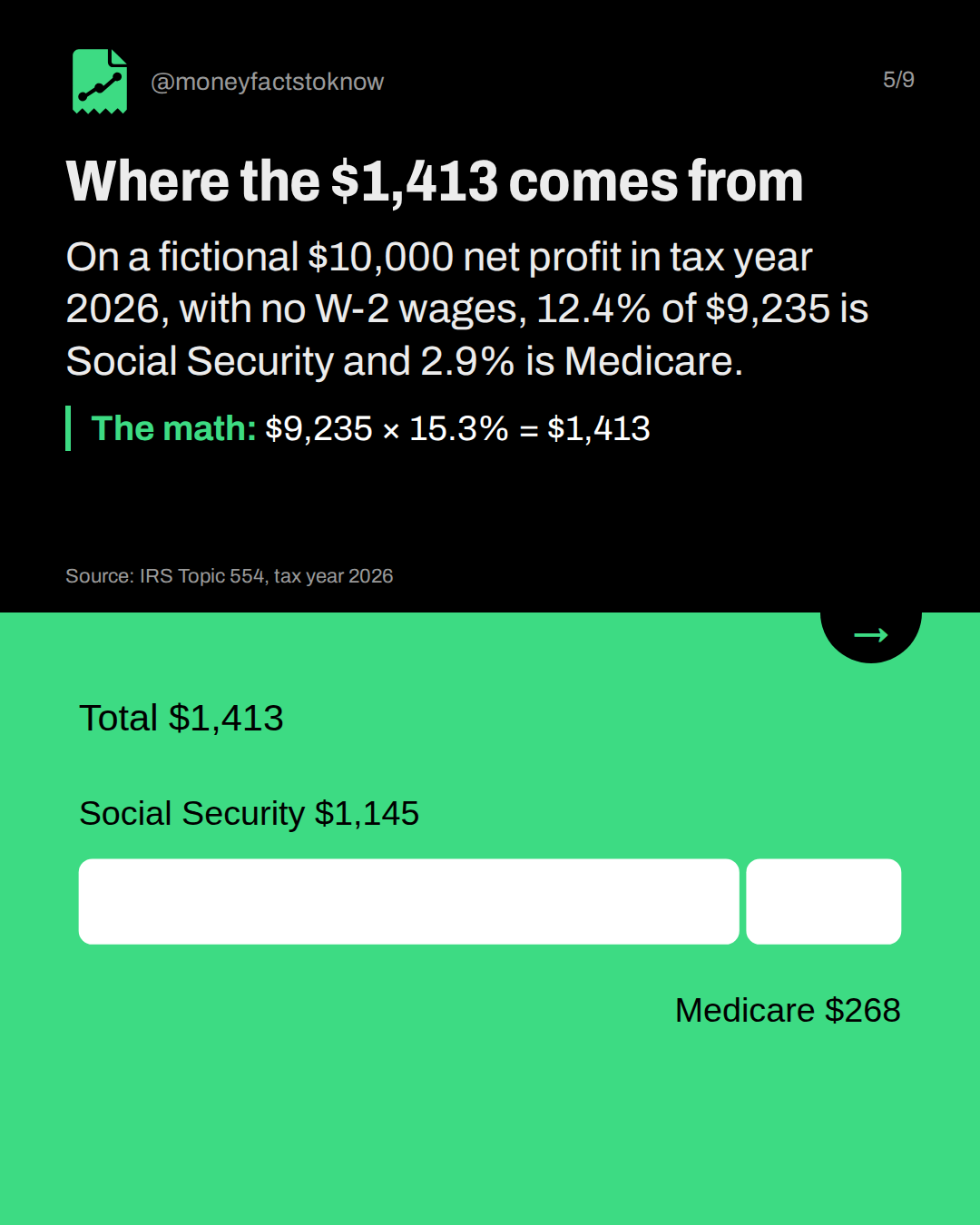
Where the $1,413 comes from
On a fictional $10,000 net profit in tax year 2026, with no W-2 wages, 12.4% of $9,235 is Social Security and 2.9% is Medicare.
The math: $9,235 × 15.3% = $1,413
Source: IRS Topic 554, tax year 2026
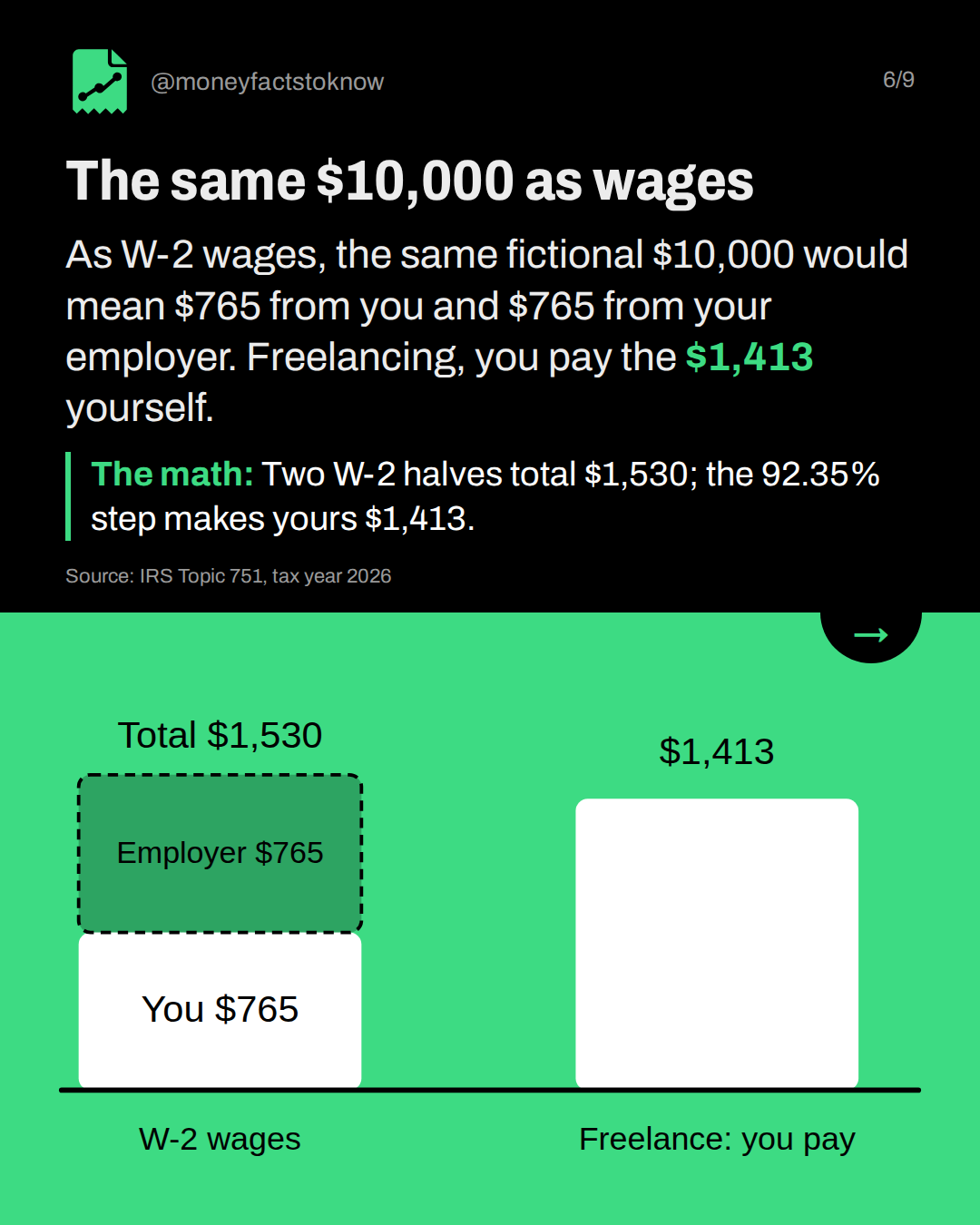
The same $10,000 as wages
As W-2 wages, the same fictional $10,000 would mean $765 from you and $765 from your employer. Freelancing, you pay the $1,413 yourself.
The math: Two W-2 halves total $1,530; the 92.35% step makes yours $1,413.
Source: IRS Topic 751, tax year 2026
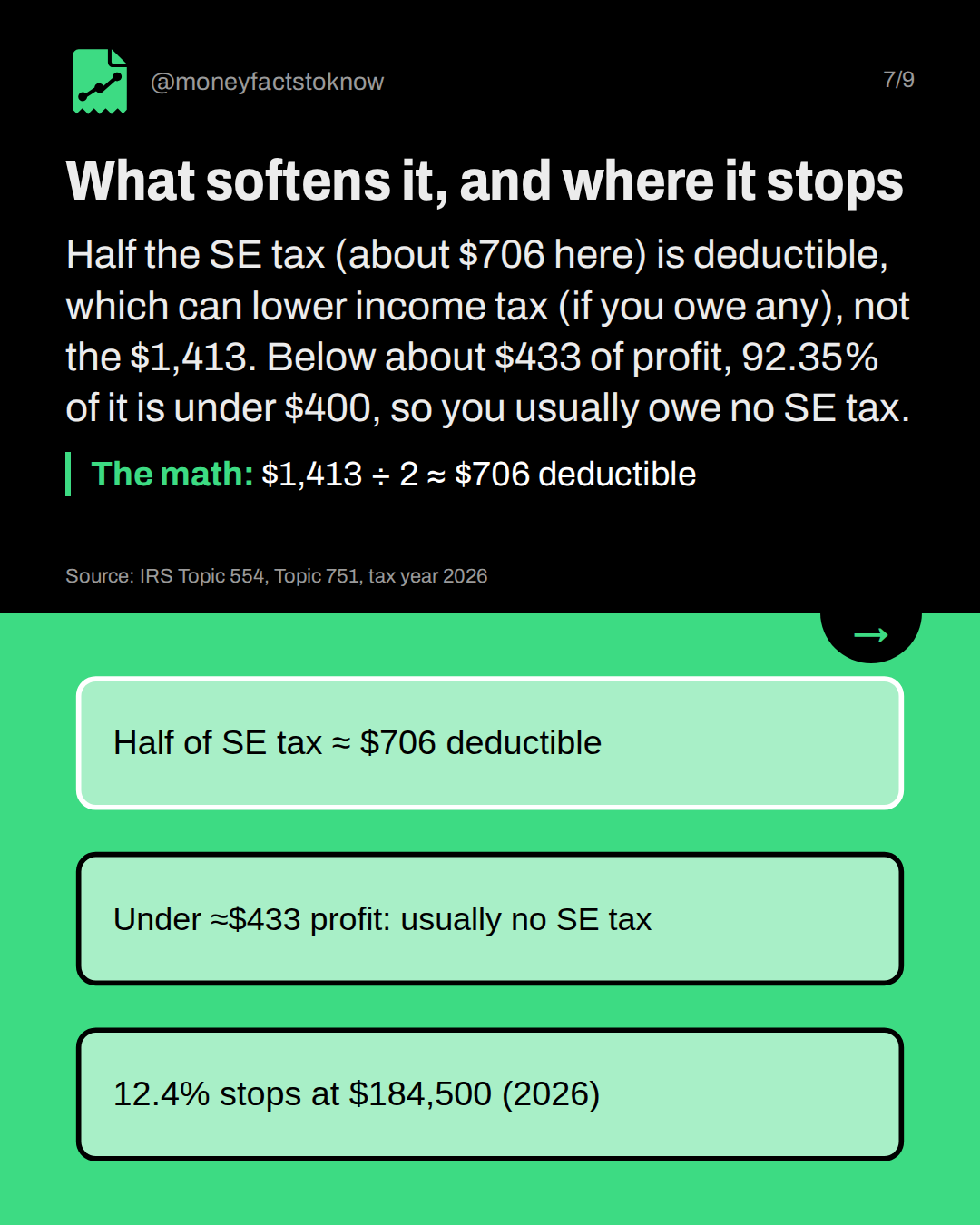
What softens it, and where it stops
Half the SE tax (about $706 here) is deductible, which can lower income tax (if you owe any), not the $1,413. Below about $433 of profit, 92.35% of it is under $400, so you usually owe no SE tax.
The math: $1,413 ÷ 2 ≈ $706 deductible
Source: IRS Topic 554, Topic 751, tax year 2026
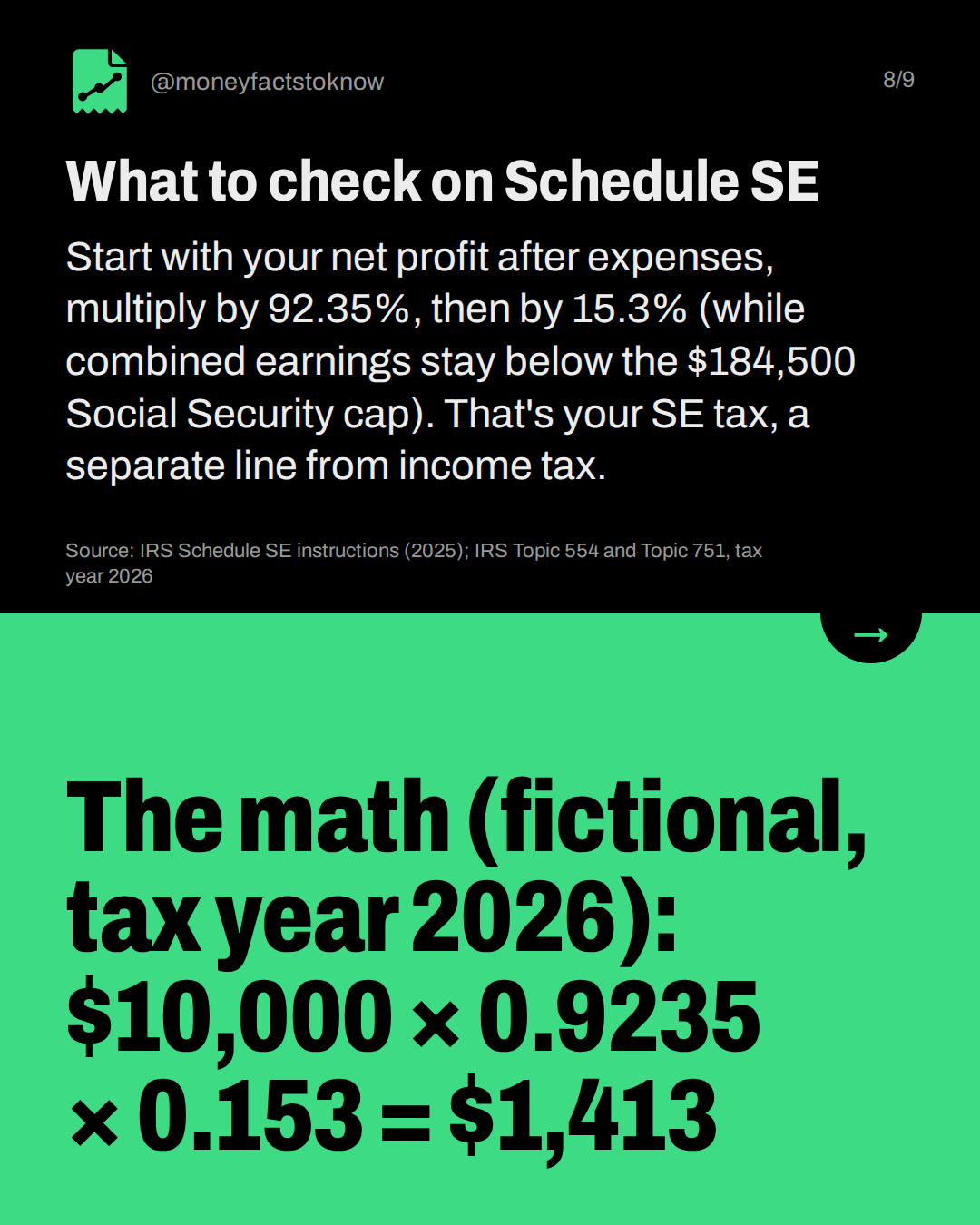
What to check on Schedule SE
Start with your net profit after expenses, multiply by 92.35%, then by 15.3% (while combined earnings stay below the $184,500 Social Security cap). That's your SE tax, a separate line from income tax.
The math: The math (fictional, tax year 2026): $10,000 × 0.9235 × 0.153 = $1,413
Source: IRS Schedule SE instructions (2025); IRS Topic 554 and Topic 751, tax year 2026
Sources and assumptions
- IRS Topic no. 554, Self-employment tax: SE tax rate = 12.4% Social Security + 2.9% Medicare; amount subject to SE tax is generally 92.35% of net earnings; usually owed if net SE earnings are $400 or more; deduct one-half of SE tax when figuring AGI; computed on Schedule SE and carried to Schedule 2; Social Security part has an annual maximum, all net earnings subject to Medicare (checked 2026-10-17)
- IRS, Self-Employment Tax (Social Security and Medicare Taxes): SE tax rate is 15.3% (12.4% + 2.9%); deduct the employer-equivalent portion of SE tax in figuring AGI, while wage earners cannot deduct their Social Security and Medicare taxes; 0.9% Additional Medicare Tax above filing-status thresholds ($125,000 to $250,000); SE tax usually paid via quarterly estimated payments (checked 2026-10-17)
- IRS Topic no. 751, Social Security and Medicare withholding rates: Tax year 2026: Social Security 6.2% employer + 6.2% employee (12.4% total); Medicare 1.45% + 1.45% (2.9% total); wage base limit $184,500 for 2026; no Medicare wage base; 0.9% Additional Medicare Tax withholding on wages over $200,000 with no employer match (checked 2026-10-17)
- IRS Instructions for Schedule SE (Form 1040), 2025: Line 4a multiplies by 92.35%; file Schedule SE if net SE earnings are $400 or more; SE tax goes to Schedule 2 line 4; deduction for one-half of SE tax on Schedule 1 line 15; SE tax is separate from income tax; (2025 maximum $176,100, superseded for 2026 by $184,500 per IRS Topic 751) (checked 2026-10-17)
Assumptions:
- Fictional freelancer with $10,000 net profit from self-employment (after business expenses) in tax year 2026
- No W-2 wages or other self-employment income, so the $184,500 Social Security cap and the Additional Medicare Tax thresholds are not reached
- Standard Schedule SE method (no optional methods, no church employee income)
- Income tax and state/local taxes are excluded; the $1,413 is federal SE tax only
- W-2 comparison assumes the same $10,000 paid as wages, no other wages that year
- Figures rounded to the nearest dollar after an exact script calculation (1,412.955 → $1,413)
The short version
- Freelancers pay both halves: 15.3%
- It applies to 92.35% of net profit
- Fictional $10,000 profit, tax year 2026: $1,413
- Income tax comes on top of that


