 Money Facts To Know
Roth IRA isn't locked: contributions come out first, federal tax-free


Not every early withdrawal is penalized
Many people assume every dollar taken from a Roth IRA before 59½ (the usual retirement-account age) gets taxed and hit with a 10% penalty. For direct contributions, the federal rules don't work that way.
Source: IRS Pub 590-B (2025); IRS Topic 557
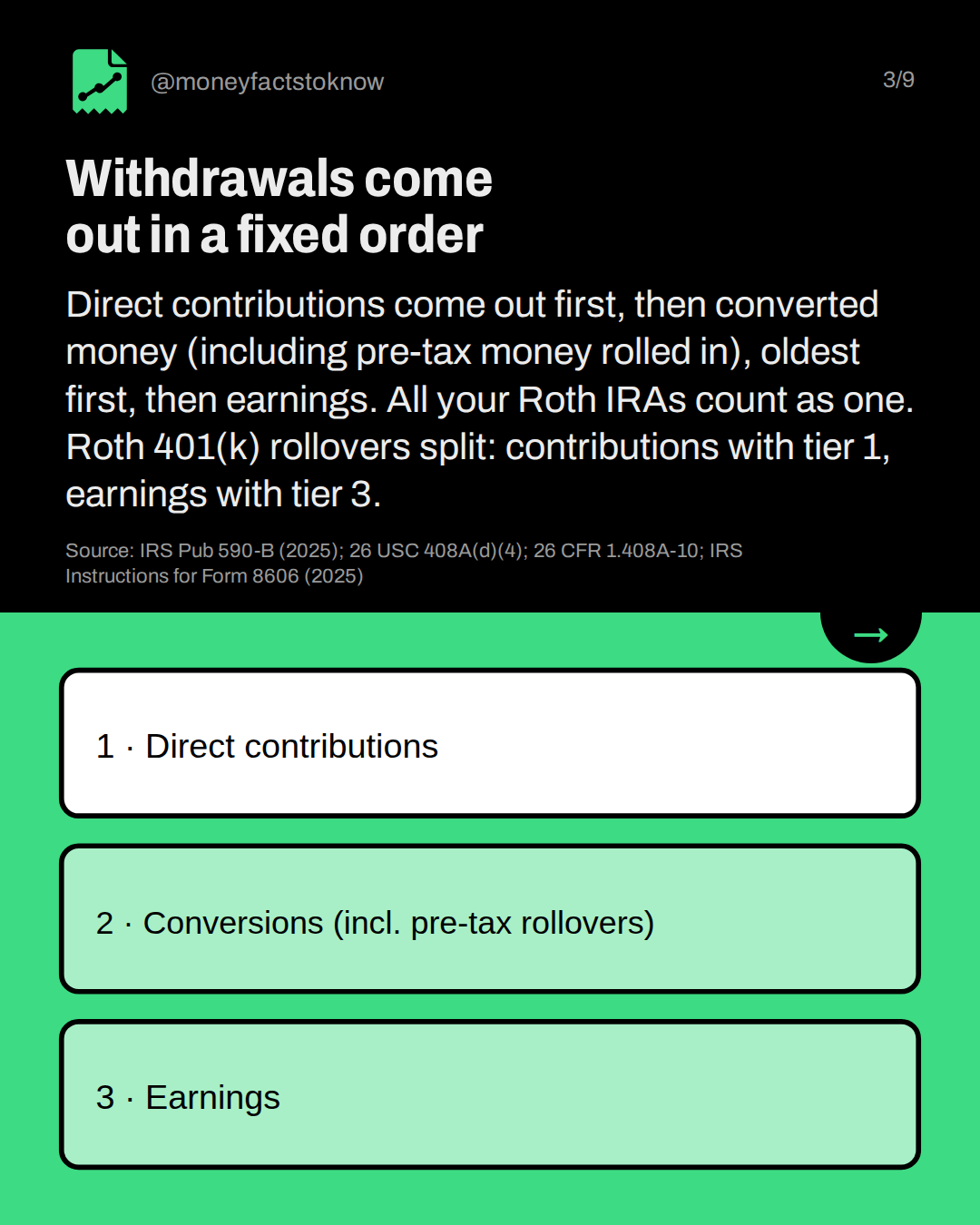
Withdrawals come out in a fixed order
Direct contributions come out first, then converted money (including pre-tax money rolled in), oldest first, then earnings. All your Roth IRAs count as one. Roth 401(k) rollovers split: contributions with tier 1, earnings with tier 3.
Source: IRS Pub 590-B (2025); 26 USC 408A(d)(4); 26 CFR 1.408A-10; IRS Instructions for Form 8606 (2025)
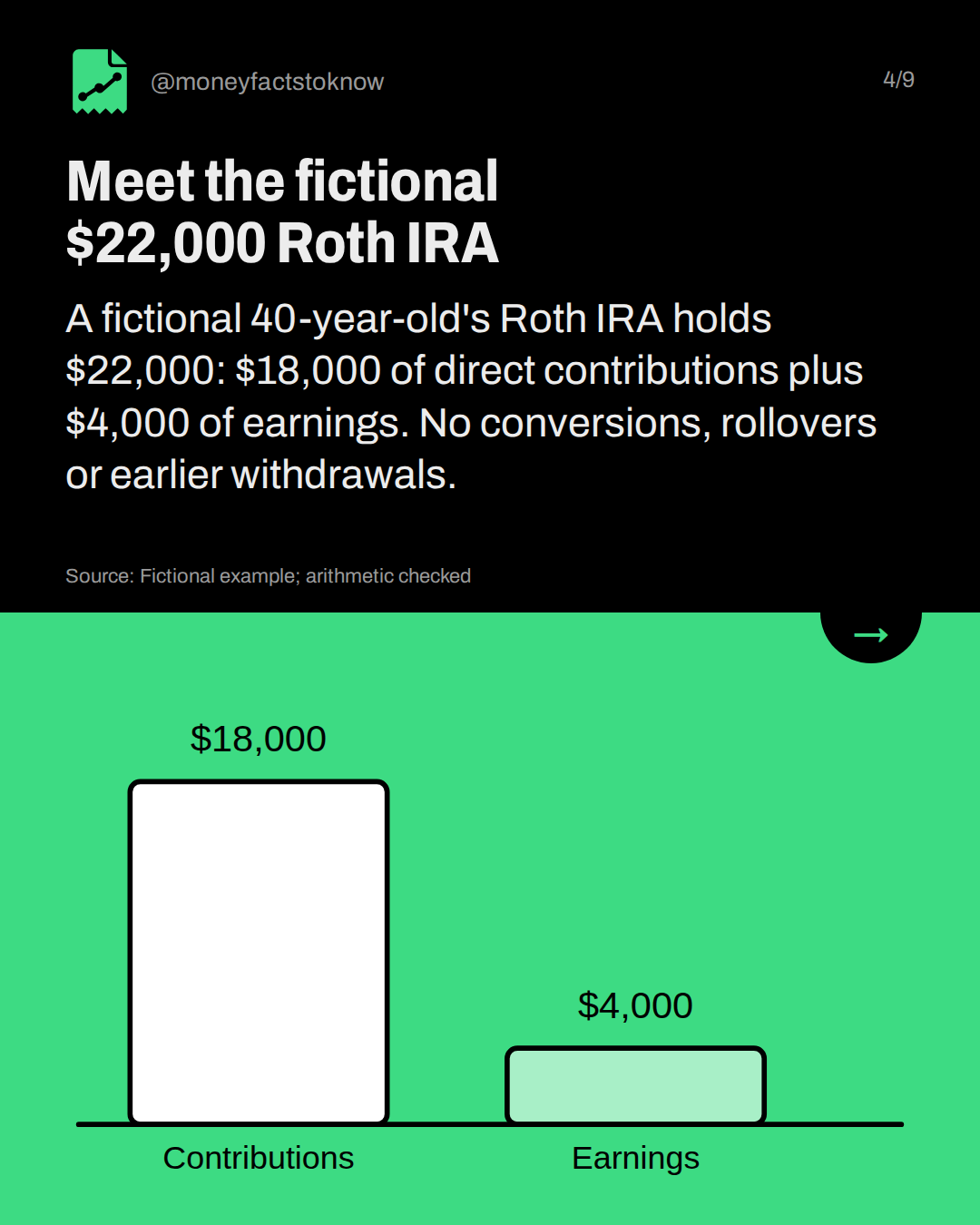
Meet the fictional $22,000 Roth IRA
A fictional 40-year-old's Roth IRA holds $22,000: $18,000 of direct contributions plus $4,000 of earnings. No conversions, rollovers or earlier withdrawals.
Source: Fictional example; arithmetic checked

Taking out $10,000 costs $0 in federal tax
In the fictional account, a $10,000 withdrawal comes entirely from contributions. That means $0 federal income tax and no 10% additional tax, and even $18,000 would cost $0.
The math: $10,000 ≤ $18,000 contributed → $0 taxable
Source: IRS Pub 590-B (2025)
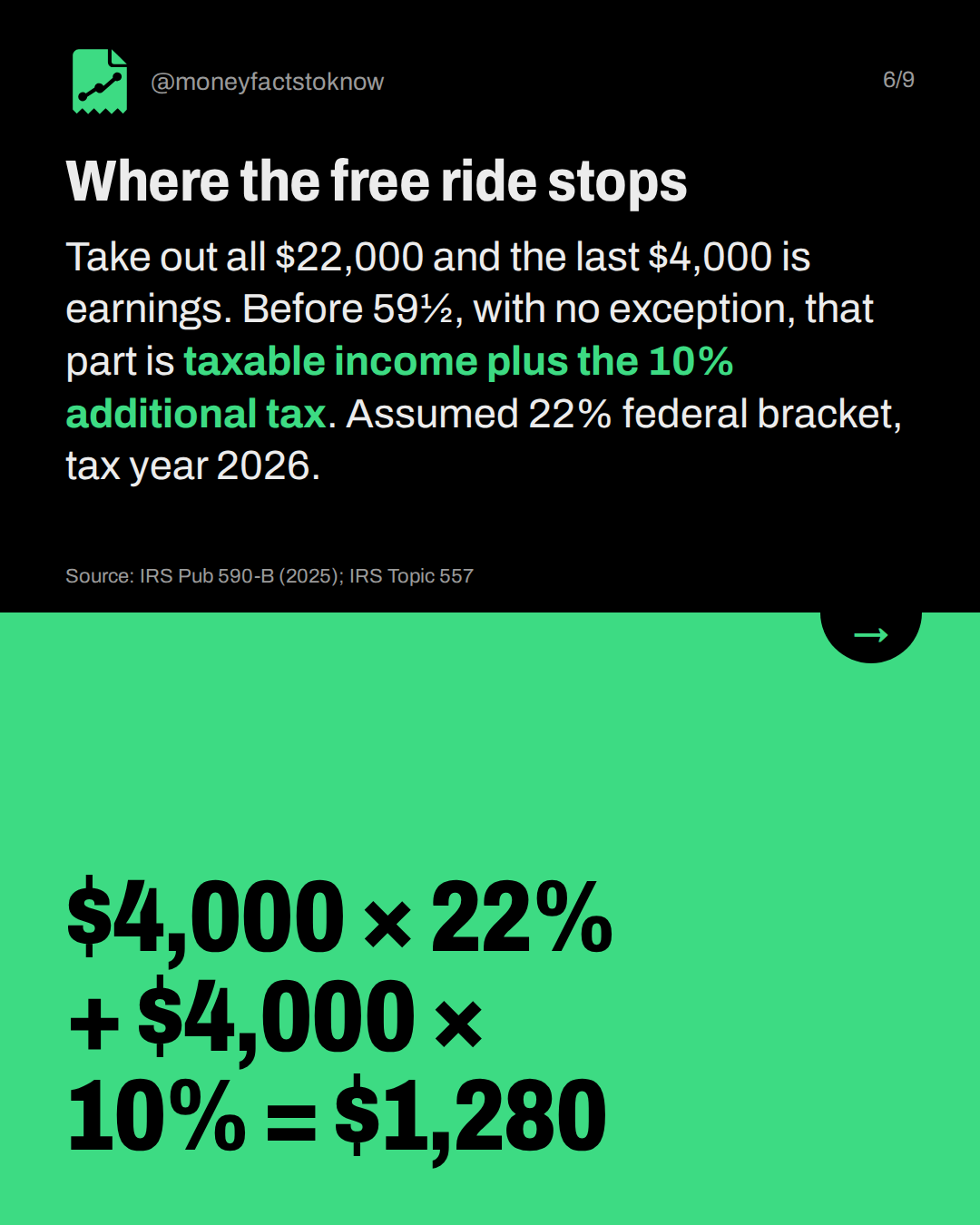
Where the free ride stops
Take out all $22,000 and the last $4,000 is earnings. Before 59½, with no exception, that part is taxable income plus the 10% additional tax. Assumed 22% federal bracket, tax year 2026.
The math: $4,000 × 22% + $4,000 × 10% = $1,280
Source: IRS Pub 590-B (2025); IRS Topic 557
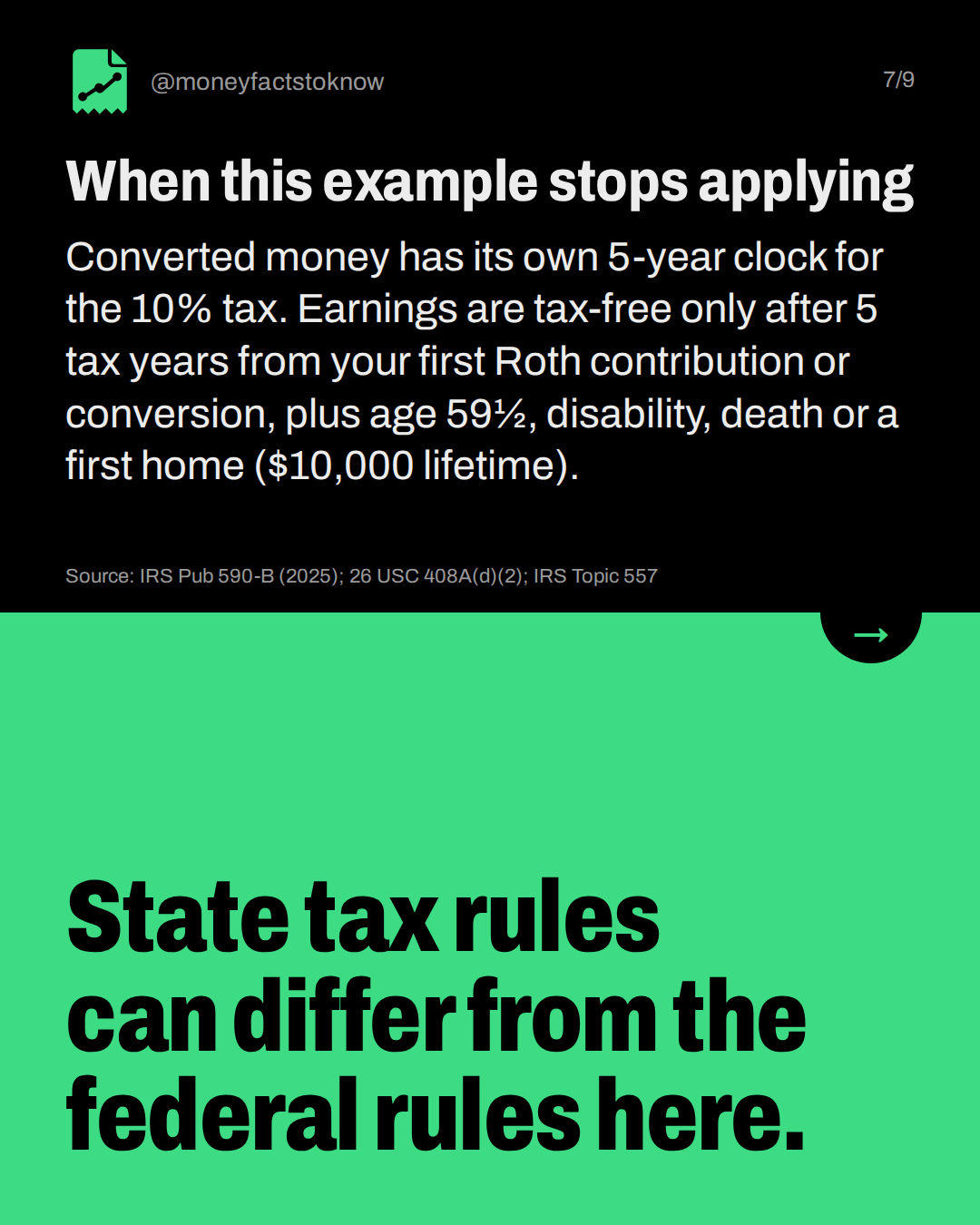
When this example stops applying
Converted money has its own 5-year clock for the 10% tax. Earnings are tax-free only after 5 tax years from your first Roth contribution or conversion, plus age 59½, disability, death or a first home ($10,000 lifetime).
The math: State tax rules can differ from the federal rules here.
Source: IRS Pub 590-B (2025); 26 USC 408A(d)(2); IRS Topic 557

Three things to check first
Add up your direct contributions (Form 5498 shows each year's; Form 8606, line 22 takes the total in a year you withdraw), check for conversions or rollovers, and note your first Roth contribution year.
The math: Putting money back is a new deposit: 2026 limit $7,500 under 50; income limits apply.
Source: IRS Instructions for Form 8606 (2025); IRS Instructions for Forms 1099-R and 5498; IRS IR-2025-111
Sources and assumptions
- IRS Publication 590-B (2025), Distributions from Individual Retirement Arrangements (IRAs): Roth IRA ordering: contributions first, then conversion and certain rollover contributions, then earnings. Distributions of regular contributions are not subject to income tax or the 10% additional tax. A qualified distribution needs the 5-year period plus age 59½, disability, death or first-time homebuyer expenses. Nonqualified earnings are taxed as ordinary income and subject to the 10% additional tax unless an exception applies. Conversion amounts withdrawn within 5 years can owe the 10% additional tax before 59½. 2025 edition (for 2025 returns). (checked 2026-10-16)
- 26 U.S. Code § 408A (Cornell LII): §408A(d)(2): qualified distribution and the 5-taxable-year period beginning with the first taxable year a Roth IRA contribution was made. §408A(d)(4)(B): distributions are treated as made from contributions first, to the extent they don't exceed aggregate contributions, with non-rollover contributions before qualified rollover contributions. (checked 2026-10-16)
- 26 CFR § 1.408A-6 (Cornell LII): Nonqualified distributions are includible in income only to the extent they exceed the owner's contributions. The ordering is regular contributions, then conversion contributions (first in, first out), then earnings. All of an individual's Roth IRA distributions in a year are aggregated. The 5-year clock starts January 1 of the first contribution year. Separate 5-year periods apply to conversions for the 10% tax. (checked 2026-10-16)
- IRS Topic no. 557, Additional tax on early distributions from traditional and Roth IRAs: The 10% additional tax applies before 59½ only to the part of the distribution included in gross income (Form 5329). Exceptions include first-time home purchase (up to $10,000 lifetime), disability, higher education and substantially equal periodic payments. (checked 2026-10-16)
- IRS Instructions for Form 8606 (2025): Part III figures the taxable part of Roth IRA distributions. Line 22 is the total of regular Roth IRA contributions (basis). (checked 2026-10-16)
- IRS IR-2025-111: 401(k) limit increases to $24,500 for 2026, IRA limit increases to $7,500: The 2026 IRA contribution limit is $7,500 (catch-up for age 50+ is $1,100). (checked 2026-10-16)
- 26 CFR § 1.408A-10 (Cornell LII), Treatment of distributions from designated Roth accounts: Q&A-3: 'distributions from Roth IRAs are deemed to consist first of regular contributions, then of conversion contributions, and finally, of earnings.' For a rollover from a designated Roth account, the regular-contribution part is 'the portion of the distribution that is treated as investment in the contract'; 'the entire amount of any qualified distribution from a designated Roth account that is rolled over into a Roth IRA is treated as a regular contribution to the Roth IRA.' (checked 2026-10-16)
- 26 U.S. Code § 72(t)(8) (Cornell LII): First-time homebuyer distributions: 'The aggregate amount which may be treated as a qualified first-time homebuyer distribution by any individual shall not exceed $10,000.' 408A(d)(5) ties the Roth 'qualified special purpose distribution' to 72(t)(2)(F). (checked 2026-10-16)
- IRS Instructions for Forms 1099-R and 5498: Form 5498 box 10 reports Roth IRA contributions. Rollover contributions (box 2) and Roth IRA conversions (box 3) are reported separately. (checked 2026-10-16)
Assumptions:
- Fictional account holder, age 40, under 59½, with no exception to the 10% additional tax
- The fictional Roth IRA holds $22,000: $18,000 of regular (direct) contributions and $4,000 of earnings
- No conversions or rollovers into any of the person's Roth IRAs; all their Roth IRAs are counted together
- No earlier withdrawals
- Federal tax only; state tax treatment may differ
- Assumed 22% federal marginal bracket for the earnings example, with the $4,000 not pushing into the next bracket
- Federal rules as stated in IRS Pub 590-B (2025 edition), current in tax year 2026
The short version
- Roth IRA withdrawals follow a fixed order.
- Direct contributions come out first.
- Up to that amount: $0 federal tax, no 10% extra.
- Only earnings can owe both before 59½.


