 Money Facts To Know
Free 1.5% card or $95 fee at 3%? The break-even spend
Neither shortcut settles it
Two shortcuts are common: the higher percentage wins, or an annual fee is a waste. Neither works until you know your spend in the bonus category, where a card pays its higher rate.
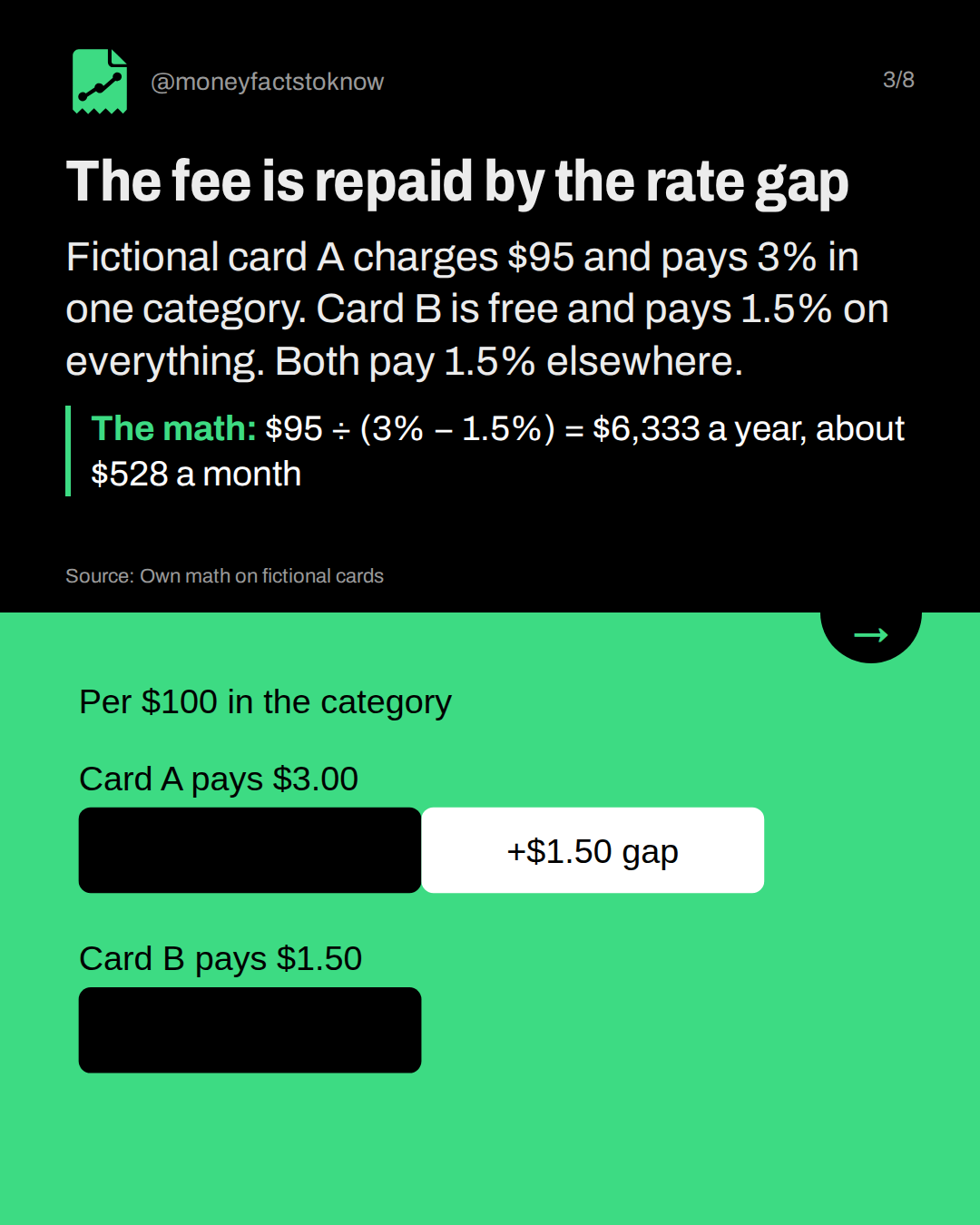
The fee is repaid by the rate gap
Fictional card A charges $95 and pays 3% in one category. Card B is free and pays 1.5% on everything. Both pay 1.5% elsewhere.
The math: $95 ÷ (3% − 1.5%) = $6,333 a year, about $528 a month
Source: Own math on fictional cards
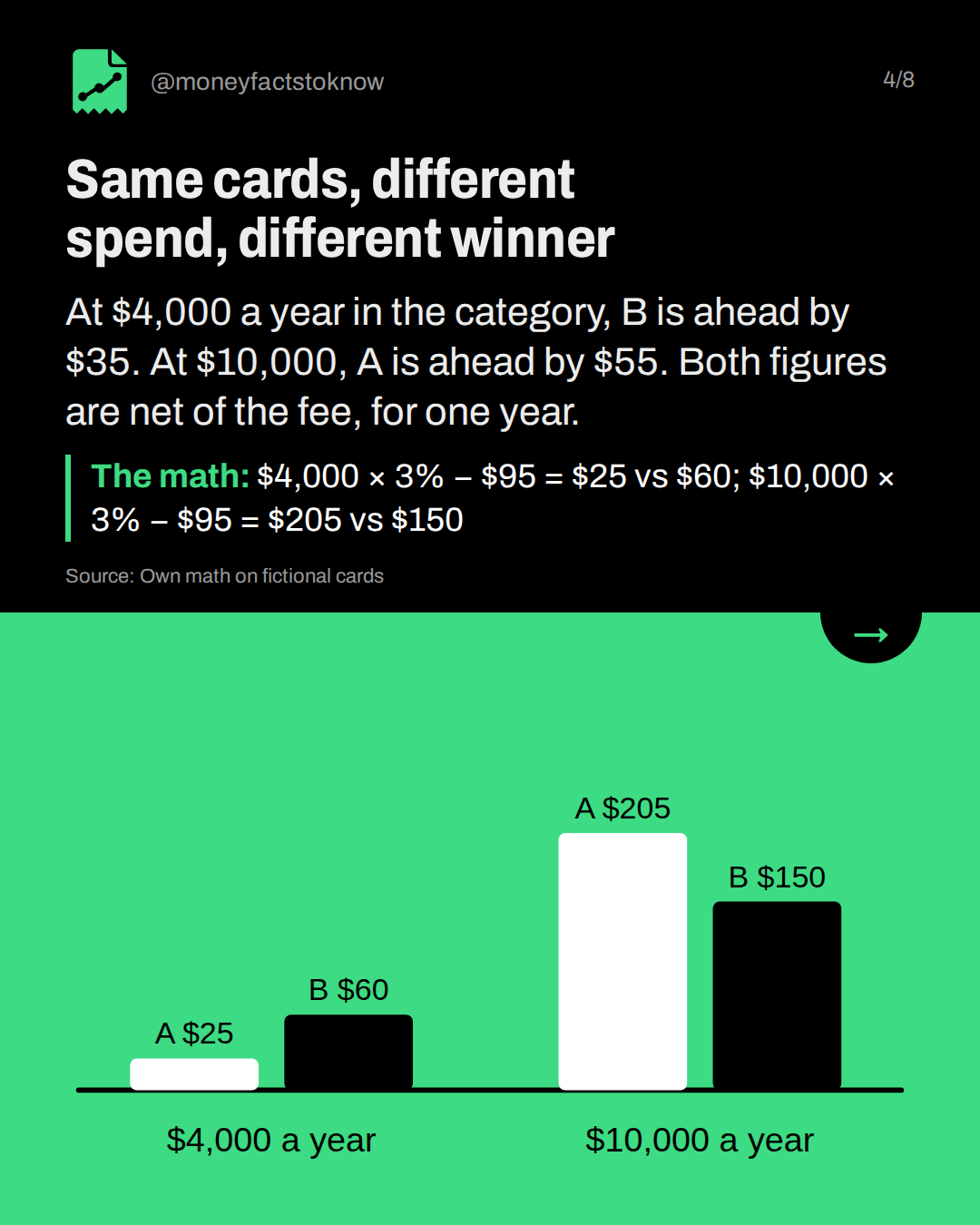
Same cards, different spend, different winner
At $4,000 a year in the category, B is ahead by $35. At $10,000, A is ahead by $55. Both figures are net of the fee, for one year.
The math: $4,000 × 3% − $95 = $25 vs $60; $10,000 × 3% − $95 = $205 vs $150
Source: Own math on fictional cards
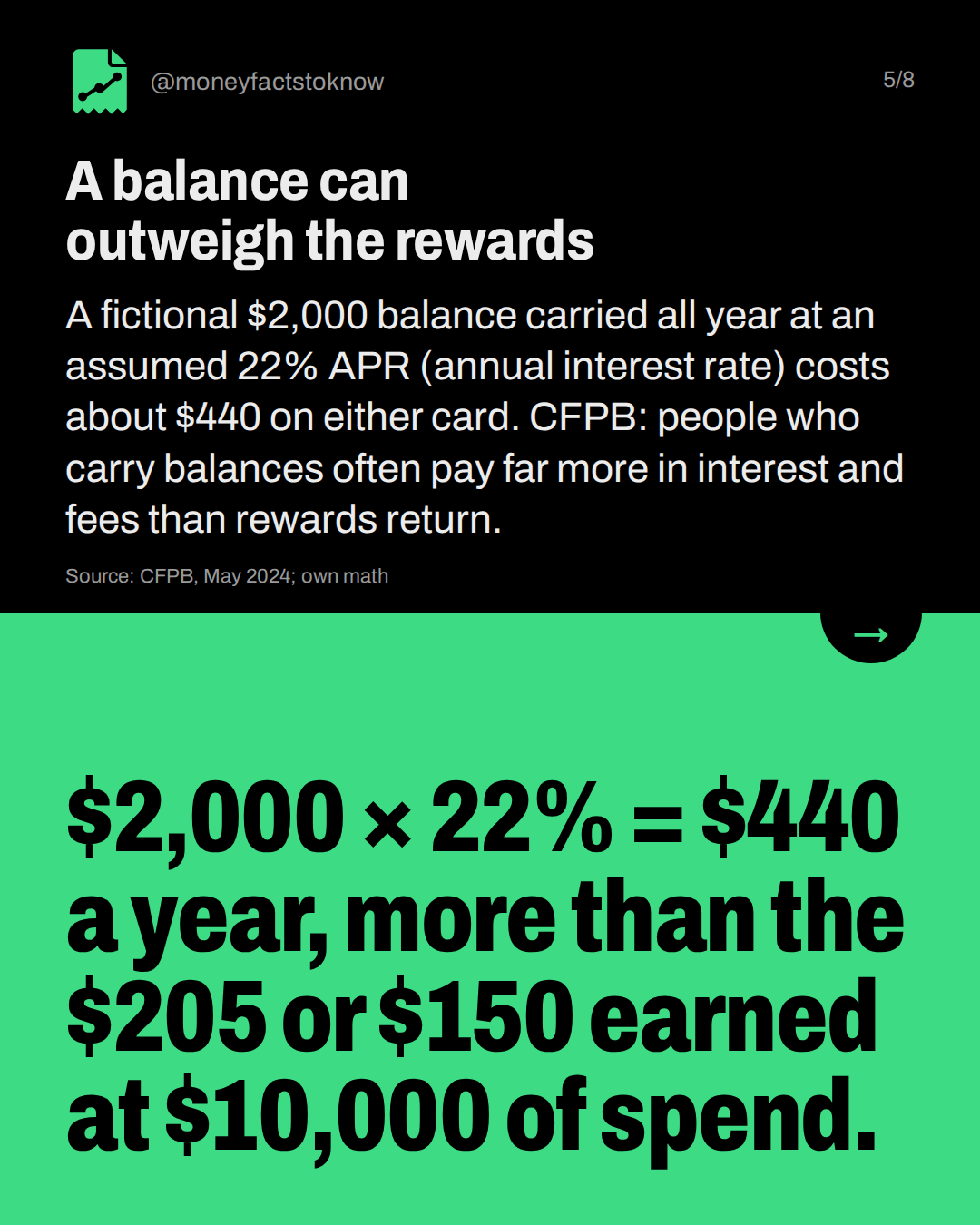
A balance can outweigh the rewards
A fictional $2,000 balance carried all year at an assumed 22% APR (annual interest rate) costs about $440 on either card. CFPB: people who carry balances often pay far more in interest and fees than rewards return.
The math: $2,000 × 22% = $440 a year, more than the $205 or $150 earned at $10,000 of spend.
Source: CFPB, May 2024; own math
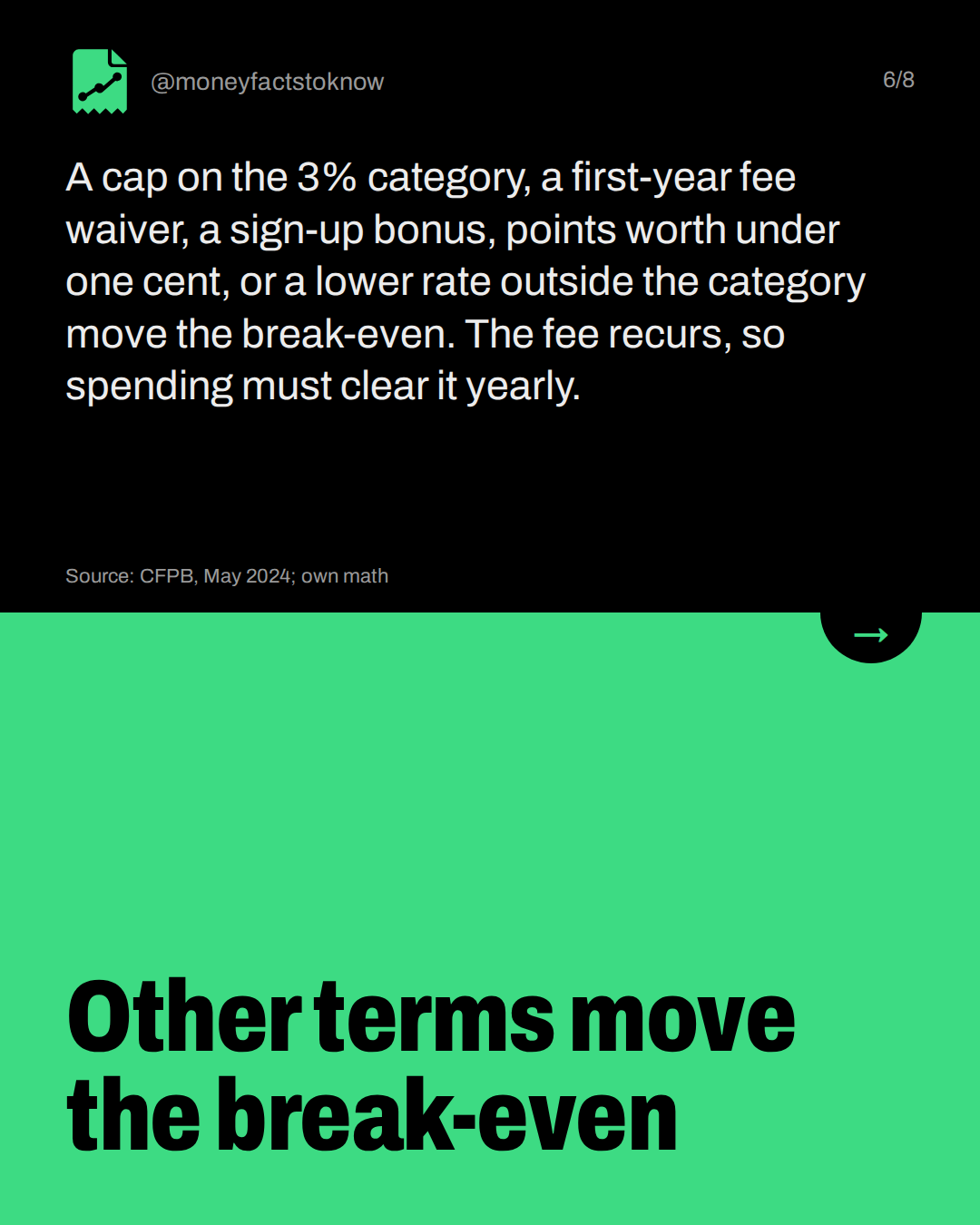
Other terms move the break-even
A cap on the 3% category, a first-year fee waiver, a sign-up bonus, points worth under one cent, or a lower rate outside the category move the break-even. The fee recurs, so spending must clear it yearly.
Source: CFPB, May 2024; own math
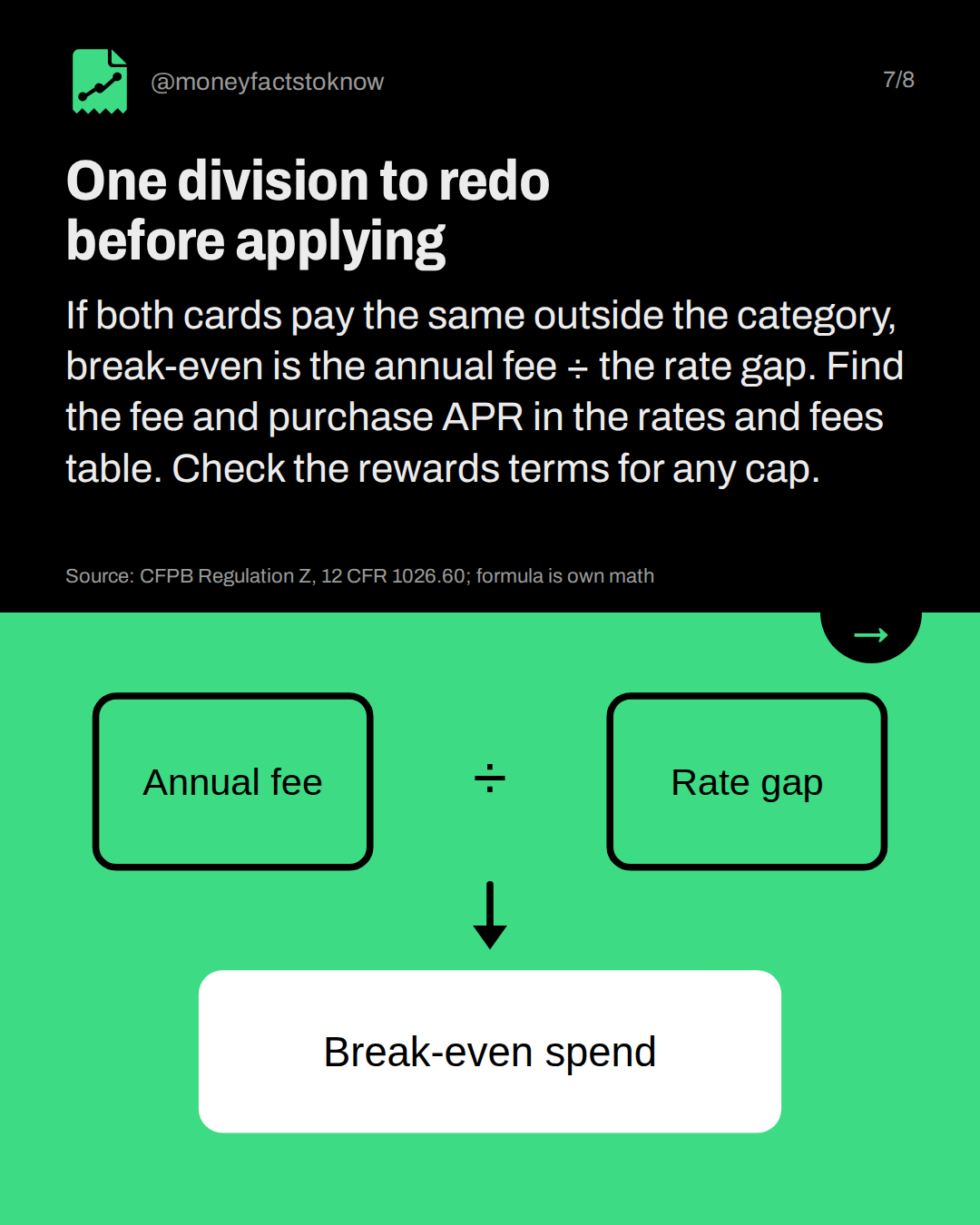
One division to redo before applying
If both cards pay the same outside the category, break-even is the annual fee ÷ the rate gap. Find the fee and purchase APR in the rates and fees table. Check the rewards terms for any cap.
Source: CFPB Regulation Z, 12 CFR 1026.60; formula is own math
Sources and assumptions
- CFPB newsroom: CFPB report highlights consumer frustrations with credit card rewards programs (May 9, 2024): "Consumers who carry revolving balances often pay far more in interest and fees than they get back on rewards." Also that issuers can devalue rewards and attach promotional conditions. (checked 2026-10-15)
- CFPB Issue Spotlight: Credit Card Rewards (landing page, May 9, 2024): Report themes: unexpected promotional conditions, devaluation, redemption problems and revocation, which are qualifiers on rewards value (checked 2026-10-15)
- CFPB Regulation Z, 12 CFR 1026.60 (current version) and official interpretation 60(a)(2)-5.iii: Card applications must show any annual fee (§1026.60(b)(2)) and the purchase APR (§1026.60(b)(1)) in the required table, with the annual fee amount in bold (checked 2026-10-15)
- Federal Reserve G.19 Consumer Credit release (Oct 7, 2026, August 2026 data): Interest rate on credit card plans: 22.36% for accounts assessed interest and 21.19% for all accounts. Context for the assumed 22% APR. (checked 2026-10-15)
Assumptions:
- Both cards are fictional. Card A charges a $95 annual fee and pays 3% cash back in one bonus category. Card B charges no fee and pays 1.5% cash back on everything.
- Outside A's bonus category, both cards are assumed to pay 1.5%, so only bonus-category spend changes the comparison.
- Rewards are cash back at face value with no cap on the 3% category, no first-year fee waiver and no sign-up bonus.
- One year, with the fee charged once.
- Balance example: a fictional $2,000 balance stays at $2,000 all year at an assumed 22% APR, with interest paid each month (simple annual estimate of $2,000 × 22% = $440). Both cards are assumed to have the same APR.
- Break-even formula: annual fee ÷ (bonus rate − other card's rate). This holds only when both cards pay the same rate outside the bonus category, which is true of these fictional cards. If the fee card pays less elsewhere, break-even = (annual fee + other spending × base-rate gap) ÷ category rate gap. This is our own arithmetic, not a CFPB formula.
The short version
- Same base rates elsewhere: break-even is fee ÷ rate gap
- $95 fee, 3% vs 1.5%: $6,333 a year
- Carrying a balance can outweigh rewards
- Caps and waivers move the break-even


