 Money Facts To Know
A $9,000 long-term gain can owe $0 federal tax in 2026
Not every gain is taxed at 15%
Many people assume every gain is taxed, usually at 15%. But most long-term gains (held more than one year) are taxed at 0%, 15% or 20%. Taxable income decides which applies.
Source: IRS Topic no. 409
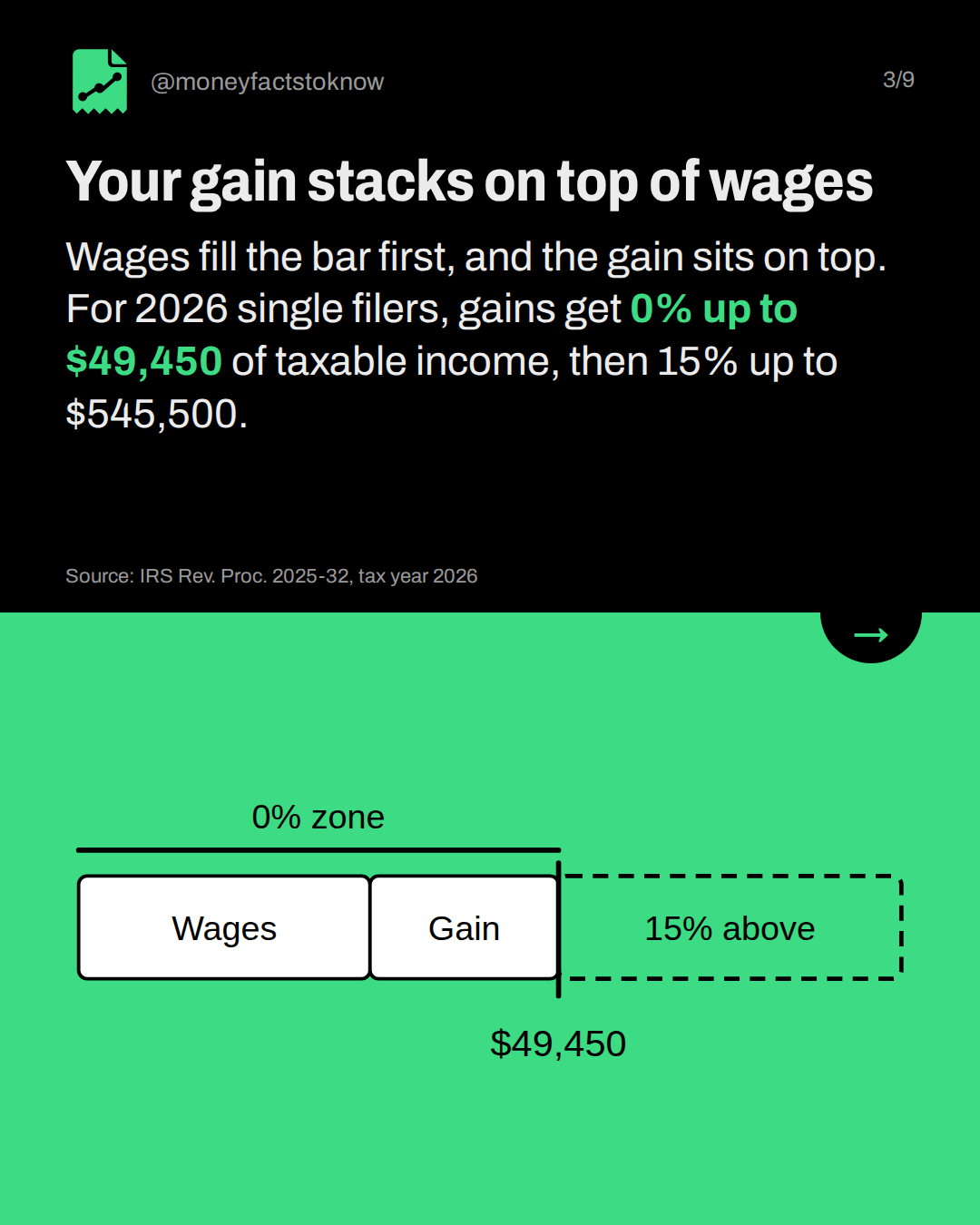
Your gain stacks on top of wages
Wages fill the bar first, and the gain sits on top. For 2026 single filers, gains get 0% up to $49,450 of taxable income, then 15% up to $545,500.
Source: IRS Rev. Proc. 2025-32, tax year 2026
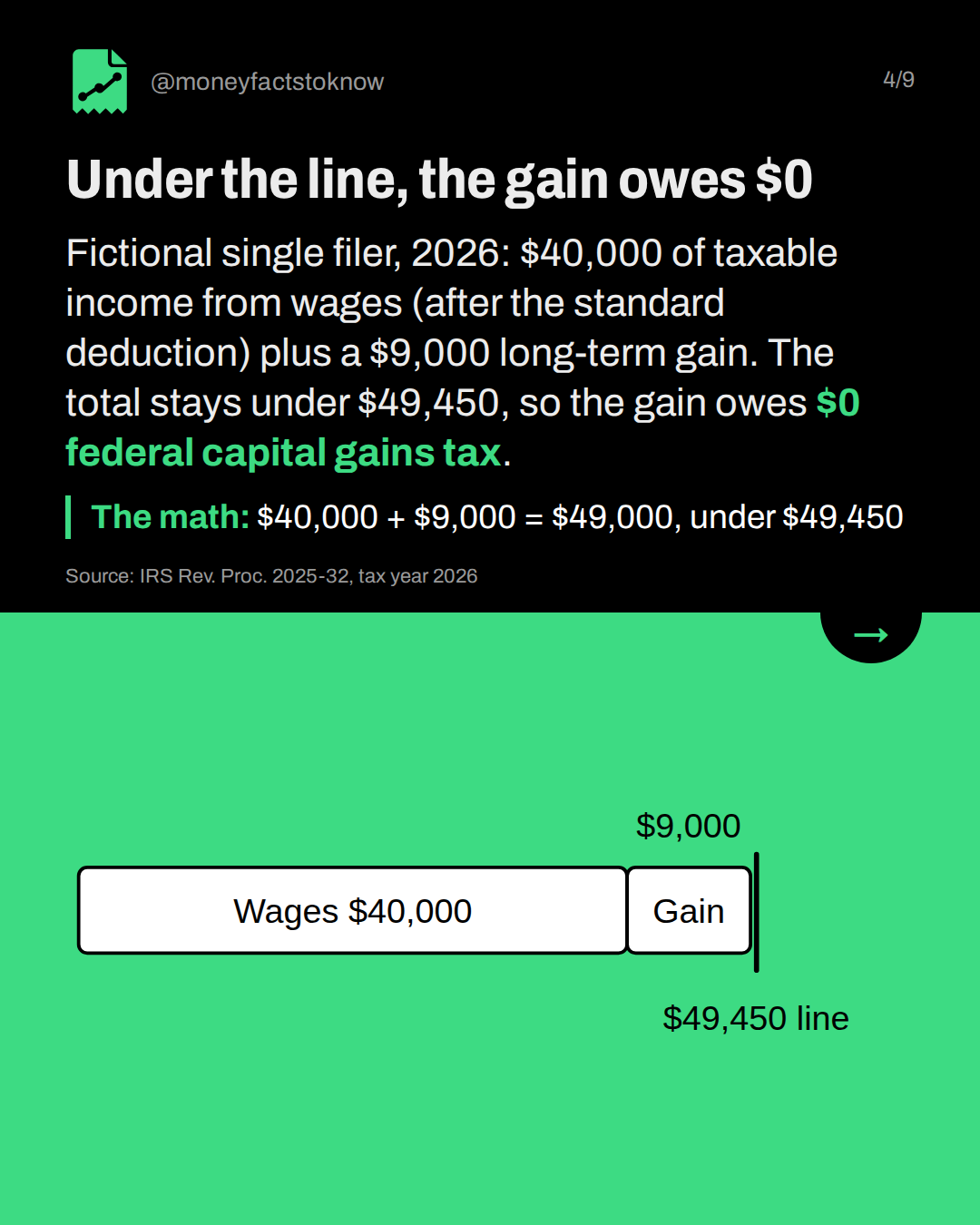
Under the line, the gain owes $0
Fictional single filer, 2026: $40,000 of taxable income from wages (after the standard deduction) plus a $9,000 long-term gain. The total stays under $49,450, so the gain owes $0 federal capital gains tax.
The math: $40,000 + $9,000 = $49,000, under $49,450
Source: IRS Rev. Proc. 2025-32, tax year 2026
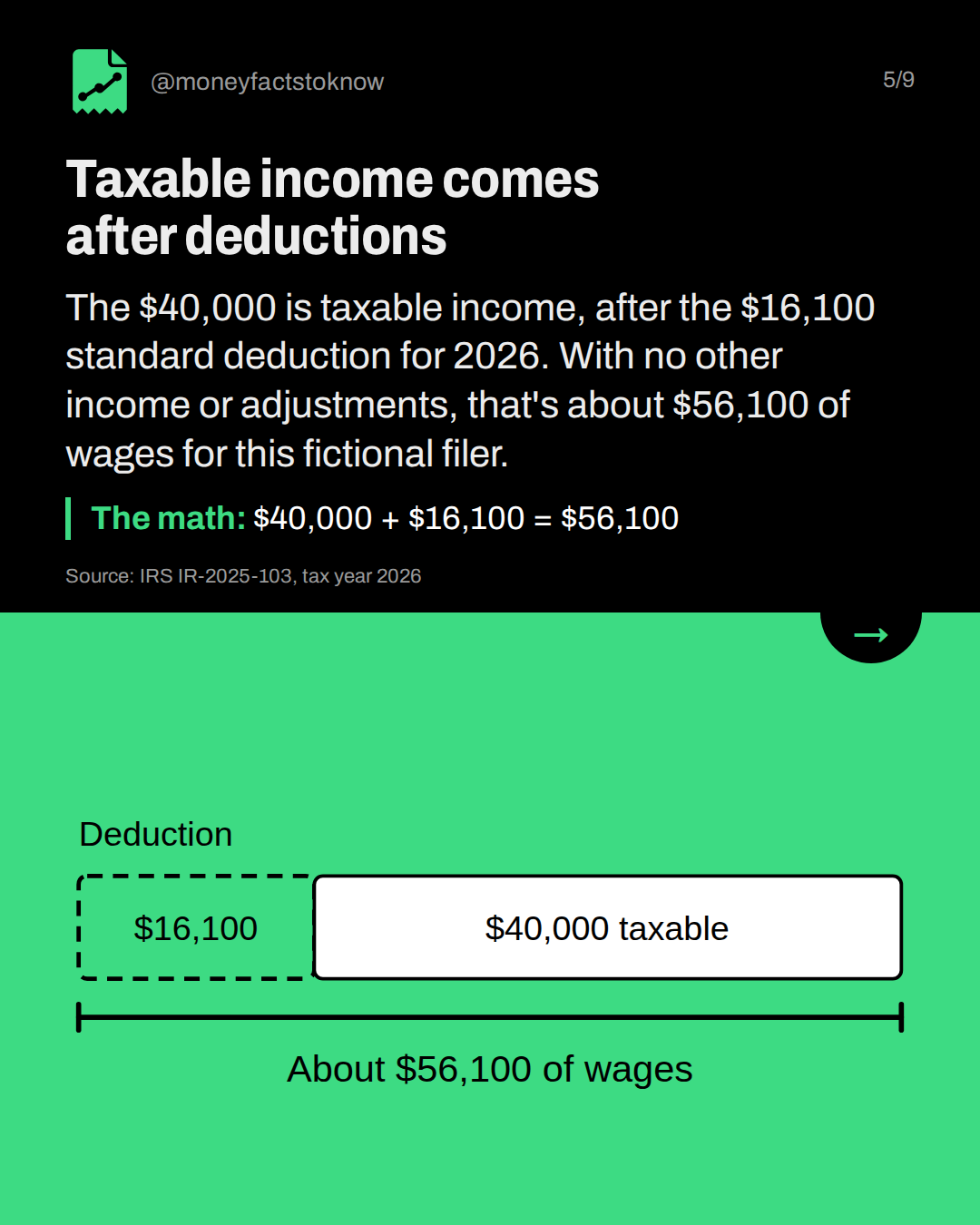
Taxable income comes after deductions
The $40,000 is taxable income, after the $16,100 standard deduction for 2026. With no other income or adjustments, that's about $56,100 of wages for this fictional filer.
The math: $40,000 + $16,100 = $56,100
Source: IRS IR-2025-103, tax year 2026
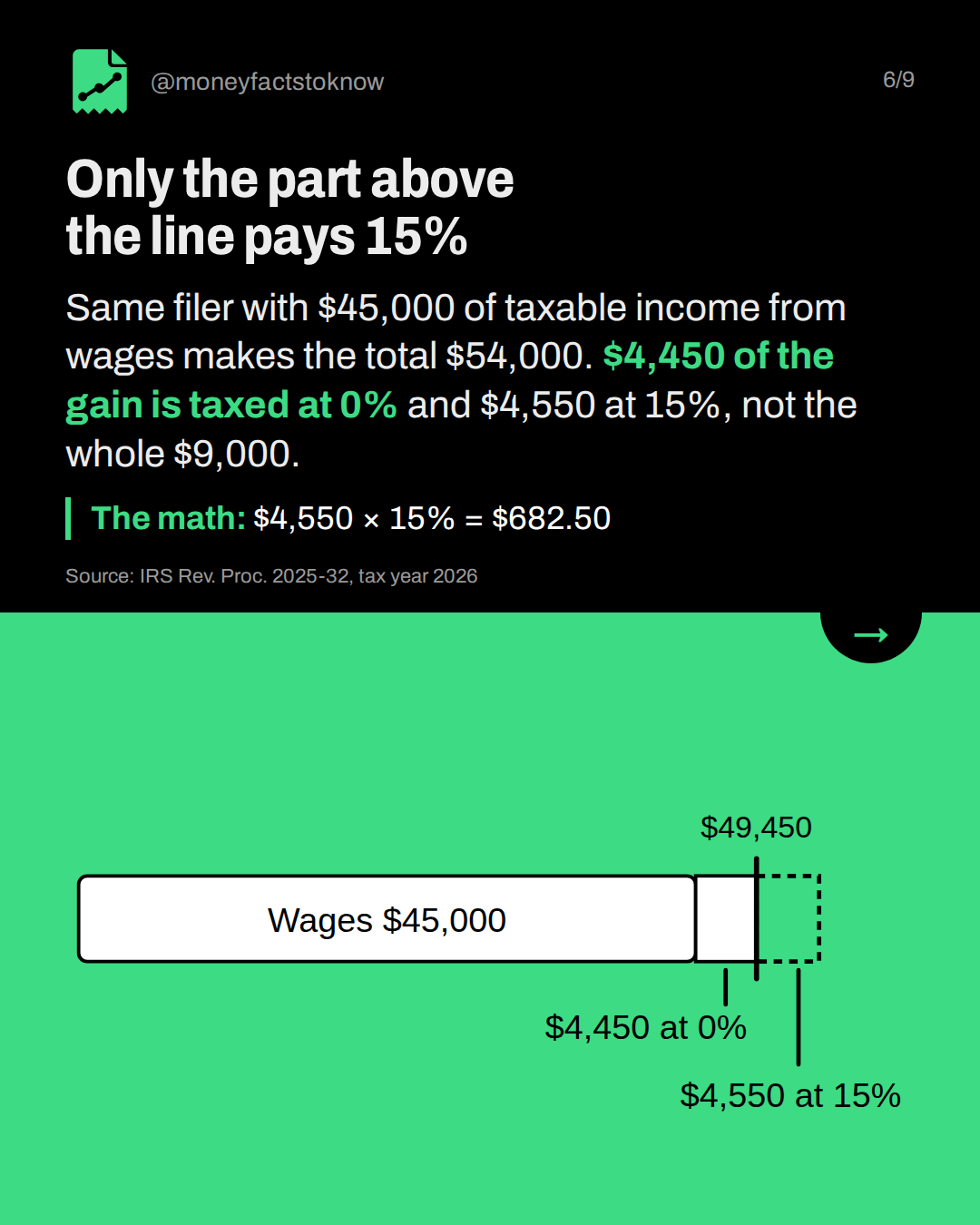
Only the part above the line pays 15%
Same filer with $45,000 of taxable income from wages makes the total $54,000. $4,450 of the gain is taxed at 0% and $4,550 at 15%, not the whole $9,000.
The math: $4,550 × 15% = $682.50
Source: IRS Rev. Proc. 2025-32, tax year 2026

When this example stops applying
Assets held one year or less are taxed as ordinary income. State tax may apply, and a higher AGI can affect other credits or benefits. Collectibles and some real estate gains follow different rules. Thresholds differ by filing status.
Source: IRS Topic no. 409
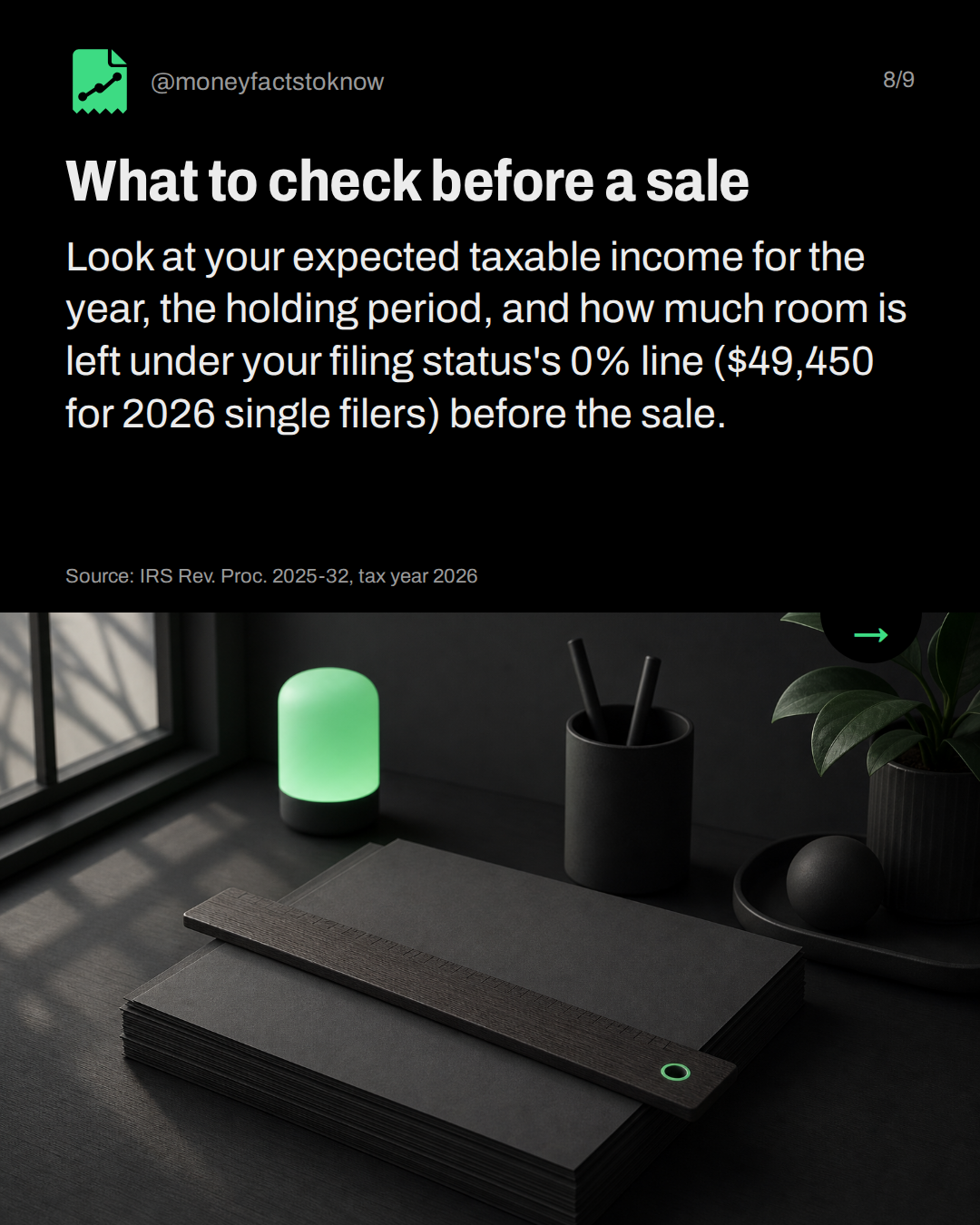
What to check before a sale
Look at your expected taxable income for the year, the holding period, and how much room is left under your filing status's 0% line ($49,450 for 2026 single filers) before the sale.
Source: IRS Rev. Proc. 2025-32, tax year 2026
Sources and assumptions
- IRS Rev. Proc. 2025-32 (Internal Revenue Bulletin 2025-45): 2026 maximum zero rate amount $49,450 and maximum 15% rate amount $545,500 for unmarried individuals; 2026 single brackets 10% up to $12,400, 12% up to $50,400 (checked 2026-10-15)
- IRS IR-2025-103, tax inflation adjustments for tax year 2026: 2026 standard deduction $16,100 for single filers; cites Rev. Proc. 2025-32 (checked 2026-10-15)
- IRS Topic no. 409, Capital gains and losses: 0% rate applies if taxable income is at or below the threshold; 15%/20% apply 'to the extent' taxable income exceeds thresholds; long-term = held more than one year (page shows 2025 figures; 2026 figures come from Rev. Proc. 2025-32) (checked 2026-10-15)
- Current Federal Tax Developments, Rev. Proc. 2025-32 analysis (secondary, used to locate the primary): 2026 0% thresholds: $98,900 married filing jointly, $66,200 head of household, $49,450 single/MFS (cross-check only) (checked 2026-10-15)
Assumptions:
- Fictional single filer, tax year 2026, federal tax only
- $40,000 (or $45,000) is taxable ordinary income after the $16,100 standard deduction, with no other income, adjustments or itemized deductions
- The $9,000 gain is long-term (asset held more than one year) and is the only capital gain, with no losses
- Gain is stacked on top of ordinary taxable income, as on the IRS Qualified Dividends and Capital Gain Tax Worksheet
- State income tax, the net investment income tax (not reached at this income) and effects of a higher AGI on other credits or benefits are not included
The short version
- Most long-term gains have 0%, 15% and 20% rates
- Your gain stacks on top of taxable income
- 2026 single filers: 0% up to $49,450
- Only the part above the line pays 15%


