 Money Facts To Know
Leave just $50 unpaid, and new purchases can start charging interest
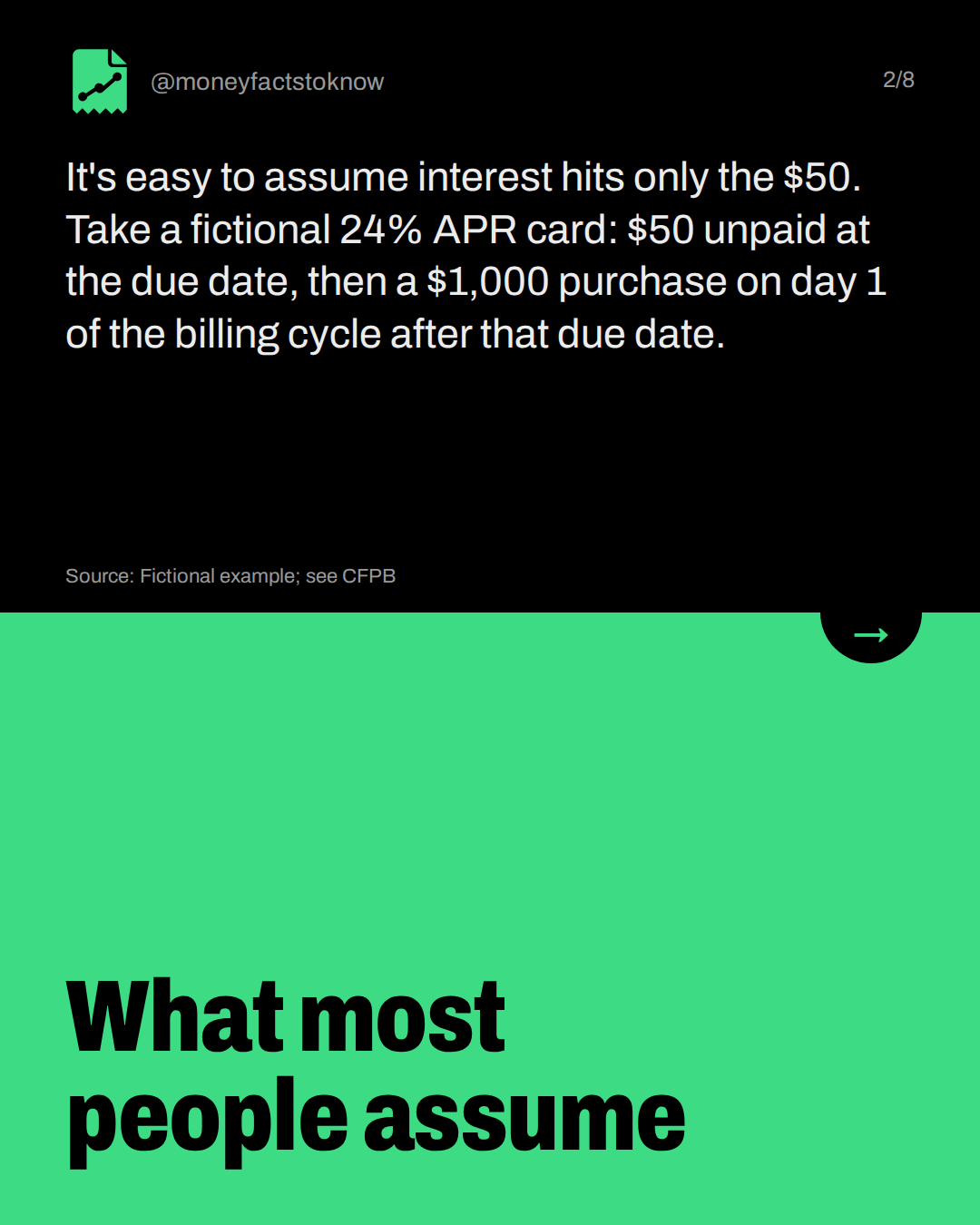
What most people assume
It's easy to assume interest hits only the $50. Take a fictional 24% APR card: $50 unpaid at the due date, then a $1,000 purchase on day 1 of the billing cycle after that due date.
Source: Fictional example; see CFPB
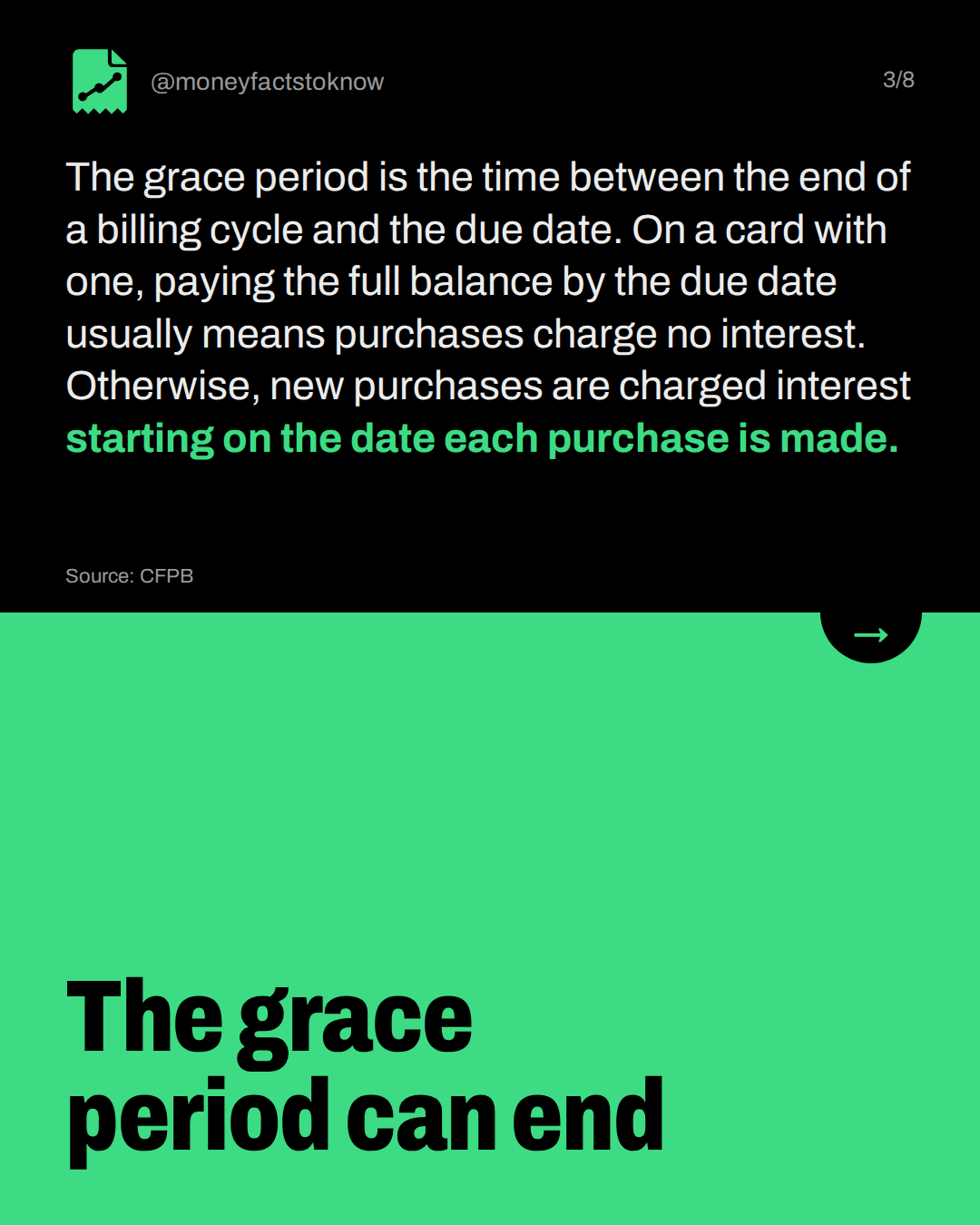
The grace period can end
The grace period is the time between the end of a billing cycle and the due date. On a card with one, paying the full balance by the due date usually means purchases charge no interest. Otherwise, new purchases are charged interest starting on the date each purchase is made.
Source: CFPB
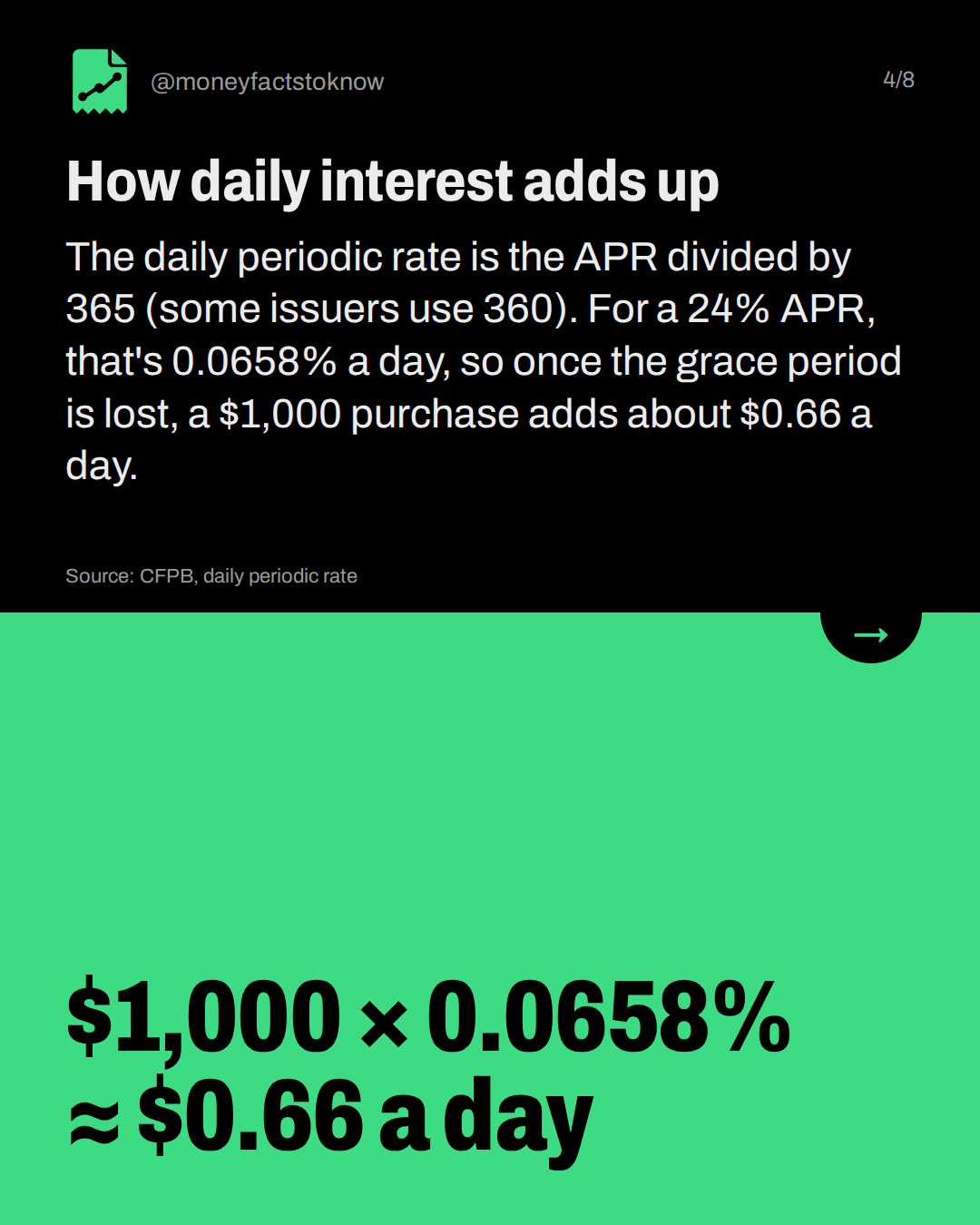
How daily interest adds up
The daily periodic rate is the APR divided by 365 (some issuers use 360). For a 24% APR, that's 0.0658% a day, so once the grace period is lost, a $1,000 purchase adds about $0.66 a day.
The math: $1,000 × 0.0658% ≈ $0.66 a day
Source: CFPB, daily periodic rate
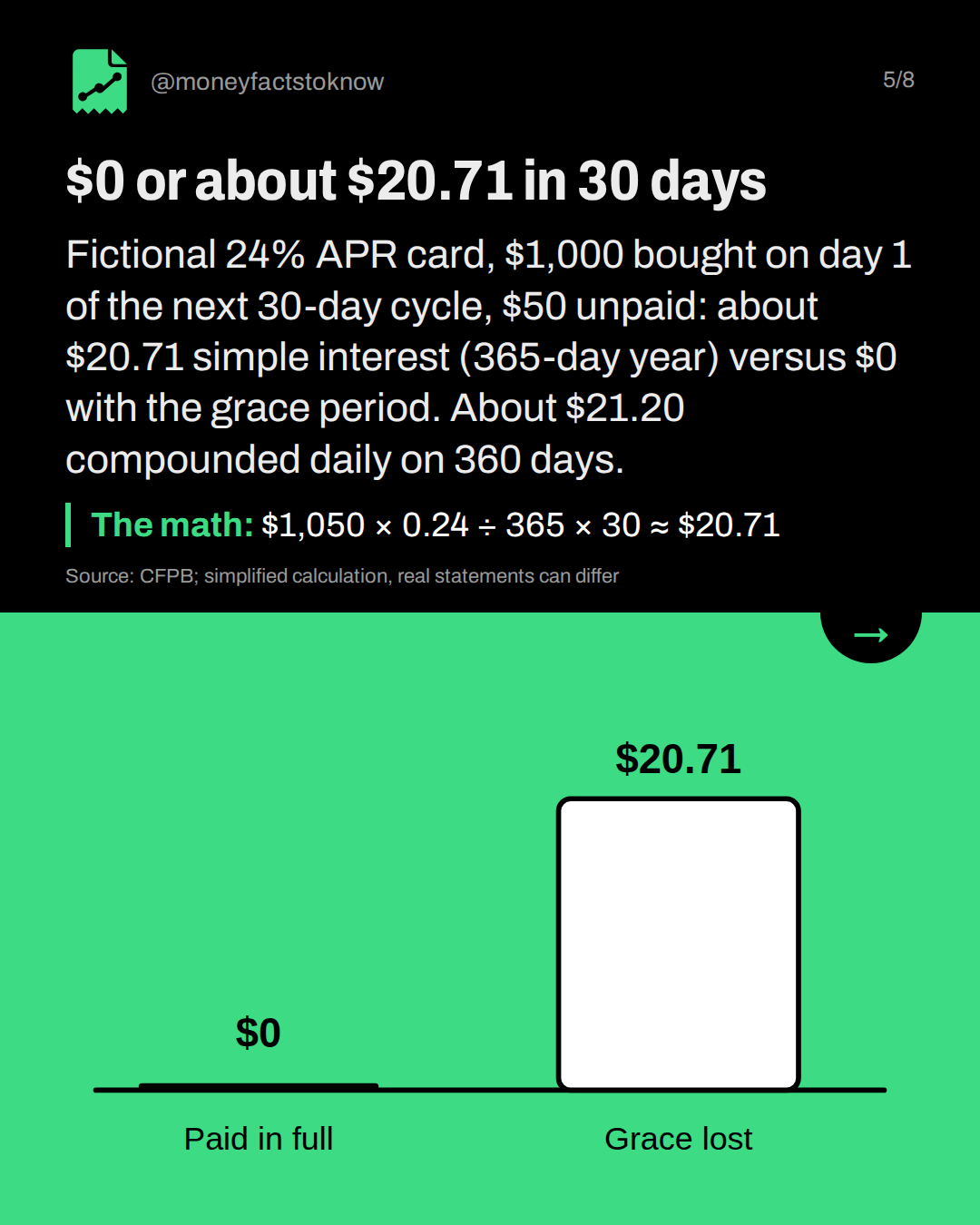
$0 or about $20.71 in 30 days
Fictional 24% APR card, $1,000 bought on day 1 of the next 30-day cycle, $50 unpaid: about $20.71 simple interest (365-day year) versus $0 with the grace period. About $21.20 compounded daily on 360 days.
The math: $1,050 × 0.24 ÷ 365 × 30 ≈ $20.71
Source: CFPB; simplified calculation, real statements can differ
Getting it back can take longer
You may lose the grace period for the month you don't pay in full and the month after. Federal rules bar that interest for cycles before your latest statement, or on the part paid by the due date.
The math: Your card's terms decide when it comes back.
Source: CFPB; 12 CFR 1026.54
The line to look for
In your card agreement's rate table, find 'How to Avoid Paying Interest' (or 'Paying Interest' on cards where some balances, like cash advances, get no grace period). Read the purchases line in that row.
The math: Check the due date rule and what it says about paying the entire balance.
Source: 12 CFR 1026.6(b)(2)(v)
Sources and assumptions
- CFPB: What is a grace period for a credit card?: Definition of the grace period (end of the billing cycle to the due date). If it's lost, interest is charged on the unpaid balance and on new-cycle purchases 'starting on the date each purchase is made.' Paying in full keeps it. Paying in full only some months 'may lose your grace period for the month that you don't pay in full and for the month after.' Bills must be delivered at least 21 days before the due date. (checked 2026-10-14)
- CFPB: What is a daily periodic rate?: The daily periodic rate is APR divided by 360 or 365 depending on the issuer, multiplied by the balance owed at the end of each day, and compounds daily. (checked 2026-10-14)
- CFPB Regulation Z, 12 CFR 1026.54 (limits on finance charges from loss of a grace period): Issuers may not charge finance charges caused by losing a grace period on balances for days in billing cycles before the most recent one, or on any portion repaid before the grace period expired. (checked 2026-10-14)
- CFPB Regulation Z, 12 CFR 1026.6(b)(2)(v) (account-opening disclosure of the grace period): The card's account-opening table must disclose the grace period and its conditions under the heading 'How to Avoid Paying Interest' ('Paying Interest' if no grace period applies to all features). Model language: 'We will not charge you any interest on your account if you pay your entire balance by the due date each month.' (checked 2026-10-14)
- CFPB bulletin 2014-02 on marketing promotional APR offers: Unpaid purchase amounts are subject to interest from the date of purchase (or the first day of the current billing cycle, whichever is later), and the consumer loses the grace period on new purchases in current and future cycles until the conditions are met again (seen via search summary; used for background only, not quoted on slides). (checked 2026-10-14)
Assumptions:
- Fictional card; not any real product's terms.
- Purchase APR 24%, with no promotional or penalty rate.
- Previous statement balance paid except $50, which is carried past the due date, so the grace period is lost under this card's terms.
- $1,000 purchase made on day 1 of the next billing cycle; 30-day billing cycle; no other purchases, payments or fees in that cycle.
- Daily periodic rate = APR ÷ 365. Headline figures are simple (non-compounded) daily interest for 30 days, labeled as a simplified estimate; daily compounding and a 360-day year are shown as the high end.
- If the grace period had applied and the full statement balance was paid by the due date, the $1,000 purchase would carry $0 purchase interest.
- Federal rules (Reg Z); how a lost grace period is restored depends on each card's agreement.
The short version
- The grace period ends at the due date.
- Pay in full and purchases usually charge no interest.
- A partial payment can lose it.
- Then interest can run from purchase day.
- Check the 'How to Avoid Paying Interest' or 'Paying Interest' line.


