 Money Facts To Know
Same 4% rate. Only the CD can owe state tax.

Same quoted rate looks like a tie
A CD and a T-bill (a short-term U.S. Treasury security) both quote a fictional 4%, so it's easy to call them a tie. But that compares rates before tax, and states can tax their interest differently.
Source: IRS Topic 403; fictional example rates
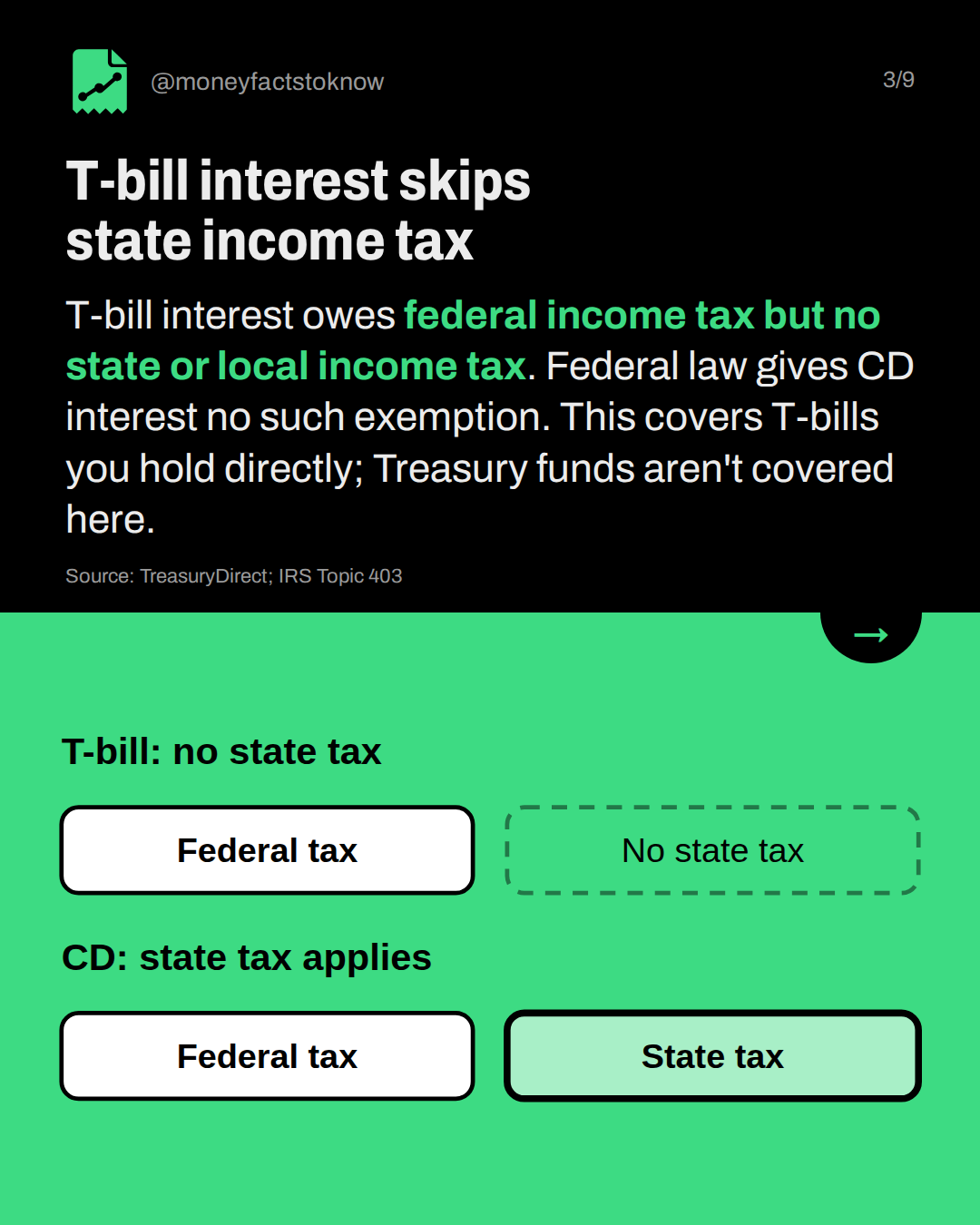
T-bill interest skips state income tax
T-bill interest owes federal income tax but no state or local income tax. Federal law gives CD interest no such exemption. This covers T-bills you hold directly; Treasury funds aren't covered here.
Source: TreasuryDirect; IRS Topic 403

The fictional setup
A fictional saver puts $10,000 in each, in a taxable account, for a year. Each earns $400 (rounded), a 4% yield: CD APY, T-bill investment rate. Assumed: 22% federal bracket (tax year 2026), flat 5% state tax.
The math: $400 × 22% = $88 federal on each
Source: Fictional example; IRS Topic 403; IRS Rev. Proc. 2025-32 (tax year 2026); TreasuryDirect
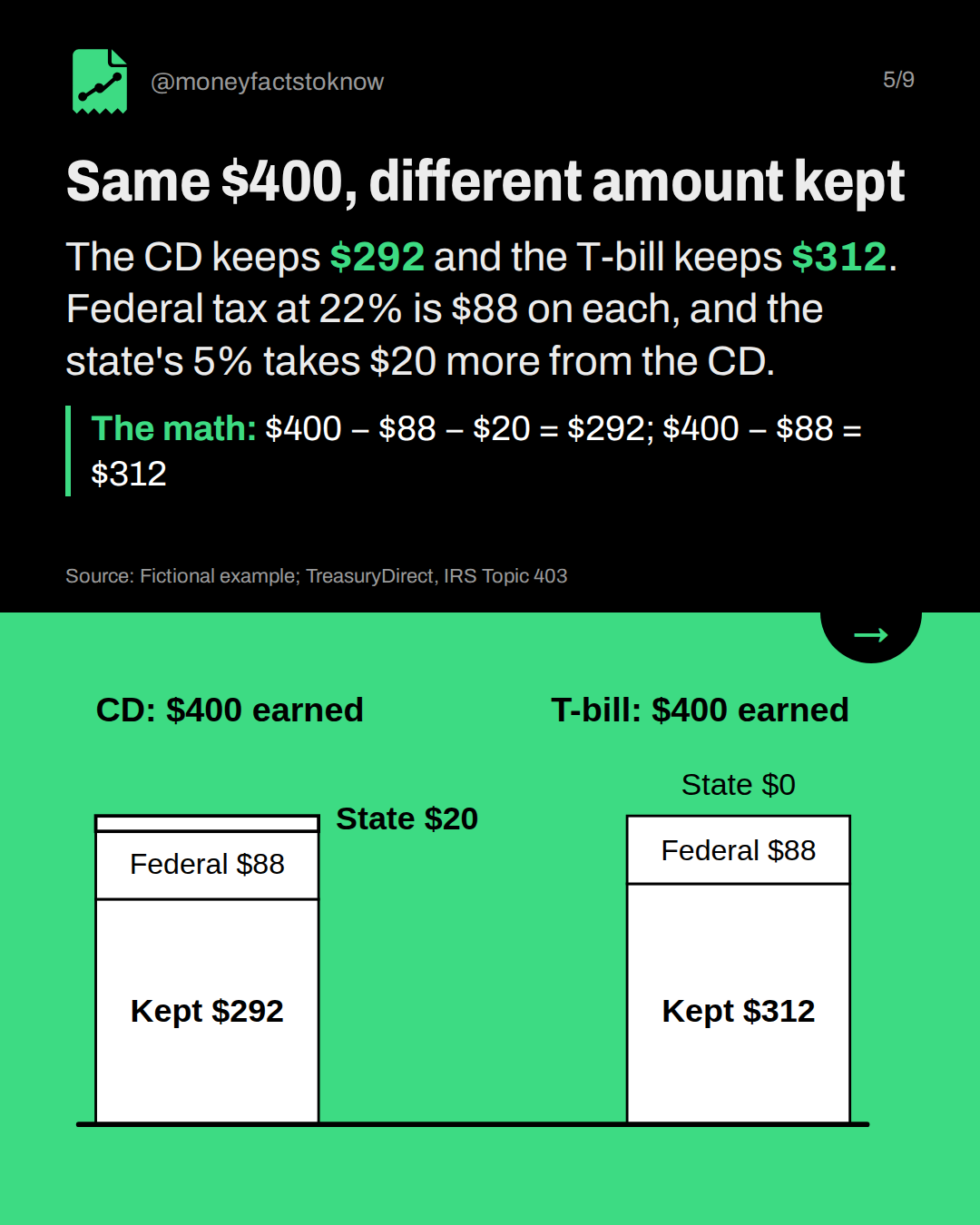
Same $400, different amount kept
The CD keeps $292 and the T-bill keeps $312. Federal tax at 22% is $88 on each, and the state's 5% takes $20 more from the CD.
The math: $400 − $88 − $20 = $292; $400 − $88 = $312
Source: Fictional example; TreasuryDirect, IRS Topic 403
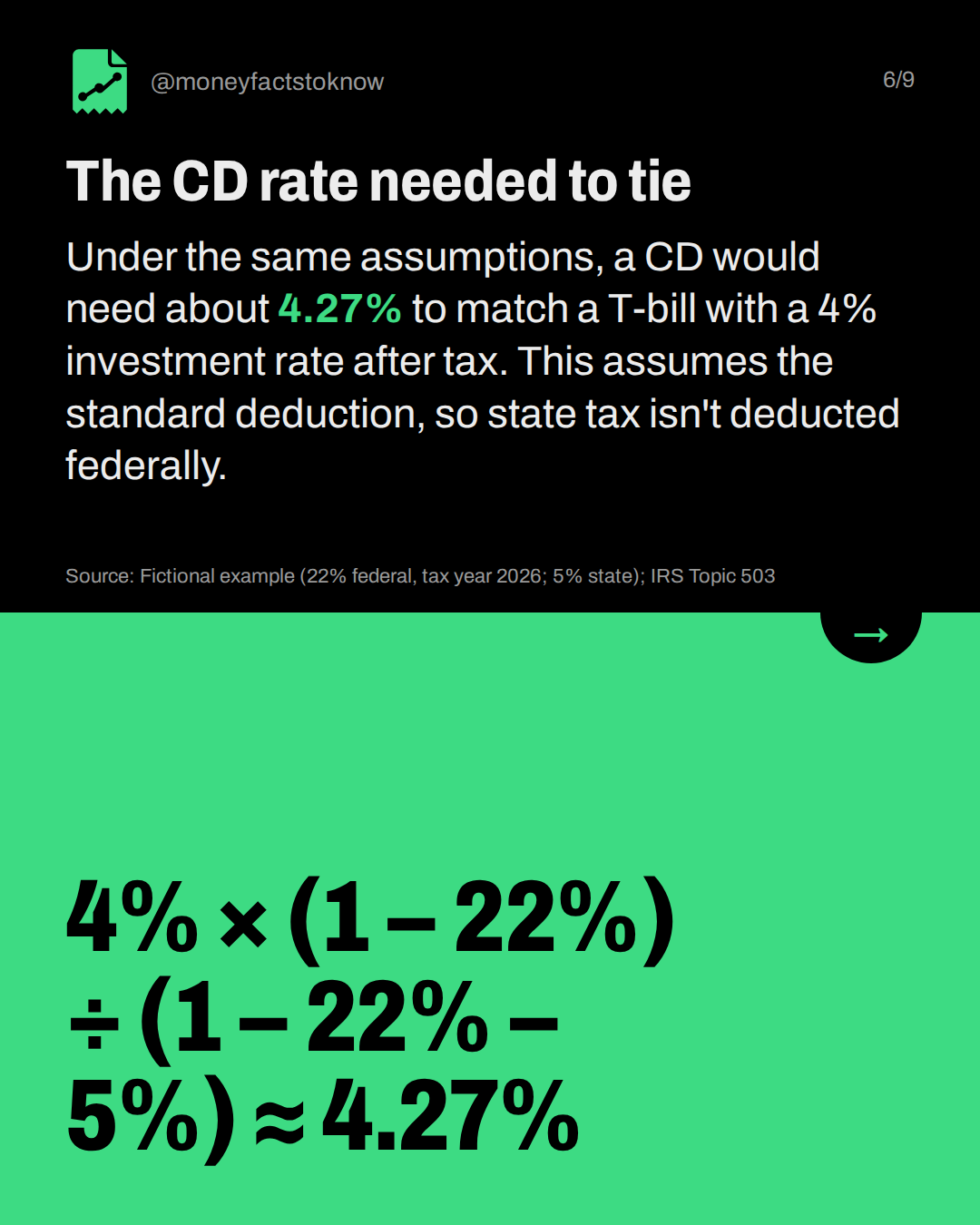
The CD rate needed to tie
Under the same assumptions, a CD would need about 4.27% to match a T-bill with a 4% investment rate after tax. This assumes the standard deduction, so state tax isn't deducted federally.
The math: 4% × (1 − 22%) ÷ (1 − 22% − 5%) ≈ 4.27%
Source: Fictional example (22% federal, tax year 2026; 5% state); IRS Topic 503
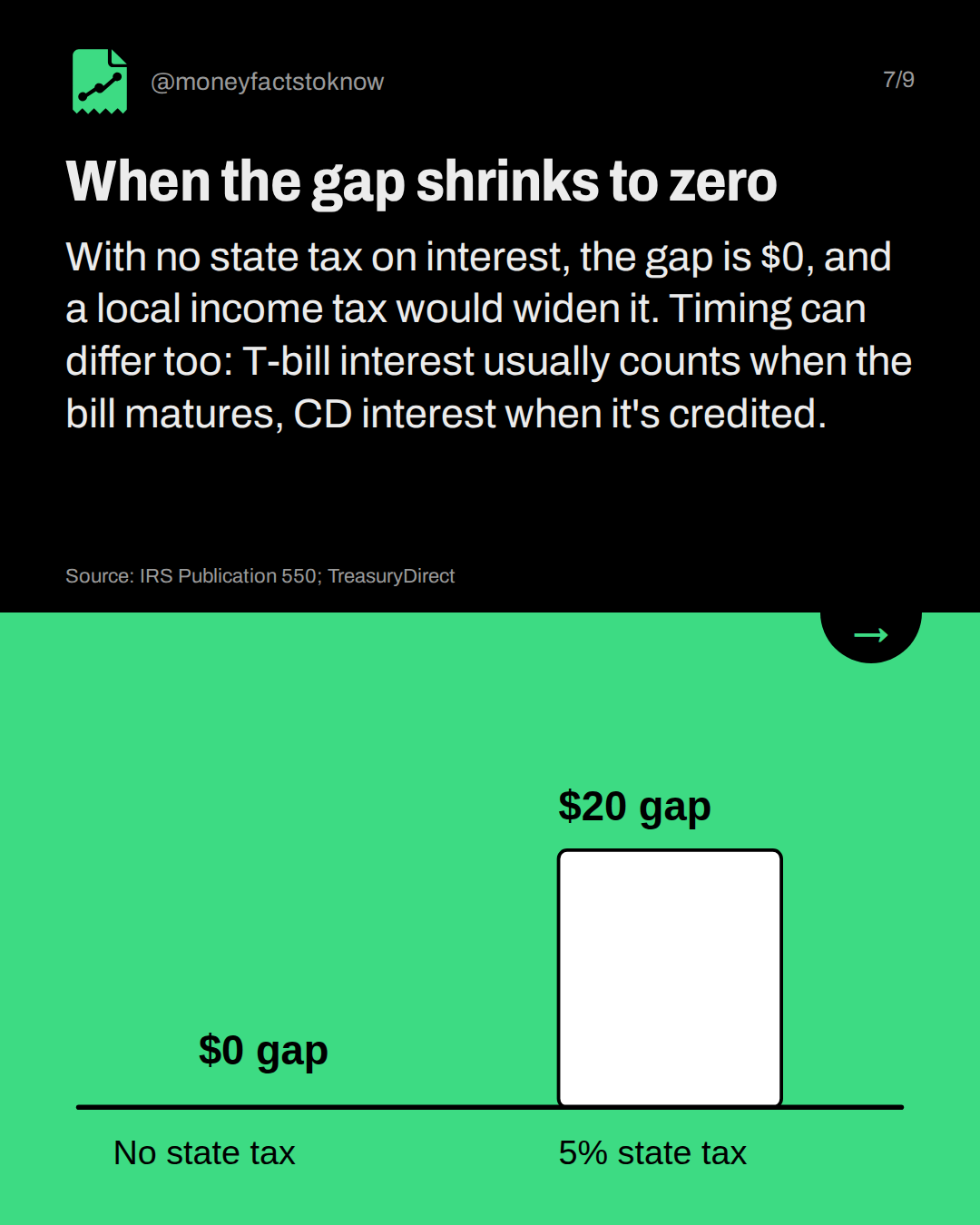
When the gap shrinks to zero
With no state tax on interest, the gap is $0, and a local income tax would widen it. Timing can differ too: T-bill interest usually counts when the bill matures, CD interest when it's credited.
Source: IRS Publication 550; TreasuryDirect

Compare dollars kept, not rates
Check your state's tax rate on interest, your federal bracket, and whether the account is taxable. This compares taxable accounts, not an IRA or 401(k). Then compare after-tax dollars, not quoted rates.
Source: IRS Topic 403
Sources and assumptions
- TreasuryDirect: Treasury Bills: Taxes: 'Federal tax due on interest earned. No state or local taxes'. Bill interest is 'the difference between what you paid and the face value you get when the bill matures'. Interest is paid 'When the bill matures'. (checked 2026-10-13)
- IRS Topic no. 403, Interest received: Interest on bank accounts, money market accounts and certificates of deposit is taxable interest. Interest on U.S. Treasury bills, notes and bonds 'is subject to federal income tax but is exempt from all state and local income taxes.' (checked 2026-10-13)
- 31 U.S. Code § 3124(a) (Cornell LII): 'Stocks and obligations of the United States Government are exempt from taxation by a State or political subdivision of a State', including taxes that would count the interest. Exceptions: nondiscriminatory corporate franchise taxes and estate/inheritance taxes. (checked 2026-10-13)
- IRS Publication 550, Investment Income and Expenses: Interest on U.S. obligations is exempt from state and local income taxes. T-bill interest is the discount and is reported in the year the bill matures. CD interest is reported in the year it is credited or made available (WebFetch returned a summary, not the verbatim text). (checked 2026-10-13)
- Colorado Department of Revenue: Income Tax Topics, U.S. Government Interest: Example of how a state applies the exemption: a subtraction from federal taxable income is allowed only for U.S. government obligation interest ('interest on U.S. Treasury bonds, notes, bills, certificates, and savings bonds'). Bank deposit interest is not on the list. (checked 2026-10-13)
- IRS newsroom: IRS releases tax inflation adjustments for tax year 2026 (Rev. Proc. 2025-32): Tax year 2026 marginal rates: '22% for incomes over $50,400 ($100,800 for married couples filing jointly)'; details in Revenue Procedure 2025-32. (checked 2026-10-13)
- IRS Topic no. 503, Deductible taxes: 'You may deduct as an itemized deduction, state and local income taxes withheld from your wages during the year'; the SALT deduction (Schedule A lines 5a, 5b and 5c) is limited to a combined total, with an MAGI-based reduction that does not go below $10,000. (checked 2026-10-13)
Assumptions:
- Fictional saver with $10,000 in a taxable account (not an IRA or 401(k))
- Both products earn exactly $400 of interest over one year (4% on $10,000). The T-bill is treated as a one-year bill that earns $400 of discount, ignoring the difference between the discount rate and the investment rate
- Assumed 22% federal marginal bracket for tax year 2026 (taxable income over $50,400 single or $100,800 married filing jointly), applied to all $400 of interest
- Fictional state with an assumed flat 5% income tax that taxes bank and CD interest like other income, with no special exclusion for bank interest and no local income tax
- Standard deduction, so state tax paid is not deducted on the federal return (this is what makes the 4.27% tie rate exact)
- Interest and tax for one year only. Timing differences between maturity and crediting are ignored in the dollar figures
The short version
- T-bill interest skips state income tax
- CD interest can owe state tax too
- Fictional 5% state: $312 vs $292 kept
- A tie needs the CD near 4.27%
- Compare after-tax dollars


