 Money Facts To Know
Your bonus isn't taxed at a higher rate. It's withheld differently

A bonus has no special tax rate
Bonus checks look smaller, so it feels like they're taxed higher. But a bonus is regular wages on your W-2. There's no special bonus tax rate.
Source: IRS Publication 525 (2025)
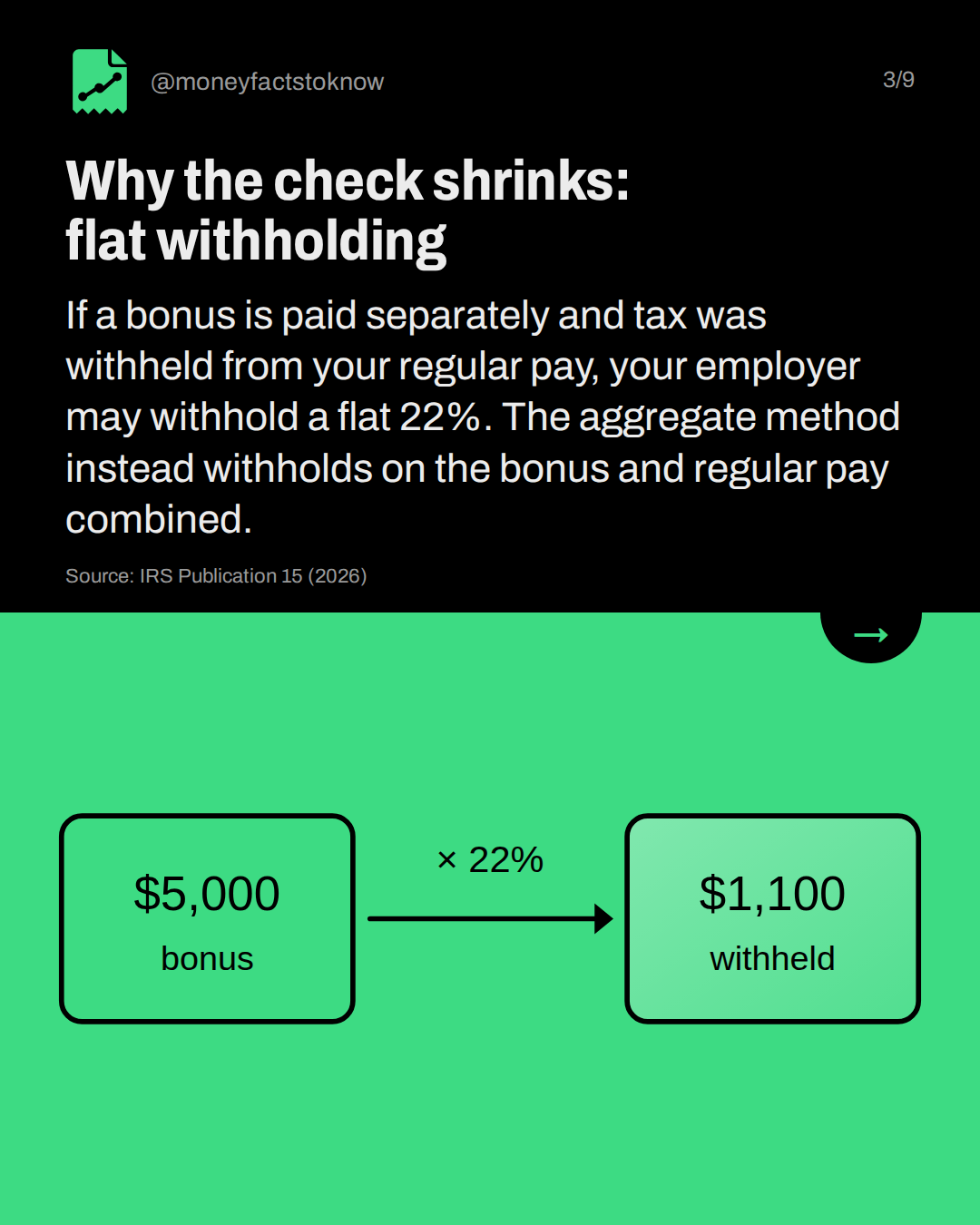
Why the check shrinks: flat withholding
If a bonus is paid separately and tax was withheld from your regular pay, your employer may withhold a flat 22%. The aggregate method instead withholds on the bonus and regular pay combined.
Source: IRS Publication 15 (2026)
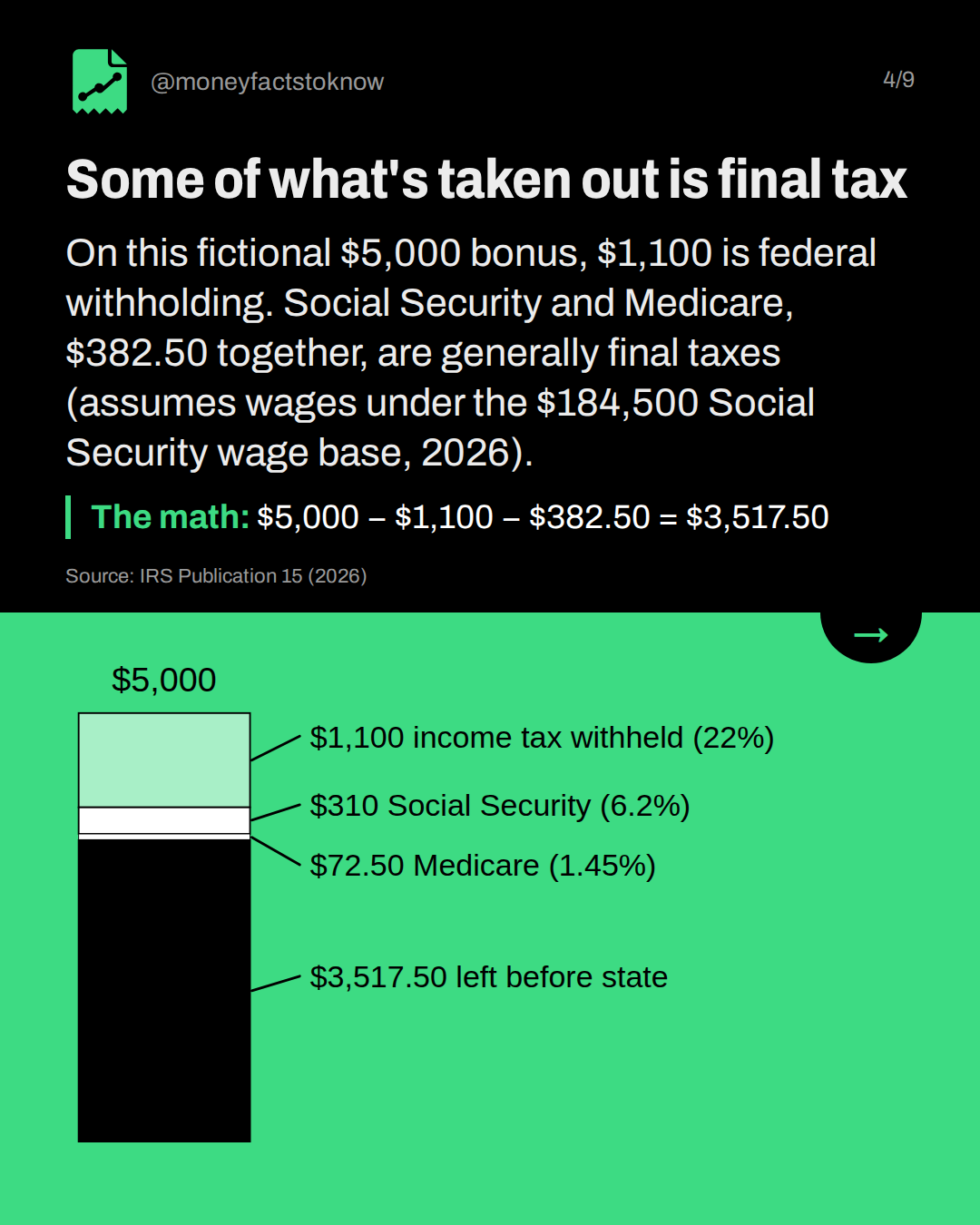
Some of what's taken out is final tax
On this fictional $5,000 bonus, $1,100 is federal withholding. Social Security and Medicare, $382.50 together, are generally final taxes (assumes wages under the $184,500 Social Security wage base, 2026).
The math: $5,000 − $1,100 − $382.50 = $3,517.50
Source: IRS Publication 15 (2026)
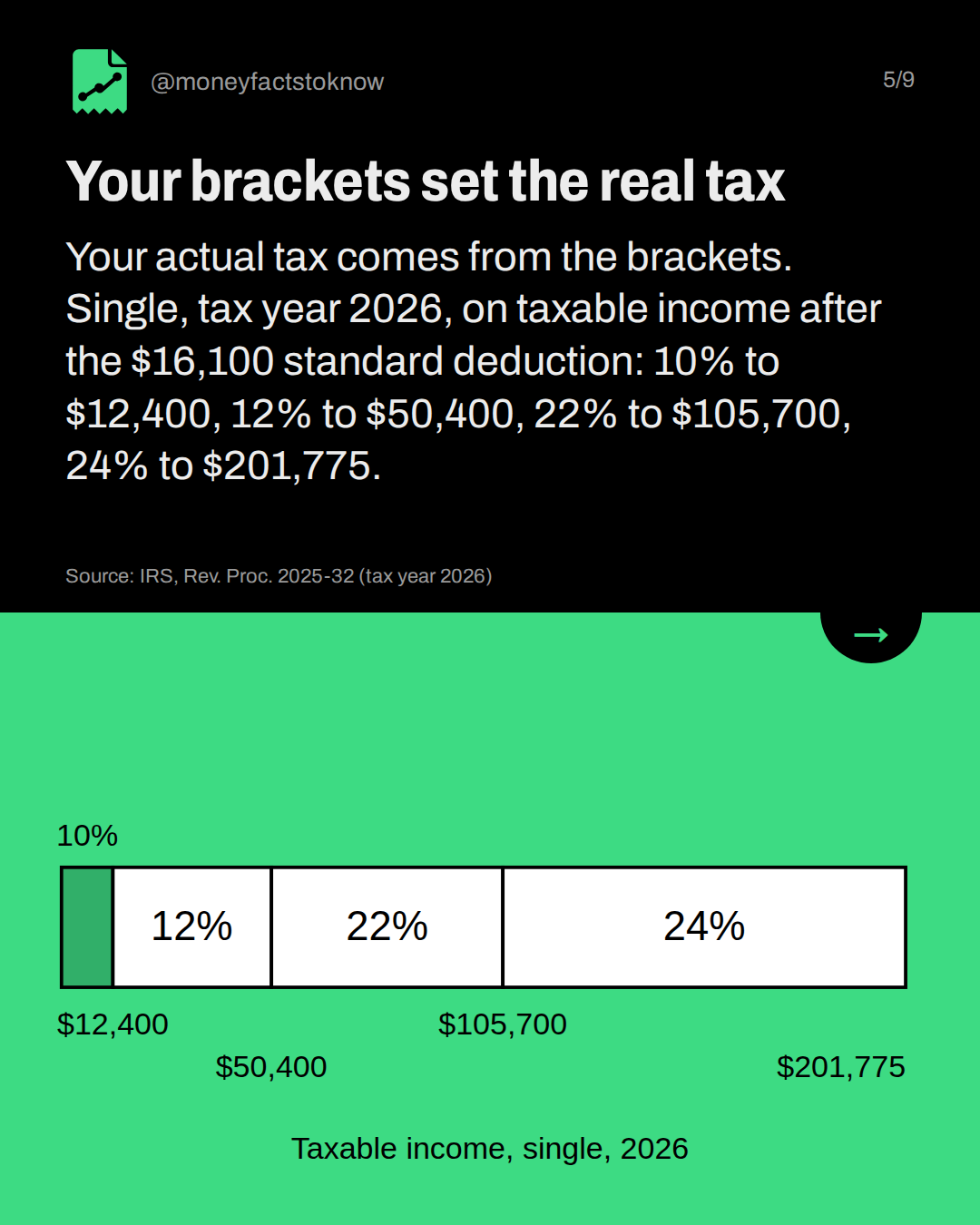
Your brackets set the real tax
Your actual tax comes from the brackets. Single, tax year 2026, on taxable income after the $16,100 standard deduction: 10% to $12,400, 12% to $50,400, 22% to $105,700, 24% to $201,775.
Source: IRS, Rev. Proc. 2025-32 (tax year 2026)
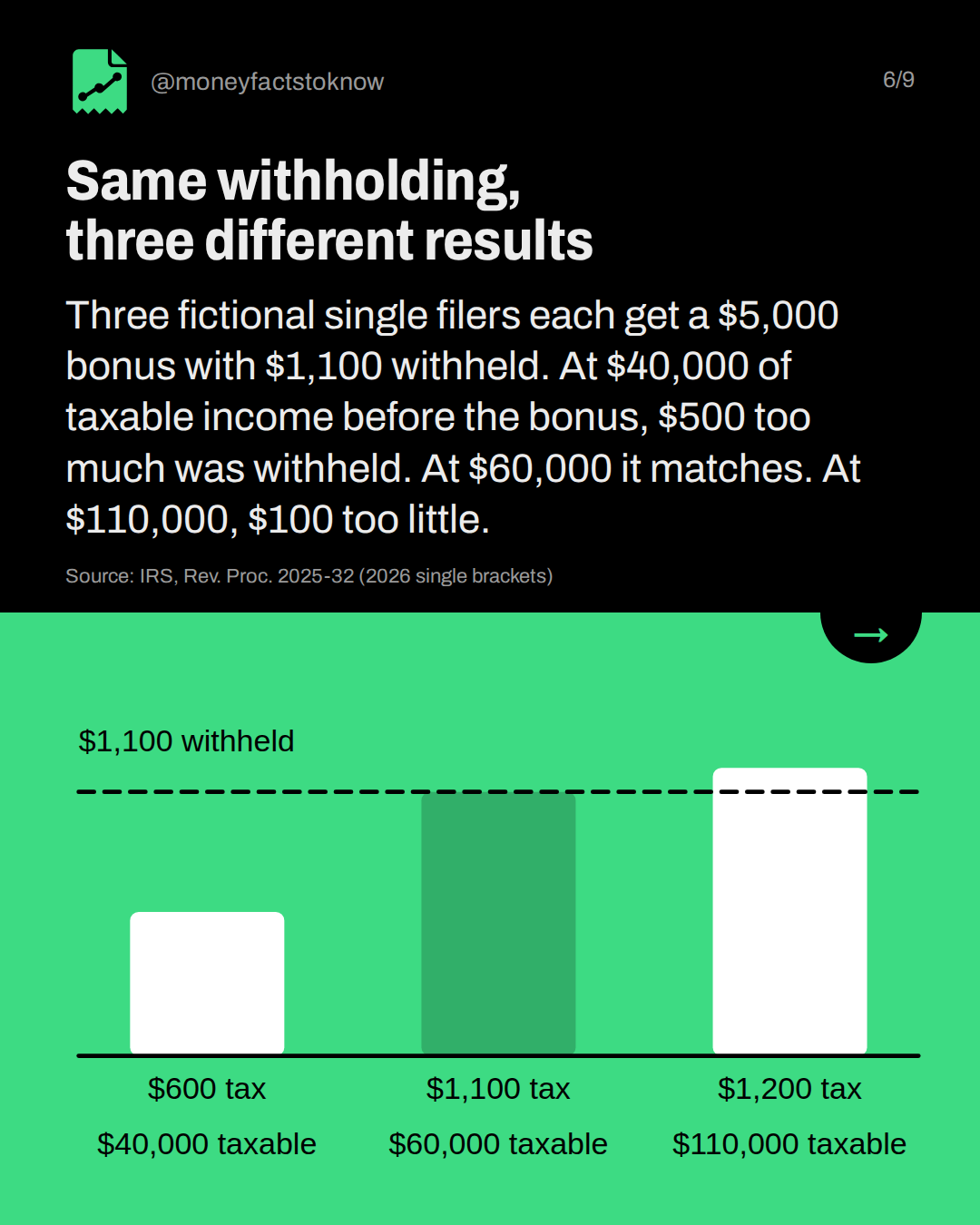
Same withholding, three different results
Three fictional single filers each get a $5,000 bonus with $1,100 withheld. At $40,000 of taxable income before the bonus, $500 too much was withheld. At $60,000 it matches. At $110,000, $100 too little.
Source: IRS, Rev. Proc. 2025-32 (2026 single brackets)
When this example stops applying
This assumes federal income tax, no change to credits or deductions, and accurate withholding on regular pay. Too much withheld generally comes back at filing; too little, you owe the rest, and possibly interest and a penalty.
Source: IRS Publication 505 (2026)
What to check on your pay stub
On your bonus pay stub, check which federal withholding was used: the 22% flat rate, or combined with regular pay. Then compare 22% with the bracket(s) your bonus falls in for the year.
Source: IRS Publication 15 (2026)
Sources and assumptions
- IRS Publication 15 (2026), Circular E, Employer's Tax Guide: Optional 22% flat-rate withholding on supplemental wages when they're paid or identified separately and income tax was withheld from regular wages; mandatory 37% on supplemental wages over $1 million in the calendar year; aggregate method as the alternative; supplemental wages subject to Social Security (6.2% employee, $184,500 wage base in 2026) and Medicare (1.45% employee, no wage base limit) (checked 2026-10-13)
- IRS newsroom: IRS releases tax inflation adjustments for tax year 2026 (Rev. Proc. 2025-32): 2026 single brackets: 10% up to $12,400, 12% over $12,400, 22% over $50,400, 24% over $105,700, 32% over $201,775, 35% over $256,225, 37% over $640,600. Single standard deduction $16,100 (checked 2026-10-13)
- IRS Publication 505 (2026), Tax Withholding and Estimated Tax: An employer may withhold income tax on supplemental wages at a 22% flat rate under certain circumstances. 'If too much tax is withheld, you will lose the use of that money until you get your refund. If not enough tax is withheld, you will owe tax at the end of the year and may have to pay interest and a penalty.' (checked 2026-10-13)
- IRS Publication 525 (2025), Taxable and Nontaxable Income: 'Bonuses or awards ... you receive for outstanding work are included in your income and should be shown on your Form W-2.' A bonus is ordinary wage income, with no separate bonus tax rate (checked 2026-10-13)
Assumptions:
- The $5,000 bonus and every filer are fictional
- Single filer, federal income tax, tax year 2026
- The bonus is paid or identified separately from regular wages, income tax was withheld from regular wages, and the employer chooses the optional 22% flat rate (it could use the aggregate method instead)
- Bracket incomes are taxable income after the $16,100 standard deduction, before the bonus is added
- The bonus doesn't change any credit, deduction or phase-out, and the filer's regular-pay withholding otherwise matches their tax on regular wages
- The employee hasn't reached the $184,500 Social Security wage base, so 6.2% applies to the whole bonus. Additional Medicare tax doesn't apply (wages under $200,000)
- State and local withholding vary by state and aren't calculated
The short version
- A bonus is regular wages on your W-2
- 22% is withholding, not necessarily your tax rate
- Brackets set the real tax when you file
- Social Security and Medicare are generally final taxes


