 Money Facts To Know
The Saver's Credit pays 50%. Why this saver gets $793, not $1,000

The headline number is $1,000
Form 8880 shows 50% on up to $2,000, so it's easy to assume $2,000 in means $1,000 back. You must also be 18+, not a dependent, and not a full-time student during any part of 5 months.
Source: IRS Form 8880 (2025) instructions; rules unchanged for tax year 2026
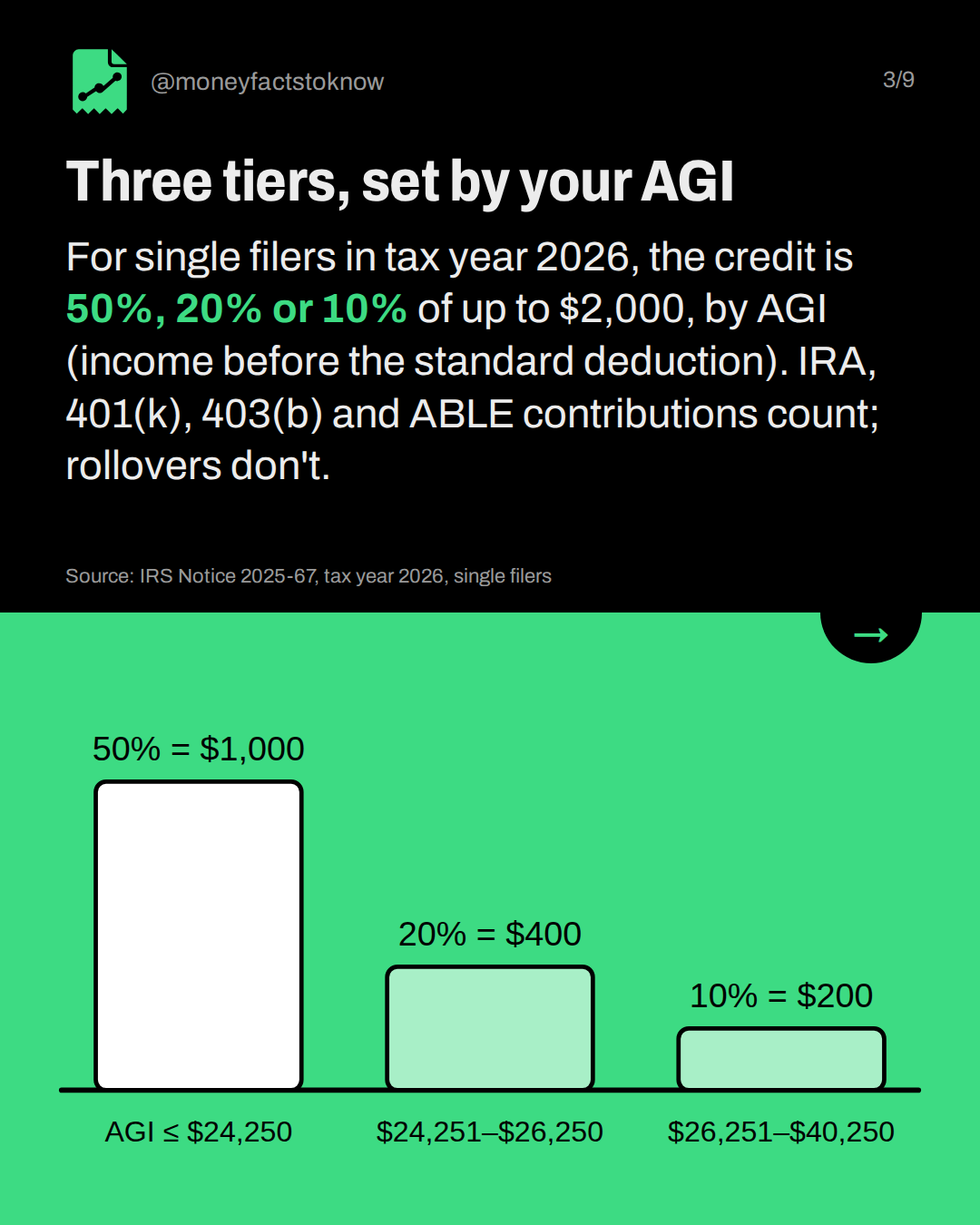
Three tiers, set by your AGI
For single filers in tax year 2026, the credit is 50%, 20% or 10% of up to $2,000, by AGI (income before the standard deduction). IRA, 401(k), 403(b) and ABLE contributions count; rollovers don't.
Source: IRS Notice 2025-67, tax year 2026, single filers
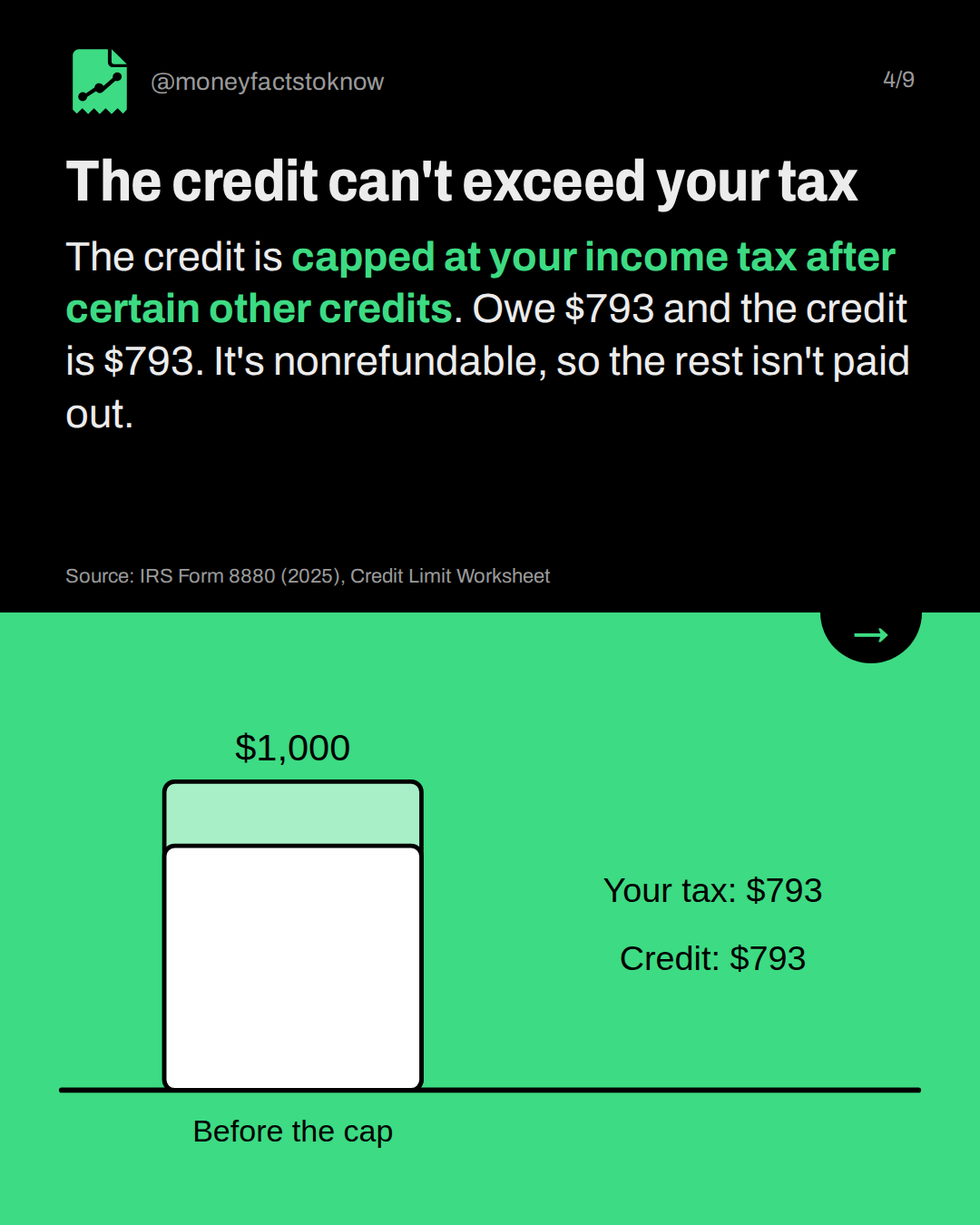
The credit can't exceed your tax
The credit is capped at your income tax after certain other credits. Owe $793 and the credit is $793. It's nonrefundable, so the rest isn't paid out.
Source: IRS Form 8880 (2025), Credit Limit Worksheet
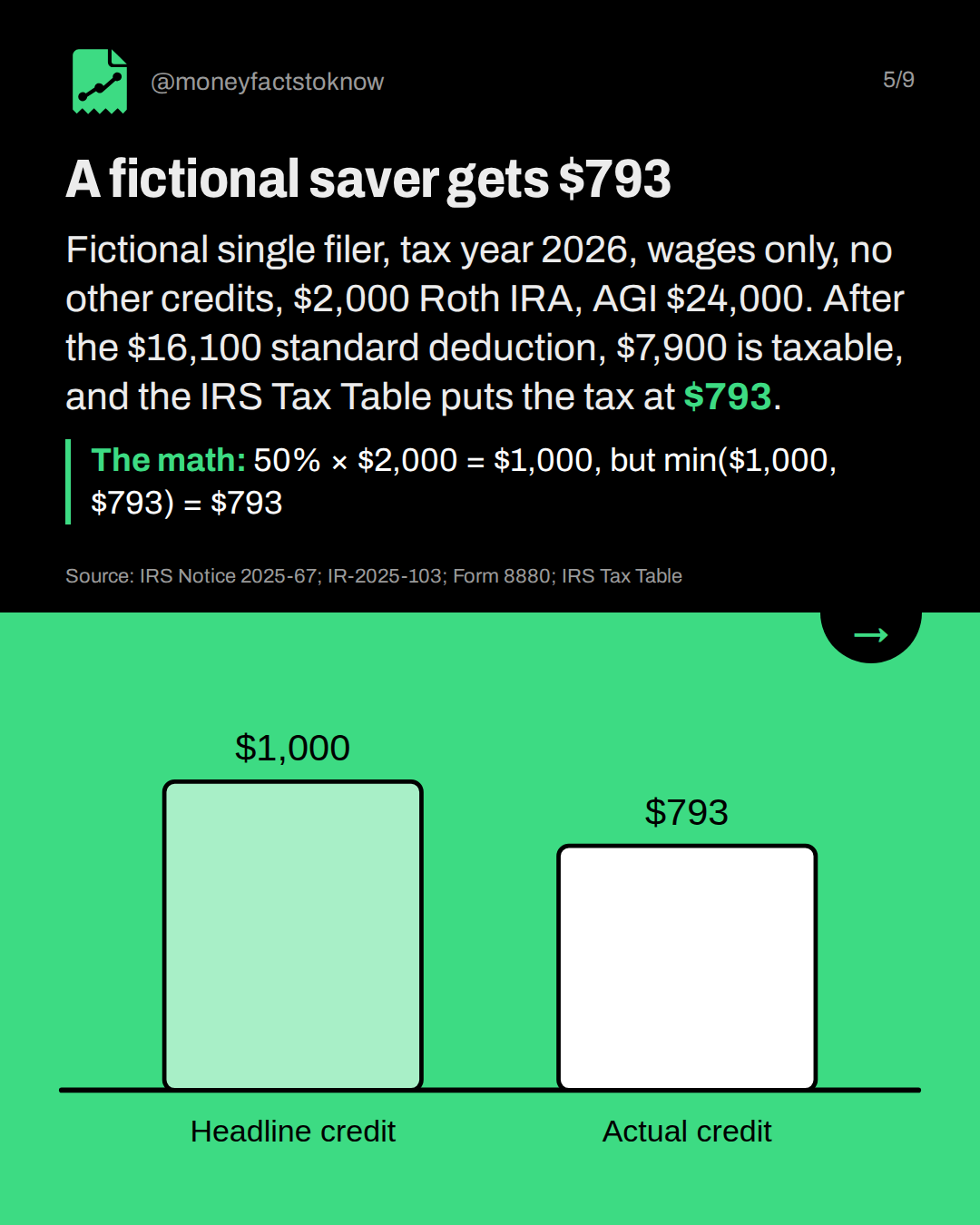
A fictional saver gets $793
Fictional single filer, tax year 2026, wages only, no other credits, $2,000 Roth IRA, AGI $24,000. After the $16,100 standard deduction, $7,900 is taxable, and the IRS Tax Table puts the tax at $793.
The math: 50% × $2,000 = $1,000, but min($1,000, $793) = $793
Source: IRS Notice 2025-67; IR-2025-103; Form 8880; IRS Tax Table
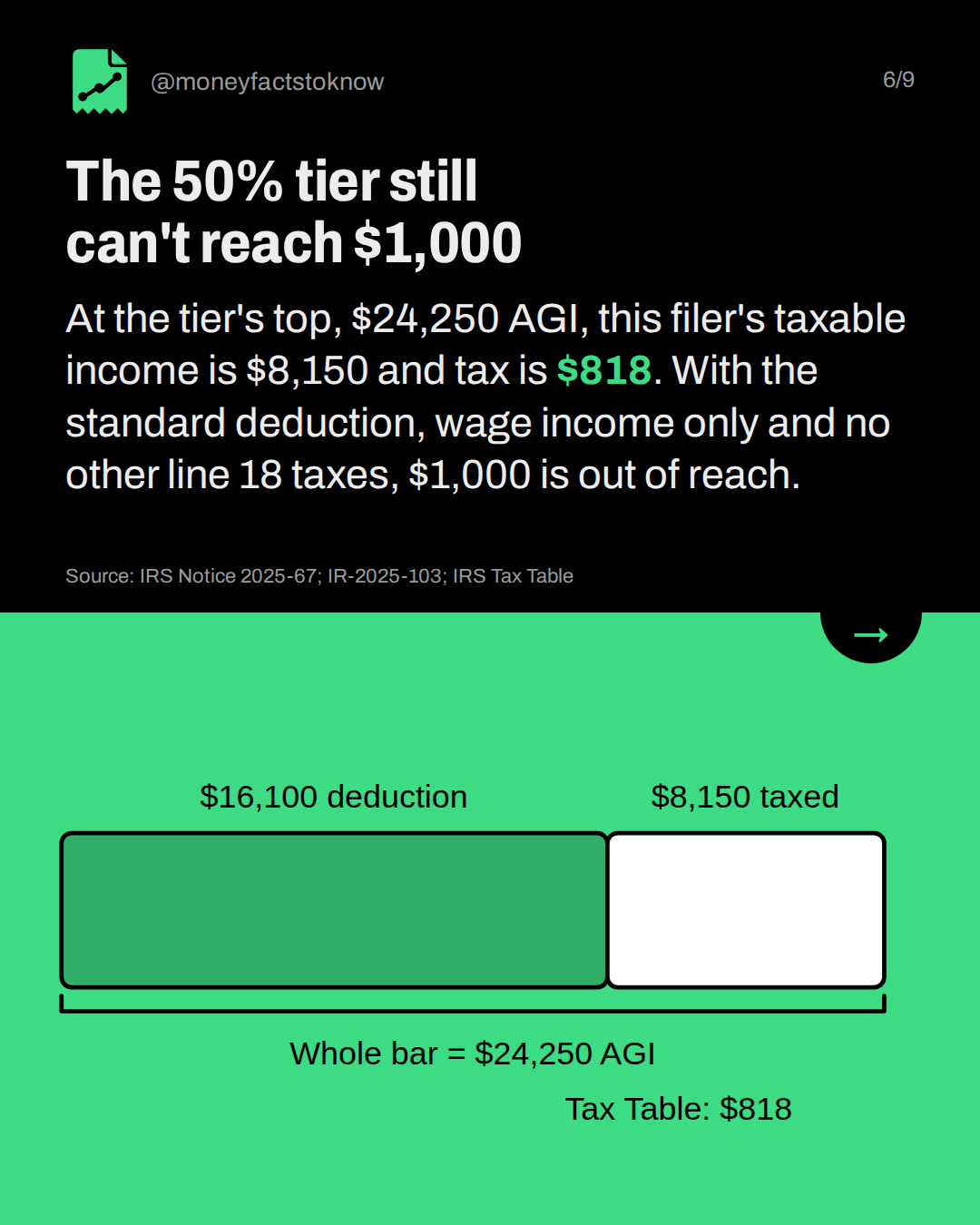
The 50% tier still can't reach $1,000
At the tier's top, $24,250 AGI, this filer's taxable income is $8,150 and tax is $818. With the standard deduction, wage income only and no other line 18 taxes, $1,000 is out of reach.
Source: IRS Notice 2025-67; IR-2025-103; IRS Tax Table
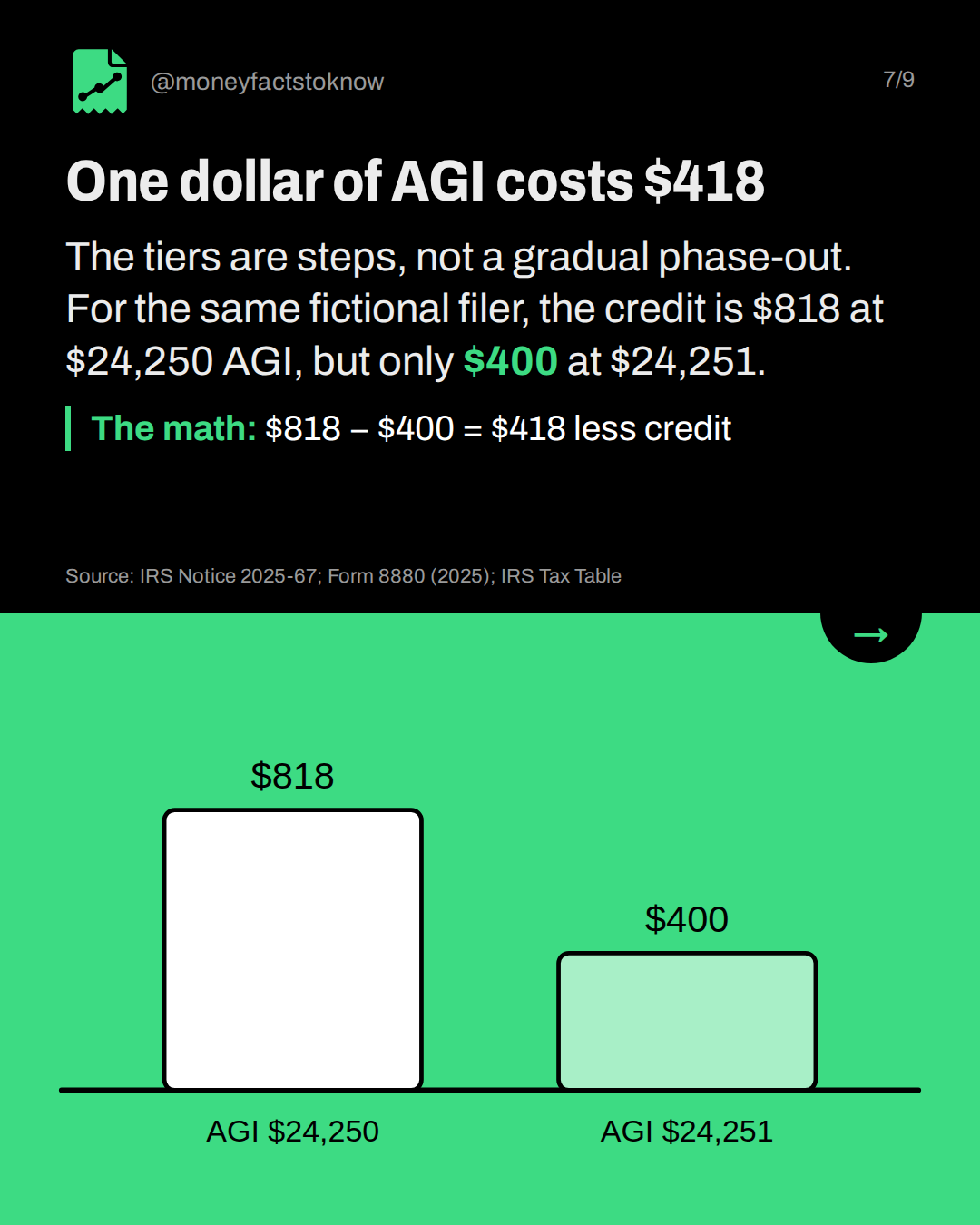
One dollar of AGI costs $418
The tiers are steps, not a gradual phase-out. For the same fictional filer, the credit is $818 at $24,250 AGI, but only $400 at $24,251.
The math: $818 − $400 = $418 less credit
Source: IRS Notice 2025-67; Form 8880 (2025); IRS Tax Table
What to check, and a 2027 heads-up
Check where your AGI falls against the tier lines, your income tax after other credits, and any retirement distributions taken from 2024 through your 2026 return's due date, which reduce the contributions that count.
The math: From tax year 2027 (filed 2028), a saver's match replaces this credit. 2026 uses it.
Source: IRS Form 8880 (2025), What's New
Sources and assumptions
- IRS Notice 2025-67, 2026 Amounts Relating to Retirement Plans and IRAs: 2026 section 25B AGI limits for 'all other taxpayers' (single/MFS): 25B(b)(1)(A) $24,250, (B) $26,250, (C)/(D) $40,250; joint $48,500/$52,500/$80,500; head of household $36,375/$39,375/$60,375; 2026 IRA limit $7,500 (checked 2026-10-12)
- IRS IR-2025-111, 401(k) limit increases to $24,500 for 2026, IRA limit increases to $7,500: Saver's Credit income limit for 2026 is $40,250 for singles and married filing separately, $60,375 for heads of household and $80,500 for married filing jointly (checked 2026-10-12)
- IRS Form 8880 (2025) with instructions: Rate table 0.5/0.2/0.1 by AGI; up to $2,000 per person (line 6); credit = smaller of line 10 (rate × contributions) or line 11 'Limitation based on tax liability' (line 12); max credit $1,000 ($2,000 MFJ); eligible contributions (IRA, 401(k), 403(b), gov 457(b), SEP, SIMPLE, TSP, ABLE; not rollovers); ineligible if born after Jan 1, 2008 (i.e. under 18), claimed as a dependent, or a student (full-time during part of 5 calendar months); distributions received after 2022 reduce contributions (line 4); 'beginning with 2027 tax returns, the saver's credit will be replaced by a saver's match' deposited into the retirement account, with Form 8880 then used only for ABLE contributions (checked 2026-10-12)
- IRS: Retirement Savings Contributions Credit (Saver's Credit): 50%/20%/10% rates; $2,000 maximum contribution counted ($4,000 MFJ), max credit $1,000 ($2,000 MFJ); age 18, not a dependent, not a student; rollovers don't qualify (checked 2026-10-12)
- IRS IR-2025-103, tax year 2026 inflation adjustments (Rev. Proc. 2025-32): 2026 standard deduction $16,100 single; 10% rate on single taxable income up to $12,400 (checked 2026-10-12)
- IRS: IRA year-end reminders: IRA contributions for a tax year can be made until April 15 of the following year (page example: 2024 contributions until April 15, 2025) (checked 2026-10-12)
- IRS IR-2026-89, Treasury, IRS begin implementing Executive Order 14403 by announcing intent to issue proposed regulations on Saver's Match (Aug. 7, 2026): 'The program, enacted as part of the SECURE 2.0 Act, replaces the Saver's Credit with respect to retirement savings contributions'; the Saver's Match 'will be paid for eligible taxpayers starting in 2028, based on contributions made for the 2027 tax year' (checked 2026-10-12)
- IRS 2025 Instructions for Form 1040, line 16: 'If your taxable income is less than $100,000, you must use the Tax Table.' (checked 2026-10-12)
- IRS 2025 Tax Table (Publication 1040, Tax and Earned Income Credit Tables): Single column: taxable income at least 7,900 but less than 7,950 → 793; at least 8,150 but less than 8,200 → 818 (checked 2026-10-12)
Assumptions:
- Fictional single filer, tax year 2026, US federal income tax only (no state)
- Income is wages only; takes the 2026 standard deduction of $16,100; no other credits on Schedule 3 lines 1–3, 6d, 6l; no AMT or other line 18 taxes
- Contributes $2,000 to a Roth IRA (doesn't change AGI); AGI $24,000
- Age 18+, not a dependent, not a full-time student, no retirement distributions after 2023 and before the due date of the 2026 return
- Tax taken from the IRS Tax Table, which Form 1040 filers with taxable income under $100,000 must use: 10% of the midpoint of each $50 band ($793 for $7,900 taxable, $818 for $8,150). The 10% rate formula would give $790 and $815.
- Cliff example compares AGI $24,250 vs $24,251 under the same assumptions
The short version
- The credit is 50%, 20% or 10% of up to $2,000
- It can't be more than your income tax
- Fictional 2026 example: $793, not $1,000
- Tiers are steps: $1 more AGI cost $418 here


