 Money Facts To Know
A fictional 0% transfer: 3% fee, $343.33 a month for 15 months
0% doesn't mean free
Many people read 0% as costing nothing until the promo ends. The CFPB says a card company is permitted to charge a balance transfer fee on a zero percent offer.
Source: CFPB
On this card, the fee posts day one
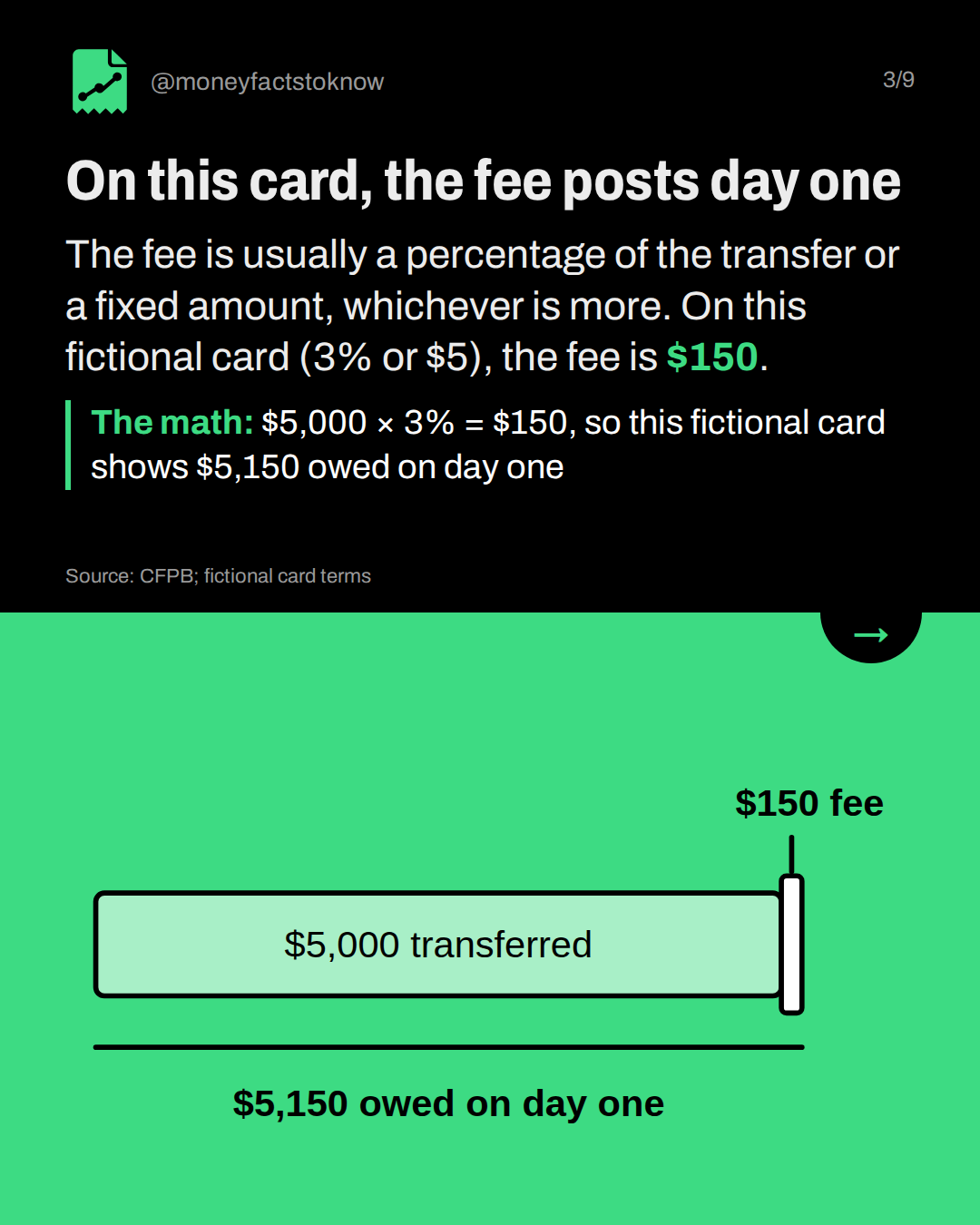
The fee is usually a percentage of the transfer or a fixed amount, whichever is more. On this fictional card (3% or $5), the fee is $150.
The math: $5,000 × 3% = $150, so this fictional card shows $5,150 owed on day one
Source: CFPB; fictional card terms
The deadline sets the payment
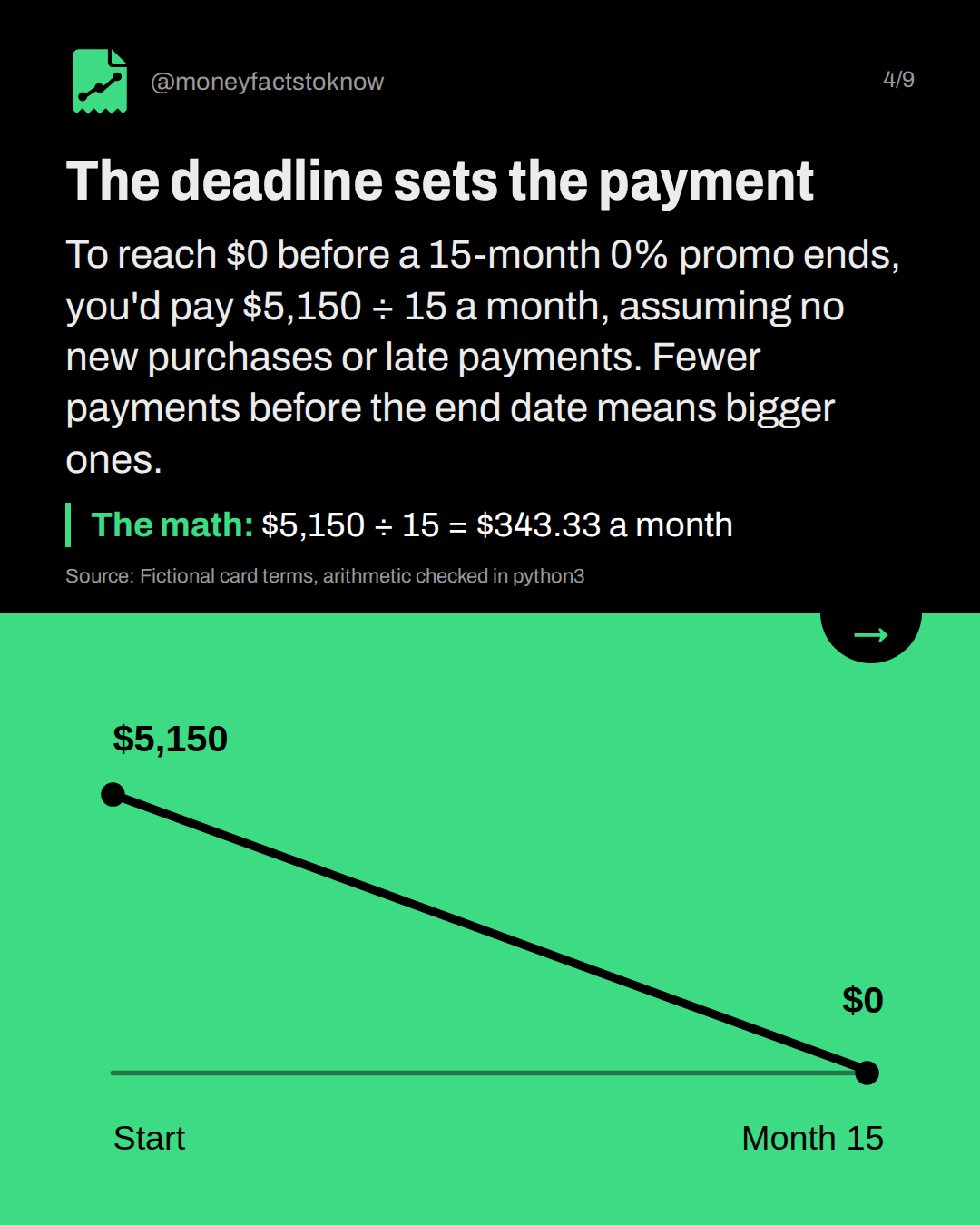
To reach $0 before a 15-month 0% promo ends, you'd pay $5,150 ÷ 15 a month, assuming no new purchases or late payments. Fewer payments before the end date means bigger ones.
The math: $5,150 ÷ 15 = $343.33 a month
Source: Fictional card terms, arithmetic checked in python3
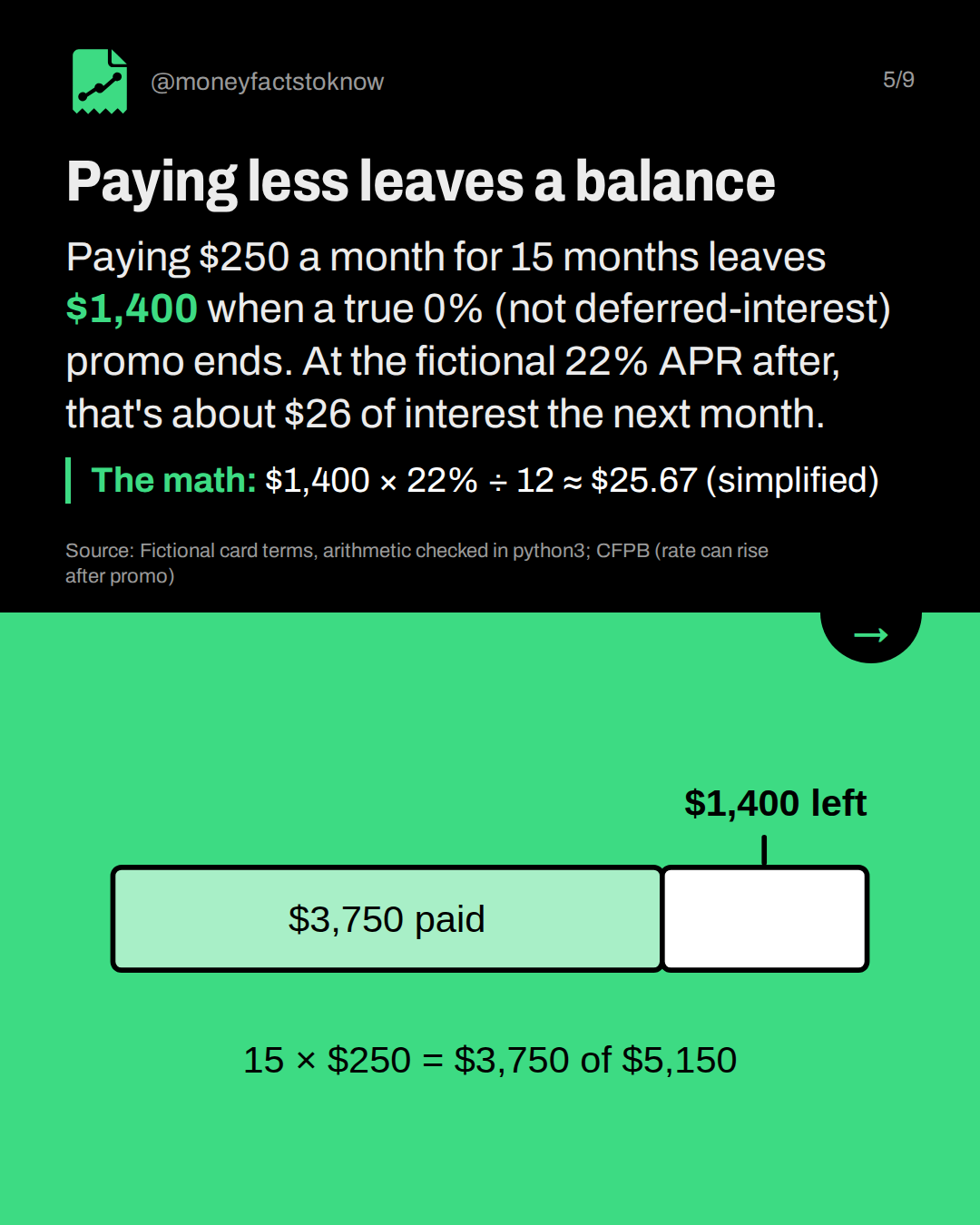
Paying less leaves a balance
Paying $250 a month for 15 months leaves $1,400 when a true 0% (not deferred-interest) promo ends. At the fictional 22% APR after, that's about $26 of interest the next month.
The math: $1,400 × 22% ÷ 12 ≈ $25.67 (simplified)
Source: Fictional card terms, arithmetic checked in python3; CFPB (rate can rise after promo)
Two things that cost extra during the promo
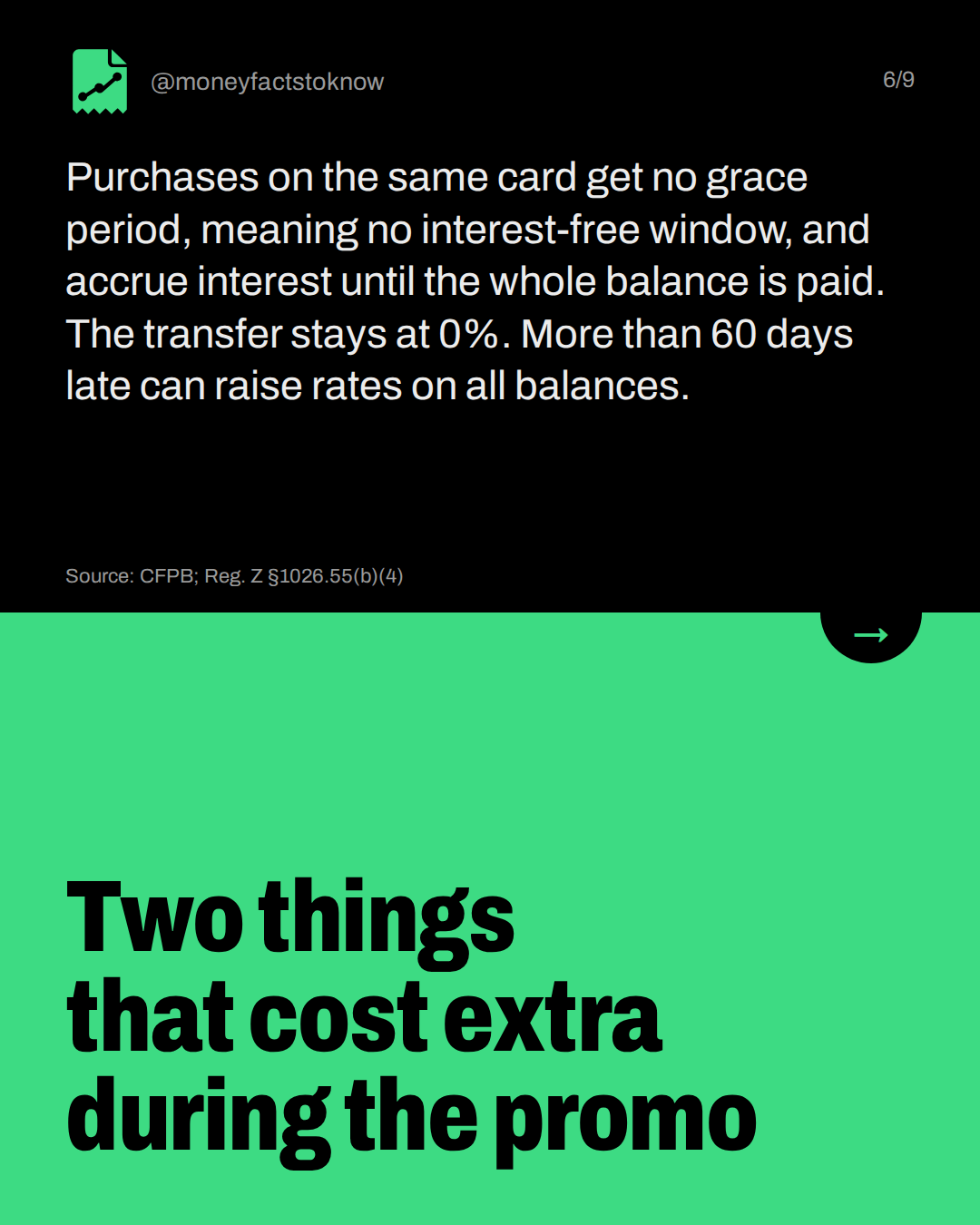
Purchases on the same card get no grace period, meaning no interest-free window, and accrue interest until the whole balance is paid. The transfer stays at 0%. More than 60 days late can raise rates on all balances.
Source: CFPB; Reg. Z §1026.55(b)(4)
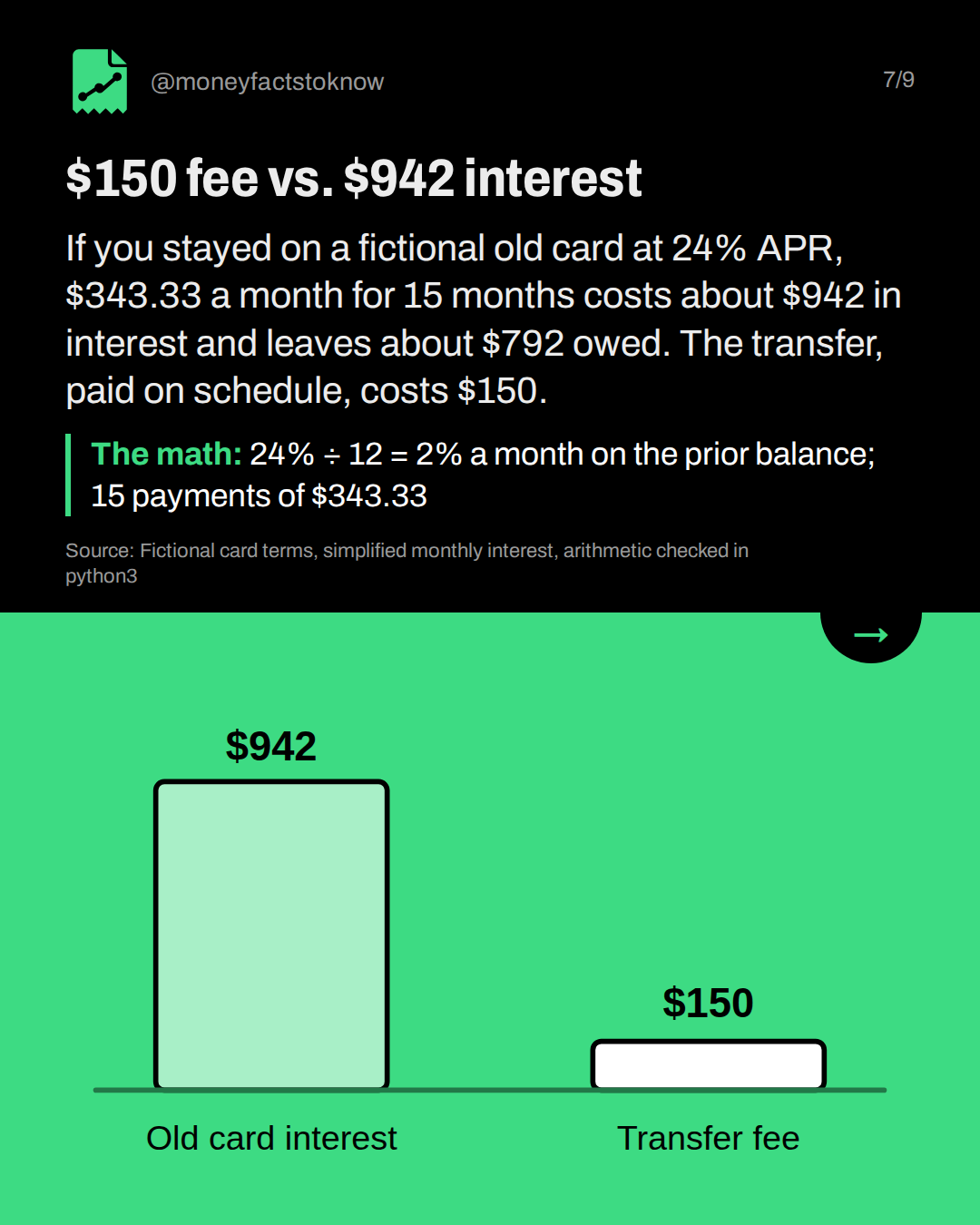
$150 fee vs. $942 interest
If you stayed on a fictional old card at 24% APR, $343.33 a month for 15 months costs about $942 in interest and leaves about $792 owed. The transfer, paid on schedule, costs $150.
The math: 24% ÷ 12 = 2% a month on the prior balance; 15 payments of $343.33
Source: Fictional card terms, simplified monthly interest, arithmetic checked in python3
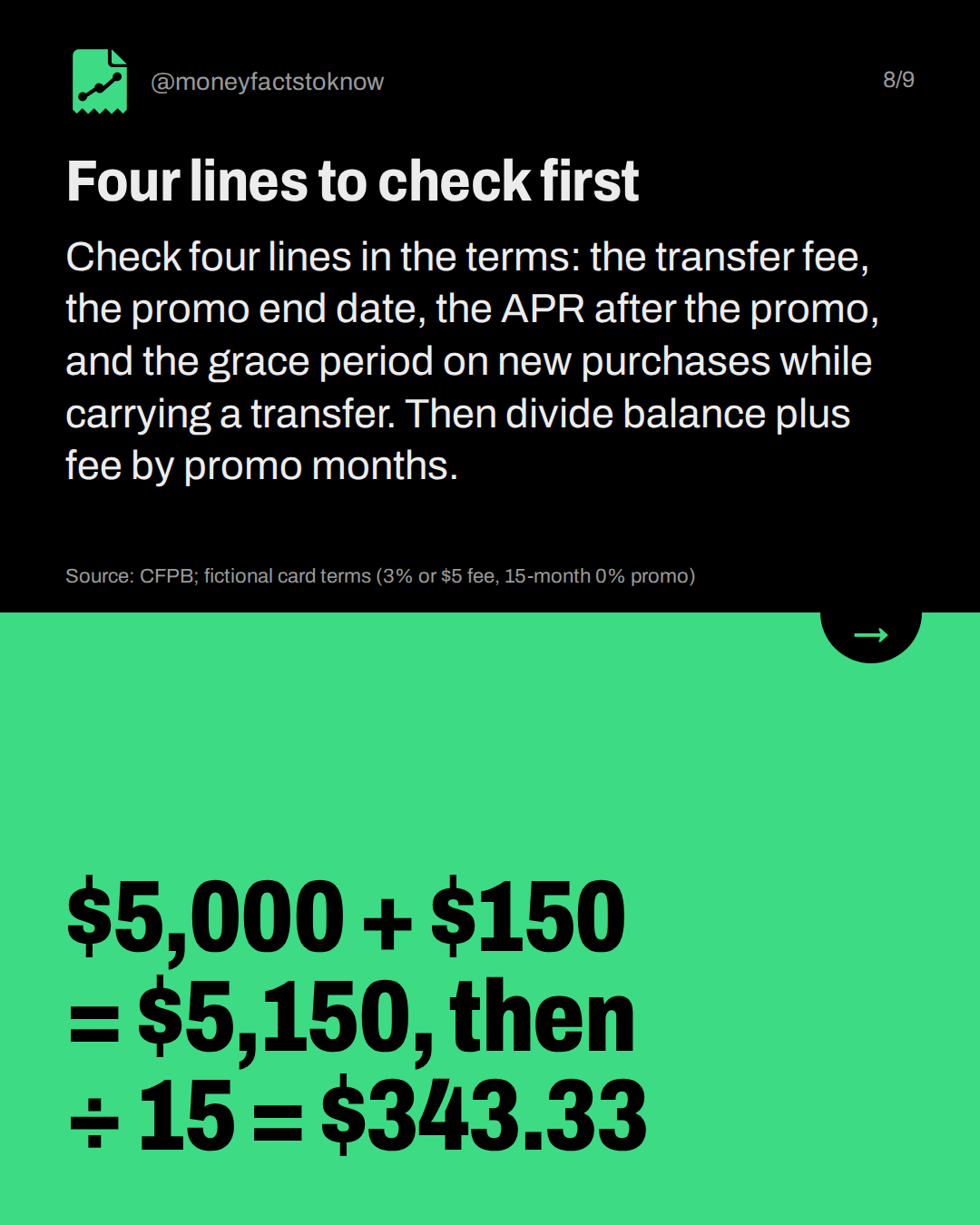
Four lines to check first
Check four lines in the terms: the transfer fee, the promo end date, the APR after the promo, and the grace period on new purchases while carrying a transfer. Then divide balance plus fee by promo months.
The math: $5,000 + $150 = $5,150, then ÷ 15 = $343.33
Source: CFPB; fictional card terms (3% or $5 fee, 15-month 0% promo)
Sources and assumptions
- CFPB, Ask CFPB: What is a balance transfer fee? Can a balance transfer fee be charged on a zero percent interest rate offer? (last reviewed 2024-09-23): 'A credit card company is permitted to charge you a balance transfer fee on a zero percent rate offer.' (checked 2026-10-11)
- CFPB, Ask CFPB: What do I need to know if I'm thinking about consolidating my credit card debt?: The fee is 'usually a certain percentage of the amount you transfer or a fixed amount, whichever is more'. Promo rates last a limited time, then the rate may rise. New purchases on the same card get no grace period and accrue interest 'until you pay the entire balance off in full, including the transferred balance'. Being more than 60 days late lets the issuer raise the rate on all balances, including the transferred balance. (checked 2026-10-11)
- CFPB, Ask CFPB (last reviewed 2024-01-22): interest on new purchases while carrying a 0% balance transfer: 'If you carry a balance month to month, any purchases you make will accrue interest from the date of the transaction. This is true even if another balance you are carrying is not subject to interest because it was a 0% balance transfer.' (checked 2026-10-11)
- CFPB, Regulation Z 12 CFR §1026.55(b)(1) and (b)(4): A promotional (temporary) rate period must be six months or longer, and the issuer must have disclosed in writing the length of the period and the APR that applies afterward. The rate may be raised if the required minimum payment is not received within 60 days after the due date. (checked 2026-10-11)
- CFPB, Regulation Z 12 CFR §1026.53(a): Payments above the required minimum must go first to the balance with the highest APR, then to the others in descending order of APR. (checked 2026-10-11)
- Chase, 'A guide to balance transfer fees' (issuer education page, used only for the minimum-fee qualifier): Issuers typically set a minimum dollar fee, 'such as $5 or $10', and charge whichever is greater, the percentage or the minimum. Its example uses a 5% fee. (checked 2026-10-11)
Assumptions:
- The card, its terms and the balances are fictional: $5,000 transferred, a fee of 3% or $5 (whichever is more), a 0% promo for 15 months, a 22% APR after the promo.
- The transfer posts at the start of the promo, and the fee is added to the balance on day one.
- No new purchases on the transfer card, and every payment is on time (a payment more than 60 days late can end the promo rate).
- Post-promo interest is simplified as APR ÷ 12 on a flat $1,400 balance for one month. A real daily-balance calculation gives about $25.32 for a 30-day cycle.
- The old-card comparison is fictional: 24% APR, simplified to 2% a month on the prior balance, interest added before the $343.33 payment, rounded to cents each month, 15 months.
- The fee and promo length vary by issuer and offer. Some cards charge a higher fee (often 5%) on transfers made after an introductory window.
The short version
- A 0% offer can still carry a fee
- Fictional 3% fee: $150 on $5,000
- $5,150 ÷ 15 months = $343.33
- Paying less leaves a balance at 22% (fictional APR)
- Check the fee, end date and APR after


