 Money Facts To Know
One bank, two owners: $500,000 can still be fully FDIC-insured


The limit isn't just per bank
Many people assume FDIC insurance covers $250,000 per bank, so anything above that is at risk. The actual rule is $250,000 per depositor, per insured bank, for each ownership category.
Source: FDIC, Deposit Insurance At A Glance, as of Oct 2026
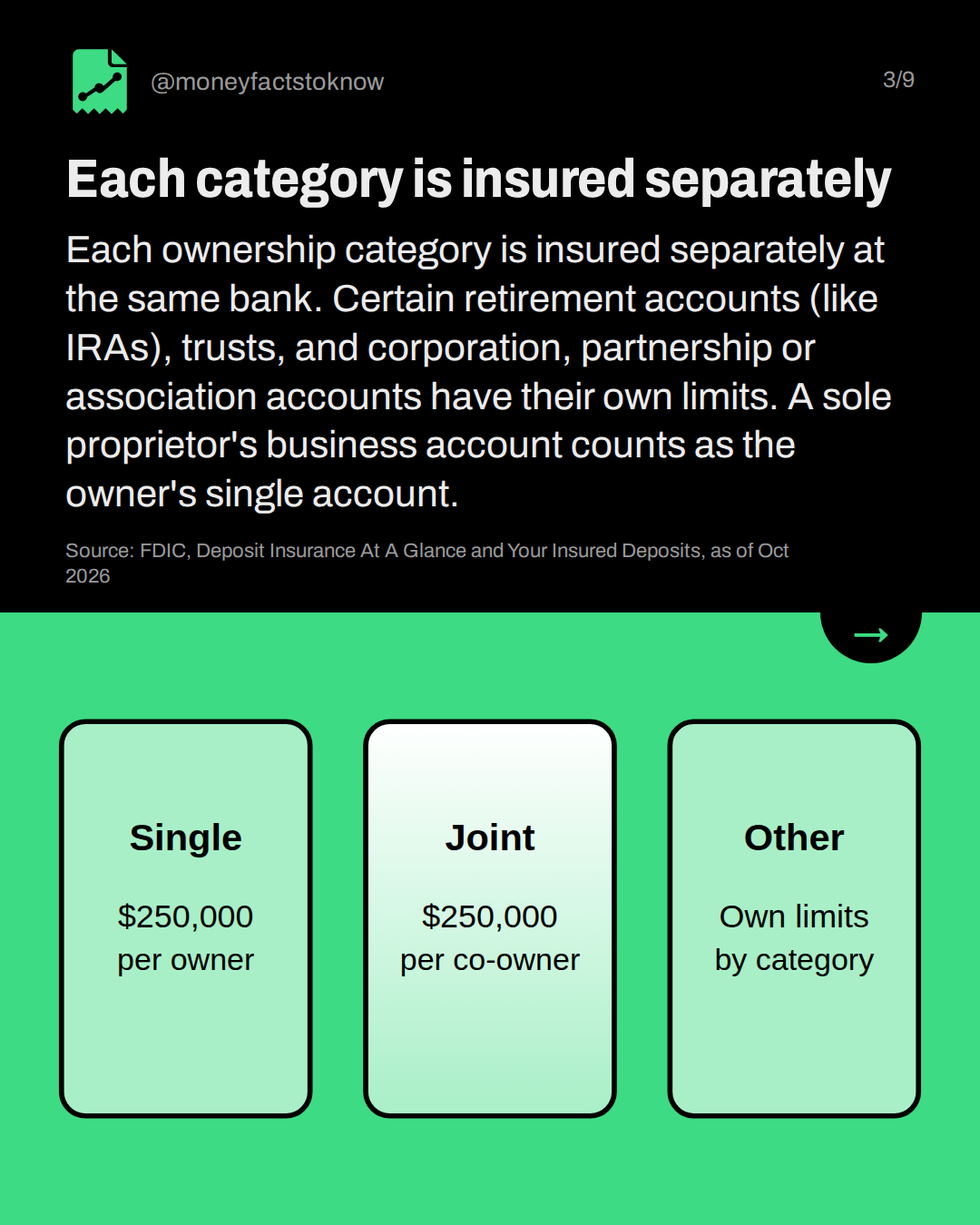
Each category is insured separately
Each ownership category is insured separately at the same bank. Certain retirement accounts (like IRAs), trusts, and corporation, partnership or association accounts have their own limits. A sole proprietor's business account counts as the owner's single account.
Source: FDIC, Deposit Insurance At A Glance and Your Insured Deposits, as of Oct 2026

How the joint rule works
Each co-owner's shares of every joint account at the same bank are added together and insured up to $250,000. The FDIC assumes equal shares unless the bank's records say otherwise.
The math: Co-owners must be people with equal withdrawal rights who each sign; e-signatures count.
Source: FDIC, Your Insured Deposits and Joint Accounts guide, as of Oct 2026

$500,000 joint, fully covered
A fictional couple holds one $500,000 joint account at one insured bank, with nothing else there. Each half is $250,000, so all is insured. The limit includes accrued interest, so a balance above $500,000 is partly uninsured.
The math: $500,000 ÷ 2 co-owners = $250,000 each
Source: FDIC, Joint Accounts guide, as of Oct 2026

Singles stack on top of joint
Single and joint accounts are separate categories. Add a $250,000 single account with no beneficiaries for each partner, and the couple's insured total at this one bank is $1,000,000.
The math: $250,000 + $250,000 + $500,000 = $1,000,000
Source: FDIC, Your Insured Deposits, as of Oct 2026
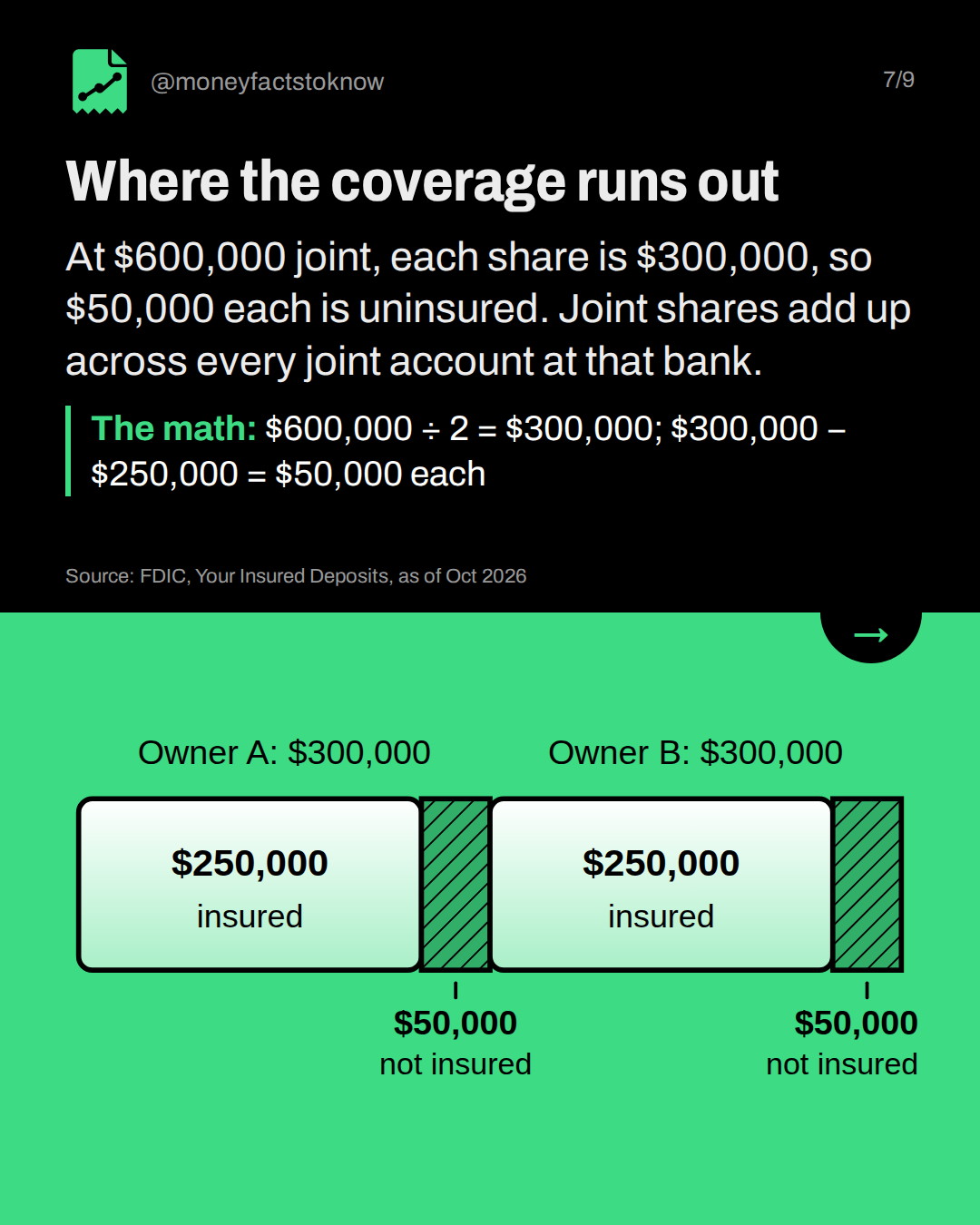
Where the coverage runs out
At $600,000 joint, each share is $300,000, so $50,000 each is uninsured. Joint shares add up across every joint account at that bank.
The math: $600,000 ÷ 2 = $300,000; $300,000 − $250,000 = $50,000 each
Source: FDIC, Your Insured Deposits, as of Oct 2026

What isn't covered, and what to check
Stocks, bonds, mutual funds, crypto and annuities aren't insured deposits. Credit unions are covered by the NCUA. A payment app's money is insured only if held at an insured bank, and only against that bank failing.
The math: Check your bank on BankFind, then total your accounts in the EDIE calculator at edie.fdic.gov.
Source: FDIC, Deposit Insurance At A Glance; CFPB advisory, 2023; as of Oct 2026
Sources and assumptions
- FDIC: Deposit Insurance At A Glance (last updated 2024-04-01): 'The standard insurance amount is $250,000 per depositor, per insured bank, for each account ownership category.' Categories: single accounts (one person, no beneficiaries) $250,000 per owner; joint accounts $250,000 per co-owner; certain retirement accounts, trust accounts, business and other categories. Not insured: stocks, bonds, mutual funds, crypto assets, life insurance, annuities, municipal securities, safe deposit boxes, U.S. Treasuries. Coverage can be checked through BankFind, 1-877-ASK-FDIC and the EDIE estimator; coverage is automatic at an FDIC-insured bank. (checked 2026-10-11)
- FDIC: Your Insured Deposits (last updated 2024-05-14): 'each co-owner's shares of every joint account that he or she owns at the same insured bank are added together and the total is insured up to $250,000'; 'The FDIC provides separate insurance coverage for a depositor's funds at the same insured bank, if the deposits are held in different ownership categories.' Example 3: Mary's shares across several joint accounts total $330,000, of which $250,000 is insured and $80,000 is not. (checked 2026-10-11)
- FDIC: Financial Institution Employee's Guide to Deposit Insurance, Joint Accounts (last updated 2024-05-29): 'Each co-owner of a joint account is insured up to $250,000 for the combined amount of his or her interests in all joint accounts at the same IDI.' Co-owners must be natural persons, must have equal withdrawal rights, and must each sign the signature card (other account-opening documents and electronic signatures can satisfy this). 'The FDIC assumes each co-owner is an equal owner unless the IDI records clearly indicate otherwise.' Example 6: a $500,000 joint CD owned by two people is fully insured at $250,000 each. (checked 2026-10-11)
- CFPB consumer advisory: Your money is at greater risk when you hold it in a payment app (2023-06-01): 'deposit insurance does not apply when a nonbank payment company fails'; 'Pass-through insurance means you are insured against the failure of the bank or credit union where the app holds the money for you. It doesn't insure you against the failure of the payment app company.' (checked 2026-10-11)
- Congress.gov: S.4198, Main Street Depositor Protection Act (119th Congress): Context for dating the limit. Proposals to raise coverage on noninterest-bearing transaction accounts were introduced on 2026-03-25 and referred to committee, and search found no enactment. The $250,000 standard maximum is therefore still the rule as of Oct 2026 (search summary; date the slide claim 'as of Oct 2026'). (checked 2026-10-11)
Assumptions:
- The couple is fictional; both are natural persons with equal withdrawal rights who signed the joint account's signature card or account agreement.
- Joint shares are equal (the FDIC default) because the bank's records show no other split.
- All accounts are deposits (checking, savings, money market deposit accounts, CDs) at one FDIC-insured bank, held directly, not through a non-bank app.
- Each single account has one owner and names no beneficiaries; an account with a payable-on-death beneficiary falls in the trust category instead.
- The couple has no other joint or single deposits at that bank, including joint accounts with anyone else.
- The $250,000 standard maximum is as of Oct 2026 (pending bills to raise coverage on some noninterest-bearing transaction accounts had not been enacted).
- Figures are principal plus accrued interest; the example uses round balances.
The short version
- The limit is per owner, bank and category.
- Joint accounts get $250,000 per co-owner.
- Single and joint accounts count separately.
- Joint shares add up across the same bank.
- Check your totals with EDIE.


